
- My daughter sends a viral video of beagles being released from a testing facility. They’ve never felt grass before. They step forward slowly, sniffing at the ground like it might swallow them whole.“The world is a bad place,” she writes.
“And also a good place,” I reply. “Both are true.”
The contradiction lives in me. Some days I carry it like it’s contagious, other days it settles in my chest as grief over the fractures we feed and the loneliness we normalize into background noise. Distrust is high. Civility is low. And somewhere along the way, self-preservation turned into isolation. We move faster, speak less, curate our interactions by keeping eyes on screens, ears plugged with headphones.
-
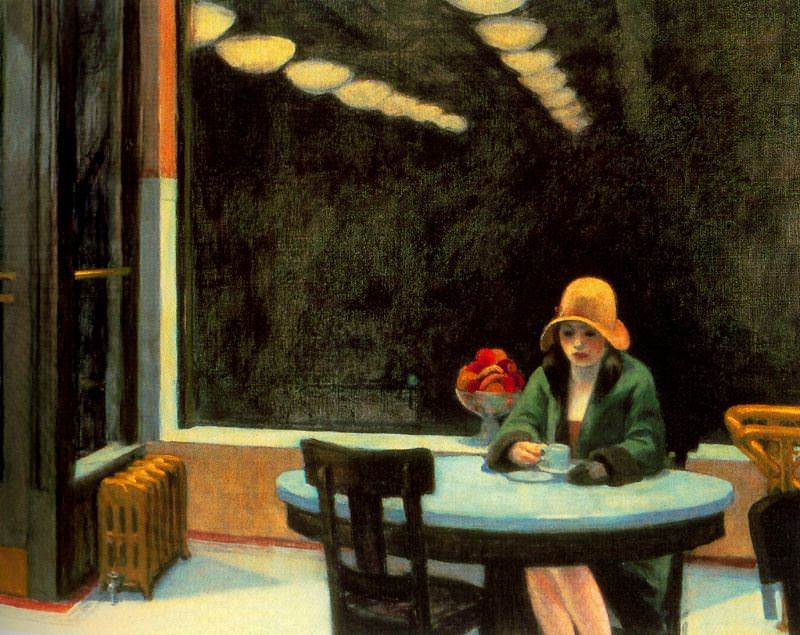
Edward Hopper, Public domain, via Wikimedia Commons But sometimes, when I’m out in the world and paying attention, I watch people open outward. In brief exchanges, along the soft edges of connection, I see something generous take root. As the distance between strangers narrows, they seem more complete.
I tell myself I’ll speak to everyone who looks my way. The grocery store is an unlikely place for a revelation, and I spend a minute considering how ridiculous this is. If the pattern of recent visits holds, at least half the shoppers here will be Spanish speaking. I speak next to none. Buenos días. Gracias. That’s about the extent of it. That might be a problem. I use my phone to look up a single sentence, just in case. Tienes una linda sonrisa. I practice saying it out loud until Google Translate recognizes it.
Eye contact is easy enough, and saying hello is a natural step from there. But ugh! Why am I so weird? I’m already letting myself off the hook. Maybe I don’t have the patience for this today. It needs to feel authentic.
I remember and regroup: the awkwardness doesn’t cancel out the goodness of the intention. They can sit side by side.
At the end of the first aisle, I spot an impossibly cute baby in a stroller, dark eyes that match a tiny thundercloud of black hair. I lean in to coo at her, then grin over my shoulder toward her parents. The mother, who is farther back selecting cucumbers, doesn’t see the exchange, but the father beams. I say something. His face answers for him. The whole event lasts seconds, but it breaks the spell of disconnection.
I know every interaction lives inside a complicated context. In a country where skin color and language differences are used to marginalize, offering even a greeting can feel suspicious. There’s risk, and there’s history. But also, there is kindness in the willingness to meet each other, however imperfectly, across those fragile lines. Both are true.
Every encounter carries a subtle transfer of energy. A nod. A glance. A comment about the weather. These gentle collisions don’t look like much, but they’re good at shaping the emotional temperature of a place.
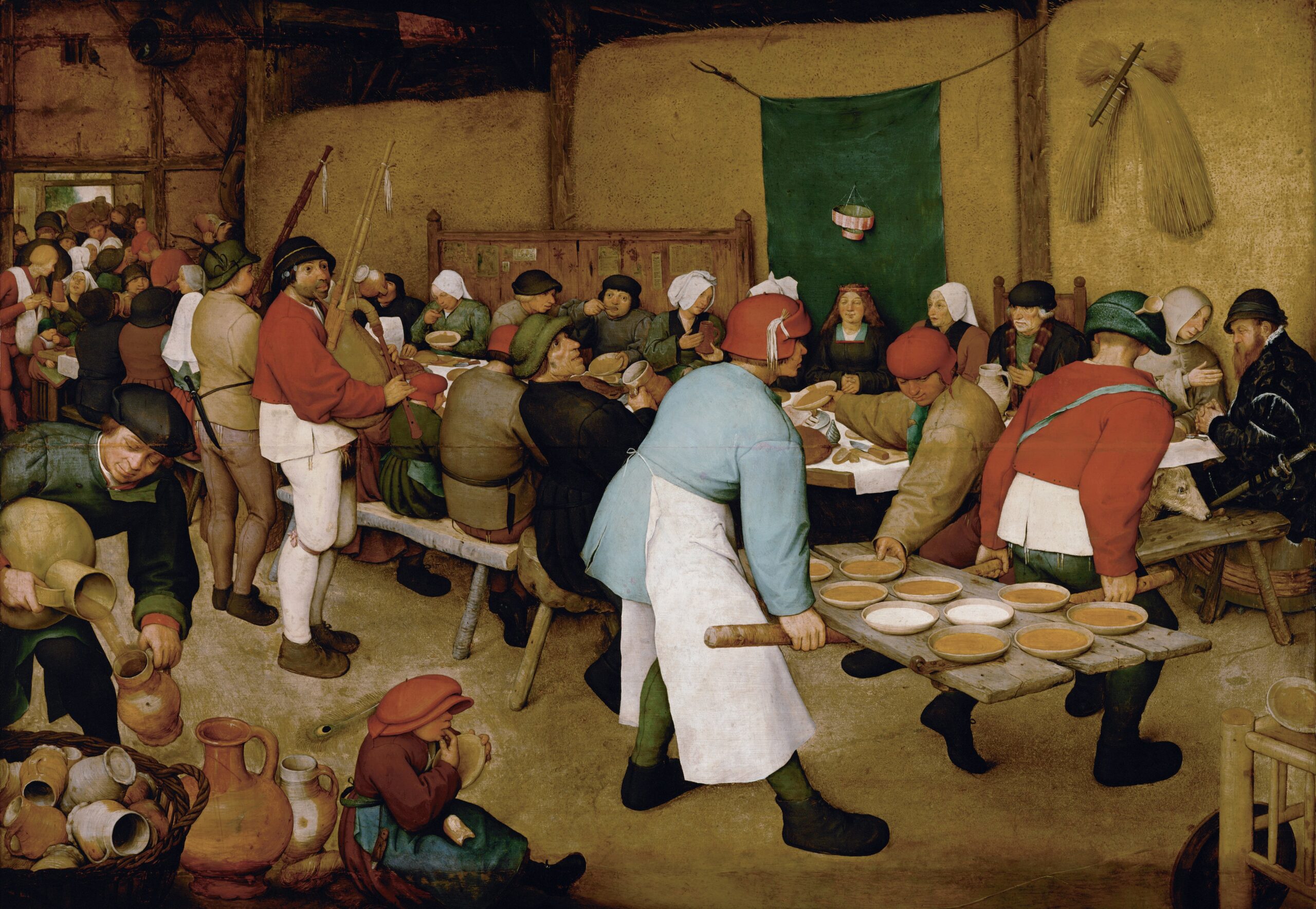
Pieter Brueghel the Elder, Public domain, via Wikimedia Commons Humans crave belonging, and there’s research to support what instinct already knows. In 2023, researchers at Sabancı University found that people who regularly engage in brief social exchanges—greetings, small talk, even a simple thank you—report higher levels of well-being than those who don’t. That sense of ease doesn’t exist in a vacuum. It correlates with other markers of social health like lower stress, increased trust, and greater civic engagement.
A few years before, psychologists Nicholas Epley and Juliana Schroeder asked Chicago commuters to strike up conversations with strangers on public transit. Most expected discomfort. Instead, those who spoke reported better moods than those who stayed silent, and so did their conversation partners. The act of reaching out felt awkward in theory, but in practice, it made people feel more alive.
The more we find ourselves in each other, the harder it is to turn away. The more rooted we are in a community, even one as temporary as a checkout line, the more likely we are to extend that care outward. Small talk isn’t just filler. It’s social glue.
It’s also a form of power, a tool we all carry, whether or not we feel equipped to use it. There’s no right way—just the attempt. And the attempt matters. It’s how we soften a culture grown sharp with distance.
I compliment a woman on her paisley blouse. “Lane Bryant,” she says, gleaming, her chin raising with a flicker of pride. When we pass each other in the next aisle, she offers that she’s DoorDashing for someone. I regret that I don’t see her again. I wish I’d told her I’ve never used DoorDash. I have so many questions I’m sure she could answer.
I tell a slender, 30-something that I love his hat. I really do—a saffron, straw fedora. His face lifts, and his posture straightens, like I just called him handsome.
These aren’t performances, they’re acts of recognition. They ask me to tolerate the twinges of discomfort in my gut, and in return, I am, paradoxically, more grounded. Not more human, exactly. I have no idea how I could feel any more human than I do lately. But more aware that I belong, that I’m part of the fabric of a place still mostly holding itself together.
No one is unraveling audibly in the cereal aisle. The planet may be trembling, but there is steadiness here, presence, a felt sense of being part of something normal.
I’m limited in my ability to undo the instability, the injustice, devastation, and cruelty unfolding in the world. But what if the vortex can be interrupted in the produce section? What if eye contact is solidarity? What if saying hello is resistance?
Psychologists call it psychological generosity, these small, low-effort behaviors that ripple outward. When someone feels seen, they’re more likely to see others. A single smile may not register as activism, but it’s a social investment, and it adds up.
These gestures won’t fix everything, and it won’t be obvious that they’ve fixed anything. But gathered across a culture, they can shift us toward one another instead of away. We become harder to divide. We become more likely to pause. We become more likely to care.
On the way home, I watch an ambulance surge through an intersection, the siren slicing the afternoon. I lift up the invisible patient inside, the one who needed an urgent intervention. I think of the caller, the driver, the medical team, the kin, people caring for each other.
Our interconnections are never more obvious. I don’t always get to be the one who changes the story, but I can be a person who stands against indifference.
I never quite work up the nerve to use the sentence I practiced in Spanish. Tienes una linda sonrisa. You have a nice smile. I carry it with me anyway, a pretty pebble in my pocket, an offering, a reminder that presence is its own kind of fluency.
Something still waiting to be said.
Maybe tomorrow, in aisle three.
~Elizabeth
An audio version of this essay, read by the author, is available here.
Elizabeth Beggins is a communications and outreach specialist focused on regional agriculture. She is a former farmer, recovering sailor, and committed over-thinker who appreciates opportunities to kindle conversation and invite connection. On “Chicken Scratch,” a reader-supported publication hosted by Substack, she writes non-fiction essays rooted in realistic optimism. To receive her weekly posts and support her work, become a free or paid subscriber here.



























0 Responses
Re the world being a bad and a good place, someone (I forget who) wrote hat life consists of compromises you really didn’t want to make but needed to get through your time in this world.
Interesting you should mention compromise, Rick, as the subject has been on my mind for a future essay. Yes, I would go so far as to say the inability to compromise leads to gridlock, challenged relationships, and missed opportunities for mutual growth and understanding. Thanks for weighing in.
Elizabeth,
So well said, so beautiful, so true.
Reaching out to others even in a small way brings joy to receiver and to giver!
Thank you for the reminder!!
Thank you, Connie. I’m the sort of person who very much wants to know what I can do (DO!) to help at times like these. I love knowing that doing something like this is as good for me as it is for ::waves arms:: everything else. Appreciate you reading and commenting.
This is beautiful. I feel the same way. Thank you.
Thank you, Sheryl. It’s nice to know there are many of us out here offering our own conversational resistance. Appreciate your comment.
Lovely Elizabeth!
Recently I spoke with a man stocking the shelves at Harris Teeter (just a few words), but he thanked me and said that I was the first person who had spoken to him that day. It matters!
What a wonderfully affirming story, Margot! Thank you for sharing it. I recognize that we live in a place where talking to strangers is more the norm, and I grew up with parents who modeled that behavior. Still, it asks so little of us and offers the potential for such big rewards. Yes, more of that, please!
Back in 1910, British writer E.M. Forster published Howards End, a novel whose central theme, contained in an epigraph, is “Only Connect”! Ms. Beggins reminds us that Forster’s powerful advice to humanity is as true in 2025 as it was in 1910, and probably even more important.
Before I retired, I worked for many years at Washington College in Chestertown. Campus parking being a daily challenge, I had a long walk to my office. One day I decided to start greeting any student I passed by saying “good morning.” Most of them were startled that anyone, but especially a staff member, was speaking to them, but almost all of them smiled. Perhaps I helped make their day just a little better.
More recently, I have been working with a local group called Friends of Democracy, which has taken as part of its mission calling and/or writing to thank people who are working hard to preserve our democracy. Despite that these are really busy people, most write back to thank us for caring enough about their efforts to thank them.
Ms. Beggins is right, and we should all follow her example. We cannot solve all the problems we face, but we can do our best to be kinder, to reach out to others, to make their day a little brighter. Perhaps trying to reach out to thank others is one of Robert Frost’s roads less taken, but it still makes all the difference.
Thank you for this lovely comment. Recently, I spent time thinking about the figure of speech “You are too kind,” wondering whether that’s actually possible. Certainly, it depends on what we mean by kindness and the context in which it’s shown. Enabling someone else’s harmful behavior is problematic, as is dodging conflict, but I would suggest those are not examples of true kindness. The point is that in many circumstances, especially in those where we are apt to categorize people, we can instead choose curiosity, compassion, or generosity. We can decide to be kind.
Thank you for this wonderful and inspiring article. A 22-year old college graduate once said to me that, “There is a light in every person. Our job is to find that light and make it grow.”
We married a year later and have just celebrated our 50th wedding anniversary.
Seeing the little bits of grace being constantly offered to us matters a great deal.
Thanks for reminding us so eloquently.
A delightful twist to learn that you married the girl who offered you that bit of sage advice. Congratulations on your years together, and thank you for what I can only assume has been a lifetime of finding and nurturing the light in others!