
The idea for a public sculpture in St. Michaels began in January 2024 during a community conversation on race in Easton. The discussion, sponsored by Nancy Andrews, covered the Frederick Douglass mural at Out of the Fire and the role public art can play in a town. Deborah Colborn was among those attending.
“I am an artist myself, but I had never really put that together about the importance of public art,” she said. “At that time I said in our large circle, ‘You know, I would love to see some public art in St. Michaels.’ Sitting next to me was the present director of the community center in St. Michaels, and he said, ‘I would too.’ So there we were.”

Colborn had raised the subject before. While serving on the St. Michaels Parks and Recreation Committee around 2006 or 2007, she suggested placing sculpture in town, but the proposal did not move forward. Years later, she brought it up again in a less formal setting.
“I had previously discussed the idea with the town administrator in the sauna at the Y,” she said. “He said, ‘Well, you’ve got to get a couple people.’ So I started with having him as my ally.”
The next stage consisted largely of meetings and conversations. Colborn and others spoke with residents, town officials and local organizations about whether St. Michaels wanted public art and what form it might take. They also sent a survey through the town office to more than 1,000 people.
“We got a very good return and positive responses,” she said. “Yes, they wanted to see public art. Yes, they wanted more art, various kinds of art.” And more importantly, yes to contributing.
Colborn also appeared several times before the St. Michaels Commissioners. The response, she said, was encouraging, though the project was still in its earliest stages. “They were very excited about it,” she said. “So I think we got on the map, so to speak.”
As the group considered possible subjects, the St. Michaels Museum entered the discussion. Jeff Fones, who was then the museum’s director, shared stories from the town’s past, including the lives of Perry Benson and Thomas Carney.
“Perry Benson, a white officer, was severely wounded in the Revolutionary War in South Carolina, being shot with a cannonball in his elbow, shoulder and face,” Colborn said. “Thomas Carney, a Black man from Caroline County who was a private, was told to get his officer off the field because they really thought he was going to die. He nursed him back to health, and saved his life.”
Their association continued after the Revolutionary War, and both later had ties to St. Michaels during the War of 1812. The proposed sculpture places the two men together rather than treating either one as a separate subject.
“The importance of collaboration,” Colborn said, “across the races, across ethnic groups. We have a lot of division. Let’s show something that represents togetherness, working together.”
The project also draws on the story that residents placed lanterns in trees and on the masts of boats during the British attack on St. Michaels in 1813. According to the legend, the lights caused British gunners to aim too high, allowing much of the town to escape serious damage. Colborn said the committee understood that the familiar account cannot be established with certainty.
“The lantern is a controversial thing because we don’t know that it really happened,” she said. “We don’t know that the people put lanterns in the trees and up on top of the masts of boats. But we think they did. It’s a good legend, and it has survived for many years.”
The museum received a planning grant from the Maryland State Arts Council, and 12 Maryland artists submitted proposals. A jury of 17 residents narrowed the field to four semifinalists, who presented their ideas to the St. Michaels Museum Board. Colborn attended the board’s final review but did not vote.
Some proposals approached the story differently. One showed one man dragging the other, while another used aluminum sails containing pieces of local history. Colborn said the sails were visually strong but seemed better suited to a waterfront location than the museum grounds.
Maryland sculptor Jay Coleman was selected for the project. His proposal shows Benson and Carney in uniform with their arms raised, jointly holding a lantern. The finished life-sized bronze would stand on the museum grounds at St. Mary’s Square.
Coleman has an established reputation as a public artist, particularly in Washington, D.C., where his work includes murals, historical tributes and bronze sculptures.
Among his projects is Communessity, a bronze sculpture at the Barry Farm Recreation Center depicting an adult and child exchanging a fist bump. He also created bronze medallions honoring notable performers for the Howard Theatre Walk of Fame.
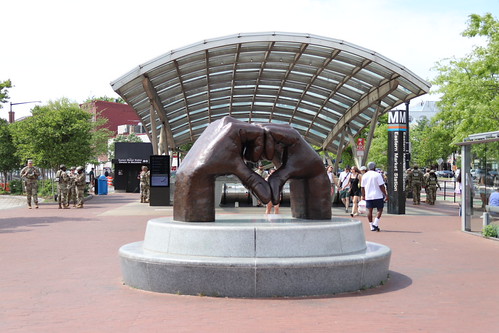
His newest major public sculpture, Loveful Hands, was unveiled at Eastern Market Metro Plaza in April 2026. The five-by-seven-foot bronze depicts two oversized hands forming a heart and invites visitors to interact with the artwork.
These works share a recurring interest in human connection, making Coleman’s selection for the St. Michaels project particularly fitting.
The lantern connects the proposed St. Michaels sculpture to one of the town’s best-known stories, but the figures beneath it carry most of the history the committee wants visitors to encounter. Colborn said she hopes people will stop long enough to learn who the men were and why they are shown together.
“I’m hoping that they’ll learn a little bit of history,” she said. “That they can see, ‘Oh, working together way back then. You know, we can do it now.’”
The museum is also considering programs that would bring local students into the project. Schools have not played a large role in the museum’s programming in the past, but the sculpture could provide an opportunity for visits, lessons and student docents.
“We’re hoping, of course, more people will come,” Colborn said. “There’s going to be a particular program for the schools. We’re hoping that the kids will come and possibly be docents.”
For now, the largest challenge is fundraising.
“The short answer is money,” Colborn said. “We’re pretty far from it. We’ve had one very successful fundraiser at the Cannonball House. We have applied for two grants. We received one. We’re looking to write more grants, but the bottom line is we need money.”
The projected cost is between $150,000 and $200,000. Donations can be made through the St. Michaels Museum, and the committee is also looking for volunteers to help with grant writing or organize future fundraising efforts.
For now, the bronze exists only as a model and a fundraising campaign. If the project reaches its goal, visitors arriving at the museum will be greeted by two soldiers, one Black and one white, standing shoulder to shoulder with their arms raised toward a lantern, a story that began more than 200 years ago and is still waiting to be cast in bronze.
To find out more or to donate, contact Donal Dougherty at 202-893-6129.








6 Responses
Thank you for all your work on this!
Thank you, Darrell, for your comment and as always your support in what I attempt to do.
All the best,
Deborah
Bravo.
Outstanding
Love the subject matter.
You have my support.
Thank you, Mr. Bollinger, for your comment. I appreciate hearing from you. We are well aware that lanterns in trees or at the top of masts may not have occurred and that the disciplined militia, under the leadership of General Benson, saved the day, on two occasions, as you referenced. That said, the legend of “the town that fooled the British” has endured for many decades through the idea of the lanterns and the brave militia. As you probably know lanterns signify not just light, but hope and wisdom, triumph of light over darkness.
We certainly discussed the idea of what else besides a lantern could the two men hold up. Nothing else surfaced. A lantern it will be; the symbolism is very powerful.
I look forward to reading your book. Congratulations!!
Deborah Colborn
Thank you Mr. Kicklighter, for your supportive and enthusiastic comments.
If you have any ideas on meaningful fund raising ideas send them our way. …that is the challenge for now!
All the best,
Deborah Colborn
It can be absolutely demonstrated that the story of lanterns in trees being used to deflect a british bombardment on August 10, 1813 is false. We know from the log of HMS Conflict, the gun-brig that led the bombardment, that it happened well after sunrise and that the captain (Henry Loraine Baker) ordered the cannons to fire after he “visually observed the militia gathering” on the shoreline. (Evidently no one before bothered to look at this.) A detailed account of the battle written by the editor of an Easton newspaper, who was physically at the battle, mentions nothing of this. This newspaper is hard to find and has not previously been reported– only one copy exists anywhere, at the Wisconsin Historical Society. An exhaustive assessment of the War of 1812 conducted by local historian Dr. Samuel Harrison in the early 1870s — including interviews with participants and their descendants — mentions nothing of it. The story about the lanterns doesn’t emerge until 75 years after the event and is hearsay. Neither of the two persons said to report this account was actually present in St. Michaels at the time. One wasn’t even born yet.
There is a far more important story that gets lost here. (My book on the 1813 campaign on the Maryland Eastern Shore will be published by Schiffer next year.) A better motto for St. Michaels is “The Town that Defied the British.” The town was not saved by a ruse, but by a well-organized and disciplined Maryland Militia. The Talbot County militia, which unlike others along the Chesapeake that year, did NOT run when the British appeared. They stood their ground, on August 10 and again on August 26. Our Talbot County militia also created two additional artillery batteries besides the one at Parrott’s Point — and these surprised the British. All of this was under the effective and disciplined leadership of Brigadier General Perry Benson.