

“I am only good at two things, and those are: gardening and painting.”
In 1870s Paris, Monet was one of the exceedingly small of group of artists known as the Impressionist who were interested in new scientific ideas and decided to incorporate them in their work. Most significantly was theory of color, discovered by Michel Eugene Chevreul {1786-1889}. His theory of color revealed that sunlight is not white, the color of paint artists used to lighten all colors. Nor was it black, the paint artists used to darken objects. Sunlight is actually composed of the colors violet, blue, green, yellow, orange and red. The proof was the rainbow or light shown through a prism. A note to the reader, look at the three colors in computer ink. This was an entirely new direction and against the long held convention since the Renaissance.
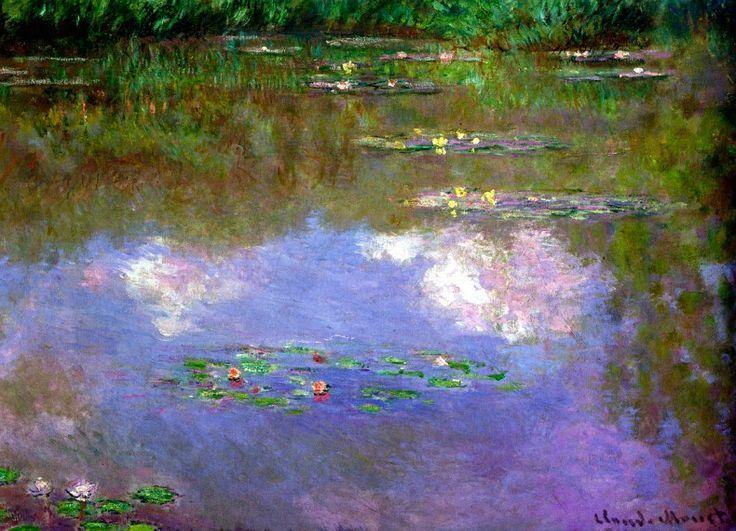
Claude Monet. Water Lilies, the Clouds (1903)
When the Impressionists went outside to paint, which they did because of the invention of the screw cap for paint tubes, they also became aware that things like water, wind and the sun move all the time. To catch movement, their brush strokes need to be shorter and more visible. Thus the works tended to look, according to the critics, messy and sketchy. We love them now but they were easily dismissed in their day.
Nevertheless Monet’s career proceeded with ups and downs but by the late 1880s he began to concentrate more and more on the effects of the light on the objects. These objects he painted over and over from different times of day and in different seasons of the years. The subject of the painting became more and more the colors of the light and not the object painted. He started painting his series of Haystacks and Poplar Trees in 1891, Rouen Cathedral’s from 1892-93 and Water Lilies. He said “…color is my day-long obsession, joy and torment.”
In November 1890, his career provided the funds to purchase a home in Giverny. In 1893 he diverted a stream into his backyard in Giverny and in 1899 he began a water garden with a Japanese footbridge. He was a landscaper as well. From 1903 to 1908 he concentrated mostly on the famous series water lily paintings. First he painted the lilies in the water with the bridge and riverbank and then just the lilies in the water with sunlight shining on the lilies and the moving water. “These landscapes of water and reflection have become an obsession for me. It is beyond my strength as an old man, and yet I want to render what I feel.” He painted 250 water lilies.
By 1908 Monet’s eyesight was failing and he some of his beloved colors he could not see. He was suffering from cataracts which worsened. He died in his home at Giverny in 1926 and in his will left 22 large panels of water lilies murals to the State. They are now displayed in the Orangerie for everyone to see. Cezanne paid tribute to Monet by saying, “Monet was only an eye, BUT WHAT AN EYE.”
“My garden is my most beautiful masterpiece”
Beverly Hall Smith was a professor of art history for 40 years. Since retiring with her husband Kurt to Chestertown six years ago, she has taught art history classes at WC-ALL and Chesapeake College’s Institute for Adult Learning. She is also an artist whose work is sometimes in exhibitions at Chestertown RiverArts and she paints sets for the Garfield Center for the Arts.
Jim Franke says
Looking forward to your next IAL class!