MENU

Sections

  • Home
  • About
    • Contact Us
    • Editors and Writers
    • Join our Mailing List
    • Letters to Editor Policy
    • Advertising & Underwriting
    • Code of Ethics
    • Privacy
    • Talbot Spy Terms of Use
  • Art and Design
  • Culture and Local Life
  • Public Affairs
    • Ecosystem
    • Education
    • Health
    • Senior Life
  • Community Opinion
  • Sign up for Free Subscription
  • Donate to the Talbot Spy
  • Cambridge Spy

More

  • Support the Spy
  • About Spy Community Media
  • Advertising with the Spy
  • Subscribe
January 19, 2026

Talbot Spy

Nonpartisan Education-based News for Talbot County Community

  • Home
  • About
    • Contact Us
    • Editors and Writers
    • Join our Mailing List
    • Letters to Editor Policy
    • Advertising & Underwriting
    • Code of Ethics
    • Privacy
    • Talbot Spy Terms of Use
  • Art and Design
  • Culture and Local Life
  • Public Affairs
    • Ecosystem
    • Education
    • Health
    • Senior Life
  • Community Opinion
  • Sign up for Free Subscription
  • Donate to the Talbot Spy
  • Cambridge Spy
Archives Op-Ed

Report from Annapolis 2020 (Part One) by Laura Price

January 22, 2020 by Opinion

It is that time of year again, when the legislature in Annapolis is back in session.  This means that it is also time for counties to keep a watchful eye on legislation that is introduced and the effect it may have on our citizens.  I am your Talbot County liaison to MACo, the Maryland Association of Counties and the second Vice President of the association. I am serving my sixth year as representative on both the committee and the Board of Directors.  I have also been selected for the second time to chair the Budget and Tax Sub-committee.

The goal of Legislative Committee is to guide positions on bills and to advise each county’s representatives on relevant issues.  MACo’s staff provides insight into the effects of legislation on the counties. We, the elected officials serving as members set the positions to be advocated for in Annapolis, with each county receiving one vote.  This is critically important because the smaller, more rural jurisdictions have the same equal voice as one of the larger counties.

We watch for unfunded mandates and advocate to retain our local autonomy and decision-making authority.  When we gather each Wednesday, we leave our partisan hats at the door. We recognize that we have the same issues, no matter big or small, rural or urban, Republican or Democrat.  The members in the room understand and agree on what is beneficial or potentially harmful when evaluating pieces of legislation and taking a position.

The tax subcommittee approved two broad statements that will be submitted on many pieces of legislation, in lieu of needing to testify on each one.  The first, which is identical to our 2019 statement is “Tax Incentives and Local Government Autonomy.” There will be bills introduced that seek to do a subtraction modification.  Since the state would like to give a tax incentive, there is a way to accomplish this without harming the county. By applying a state tax credit instead, the state can give the incentive without it reducing our county income tax revenue.  This is similar to how property tax credits work and MACo members feel that State tax credits ought to work the same way.

The second statement is new this year.  “Equity with New Revenue Sources” is designed to advocate sharing any additional monies the State is looking to raise to support new education funding.  As most may know, there will be legislation introduced this year, based on the Kirwan education workgroup. I have written previously on this topic and more information will be coming when the legislation is introduced.  With a price tag of $6 billion annually by 2030 and the counties funding half of all education, we believe that any new revenue source should be shared with the locals to help pay the cost.

We used each of these statements on several of our tax bills this week and will continue to submit them going forward.  This also pairs with the first of our four MACo initiatives, “School Funding – Funding Fairness, County Role.”  

MACo has three additional initiatives for 2020.  “Strong Progress for School Construction” urges State policymakers to retain the State’s commitment to this top funding priority.  County governments share responsibility and fund over half of this cost and we need the State to keep up with their share, especially in light of modern cost factors for new environmental and energy standards and a heightened need for security.

“Next Steps in the Drug and Mental Health Crises” is our third initiative as substance use disorders and mental illness remain two of our most pressing health issues.  Our local health departments are often the first line of defense, but they have had to do more with less, since there were significant cuts made by the State. MACo is advocating for State partnership in support of innovative and gap-filling measures to improve accessibility and resources.

Finally, “Repeal Implied Preemption Court Doctrine.”  Maryland courts have assumed that counties are preempted from making some of their own local laws, even if the State law does not explicitly say so.  This will be MACo’s only stand-alone piece of legislation this year, which will state “Legislation should clarify, prospectively, that preemption should not take place in the courts, but in the open and accessible law-making process, where all stakeholders may be heard on the merits of their arguments.”

During week one, there were a few major bills reviewed and several smaller ones, but all are important to consider and sometimes that smaller bill might have a very large unintended consequence.  We considered 18 bills and took positions on all but four. We considered bills on a digital advertising tax and sports gaming and used our approved broad tax statements for those. We supported with amendments HB1, Built to Learn Act, as it pairs well with our MACo initiative.  We also supported bills on agricultural alcohol definitions similar to wineries and breweries, advancing Next Generation 9-1-1 (HB44/SB47), and Cyber Security (SB5).  

Looking forward, there will be no larger piece of legislation than the “Kirwan” education bill but at this point we are still waiting on it to be drafted.  It seems there will be changes to the actual Kirwan committee recommendations, but we don’t know at this time what they will be. I will write in more detail about that and all the other pieces of legislation we will consider as they get introduced.  But for this week, I wanted to give an overview of the process, and how important the county viewpoint can and must be, in influencing policy in Annapolis.  

Laura Price is 2nd Vice President on the Executive Board of Directors of MACo, Chair of Budget and Tax, Talbot’s legislative liaison and member of the Talbot County Council.
 

The Spy Newspapers may periodically employ the assistance of artificial intelligence (AI) to enhance the clarity and accuracy of our content.

Filed Under: Archives, Op-Ed Tagged With: Annapolis, Laura Price, Talbot Spy

Gov. Hogan: Fighting Baltimore Crime a Priority in New Maryland Budget

January 15, 2020 by Capital News Service

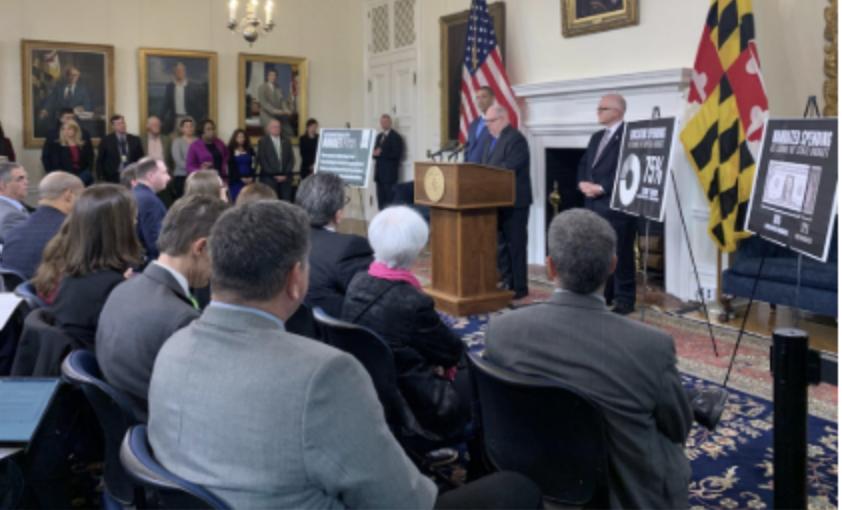
Gov. Larry Hogan said his 2021 budget will prioritize fighting violent crime in Baltimore, provide “record levels” of education funding and finish paying for a major economic development project.

The governor released the details of his “Accountability Budget” at a news conference  Tuesday morning. The full text of the $47.9 billion budget isn’t expected until Wednesday, but Hogan touted the highlights that include a 1% increase in expenditures with no new taxes.

Hogan said his legislative package to fight violent crime in Baltimore is “the most important thing” legislators can do this session, emphasizing that it is the top concern of Marylanders, according to a recent poll.

“It would be outrageous if we cannot get that done,” Hogan said.

“Right now, we have to stop the bloodshed in the streets that is happening every single day.”

Hogan has proposed $74.5 million in police aid for local governments, $38.7 million in local law enforcement grants and $6.9 million to support crime prevention and witness protection.

The line items coincide with legislation Hogan has said he would propose that would increase penalties for offenders who use or possess illegal guns and crackdown on witness intimidation.

He also proposed $2.6 million to fund 25 new prosecutors in the Maryland Office of the Attorney General who would handle violent crime, as well as $23 million for Project C.O.R.E, a state and Baltimore city initiative that demolishes blighted and abandoned buildings with the aim of revitalizing the city.

Education has long been expected to dominate this year’s General Assembly because of the Kirwan Commission’s recommendations, and it dominates the governor’s proposed budget.

Hogan said Tuesday that his budget will provide $7.3 billion for K-12 schools in the state, going “above and beyond” funding formulas, as well as $94 million to expand access to Pre-K. Education spending makes up about 75% of spending on new buildings and infrastructure in his proposed budget.

“No governor in the history of our state has ever invested more in K-12 education,” Hogan said. “But Marylanders are demanding, and we are pushing for, more accountability in our school systems to make sure those dollars are being well spent, they are making it into the classrooms and we are achieving better results for our children.”

Hogan’s record spending comes with a caveat, though, said Senate Majority Leader Guy Guzzone, D-Howard, who also chairs the Senate Budget and Taxation Committee. He said the mandatory spending required by laws passed by the Democrat-dominated General Assembly, inflation, and more children in classrooms means education spending “effectively goes up every year.”

“But we are grateful he is adhering to the budget mandates,” Guzzone said.

“This is about what we value the most. The education of our kids is at the very top of it.”

Guzzone had not seen Hogan’s proposals when he spoke to the Capital News Service on Tuesday afternoon but said he expects the budget process to “look pretty much like it does every year.”

Hogan’s budget will appropriate $80.3 million to pay for the expansion of the Howard Street Tunnel — a rail passthrough in Baltimore — to “break this major East Coast bottleneck.” The money will join $125 million in federal grant dollars to pay for the project, which will expand the tunnels to allow double-stacked rail cars through. Hogan said it would create thousands of jobs and increase production at the Port of Baltimore. The CSX freight railroad is also expected to pay for part of the cost.

Hogan said he has also allocated $57.2 million to the Chesapeake and Atlantic Coastal Bays 2010 Trust Fund and will contribute more than he is required — $242 million — to state reserves. That would leave $1.3 billion in reserves.

During a briefing with the Senate Budget and Taxation Committee meeting Tuesday, Dan White, an economist with Moody’s Analytics, warned lawmakers about the risk of another recession, which he said could happen right around the end of the state’s 2021 fiscal year.

The 2021 fiscal year starts on July 1 and ends July 30, 2021.

White said there is an “uncomfortably high risk” of another recession, citing the low unemployment rate and other economic indicators. White said the next recession would likely be less severe, but may take longer for the economy to recover.

“Recessions are not the end of the world,” White said. “It’s not armageddon.”

White said it may be a good time for the state to look at financing infrastructure to take advantage of current interest rates and to stimulate the state’s economy if and when the recession hits.

The official budget is expected to be released in its entirety on Wednesday. Both chambers of the General Assembly will likely make changes to it before it is finalized.

By Ryan E. Little 

The Spy Newspapers may periodically employ the assistance of artificial intelligence (AI) to enhance the clarity and accuracy of our content.

Filed Under: Maryland News Tagged With: Annapolis, Maryland General Assembly

« Previous Page

Copyright © 2026

Affiliated News

  • The Chestertown Spy
  • The Talbot Spy

Sections

  • Arts
  • Culture
  • Ecosystem
  • Education
  • Mid-Shore Health
  • Culture and Local Life
  • Shore Recovery
  • Spy Senior Nation

Spy Community Media

  • Subscribe
  • Contact Us
  • Advertising & Underwriting

Copyright © 2026 · Spy Community Media Child Theme on Genesis Framework · WordPress · Log in