MENU

Sections

  • Home
  • About
    • Contact Us
    • Editors and Writers
    • Join our Mailing List
    • Letters to Editor Policy
    • Advertising & Underwriting
    • Code of Ethics
    • Privacy
    • Talbot Spy Terms of Use
  • Art and Design
  • Culture and Local Life
  • Public Affairs
    • Ecosystem
    • Education
    • Health
    • Senior Life
  • Community Opinion
  • Sign up for Free Subscription
  • Donate to the Talbot Spy
  • Cambridge Spy

More

  • Support the Spy
  • About Spy Community Media
  • Advertising with the Spy
  • Subscribe
December 6, 2025

Talbot Spy

Nonpartisan Education-based News for Talbot County Community

  • Home
  • About
    • Contact Us
    • Editors and Writers
    • Join our Mailing List
    • Letters to Editor Policy
    • Advertising & Underwriting
    • Code of Ethics
    • Privacy
    • Talbot Spy Terms of Use
  • Art and Design
  • Culture and Local Life
  • Public Affairs
    • Ecosystem
    • Education
    • Health
    • Senior Life
  • Community Opinion
  • Sign up for Free Subscription
  • Donate to the Talbot Spy
  • Cambridge Spy
2 News Homepage

Politico: Md. Dems Eyeing State’s Only Republican Congressman in Redistricting

November 9, 2021 by Spy Desk

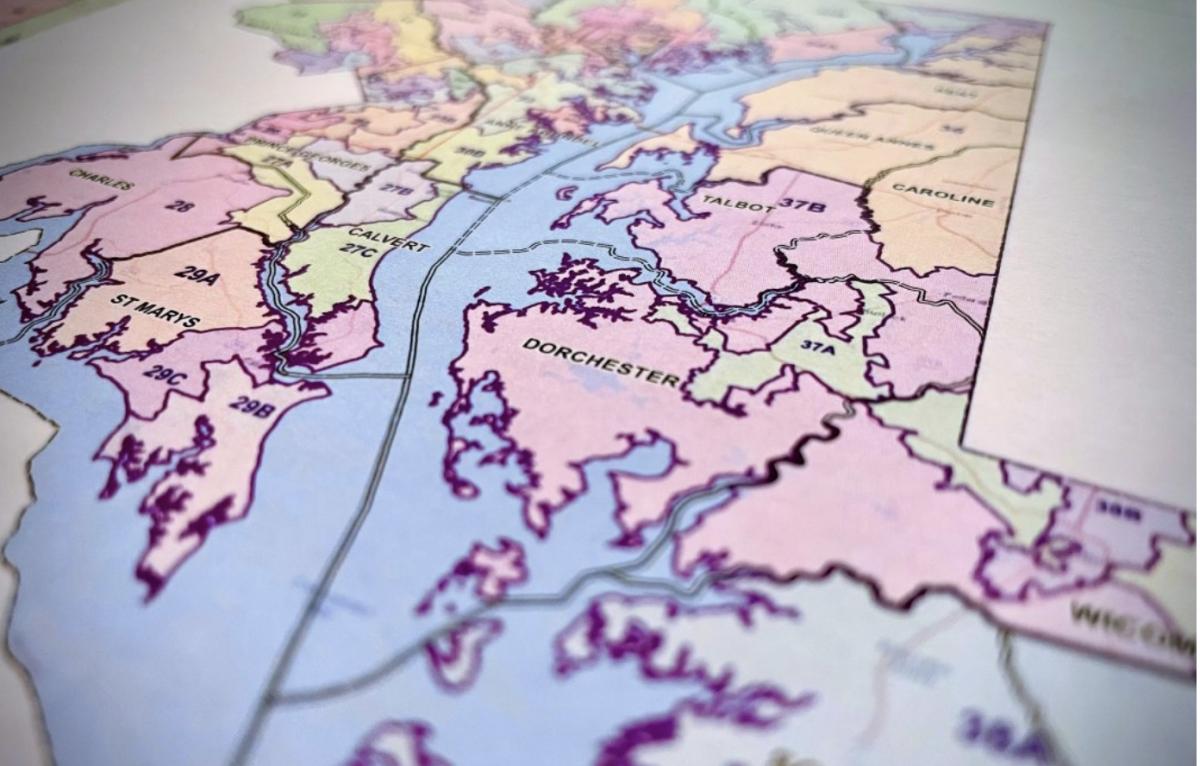
Democratic leaders in Maryland are considering a congressional redistricting that could result in eight Democrats representing the state in Congress, Politico reported Nov. 9.

The state’s current congressional delegation has seven Democrats and one Republican, First District Rep. Andy Harris. Prior to the 2010 redistricting, there were two Republicans representing Maryland, one in western Maryland and one in the First District, which includes the Eastern Shore.

The Maryland General Assembly, with solid Democratic majorities, will have the final say on the districts for Congress, Maryland Senate, and Maryland House of Delegates.

The legislature’s redistricting advisory commission has additional public hearings scheduled through mid-November, but is expected to release a draft congressional map this week, according to Politico.

A citizens redistricting commission appointed by Gov. Larry Hogan has completed its work and proposed a congressional map with six Democratic districts and two Republican districts.

The General Assembly will begin meeting Dec. 6 in a special session to map the congressional districts.
The Spy Newspapers may periodically employ the assistance of artificial intelligence (AI) to enhance the clarity and accuracy of our content.

Filed Under: 2 News Homepage Tagged With: andy harris, Congress, house of delegates, Maryland, redistricting, senate

Md. Citizens Redistricting Commission Finalizes Congressional, Legislative Maps

November 4, 2021 by Maryland Matters

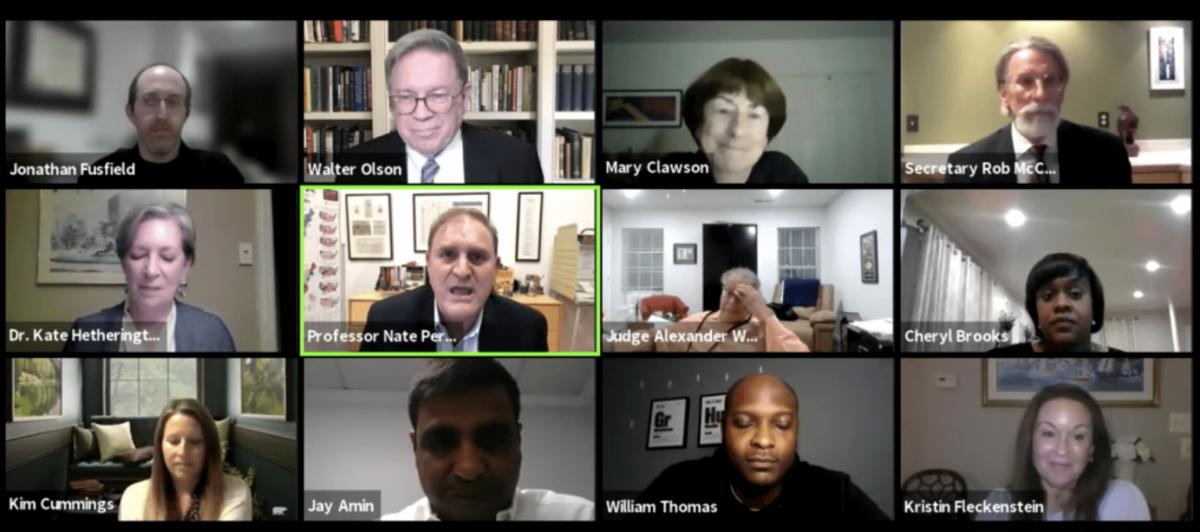
The Maryland Citizens Redistricting Commission, created by Gov. Lawrence J. Hogan Jr. (R) to draw up maps that he will propose to the General Assembly, finalized its redistricting proposals at a Wednesday evening meeting.

Commission members voted 8-1 to approve of congressional maps and unanimously to approve legislative maps at the meeting. Those maps, which are available online, are vastly different from the state’s current configuration because commissioners started from scratch and didn’t use existing districts to begin with.

Commission members weren’t allowed to consider partisan district makeup when creating the maps, but their congressional maps received high marks for partisan fairness from the Princeton Gerrymandering Project. The congressional map creates six Democratic and two Republican districts as opposed to the current 7-1 configuration, according to the Princeton Gerrymandering Project’s Redistricting Report Card. That report also rated the commission’s state senate maps highly in October, although panelists have since made changes to the legislative map and the group hasn’t reviewed the finalized version yet.

The commission is composed of three Republicans, three Democrats and three unaffiliated voters, and has been conducting public hearings on redistricting since June. Hogan has said he will submit the commission’s maps to the General Assembly, where Democrats hold a veto-proof majority in both the House of Delegates and the Senate. Lawmakers have formed their own redistricting panel, the Legislative Redistricting Advisory Commission, to conduct public hearings and draw up congressional and legislative maps.

Here are a few takeaways from the Maryland Citizens Redistricting Commission’s final redistricting proposal:


County splits are minimized compared with current congressional maps

Keeping communities and neighborhoods intact was a common ask from residents throughout the commission’s public hearings, and commissioners said Wednesday evening that they tried to minimize county splits as much as possible in their proposed maps.

Under the state’s current congressional maps, Baltimore City is split between the 2nd, 3rd and 7th Districts. The city would be contained within a single congressional district alongside portions of northern Anne Arundel County in the commission’s proposed maps.

Commission member William Thomas (D), a Baltimore City resident, was the only commission member to vote against the congressional proposal. Thomas said he was “disappointed” that he received little feedback on the congressional maps from city residents, and added that he couldn’t be sure the map accurately reflected what Baltimore residents want in their congressional configuration. He said he would’ve preferred an east-west split for Baltimore in the commission’s maps.

Anne Arundel County, currently split between four congressional districts, would also be kept more intact: Aside from neighborhoods included in a district with Baltimore City, the county is contained within a single district with all of Howard County and a small portion of northern Calvert County in the proposed maps.

Baltimore County, which is also split between four congressional districts in current maps, would be split between two districts from north to south. The northern portions of the county are included with the Eastern Shore in the 1st District, and the southern half of the county has its own self-contained district.

Northern portions of Montgomery County are kept in a district with Western Maryland, although that district would include all of Frederick and Carroll counties. Most of Montgomery County would include a self-contained district extending from Germantown to east of Aspen Hill. The eastern portion of the county, including Silver Spring and White Oak, would be included in a district with northern Prince George’s county.

Roughly the southern half of Prince George’s County is included in a district with Charles, St. Mary’s and Calvert counties.

The legislative map includes both single- and multi-member delegate districts

In his executive order creating the commission earlier this year, Hogan said single-member delegate districts should be used in the map “to the extent possible.” After weeks of debate, panelists decided to use a mix of single- and multi-member districts based on population density.

Eighteen of 47 state Senate districts contain three-member delegate districts in the Maryland Citizens Redistricting Commission’s proposed maps.

The commission’s proposed delegate map generally includes multi-member House districts in counties with a population density of more than 2,000 per square mile, commission Co-Chair Walter Olson (R) previously said.

There are various exceptions to the use of multi-member districts in the commission’s map: Single-member districts are used as required by the federal Voting Rights Act to ensure representation of people of color, and a Senate district of fewer than 500 people per square mile that is in a county with a population density of more than 2,000 per square mile will have single-member House districts. That exclusion would affect the Agricultural Reserve in northern Montgomery County, which would include single-member districts.

Single-member House districts are also used in all districts that cross county lines except District 39, which crosses from Prince George’s County into Charles County, because the population on the Charles County side of the district is too low to “make up the core of a single-member district,” according to a previous email from Maryland Department of Planning Public Affairs Director Kristin R. Fleckenstein.

The Maryland constitution allows state delegate districts with between one and three members, and the state currently uses a mix of both single- and multi-member districts. Delegate districts must be nested within state Senate districts in Maryland, with three delegates per Senate district. Potential configurations include three single-member delegate districts within a Senate district; one single-member delegate district and a two-member delegate district; and one three-delegate district.

Multi-member districts are more widely used than single-member districts statewide in current legislative maps. Single-member districts are generally used in more rural or geographically large districts or when required by the Voting Rights Act. They are also sometimes used in current maps when a portion of a Senate district crosses county lines.

Proponents of single-member districts who testified during the Maryland Citizens Redistricting Commission’s three rounds of public hearings said they make it easier for political newcomers to challenge incumbents and create more specialized local representation, while proponents of multi-member districts have said they offer voters broader representation and helped the Maryland General Assembly outpace other states in terms of gender and racial diversity.

The MCRC maps are highly unlikely to be enacted

The General Assembly, where Democrats hold a veto-proof majority in both the House of Delegates and the Senate, will have the final say over redistricting in Maryland. Legislative leaders created their own commission, the bipartisan Legislative Redistricting Advisory Commission, to draw up their own set of congressional and legislative maps.

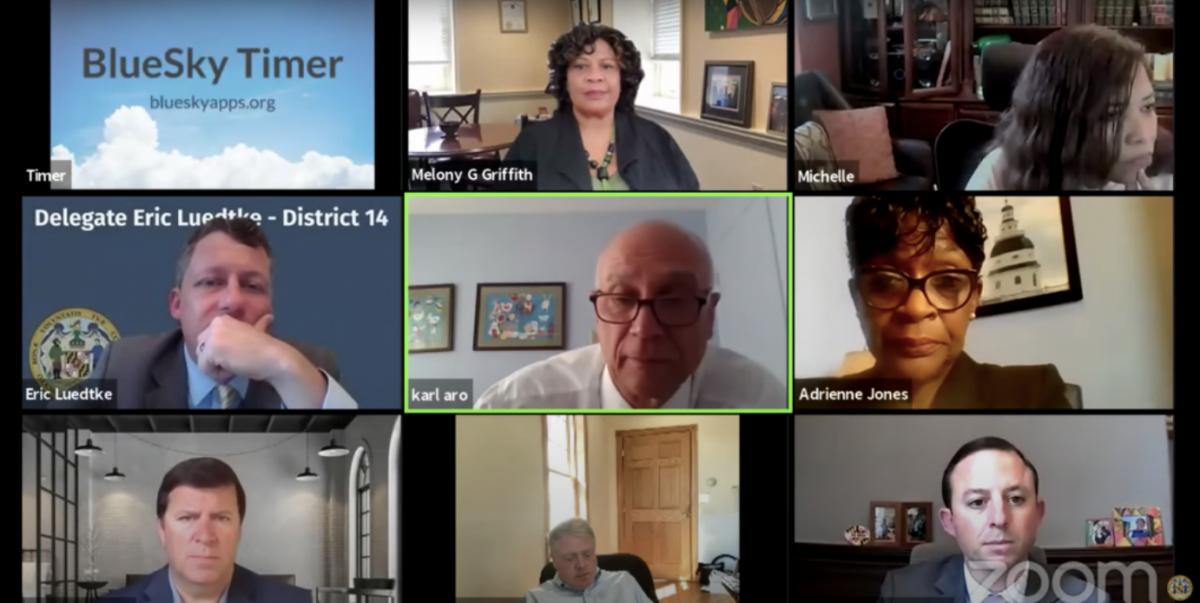
The legislative commission includes four Democratic and two Republican legislative leaders and is chaired by Karl Aro, the former director of the nonpartisan Department of Legislative Services. That panel kicked off its public hearings in September, but hasn’t produced congressional or legislative maps for public comment yet.

Hogan said last week that he would oppose maps from the General Assembly that “don’t follow what the Citizens Redistricting Commission has come up with.” The governor can veto congressional maps, but Democrats hold a veto-proof majority in both the House of Delegates and Senate and easily overrode his vetoes on several measures during the 2021 legislative session.

Lawmakers are planning a special session in December to tackle congressional redistricting. The Legislative Redistricting Advisory Commission is set to wrap up its hearings this month before recommending maps to the General Assembly.

By Bennett Leckrone

The Spy Newspapers may periodically employ the assistance of artificial intelligence (AI) to enhance the clarity and accuracy of our content.

Filed Under: Maryland News Tagged With: commission, congressional, districts, legislative, Maryland, redistricting

Report: Majority of Md. Poultry Farms Failed Inspections But Faced Few Penalties

October 28, 2021 by Maryland Matters

Eighty-four percent of poultry farms in Maryland failed their first state inspection over the last several years, most due to inadequate waste management and failure to keep records — but the state rarely penalized poultry farms for their violations, according to a recent report by an environmental watchdog organization.

Out of 182 poultry farms that were inspected, 153 failed their initial inspection and 78 failed follow-up inspections from 2017 to 2020. Two thirds of the inspected poultry farms failed due to waste management problems and 95% failed to file annual reports to the state or maintain records about their operations, the report by the Environmental Integrity Project on Maryland’s poultry industry found.

Despite the failed inspections, the report found that the Maryland Department of the Environment, which is responsible for issuing water pollution control permits for animal feeding operations and for enforcing the federal Clean Water Act, imposed fines on only eight of the 78 facilities with repeated violations, and collected fines from only four poultry farms.

Jay Apperson, a spokesman for MDE, said he could not comment on the report’s findings because MDE has not seen it. But, he said, “The Maryland Department of the Environment, in coordination with the Maryland Department of Agriculture, maintains a strong program to enforce environmental regulations pertaining to poultry operations. A high percentage of violations that are found are associated with record-keeping requirements, as opposed to water quality issues. Where we do find environmental concerns we focus on returning facilities to compliance with regulations, but we will go after polluters and impose financial penalties when needed.”

The Environmental Integrity Project report is based on public records obtained from MDE and MDA from Maryland’s Public Information Act law. For the last nine months, EIP reviewed more than 5,000 pages of poultry operation inspection reports and other state records to evaluate how much oversight there is of the state’s poultry operations.

The state has limits on how much manure farmers can apply to fields that already have high soil phosphorus levels. Adding manure to fields can help provide nutrients for crops, especially when soils are low in phosphorus. However, excessive phosphorus on fields can get into waterways after storms, which risks algal blooms and sucks up the oxygen needed by fish.

According to the Chesapeake Bay Foundation, agriculture runoff is the largest source of pollution into the Chesapeake Bay, contributing to 40% of the nitrogen and 50% of phosphorus in the Bay.

Twenty-nine of 57 poultry farms that EIP reviewed reported to the state that they had been applying illegal amounts of animal manure on their crop fields in 2019. Most farms are required to have nutrient management plans when fertilizing crops and managing animal manure in order to prevent excess nutrients going into waterways, and the Maryland Department of Agriculture is responsible for enforcing these plans.

But MDA has not issued any fines on poultry farms for spreading excess poultry manure, according to Jason Schellhardt, the spokesman for the agency.

Currently, there are 553 permitted poultry concentrated animal feeding operations (CAFOs) and Maryland animal feeding operations (MAFOs) in Maryland, according to Apperson. In 2019, Caroline County had 108 poultry farms that produced almost 50 million birds, the highest number in any county, according to the report. Dorchester County had 45 poultry farms in 2019, which yielded 28 million birds.

The report also found that 174 poultry operations on the Eastern Shore are within 400 feet of a house, which increases residents’ exposure to ammonia, dust and manure particles. Only 64 of these poultry farms had vegetated buffers such as a row of trees between the poultry house and residents’ homes, which is a way to divert emissions, the report said.

In 2016, Wicomico County residents formed Concerned Citizens Against Industrial CAFOs to oppose construction of what was going to be the largest poultry operation in the state near Salisbury, citing health concerns from air pollution and manure that could pollute drinking water sources. Two years later, the chicken farm operators canceled their plans.

During the 2020 legislative session, Del. Vaughn Stewart (D-Montgomery) introduced a bill that would have blocked the expansion of industrial poultry operations in the state by precluding MDE from issuing stormwater permits for any animal feeding operations producing more than 300,000 chickens annually. However, the bill never made it out of committee.

MDE has just three employees who perform in-person inspections at poultry farms and MDA has nine employees who oversee nutrient management plans of over 5,000 farms across the state. The report found that the number of poultry farms inspected by MDE fell by 40% since 2013.

To improve poultry farms’ compliance with the federal Clean Water Act and state laws, EIP recommends that MDE and MDA impose more penalties against poultry farms in violation with their nutrient management plans and water permits. The report also recommends that the state hire more inspectors, increase water and air monitoring near poultry farms and enforce the state’s new manure application rules for farms.

“MDA is failing to provide any reality-based ground-truthing or accountability for the largest single source of pollution in the Bay, the agricultural industry,” the report states. EIP also described state oversight over poultry operations as “an empty paperwork exercise that falls well short of what is needed to control agricultural runoff pollution or protect the Chesapeake Bay.”

By Elizabeth Shwe

The Spy Newspapers may periodically employ the assistance of artificial intelligence (AI) to enhance the clarity and accuracy of our content.

Filed Under: Eco Lead Tagged With: agriculture runoff, CAFO, Chesapeake Bay, clean water act, farms, inspections, Maryland, mde, nitrogen, phosphorus, poultry, records, waste management, water pollution

Shore Residents Say Legislative Redistricting Panel Should Boost Representation of People of Color

October 19, 2021 by Maryland Matters

Eastern Shore residents urged members of the Legislative Redistricting Advisory Commission to boost representation for people of color in their legislative maps at a Monday evening public hearing.

Sonya Whited, a Wicomico County resident, said during a public hearing at the Todd Performing Arts Center in Wye Mills that the commission should look at drawing an additional single-member delegate district with a majority of people of color on the Eastern Shore in their proposed legislative maps in addition to District 37A, which is represented by House of Delegates Speaker Pro Tem Sheree Sample-Hughes (D).

“We are at the point where carving out one minority district represented by Delegate Sheree Sample-Hughes is not enough to truly address the concerns of other minority and sometimes marginalized communities,” Whited said. “I am hopeful that this critical district could be part of the fair map drawing process versus a court case.”

Patrick Firth, the chairman of the Talbot County Democratic Central Committee, said the panel could create an additional single-member district that would stretch from Salisbury University to the University of Maryland Eastern Shore, the historically Black university in Princess Anne.

“It’s time for the General Assembly to recognize the changing population and growing diversity (of) the Eastern Shore,” Firth said.

He also said Talbot County should be drawn into a single-member district with parts of Caroline Counties rather than a broader district with portions of the lower Eastern Shore.

Whited also said she wants the commission to largely keep multi-member delegate districts in their legislative maps. Maryland’s delegate maps currently contain a mix of single- and multi-member districts, with multi-member districts generally used in more densely populated areas and some rural areas including on the Eastern Shore. Whited and other proponents of multi-member districts say having multiple delegates gives voters access to legislators with different areas of expertise and broader representation.

Single-member districts are generally used in geographically larger and more rural districts or when required by the Voting Rights Act to ensure representation of people of color. They are also sometimes used when a portion of a senatorial district crosses county lines. Proponents of single-member delegate districts say they make it easier for political newcomers to challenge incumbents and also give voters a single point of contact in the House of Delegates.

Diana Waterman, a Queen Anne’s County resident and former state Republican Party chair, testified in favor of single-member districts at the public hearing, and argued that using single-member districts statewide “would ensure that all citizens receive the same level of service from their delegate.”

Waterman said the LRAC should consider supporting maps drawn up by the Maryland Citizens Redistricting Commission, a multi-partisan panel created by Gov. Lawrence J. Hogan Jr. (R) and tasked with drawing up congressional and legislative maps that he will propose to the General Assembly. That panel recently released draft delegate maps with both single- and multi-member districts based largely on population density, and will hold a virtual public hearing Wednesday at 6 p.m.

The General Assembly, where Democrats hold a veto-proof majority in both the House of Delegates and the Senate, will have the final say over the state’s next set of maps, and legislative leaders created the bipartisan LRAC to draw up their own set of maps.

Sen. Adelaide C. Eckardt (R-Lower Shore) said she supports single-member districts to ensure that individual counties have a shot at electing local delegates.

“Most of the counties want to make sure that they have somebody that lives in their district representing them,” Eckardt said.

Kathleen Bangert, speaking on behalf of several Eastern Shore chapters of the League of Women Voters, said her organization supports maintaining a mix of single- and multi-member districts in legislative maps.

“It is our position that the right mix of the two helps to promote full minority representation, preserve political and community boundaries, and encourage a more diverse candidate pool,” Bangert said.

Some Eastern Shore residents who testified at the public hearing also said the commission should look at crossing the Chesapeake Bay to include portions of Anne Arundel County with the Eastern Shore in congressional maps. The 1st Congressional District currently stretches into Harford, Carroll and Baltimore counties — but some who testified said Eastern Shore residents have more in common with Anne Arundel County because of the Chesapeake Bay Bridge.

“There is clearly a strong association between the Eastern Shore and Anne Arundel-related business and workforce development interests that impact our shared regional economy,” Chestertown resident Rebecca Flora said.

Tara Newman-Bell, a Talbot County resident, said in addition to ensuring that people of color’s voting power isn’t diluted and that maps aren’t drawn to favor any particular political party, commission members should provide clear rationale behind their eventual congressional and legislative maps.

By Bennett Leckrone

The Spy Newspapers may periodically employ the assistance of artificial intelligence (AI) to enhance the clarity and accuracy of our content.

Filed Under: 2 News Homepage, News Portal Highlights Tagged With: commission, Maryland, minority district, multi-member, redistricting, single member

Gubernatorial Candidates Talk Eastern Shore Economic Development at Crisfield Clam Bake and Crab Feast

October 14, 2021 by Maryland Matters

Droves of visitors swelled the population of Crisfield, the southernmost town in Maryland, on Wednesday for the J. Millard Tawes Clam Bake and Crab Feast.

The feast – typically held at the end of July each year and delayed since 2020 because of the COVID-19 pandemic – is one of two major annual events hosted by the coastal town’s Chamber of Commerce.

Ahead of and during Wednesday’s event, Maryland Matters spoke to each of the candidates vying to be Maryland’s next governor about their ideas for boosting the Eastern Shore economy ― though some offered more details than others and, in some cases, the proposals are essentially repackaging their broader campaign themes.

Here is a sampling of their views:

Former Prince George’s County Executive Rushern L. Baker III (D)

Baker, who only recently returned to the campaign trail following his wife’s death, was not on hand in Crisfield — though he made news this week by announcing that Montgomery County Councilmember Nancy Navarro (D) was joining his ticket.

Baker said that with its outdoor recreation opportunities and low cost of living, the Eastern Shore is “the perfect place to attract technology companies or other employers that primarily provide virtual services and folks who can work remotely.”

“In order to do that, we have to invest in infrastructure like high speed broadband and 5G in every community,” he said. “We can also utilize the state’s economic development fund to attract new companies to the region. That’s exactly what I did as county executive with 2U, an education technology company that we convinced to build their headquarters in Lanham… They employ over 5,000 people now. Between technology and the pandemic, our economy is transforming as we speak and there are lots of opportunities for communities on the Eastern Shore if we have the right leadership that’s prepared to take advantage of them.”

Jon Baron (D)

Baron, a former Clinton administration official making his first run for office, moved slowly through the circus-sized tent erected by Annapolis lobbyist Bruce C. Bereano, introducing himself to the elected officials and political insiders congregated inside.

“I love it, I really do,” he said. “I’m talking to a lot of people. I like talking to them and learning what’s on people’s minds. I’m talking about some of my policies and they’re giving me feedback.”

Baron’s core message is that the state’s biggest challenges have existed for decades and that current programs aren’t addressing them. He has held leadership positions at policy-oriented nonprofit groups and believes that there are proven solutions to to problems with health care, education, economic development and the criminal justice system that can be borrowed from different jurisdictions around the country and can be applied in Maryland. For the Eastern Shore, he said, “broadband especially” has been a vexing challenge.

Comptroller Peter V.R. Franchot (D)

Franchot has been to more Crisfield crab feasts than any other candidate for governor, and he moved through the crowd with the largest entourage — most of them sporting electric blue T-shirts. It displayed an incumbent’s strength — Franchot is completing his fourth term as comptroller — but also kept him from engaging in substantive conversations.

Franchot said that “when” he wins, his administration will “reverse some of the policies that have prevented the state from really prospering,” like impediments on homeownership and the effects of redlining in areas with high concentrations of poverty.

“We’re gonna address that very vigorously,” Franchot said.

Anecdotally, Franchot is seen as having the strongest support among Eastern Shore Democrats, at least at this early stage.

Former Attorney General Douglas F. Gansler (D)

Gansler, sporting a red golf shirt, moved in and out of the tents, greeting old friends.

Gansler said he’s the only candidate in the race “besides the tax collector” — Franchot — who has a long, solid relationship with the Eastern Shore and intends to augment the job market that exists there.

“Too often,” he said, politicians “pay lip service to the Eastern Shore … and we need to make sure we support our businesses on the Eastern Shore and bring Democratic values back to the Eastern Shore.”

Gansler recently rolled out his environmental plan, which includes off-shore wind energy for Ocean City, “which is a no-brainer and far past its time and due,” he said. He also wants to build a power plant on the Shore to help convert millions of pounds of chicken manure into energy and economic opportunity.

“I’m the only one with a record of environmental accomplishment,” Gansler said.

Ashwani Jain (D)

Jain, a former Obama administration official, did not attend the crab feast.

Jain said he plans to make state government more accessible to the Eastern Shore.

“When I talk to residents — when I see their concerns, when I hear what they’re always talking about — they always feel that, no matter what … their specific local economy is going through, no one at the high levels are actually listening to them or making them feel like they’re being heard and respected,” he said.

Jain also said he wants to eliminate the state income tax for anyone who makes less than $400,000 and proposes to create the nation’s first guaranteed jobs program.

“In that way, we’re going to make sure that everyone has [a] lower cost of living, more disposable income in their pocket, and a good job if they need one and they can’t find one,” he said.

Former U.S. Education Secretary John B. King Jr. (D)

King was not in Crisfield, but he had a handful of campaign volunteers handing out fliers by the marina entrance.

In an interview, he said it is important to ensure Eastern Shore residents have access to affordable child care and health care while thinking about economic development in the region.

He suggested the development of a state bank, which would hold state assets and give loans to businesses that private commercial banks may not give, would help provide smaller businesses on the Shore with greater access to capital.

Wes Moore (D)

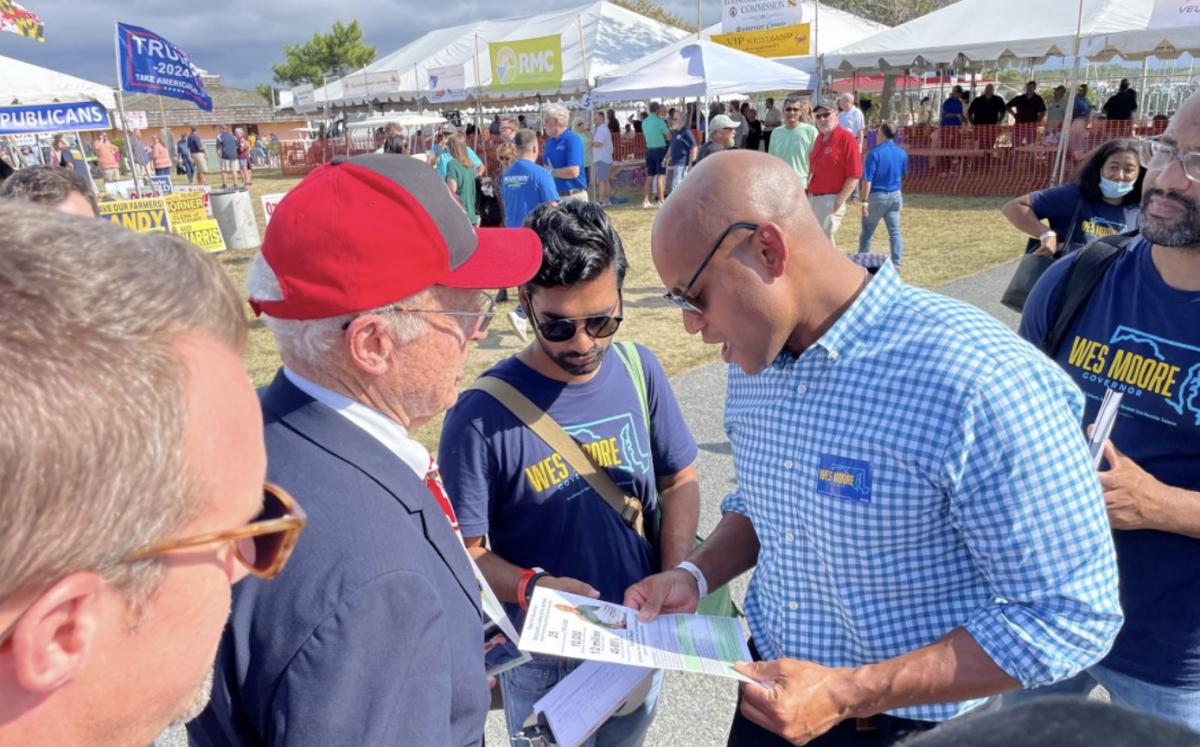
Moore, the author and former nonprofit CEO, was a sought-after figure at the crab feast, having lengthy conversations with scores of voters.

Moore said the economic challenges facing the Eastern Shore are not new — and there is no “one solution.”

“The reality is there are three jurisdictions in the entire state of Maryland where 100% of the children are on free and reduced lunch; two of them are on the Eastern Shore.” In many homes, parents and children face other challenges, like mental health and substance abuse.

“When the Shore says we have felt ignored and left out of the conversation, they’re not wrong,” Moore said.

The candidate said he would focus on “accessible broadband,” improved transportation and “smart jobs/green jobs.”

Moore said he is spending a lot of time on the Eastern Shore.

“I want to show people that how we are campaigning is how I plan on governing,” he said. “When people say, ‘you guys are working hard’ and ‘you’re everywhere,’ that’s exactly how I plan on governing.”

Former DNC Chair Tom Perez (D)

Perez, a former state Labor secretary and former Montgomery County councilmember, is not a stranger to the crab feast. He called it “retail politics, I think, at its best.”

Perez said he believes the Eastern Shore has the potential to have a robust diversified economy by complementing its seafood, poultry and tourism industries with the budding clean energy economy in offshore wind.

The Shore, he said, could be a “vital engine of a clean energy economy,” especially with offshore wind offering good union jobs, Perez said. “Extreme weather is a huge challenge for the Shore and for our survival and that is why becoming a solar and wind capital of America is an existential interest and it’s vital to our economic survival,” Perez said.

As governor, Perez said he would work with local community colleges, universities and businesses to build a pipeline of workers, especially in the clean energy industry. He referred to the Blueprint for Maryland’s Future’s expansion of career and technical education programs as something to take advantage of on the Shore.

Not only is access to broadband important for the Eastern Shore, but it is also vital to its economy, Perez said.

“Broadband is like water — it’s an essential public utility that should be affordable and accessible to everyone,” he said.

Michael Rosenbaum (D)

Rosenbaum, a Baltimore-based tech CEO, missed the crab feast — “the logistics of trying to be in every corner of the state are complicated sometimes,” he said. But Rosenbaum said he believes his prescription for jump-starting the economy, by offering training programs that propel workers into the middle class, will especially resonate on the Shore.

“We have not made it possible for folks to have a pathway to economic opportunity,” he said.

Rosenbaum points to his own work as a job creator in the private sector and says the state needs “a coherent strategy” to do the same on the Eastern Shore — a strategy that also includes affordable, accessible child care, better transportation, and stronger health care coverage.

“We need to support the jobs for the people on the Eastern Shore to support a family,” he said. “We need to create the resources to make it easier to work.”

Del. Daniel L. Cox (R-Frederick)

Cox, who is running as a vocal supporter of President Trump, had a tent at the crab feast and moved through the crowd with a small but enthusiastic group of supporters.

“Above all,” he said, Maryland’s next governor should lift restrictions on watermen.

Cox said he opposed bills in the General Assembly to expand Maryland’s oyster sanctuaries, and he pointed out that one of the Democratic candidates, Franchot, recently angered watermen by suggesting he would phase out wild fishery and oystering.

“I want to make sure the Eastern Shore has the freedom it needs to grow its watermen, its water industry, as well as its farming industry,” Cox said. “I think those are two crucial areas that need to be honored and respected. We need to protect it.”

Robin Ficker (R)

Ficker, the attorney and perennial candidate whose Cut Sales Tax by 2 Cents signs lined the highways leading to Crisfield, said his focus on cutting Maryland’s sales tax by a third would help the state attract businesses generally and would specifically help economic fortunes on the Eastern Shore.

“We have an 85-mile border with Delaware, which has no sales tax at all, so a 6% difference. That’s enough to get people to move across the line,” said Ficker, who moved aggressively throughout the crab feast crowd. “So we’re going to cut the sales tax, give everyone a tax cut, give everyone a fiscal stimulus each and every year and bring business in here and bolster our economy.”

Maryland Commerce Secretary Kelly M. Schulz (R)

Schulz also had a presence at the event, pressing the flesh while accompanied by supporters in white T-shirts.

“We have a very positive message about the state of Maryland moving forward and what we can do in this race for governor,” she said.

Schulz touted Maryland’s Outdoor Recreation Economic Commission as a way to “bring tourism and recreation into the business world,” which is also a shared goal of the Department of Commerce she heads and the state’s Department of Natural Resources. Recently, Hogan established the Office of Outdoor Recreation in response to one of the commission’s proposals.

Schulz also said she would also support the Shore’s agricultural, forestry and waterman industries as governor.

By Bruce DePuyt, Danielle E. Gaines, Hannah Gaskill, Josh Kurtz and Elizabeth Shwe

The Spy Newspapers may periodically employ the assistance of artificial intelligence (AI) to enhance the clarity and accuracy of our content.

Filed Under: Maryland News Tagged With: candidates, crab feast, crisfield, Eastern Shore, Economy, governor, Maryland, tawes

Marylanders Urge Transparency at Legislative Redistricting Advisory Commission Hearing

October 6, 2021 by Maryland Matters

Marylanders urged members of the General Assembly’s Legislative Redistricting Advisory Commission at a Tuesday hearing to make draft maps available for public comment before the panel’s last public hearing in November, arguing that the public should have a chance to weigh in before the General Assembly takes them up for a vote.

“It seems rather difficult for people to comment on the basis of a blank map,” Jacqueline Coolidge of the League of Women Voters told the panel at the online hearing.

Edward Johnson, co-leader of the Maryland Legislative Coalition, a progressive advocacy group, said that meaningful hearings can happen only when the commission presents draft maps.

Legislative leaders are tentatively planning a special session in early December to handle congressional redistricting, and Johnson said maps should be produced for public comment before then.

Morgan Drayton, policy and engagement manager for Common Cause Maryland, also urged the commission to produce draft maps before it concludes its public hearings in November. And she said the commission should consider starting its next statewide virtual public hearing at 6 p.m., rather than 3 p.m., to allow Maryland residents who work during the day to participate.

Nicole Y. Drew of Delta Sigma Theta, a public service-focused sorority that advocates for black communities, said the commission needs to undertake a “fair and transparent” process. She also urged members of the commission to ensure that people of color don’t have their votes diluted in the state’s next set of maps.

Commission Chair Karl Aro, a former director of the Department of Legislative Services, said the commission “will have draft maps for comment” but is gathering information.

Commission member Sen. Bryan W. Simonaire (R) noted the commission is set to conclude its public hearings on Nov. 18, and pressed Aro on when draft maps will be available for public comment.

Aro said he hopes the commission will produce draft maps by Nov. 15, and said the pandemic-related delay in Census redistricting data is to blame for the panel’s time constraints.

Aro said the public will also be able to comment when proposed district maps come up for committee hearings in the General Assembly’s special and regular sessions.

The Legislative Redistricting Advisory Commission’s next in-person meeting is set for Tuesday, Oct. 12 at 6 p.m. at Morgan State University in Baltimore.

The Maryland Citizens Redistricting Commission, a separate panel created by Gov. Lawrence J. Hogan Jr. (R) to draw maps that he will propose to the General Assembly, has already drafted maps for state senate and congressional districts and is currently weighing single- vs. multi-member delegate districts. That panel is set to begin its final round of virtual public hearings Wednesday at 6 p.m.

On Tuesday, the legislative commission also heard from Brandon Russell, a St. Mary’s County resident, who urged them to keep his county whole in congressional and state legislative maps. He noted that members of the Maryland Citizens Redistricting Commission included a portion of St. Mary’s County with Calvert County in their initial senate district maps, but that commission reversed course after backlash from county residents and made the county whole in a subsequent draft.

While both the Maryland Citizens Redistricting Commission and Legislative Redistricting Advisory Commission are tasked with conducting public hearings and drafting maps for congressional and state legislative districts, the General Assembly will have the final say over the state’s coming redistricting. Democrats hold a veto-proof majority in both the House of Delegates and the Senate.

By Bennett Leckrone

The Spy Newspapers may periodically employ the assistance of artificial intelligence (AI) to enhance the clarity and accuracy of our content.

Filed Under: Maryland News Tagged With: advisory commission, districts, general assembly, maps, Maryland, redistricting, transparency

Md. Park Leaders Tell Lawmakers State Parks Are Severely Understaffed and Underfunded

October 6, 2021 by Maryland Matters

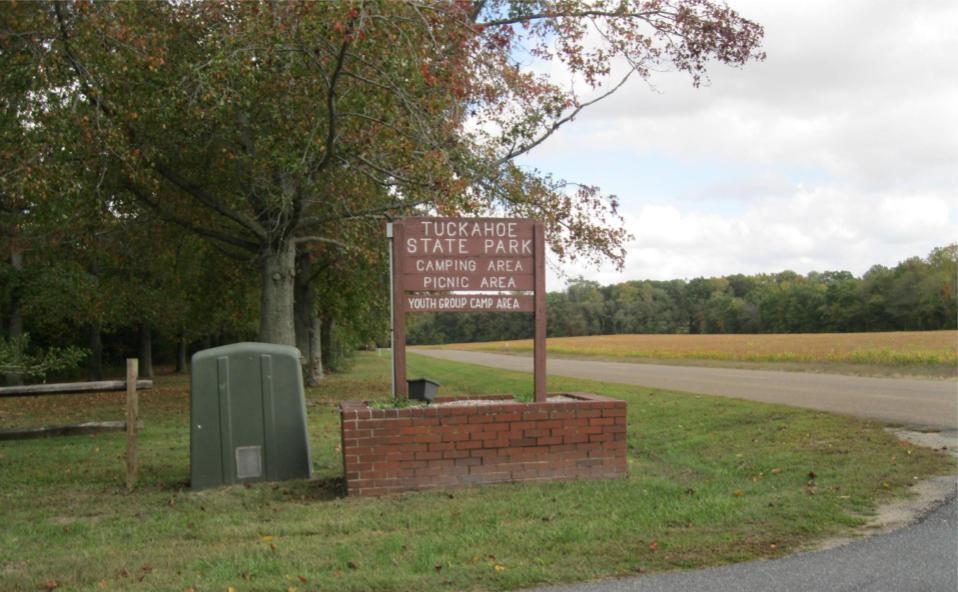
Maryland state parks desperately need a boost in funding to hire more permanent staff and update old infrastructure if they want to meet growing demands for park access, state park leaders told lawmakers on Tuesday.

Due to years of low funding and understaffing, park rangers in state parks are overburdened and need support, state park leaders said.

For instance, it took 500 hours for staff to remove nearly 10,000 pounds of trash along a half-mile stretch of the Gunpowder River in Gunpowder Falls State Park in Baltimore County last summer, Dean Hughes, president of the Maryland Rangers Association, told the State Park Investment Commission Tuesday.

“We’re seeing how the sheer number of people is causing irreparable damage to sensitive environments,” he said.

State parks also are losing some of their rangers, who work at or near state minimum wage ($11.75), to the private sector and parks in Anne Arundel, Howard and Baltimore counties which offer better wages, Hughes said.

Although some park rangers do leave state parks to work for county parks, most of the time they think, “this is just not worth it,” said Chris Czarra, a park ranger at Patapsco Valley State Park and a member of Maryland Professional Employees Council Local 6197.

Czarra said that park rangers want yearly wage increases and to be recognized as first responders since they are trained to provide some of the same emergency services that emergency medical technicians and police provide.

“Every day, you don’t know what you’re going to be dealing with and your plans are always being upended by circumstances in the park,” he said.

To meet growing demands, new state parks have opened but without additional permanent staff, Hughes said.

For example, Wolf Den Run State Park in Garrett County opened in 2019 but is managed by the same staff responsible for Herrington Manor and Swallow Falls State Park.

And if a park ranger is on sick leave, there is no trained staff person to substitute, Czarra said.

Meanwhile, park visitors increased during the COVID-19 pandemic.

Unrealistic workloads and low wages make a career within the park service an unattractive option to future stewards, Hughes said.

“The current trajectory of our state parks is simply not sustainable, and we’re in desperate need of a major investment to meet our state’s growing demand for outdoor recreation,” Hughes said.

There is also a disparity between the resources of state parks and national parks. Assateague State Park only has 10 permanent employees, but Assateague Island National Seashore has 50 permanent employees and, with seasonal staff, twice as many on hand in summer, Hughes said.

With an annual operating budget of around $50 million for Maryland state parks and with 21 million visitors last year, spending around $2 per visitor is not enough, Hughes said.

Mel Poole, president of Friends of Maryland State Parks, a volunteer organization, recommends that the state park system add at least 100 permanent staff positions to address the pre-pandemic visitation levels alone.

Poole also estimated a backlog of $100-million worth of maintenance work that was delayed and must be addressed in next year’s budget.

Park rangers want funding to upgrade bathrooms, sewage treatment systems and replace out-of-date maintenance equipment. Some is so outdated that it costs more to pay rangers overtime to repair it than it would to buy new equipment, Czarra said.

Funding is even more dire for local park systems, especially in Baltimore, said Frank Lance, president of the Parks and People Foundation, a non-profit that seeks to improve the quality of life in Baltimore by increasing access to green space.

Lance said he regularly meets with the director of Baltimore City Recreation and Parks Department to figure out how to make a difference in disenfranchised communities. “But from a funding source, we’re trying to make bricks without straw,” he said.

Joel Dunn, president of the nonprofit Chesapeake Conservancy, also recommended that the state develop a long-term capital budget plan separate from Program Open Space, which is run by the Maryland Department of Natural Resources and provides financial assistance to local governments to support recreational land and open space areas.

The federal Great American Outdoors Act that passed last year allocates $900 million annually to the Land and Water Conservation Fund and provides up to $9.5 billion over five years to address the maintenance backlog at national parks. Dunn suggested that lawmakers could follow this national funding model for Maryland state parks.

Hughes said he would like to see the State Park Investment Commission bring about progressive policies for state parks as the Kirwan Commission did for education with its landmark Blueprint for Maryland’s Future.

By Elizabeth Shwe

The Spy Newspapers may periodically employ the assistance of artificial intelligence (AI) to enhance the clarity and accuracy of our content.

Filed Under: Eco Lead Tagged With: environment, funding, Maryland, park rangers, staffing, state parks, wage

After Years of Legislating, Anton’s Law Goes Into Effect

October 1, 2021 by Maryland Matters

After several legislative attempts in past years fell short, beginning today, civilians will have the right to request to review police misconduct records.

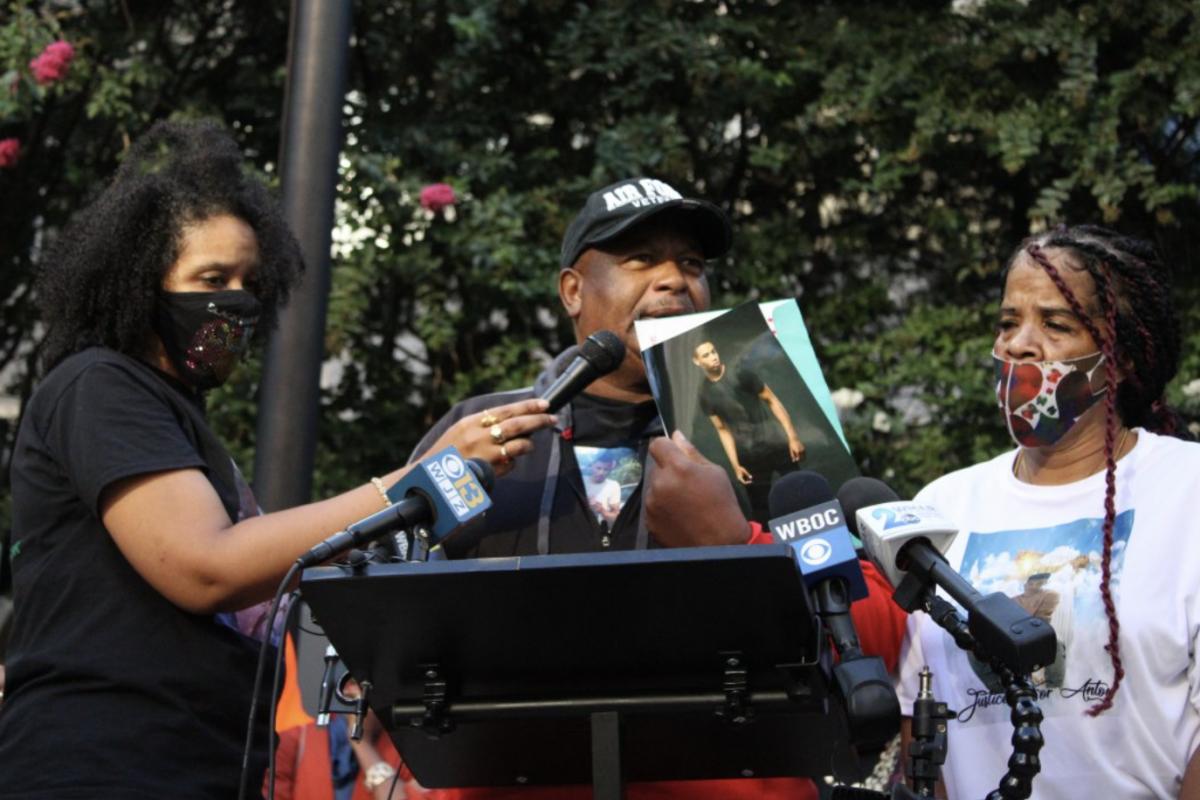
Anton’s Law, named after 19-year-old Anton Black, who died in police custody in 2018, reclassifies police administrative and criminal misconduct records from personnel records to public records, allowing them to be inspected by civilians through the Maryland Public Information Act.

“Let me be clear, we are not seeking justice for Anton because justice would have been Anton being alive today — with his daughter, with his family, with the very community that raised him,” Del. Gabriel Acevero (D-Montgomery), the bill’s House sponsor, said at a news conference Thursday. “But what we can get and what we’re fighting for is accountability … that will not only ensure transparency but ensure that those members of the public who are seeking information about investigative and misconduct records, that that information is not only accessible but we’re changing the way law enforcement operates in our communities.”

The law also puts limits on when no-knock search warrants can be utilized by police agencies, alters the standard requirements placed on general search warrants and requires law enforcement agencies to provide annual summarized data reports regarding their use of search warrants to the Governor’s Office of Crime Prevention, Youth and Victim Services.

Acevero and Sen. Jill P. Carter (D-Baltimore City), the bill’s Senate sponsor, unsuccessfully worked two versions of legislation bearing Black’s name in the General Assembly before their bill passed in 2021.

“My hope is that with the passage of Anton’s Law, we will no longer allow the patterns and practices of unconstitutional policing … and most importantly, we will save lives by preventing other heinous, brutal, extrajudicial killings such as that of Anton Black,” Carter said Thursday.

On Sept. 15, 2018, Black was chased on foot by police to his Greensboro home, forcibly dragged from a locked car, put in restraints and subdued under the weight of law enforcement officers for several minutes.

He died on the ground, feet away from the entrance of his mother’s home.

“Out of fear, this mother, this loving mother, Anton’s mother, had to compose herself the entire time while they were killing her son,” said René Swafford, an attorney representing the Black family. “And even in the midst of her pain, her anguish and her fear, she was the only one on the scene that night that did anything to try and de-escalate the situation.”

Carter said that Anton was “one of 31 extrajudicial killings” in Maryland in 2018.

“They threw him on the ground, they beat him, they choked him. He’s crying for his mother,” said Anton’s father, Antone Black. “My son was George Floyd before George Floyd, and there’s no justice, so far, for Anton Black, and there’s no peace for me.”

According to an autopsy report published by The Baltimore Sun, Maryland’s former chief medical examiner, Dr. David Fowler, ruled that sudden cardiac death with factors contributed by Black’s diagnosis of bipolar disorder was the cause of his death.

Fowler testified for the defense during the murder trial of former Minneapolis Police Officer Derek Chauvin in the George Floyd case. In his expert testimony, Fowler ruled that Floyd did not die because he was restrained, but because of sudden cardiac arrest exacerbated by drug use and potential carbon monoxide poisoning from vehicle exhaust.

Maryland Attorney General Brian E. Frosh (D) called for an audit of deaths in police custody overseen by Fowler during his nearly 20-year tenure.

‘The murders will not stop’

The Black family struggled for months to access police and autopsy records following his death.

Black’s sister, LaToya Holley, testified before the House Judiciary Committee in 2020 that only after the media pressed Gov. Lawrence J. Hogan Jr. (R) to comment on the case did they receive any State Police or Medical Examiner reports.

Holley said Thursday that, in the meantime, her brother was “demonized purposefully and was made out to be this really bad young man to … prevent the media from actually reporting accurate information.”

“They took the narrative that was provided to them by the law enforcement officers and ran with it,” she said. “It is something that I’ve never forgotten; of course it’s forgiven, but the killings aren’t going to stop.”

One of the police professionals who pursued Black, former Greensboro officer Thomas Webster IV, had multiple use of force reports on his record during his time as an officer on a Delaware police force.

Kenneth Ravenell, an attorney for the Black family, said that, while working in Delaware, Webster “assaulted over 29” Black people, and that the Caroline County police chief “falsified records” to allow him to work in Maryland.

Webster has since been decertified as a police officer by the Maryland Police Training and Standards Commission, though he was cleared of criminal charges in Black’s death.

In December 2020, the Black family and the Coalition for Justice for Anton Black, backed by the ACLU of Maryland, filed a wrongful death lawsuit in federal court against the state, the town of Greensboro, Fowler and Webster, among other municipalities, medical experts and members of law enforcement.

The lawsuit asserts that excessive force, racial bias and “positional asphyxiation” — rather than Fowler’s ruling of a cardiac condition — caused Black’s death.

Ravenell, who represents the Black family in the suit, said that law enforcement is trying to get the case dismissed on the basis of qualified immunity.

Qualified immunity is a Maryland law that exempts state and municipal employees from civil liability for actions that infringe upon the rights of others if they fall within the scope of their job description, were objectively reasonable or were enacted without malice or gross negligence.

“We know that until we get rid of things like qualified immunity — when these police officers have this protection under the law that the Constitution never guaranteed them — that we are not going to get justice and the murders will not stop,” said Ravenell.

In addition to Anton’s Law, a bill sponsored by Senate Judicial Proceedings Committee Chairman William C. Smith Jr. (D-Montgomery) that limits law enforcement’s ability to procure military equipment and would set forth a process to independently investigate use of force incidents that result in death will also go into effect Friday.

By Hannah Gaskill

The Spy Newspapers may periodically employ the assistance of artificial intelligence (AI) to enhance the clarity and accuracy of our content.

Filed Under: Maryland News Tagged With: anton black, inspect, Maryland, misconduct, police, public information, records

Ocean City Officials Make Last-Ditch Effort on Offshore Wind, But They’re Outnumbered at Hearing

September 29, 2021 by Maryland Matters

Ocean City leaders used a public hearing Tuesday night on proposals to expand offshore wind-generated electricity production along Maryland’s coast for a last-ditch attempt to push the proposed turbine installations farther out to sea.

But they found themselves badly outnumbered during a three-hour virtual hearing of the Maryland Public Service Commission (PSC) on two companies’ bids for the next phase of offshore wind energy development in the state: About three-quarters of the people testifying favored expanding the lease area in federal waters.

Two energy companies, Ørsted and US Wind, are awaiting final U.S. government approval to build the first phase of Maryland’s offshore wind development off the coast of Ocean City. But even before the Interior Department’s Bureau of Ocean Energy Management weighs in, state officials are seeking bidders for the second phase of wind development; both US Wind and Ørsted are interested in winning that contract as well.

But even as wind energy installations seem likely to appear up and down the Atlantic coast over the next decade, some Ocean City political and business leaders continue to insist that giant turbines located 12-20 miles offshore will damage views from the shore, jeopardizing tourism, real estate values and the local economy.

State Sen. Mary Beth Carozza (R-Lower Shore) urged the PSC to “preserve and protect the Ocean City way of life.”

“We support clean energy in Maryland, including offshore wind, but we stand in opposition to the size and location of the turbines,” she said.

The simple solution, Carozza and other officials argued, is to push the wind energy projects farther offshore, noting that similar moves are being made in other East Coast states. But designated federal lease areas off the coast of Maryland and Delaware only go so far, meaning moving them farther offshore isn’t practical.

Ocean City Mayor Rick Meehan said he did not know why, with the federal approval process for the first phase of the development moving so slowly, the PSC seemed so eager to award a lease for the second phase.

“Why would the PSC rush to [approve another lease] with so many unanswered questions?” he asked, adding that the impacts of the wind turbines on the Ocean City economy would be “irreversible.”

“We can’t rely on [the wind energy companies] to protect the future of Ocean City,” Meehan said.

Danny Robinson, an Ocean City restaurant owner, laid out his opposition in more dramatic terms. He said he informally polls his customers and hasn’t found a single one who favors the wind projects.

“I understand that we in this little community are the only thing standing between the big wind cartel and billions of dollars in government subsidies,” Robinson said, calling the projects “a plunder of our resources” rather than “a solution for climate change.”

“I don’t want to have to explain to my grandchildren what a sunrise used to look like in Ocean City, Maryland,” he said.

But dozens of people testified in favor of the expansion plans, saying that Ocean City might cease to exist altogether if renewable power projects aren’t advanced aggressively.

“The fact of the matter is, if we don’t act now, there will be no Ocean City,” said Cindy Dillon, a resident of Ocean Pines.

Kathy Phillips, director of the Assateague Coastal Trust, said the current debate over offshore wind reminds her of the furor in Ocean City over beach replenishment in the 1980’s, when some residents feared that higher dunes would block views from low-level condominiums. Instead, she said, they have become natural treasures that attract red foxes and other wildlife.

“Twenty years from now, our offshore wind farms will be claimed proudly by new residents and tourists,” Phillips predicted.

Representatives from labor unions, regional business organizations, Baltimore County government and the Tradepoint Atlantic industrial development near Dundalk touted the economic development benefits of offshore wind and said the projects would provide thousands of construction jobs in Maryland and hundreds of maintenance jobs in the Ocean City area. In August, US Wind announced ambitious plans to establish a manufacturing operation and steel plant at Tradepoint Atlantic, the site of a former Bethlehem Steel factory.

The Public Service Commission will hold a second virtual hearing on the two wind companies’ bids to expand offshore wind on Thursday at 6 p.m. The commission will take written testimony on the proposals until Nov. 19. The agency has promised to make a decision on the bids by Dec. 18.

By Josh Kurtz

The Spy Newspapers may periodically employ the assistance of artificial intelligence (AI) to enhance the clarity and accuracy of our content.

Filed Under: Eco Lead Tagged With: environment, Maryland, ocean city, wind turbines

Md. Health Secretary Pushes Back as Senators Call for Mandatory COVID-19 Vaccines in Schools

September 29, 2021 by Maryland Matters

Senators continued to push Maryland Health Secretary Dennis R. Schrader to exercise his authority to mandate COVID-19 vaccination for eligible school-age students Monday.

“I brought this up in the last briefing last month and you weren’t sure that you had the authority to do so and it sounds like this month, you’re still uncertain and not willing to explore that as a possibility,” Sen. Clarence Lam (D-Howard) said at a meeting of the Senate Vaccine Oversight Workgroup Monday. “I hope that next month you’ll be able to bring back some additional considerations as to how you can improve those rates in schools through a mandatory vaccination program in conjunction with [the Maryland State Department of Education].”

According to a presentation from the Office of Program Evaluation and Government Accountability for the Department of Legislative Services, since school has been in session, the sharpest increase in COVID positivity rates in the state has been among children.

About 72% of children between 12 and 17 years old have received at least one shot.

Lam asked Schrader what is being done to encourage eligible minors to get vaccinated.

Schrader said that the Department of Health has “two tracks of priority:” getting booster shots in the arms of the state’s most vulnerable and tracking down the nearly one million eligible Marylanders who have yet to get vaccinated.

But Schrader also clearly demonstrated his disinterest in mandating COVID-19 vaccines for school-aged students.

Under Maryland’s education code, the Department of Health has the ability to issue regulations that require students to be inoculated to attend school.

“You do have the tool to be able to require vaccination of students going into schools,” said Lam. “Is that right, is that something that you’re looking at?”

Schrader responded “not at the moment.” He said there have been conversations about working with school systems to increase the vaccination rate in 12- to 17-year-olds but he wants to respect local school districts’ authority.

“We really need to rely on the schools to help us with this,” Schrader said. “They’re autonomous and we want to make sure we respect that autonomy in working with them.”

Lam, a physician, pushed back and said the state is falling short on protecting its kids.

“I am concerned about the spread of COVID in our schools and you have a tool that you can use as the secretary to require this to be required vaccination and students coming into our schools, but it sounds as though [the Department of Health] is not reaching for this tool or is not willing to do so,” he said.

Schrader said the health department’s focus now is increasing the rate for routine vaccinations in elementary school students.

“We want to make sure that those are taken care of, but we’ll go back and take a look at your suggestion,” he said.

After other senators pressed the health department to take more decisive action, Sen. James C. Rosapepe (D-Prince George’s) grew frustrated and asked Schrader where the buck stops: with the State Department of Education or with the Department of Health?

“So, we have the adults pointing fingers at each other while the kids are suffering and the parents are suffering,” he said.

Rosapepe told Schrader that he should exercise the power he has to mandate the vaccine in schools.

But, “if for whatever political reason” he decides not to do that, Rosapepe suggested that the Department of Health “aggressively work with the school systems to identify in every school which kids have been vaccinated which kids haven’t been vaccinated” through the state’s ImmuNet vaccination record system and bring mobile vaccination units to those locations.

Rosapepe also proposed rating school systems like the Department of Health rates nursing homes based on their rates of vaccination.

“A couple of suggestions if you’re not willing to go with mandatory vaccinations,” he said.

By Hannah Gaskill

The Spy Newspapers may periodically employ the assistance of artificial intelligence (AI) to enhance the clarity and accuracy of our content.

Filed Under: Health Lead Tagged With: Covid-19, Education, Health, mandate, Maryland, schools, vaccinations, vaccine

« Previous Page
Next Page »

Copyright © 2025

Affiliated News

  • The Chestertown Spy
  • The Talbot Spy

Sections

  • Arts
  • Culture
  • Ecosystem
  • Education
  • Mid-Shore Health
  • Culture and Local Life
  • Shore Recovery
  • Spy Senior Nation

Spy Community Media

  • Subscribe
  • Contact Us
  • Advertising & Underwriting

Copyright © 2025 · Spy Community Media Child Theme on Genesis Framework · WordPress · Log in