MENU

Sections

  • Home
  • About
    • Contact Us
    • Editors and Writers
    • Join our Mailing List
    • Letters to Editor Policy
    • Advertising & Underwriting
    • Code of Ethics
    • Privacy
    • Talbot Spy Terms of Use
  • Art and Design
  • Culture and Local Life
  • Public Affairs
    • Ecosystem
    • Education
    • Health
    • Senior Life
  • Community Opinion
  • Sign up for Free Subscription
  • Donate to the Talbot Spy
  • Cambridge Spy

More

  • Support the Spy
  • About Spy Community Media
  • Advertising with the Spy
  • Subscribe
January 19, 2026

Talbot Spy

Nonpartisan Education-based News for Talbot County Community

  • Home
  • About
    • Contact Us
    • Editors and Writers
    • Join our Mailing List
    • Letters to Editor Policy
    • Advertising & Underwriting
    • Code of Ethics
    • Privacy
    • Talbot Spy Terms of Use
  • Art and Design
  • Culture and Local Life
  • Public Affairs
    • Ecosystem
    • Education
    • Health
    • Senior Life
  • Community Opinion
  • Sign up for Free Subscription
  • Donate to the Talbot Spy
  • Cambridge Spy
2 News Homepage

Talbot Officials Pleased, Thankful for Passage of Tax Cap Changes

November 4, 2020 by John Griep

Talbot voters are willing to pay slightly higher property taxes in order to better fund public safety and county officials are thankful for the support.

“I am very pleased with the results, and thankful that the citizens of Talbot County have decided to invest in their future,” Talbot County Council President Corey W. Pack said Wednesday in a statement.

“The additional revenue will allow for Talbot County to stay competitive in attracting and maintaining public safety professionals as well as providing for related capital needs,” Pack said. “Again thank you citizens of Talbot!”

Councilman Pete Lesher said he was surprised and relieved by the results but noted the county council will continue be cautious with spending.

“I am quite surprised by the election results on these questions, particularly by the solid majorities that each received,” Lesher said in a statement. “But most particularly, I am relieved, because without the passage of these reforms, Talbot County government was facing the distasteful choice about which essential services to cut.

“My priorities, as promised to the voters, will be to focus additional revenues on public safety, including emergency services and a compensation package that will attract and retain deputies in the sheriff’s office,” Lesher said. “The charter changes still constitute restrictive property tax revenue cap, and county government will still need to be cautious and strategic with expenditures.”

No matter when they voted, Talbot citizens responded favorably to the campaign led by the county council, Emergency Medical Services Director Clay Stamp, Sheriff Joe Gamble, and first responders.

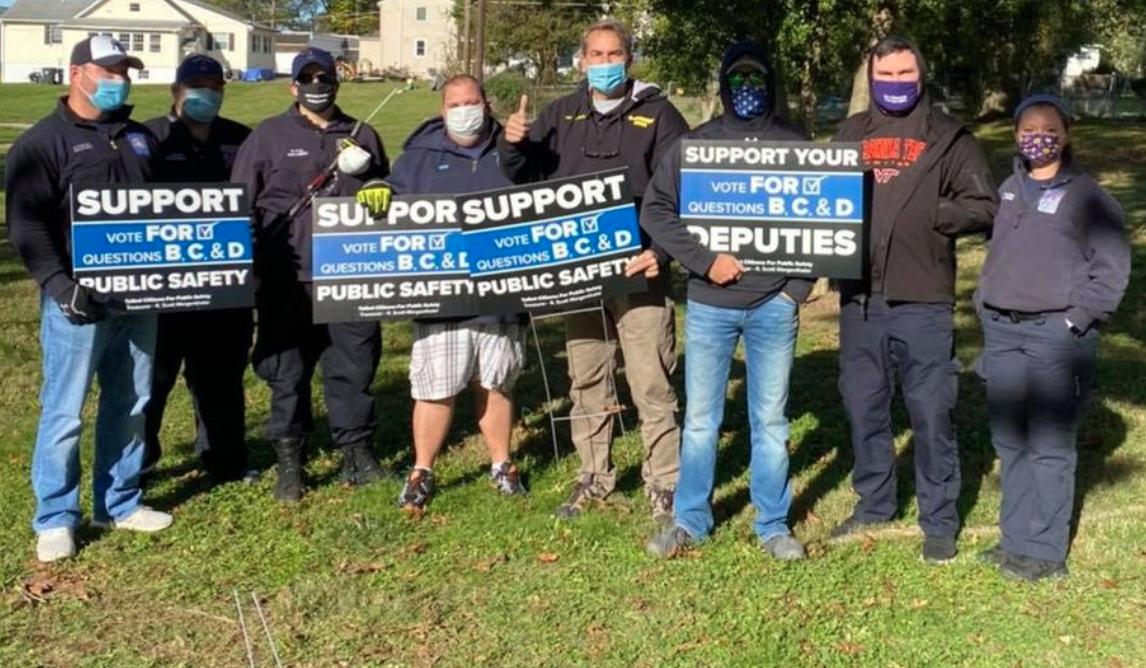
Talbot Citizens for Public Safety urged support for Questions B, C, and D.

Also lending support was the Talbot Citizens for Public Safety group and the local FOP lodge.

Those urging passage of Questions B, C, and D said additional funding was needed to support deputies, EMS crews, and other first responders.

Question B corrects inaccurate language in the tax cap; Question C eliminates a reference to CPI-U; and Question D allows the county council to temporarily increase the property tax rate above the revenue cap by up to one cent per $100 of assessed value for five years only.

A 2018 effort that included all three measures passed Tuesday in a single ballot question failed on a vote of 53.9% against and 46.1% for the charter amendment. One major difference in 2018 was an attempt to raise the allowed annual increase in revenue from 2% to 2.5%.

Following that failure, county officials created a committee to look at Talbot’s property tax revenue cap and make suggestions for changes.

Those suggestions included separating the three provisions into separate charter amendments over concerns that the 2018 ballot question had been too complicated.

The Spy Newspapers may periodically employ the assistance of artificial intelligence (AI) to enhance the clarity and accuracy of our content.

Filed Under: 2 News Homepage Tagged With: ballot question, charter amendment, county council, election, revenue, Talbot County, tax, tax cap

Talbot Voters Will Decide on Proposed Changes to Tax Cap

October 25, 2020 by John Griep

This video is about 17 minutes long.

Talbot voters will decide on two substantive changes to the county’s property tax revenue cap and a third measure that would correct faulty language in the current tax cap, which was approved by voters in 1996.

Talbot County Sheriff Joe Gamble and Emergency Services Director Clay Stamp have been leading the charge in seeking voter approval for the ballot questions.

The public safety officials say the existing cap has limited the county’s ability to attract and retain deputies, paramedics, and other first responders.

Salaries and benefits for first responders are lower than in surrounding counties, the two have said, making it difficult to find new hires for open positions and leading to trained staffers leaving for better compensation packages elsewhere.

The county also needs to build a new office for the sheriff’s office and the county health department, as well as provide an additional substation for paramedics, officials have noted.

Question B on the ballot for Talbot County voters is a charter amendment that would clarify how the county computes the property tax rate.

The current language, in Section 614 of the Talbot County Charter, identifies the properties included in the calculation as those “existing on the County real property tax rolls at the commencement of the County fiscal year.”

But that wording does not accurately reflect how the information is determined.

The county finance department actually uses the constant yield tax rate certification supplied by the state to determine the tax rate needed to comply with the tax cap.

Question B would amend the language to change it to those properties “included in the Constant Yield Tax Rate Certification prepared by the Maryland State Department of Assessments and Taxation.”

According to the League of Women Voters (LWV) analysis in the voters’ guide at vote411.org:

“A vote FOR the Charter amendment means the Talbot County Charter would be amended to clarify that the County would use the Constant Yield Tax Rate Certification supplied by the State when determining the property tax rate to be used in the new fiscal year.

“A vote AGAINST the Charter amendment means that the inaccurate wording would remain in the Charter.”

This video is about 20 minutes long.

Question C would amend the tax cap by eliminating a reference to the Consumer Price Index-Urban (CPI-U). The existing property tax revenue cap limits the annual increase in property tax revenues to 2% or CPI-U, whichever is less.

Question C would eliminate CPI-U, which in some years has been less than 2%, further restricting the county’s ability to increase revenues to fund needed services and capital projects.

Since the current tax cap took effect in 1997, the increase in property tax revenues has been limited below 2% during nine fiscal years (with an average increase of 1%) and has been limited to 2% during 15 fiscal years (when CPI-U increased an average 2.78%), according to the LWV voters guide.

“This means that nine times the revenue cap has kept pace with the yearly national rate of inflation, but it has also been less than the national rate of inflation 15 times,” according to the League of Women Voters. “This resulting constriction of tax revenue leaves the County with insufficient revenue to fund all of the budget requests from County departments. While County services have continued to be funded, funding has not addressed all of the needs of the County and has left County departments with unfunded needs. Eliminating the CPI-U alternative would help County services over the long term keep pace with fixed costs and growing needs.

“County salaries and benefits, especially for public safety and emergency services employees, are not competitive with surrounding counties causing Talbot County the loss of valuable, trained personnel to those jurisdictions. For example, Talbot County loses several deputies every year, and it costs the County $97,482 for the first year of a newly trained deputy.”

“A vote FOR the Charter amendment means the Talbot County Charter would be amended to eliminate the use of the CPI-U as an alternate to the 2% cap on tax revenue, leaving the cap on tax revenue at 2% going forward.

“A vote AGAINST the Charter amendment means that the CPI-U would continue as an alternate to the 2% cap on tax revenue.”

Question D would allow the county council to temporarily increase the property tax rate above the revenue cap by up to one cent per $100 of assessed value for five years only.

A one cent increase in the property tax rate would cost the owner of a home assessed at $250,000 an additional $25 annually; an additional $50 annually for the owner of a home assessed at $500,000.

Officials have pitched the one cent increase as a way for the county to catch up on lost revenue from the years when CPI-U limited the increase in revenue below 2% and as a way to help fund much-needed capital projects.

“Talbot County’s revenue cap is one of the most restrictive in the State of Maryland, making it extremely difficult for the County to raise sufficient revenue to fund certain initiatives, including key public safety projects, such as a new facility for the Talbot County Sheriff; additional equipment and personnel for the Talbot County Department of Emergency Services; and, a new facility to house the Talbot County Health Department,” according to the League of Women Voters.

In its voter guide, the LWV notes:

“The County Council is, therefore, asking the voters to give the Council authority to increase revenues above the revenue cap, but only temporarily and with a limit of up to one cent (1¢) per one hundred dollars of assessed value. The Charter Amendment would authorize the County Council to raise revenues above the revenue cap by up to one cent (1¢) per one hundred dollars of assessed value for five years only.

“Arguments in Favor: County tax revenues have not kept pace with the rise in County costs to fund the full functioning of all County departmental needs, nor to remain competitive with other counties in our region in attracting and retaining employees,” according to the League of Women Voters. “This means there are fewer dollars available to fund capital projects that this ballot question is meant to address.

“The ability to increase revenues temporarily above the revenue cap would allow the County Council to fund costs anticipated for near-future capital expenses, including the new Sheriff and Health Department buildings and equipment for emergency services. Any temporary rise in tax revenue above the cap would go toward these projects. Increasing revenue now would reduce the cost of borrowing money to fund these needs.

“Arguments Against: This measure is almost sure to be used by the County Council over the next five fiscal years resulting in property taxes that are higher than 2% over the previous year.

“A vote FOR the Charter amendment means the Talbot County Charter would be amended to allow the Council the option of generating revenues above the revenue cap by up to one cent (1¢) per $100 of assessed valuation for the next five fiscal years.

“A vote AGAINST the Charter amendment means that the Charter would not be amended to allow an exception to the cap on tax revenue beyond the limit specified in the Charter.

The Talbot County Democratic Central Committee supports passage of all three tax cap measures, noting on its website:

“Question B will have no impact on property tax rate. This is a technical fix to reflect the way the assessable tax base is determined in the original charter.

“Question C is a permanent change to the way revenue is calculated. We currently use the Urban CPI or 2% whichever is lower. The Urban CPI does not accurately reflect the needs of a rural county.

“Question D is urgent for 2021 Fiscal Year for the County. Based on our population growth, we need more ambulance crews. Currently we cannot guarantee the twenty-minute minimum response time for an ambulance will be met, especially in the north part of the County without a fourth ambulance. This provision would also allow for more competitive pay for first responders.

“This amendment would allow a temporary increase of one penny per hundred dollars of assessed property value. It will provide the funds we need to meet the public safety needs of our citizens. The cost would amount to an annual increase of $25 for a property valued at $250,000 or $50 for a property valued at $500,000.

“The increase ends in five years.”

The Spy Newspapers may periodically employ the assistance of artificial intelligence (AI) to enhance the clarity and accuracy of our content.

Filed Under: 2 News Homepage Tagged With: ballot questions, charter, clay stamp, election, Joe Gamble, league of women voters, property tax, revenue, Talbot, Talbot County, tax cap, voters guide

Citing Estimated $2.8B Revenue Loss, Hogan Freezes State Budgets, Hiring

April 12, 2020 by Maryland Matters

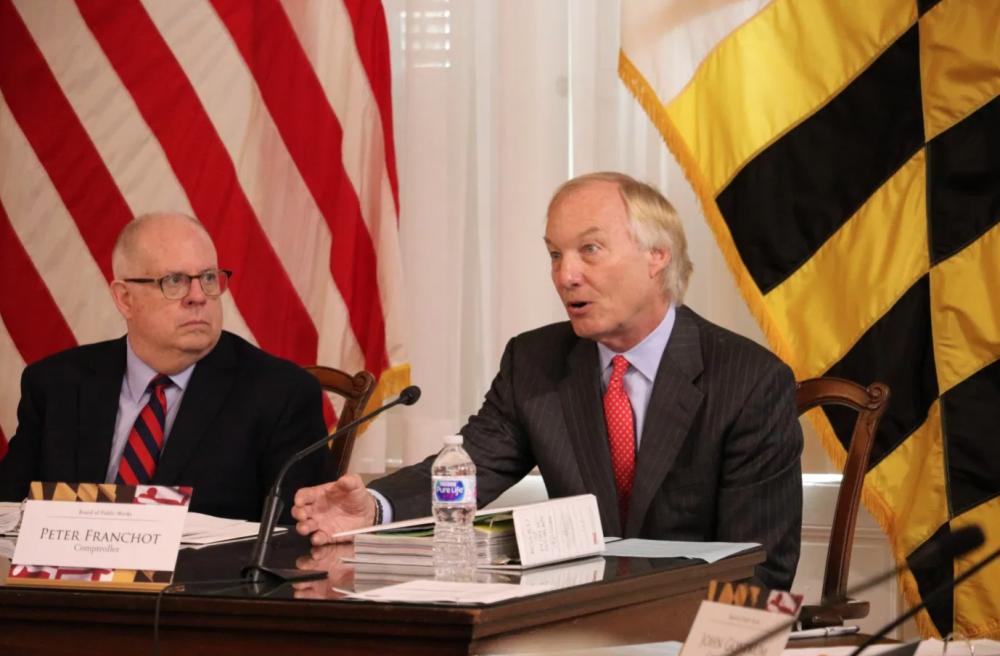
Budgets are frozen and new employees aren’t being hired, Gov. Lawrence J. Hogan Jr. (R) said Friday afternoon, moments after the state’s comptroller painted a grim picture of the Maryland’s financial future in light of dramatic revenue losses caused by the COVID-19 pandemic.

In the space of three months, state revenues are estimated to contract by about $2.8 billion, according to new estimates released Friday by Comptroller Peter V.R. Franchot (D) and the Bureau of Revenue Estimates.

Both income tax revenues and sales tax revenues are expected to fall by almost $1 billion before June 30, according to the new predictions. Other smaller pots of revenue, like lottery sales and court fees, have also contracted.

The losses since March and estimated through the end of June amount to about 15% of the state’s overall annual revenues.

The state has never before seen such a steep decline in revenues so close to the end of a fiscal year, officials said.

“The stay-at-home order as well as social distancing are absolutely creating the steepest economic nosedive in modern history,” Andrew Schaufele, director of Maryland’s Bureau of Revenue Estimates, said during a virtual news conference on Friday. “But in their absence, the final economic impacts would be far greater and playing out over a much longer period of time.”

The state will continue to meet payroll expenses and allow necessary increased spending to respond to the novel coronavirus, Hogan said. But his Department of Budget and Management will soon make recommendations for budget cuts, which will be required in all state agencies.

The state will also be tapping into and “spending much of, perhaps all of” the $6-billion-plus Rainy Day Fund to cope with revenue losses, Hogan said.

The state’s three-member Board of Public Works ― which includes Hogan, Franchot and Treasurer Nancy K. Kopp (D) ― is empowered to cut the state’s budget in real-time.

Franchot said the process of trimming the state’s budget by more than $1 billion during the Great Recession was likely easier than the fiscal stress the board will soon be forced to reckon with during the pandemic.

“That period, as awful as it was ― and it was just horrendously painful ― is going to be like a picnic compared to what we’re going to go through with this coronavirus impact on our state budget,” Franchot said.

Hogan noted that the fiscal estimates released Friday were a “worst-case” scenario that he hoped would not come to fruition.

“Hopefully we will not have to make the kind of cuts [the comptroller] was envisioning,” Hogan said later in the afternoon.

With much of the private sector shut down in Maryland to stop the spread of COVID-19, the state is grappling with never-before-seen figures when it comes to losses in tax revenue and employment.

In a matter of weeks, the state’s new unemployment filings have increased by nearly 5,200%, with more than 235,000 people filing new unemployment claims in just the last three weeks.

“We’ve never seen such a decline. Never,” Schaufele said.

By contrast, it took about 10 months during the Great Recession for the state to see 240,000 job losses.

Even with the sobering numbers, there are some things that may blunt the impact to Maryland’s economy.

While state income tax withholdings are expected to drop by 22%, Schaufele said it was a testament to the strength of the state’s workforce and close ties to the government that the number is not larger.

Maryland will see some financial relief from a federal stimulus package, about $4.9 billion, but that funding is generally intended to enhance safety net programs and cover new expenses, not backfill lost revenues.

The lost revenues and economic downturn will almost certainly have an impact on Democrats’ top priority this year ― a decade-long multi-billion-dollar effort to reform the state’s education system.

That bill, along with more than 650 others passed during the 2020 General Assembly session, were formally sent to Hogan’s office for consideration earlier this week. While his office has not yet reviewed the bills, Hogan said Friday “that it is very unlikely that any bills that require increased spending will be signed into law.”

In response, state Senate President Bill Ferguson (D-Baltimore City) agreed with Hogan that “we will be forced to make hard choices about priorities and values. COVID-19 has changed the world and it has changed Maryland.”

But without specifically referring to the Blueprint for Maryland’s Future, the ambitious education spending and reform plan that the legislature passed last month, Ferguson suggested that it would be wrong for state leaders not to look ahead and bolster the state’s education system.

“This crisis will end, and the cost of containing this crisis cannot be the foreclosure on hope for a better future,” Ferguson said. “Now, more than ever, our decisions about who we are and what we believe about every individual’s God-given potential must continue to be our guide.”

Public health will dictate ‘return to normalcy’

The estimated revenue losses released Friday assume that a stay-at-home order remains in place at least through June 30.

In recent interviews, Hogan and the state’s public health professionals have expressed reluctance to begin lifting social-distancing measures too early, fearing that could cause a new spike in the number of COVID-19 diagnoses in the state.

As of Friday morning, there were 6,968 confirmed coronavirus cases in the state, and 171 Marylanders have died since mid-March.

All officials have said advice from public health experts will dictate the end of measures intended to stop the spread of the virus.

“To be clear, the timeline and pace for when we return to normalcy should and must be dictated by our public health experts, and must be influenced by the health dangers this virus may continue to pose to our citizens,” Franchot said.

By Danielle E. Gaines

The Spy Newspapers may periodically employ the assistance of artificial intelligence (AI) to enhance the clarity and accuracy of our content.

Filed Under: Maryland News Tagged With: budget, Covid-19, Economy, franchot, Hogan, loss, Maryland, revenue

Fearing Possible Depression, Franchot Urges ‘Timeout’ on Tax Measures

March 14, 2020 by Maryland Matters

Maryland’s chief tax collector implored state lawmakers to delay action on revenue measures, saying that a looming recession — or worse — make this a dangerous time to add to the tax burden businesses and consumers face.

In an interview on Friday, Comptroller Peter V.R. Franchot (D) warned that Maryland faces not just a recession “but a possible depression” due to the spread of COVID-19. The expected downturn in economic activity triggered by the disease could take a 20% bite out of revenues this year, he predicted.

“This is precisely the wrong time to be imposing higher taxes on the state of Maryland’s business and/or individuals,” he said. “I can’t emphasize that enough.”

Franchot has sided with Gov. Lawrence J. Hogan Jr. (R) in opposing the Blueprint for Maryland’s Future, the bill that would advance the recommendations of the Kirwan Commission, a panel that spent years crafting ways to improve the state’s K-12 education system. In that respect, his opposition to Kirwan-related tax hikes is not particularly noteworthy. Hogan’s political Twitter accounts on Friday linked to articles containing Franchot’s recent warnings about taxes — a reminder of how frequently the governor’s and comptroller’s agendas are aligned.

But Franchot’s appeal to lawmakers appeared to go beyond earlier statements of opposition.

“Take a time out,” said Franchot, an already-announced candidate for governor in 2022. “Wait for a special session, or whatever, six months from now. Don’t pull the trigger right now. The world has changed in the last few days.”

University of Maryland economist Peter Morici said the severity of the drop in economic activity will depend on how long the virus lingers — and that two quarters of low or depressed economic growth is likely.

“I think his number of 20% is probably a responsible number, and just the mere delaying of revenues means the state has to borrow more,” said Morici. “We’re looking at a period of extended austerity, at least for this year and maybe into next, or this year into 2022. But I think his comments are very responsible given the uncertainty of this thing.”

Morici, who teaches economics at the University of Maryland’s Smith School of Business, called this “a very imprudent time to raise taxes.”

In the wake of Franchot’s warning and the uncertainty surrounding the COVID-19 outbreak, Kirwan backers signaled on Friday that they recognize the need to maintain flexibility in financing their education reform efforts.

“We’re having those conversations right now,” House Majority Leader Eric G. Luedtke (D-Montgomery) said. “A number of the revenue bills we’ve passed have delayed effective dates. They wouldn’t be effective until 2021.”

House Economic Matters Committee Chairman Dereck E. Davis (D-Prince George’s), whose jurisdiction stands to reap significant benefits from Kirwan, said the General Assembly isn’t “going to do anything reckless.”

“Speaker [Adrienne A.] Jones and [Appropriations Committee] Chairwoman [Maggie] McIntosh… are thinking about the same things that the comptroller is thinking about. This is, we trust, a temporary situation. Things are going to bounce back as soon as we can get through this crisis. Things will return to normal. And we can make minor adjustments in some of the timetables.”

Sean Johnson, the state teachers’ union’s chief legislative strategist, said financing Kirwan reforms “was always going to require a delicate balance and a multi-year approach.”

“Ultimately the most important thing for this session is for the Blueprint and a new funding formula to pass so our students get the support that they deserve,” he added.

On Thursday the state’s Board of Revenue Estimates chose not to update prior budget estimates for the current and next fiscal year, citing economic uncertainty due to the global pandemic.

To give business-owners time to grapple with the outbreak, the comptroller’s office has extended certain business tax filing deadlines until June 1. Franchot said he will also delay the April 15 tax-filing deadline for individuals an unspecified period, either in tandem with the IRS or, if necessary, on his own.

For the state’s treasury, that sets up a one-two punch — delayed revenues and lower-than-projected revenues.

“I’m in touch with businesses all around the state,” Franchot said. “They’re already saying the supply chain is getting choked off and they’re very concerned about being able to… survive this.”

“We’re waking up every day and the world has changed.”

By Bruce DePuyt

The Spy Newspapers may periodically employ the assistance of artificial intelligence (AI) to enhance the clarity and accuracy of our content.

Filed Under: Maryland News Tagged With: comptroller, depression, Maryland, recession, revenue

Report: State Lost Billions by Not Closing Corporate Loopholes

February 28, 2020 by Maryland Matters

A liberal-leaning think tank is pressing for passage of a series of revenue bills targeting business loopholes and tax breaks ― by looking back at what could have been.

The Maryland Center on Economic Policy released a memo on Thursday detailing $2.8 billion in revenue that could have been raised by their bill package if lawmakers had passed the measures last term.

The center, which produced the memo independently, is part of the Fair Funding Coalition, which is pressing for passage of 10 bills that they say would close corporate loopholes, end policies that benefit special interests and establish a more equitable income tax system in the state.

The goal of the proposals is to raise dedicated revenues to help the state cover the costs of Kirwan Commission education reform proposals, which could become substantially more expensive in coming weeks as lawmakers consider tweaks to relieve local spending mandates.

“We made it much harder on ourselves because we didn’t take these steps sooner,” said Benjamin Orr, executive director of the Center on Economic Policy.

The analysis found that eliminating pass-throughs in corporate tax reporting and implementing combined reporting for multi-state corporations could have generated more than $1.8 billion between 2014 and 2018.

The center also would have ended some businesses subsidies during that time period, amounting to $194 million.

Levying a 1% state surtax on capital gains would have generated $455 million, and closing the “carried interest loophole” by taxing income of investment fund managers at 17% ― instead of the lower capital gains tax rate ― could have generated $209 million.

Orr said he was still optimistic that lawmakers might pass one or more of the measures included in the analysis this legislative session. The bills, he said, would minimize impact on low- and moderate-income residents while, in cases like combined reporting, bring Maryland in line with the majority of other states.

Sen. Paul G. Pinsky (D-Prince George’s) has introduced a combined reporting bill for more than a decade.

“We would have had a hell of a lot of money,” Pinsky said, if his bill had been passed earlier.

He believes there’s still a chance that his bill and others could be part of a revenue package advanced this session, and that it makes sense to focus efforts to raise revenue for education reforms by focusing on businesses.

“I hear from some of these companies that say we have jobs, but we don’t have people to fill them. So I think there’s a nexus between them paying their fair share and investing in education, because they’re the ones who are going to take advantage of it,” Pinsky said. “We’re the ones preparing their future employees. I think it’s way past due.”

The Center on Economic Policy’s push for business tax reform has been boosted by Warren Deschenaux, who retired as the General Assembly’s long-serving top fiscal analyst in 2017.

On Thursday, he said it was critical that lawmakers increase state revenues not only to fund education reform, but also to address the state’s structural deficit.

“If you look at the outlook, things are rather grim ― and that’s before anything bad [like a recession] happens,” Deschenaux said.

The Fair Funding Coalition’s package of bills are just a small portion of an influx in revenue measures introduced this year, encompassing everything from sports betting to digital downloads and a recent proposal to dramatically expand the state’s sales tax to services.

A hearing on the sales tax proposal ― which sponsor Del. Eric G. Luedtke (D-Montgomery) has said could generate an additional $2.6 billion ― is expected to draw strident opposition from corners of the business community on Monday.

Orr said while the center has endorsed limited sales tax expansions for specific services in the past, it has not yet taken a position on the broader 2020 sales tax proposal.

“Our top priority remains closing loopholes and getting rid of tax breaks that only benefit special interests,” he said.

Deschenaux said the sales tax proposal could end up making the other proposed revenue bills more attractive to lawmakers in contrast.

“Some of those consumers are wealthy and they’re getting lawyer advice and having their taxes done,” he said of the proposed tax on services. “But a lot of those people are having their dry cleaning done, their cars repaired, and so forth. And so it reaches perhaps more broadly than one might prefer.”

by Danielle E. Gaines

The Spy Newspapers may periodically employ the assistance of artificial intelligence (AI) to enhance the clarity and accuracy of our content.

Filed Under: Maryland News Tagged With: business loopholes, Education, Kirwan, Maryland General Assembly, revenue, tax breaks

Copyright © 2026

Affiliated News

  • The Chestertown Spy
  • The Talbot Spy

Sections

  • Arts
  • Culture
  • Ecosystem
  • Education
  • Mid-Shore Health
  • Culture and Local Life
  • Shore Recovery
  • Spy Senior Nation

Spy Community Media

  • Subscribe
  • Contact Us
  • Advertising & Underwriting

Copyright © 2026 · Spy Community Media Child Theme on Genesis Framework · WordPress · Log in