
MENU

Sections

  • Home
  • About
    • Contact Us
    • Editors and Writers
    • Join our Mailing List
    • Letters to Editor Policy
    • Advertising & Underwriting
    • Code of Ethics
    • Privacy
    • Talbot Spy Terms of Use
  • Art and Design
  • Culture and Local Life
  • Public Affairs
    • Ecosystem
    • Education
    • Health
    • Senior Life
  • Community Opinion
  • Sign up for Free Subscription
  • Donate to the Talbot Spy
  • Cambridge Spy

More

  • Support the Spy
  • About Spy Community Media
  • Advertising with the Spy
  • Subscribe
December 9, 2025

Talbot Spy

Nonpartisan Education-based News for Talbot County Community

  • Home
  • About
    • Contact Us
    • Editors and Writers
    • Join our Mailing List
    • Letters to Editor Policy
    • Advertising & Underwriting
    • Code of Ethics
    • Privacy
    • Talbot Spy Terms of Use
  • Art and Design
  • Culture and Local Life
  • Public Affairs
    • Ecosystem
    • Education
    • Health
    • Senior Life
  • Community Opinion
  • Sign up for Free Subscription
  • Donate to the Talbot Spy
  • Cambridge Spy
News Maryland News

What Will We Know and When Will We Know it on Tuesday (Or Later)?

November 3, 2020 by Capital News Service

With record voter turnout, including a high volume of mail-in ballots, and mail delays expected, it is unclear whether we will know who the next president is on election night, experts say.

“I’ve been expecting the unexpected,” said Michael Hanmer, research director at the Center for American Politics and Citizenship, a nonpartisan research center at the University of Maryland, College Park. “I think that’s the best way to work through this because there’s so many different possibilities.”

However, Hanmer told Capital News Service it’s “pretty safe to say” that Democratic nominee Joe Biden is headed for a significant popular vote margin over President Donald Trump. But, similar to 2016, determining the next occupant of the Oval Office is going to come down to the Electoral College – and it’s possible this year that may not be settled until some days after Tuesday.

As of Friday morning, nearly 83.5 million early votes were already cast, of which nearly 54 million, or 64.6%, were mailed, according to the University of Florida’s United States Elections Project.

But in many states, including four of eight battleground states — Georgia, Michigan, Wisconsin and Pennsylvania — ballots are not allowed to be counted until Election Day.

Twenty-one states, plus the District of Columbia, accept ballots up to 17 days after Election Day. Of these, two are battleground states: Pennsylvania and North Carolina.

New York and Alaska, which accept mail-in ballots 7 and 10 days after Election Day, respectively, have said that they will not report “any mail votes on election night,” according to the New York Times.

In the battleground state of Michigan, Secretary of State Jocelyn Benson has estimated her count may be completed by Nov. 6, three days after Election Day. Pennsylvania, another battleground, may get the bulk of its votes tallied within a couple of days, according to Secretary of State Kathy Boockvar.

But the nation might not have to wait too long because “we’ll have a lot of information about a couple of really key states (on election night),” particularly Florida and Arizona, where mail-in ballots must be received by Election Day, Hanmer said.

“That might allow us to project forward what’s going to happen in a definitive way,” he said.

“I think really the only state that (Hilary) Clinton won (in 2016) that (Donald) Trump has a shot at is Nevada and it’s a relatively small number of electoral votes, so I don’t think Trump can win without Florida,” Hanmer he said.

While a Biden win in Florida would suggest that he’s going to win in both popular and electoral votes, turning Arizona blue would not make results as clear, according to Hanmer. If Biden gets Arizona, it can foreshadow a national victory by a huge margin or a close race determined by few electoral votes for either candidate, he said.

However, FiveThirtyEight’s presidential forecast predicts that if Biden wins Florida or Arizona, he has a 99% and 98% chance, respectively, for an Electoral College win.

Hanmer, who also is a government and politics professor at Maryland and an expert for MIT’s Election Data & Science Lab, expects that “we should know a good bit” about Georgia, which has an Election Day deadline for mail-in ballots, and North Carolina, as well.

While North Carolina accepts ballots after Election Day, the state has seen a high volume of early voting. FiveThirtyEight’s founder Nate Silver reported that “it’s expected that as much as 80% of the vote there can be announced shortly after polls close.”

If those go to Biden, Hanmer predicts that the country won’t “have to worry as much about what the count is going to be in some of the states that are processing late because I think that will largely solidify things in terms of us having a clear winner.”

If Biden wins Georgia, his chances for an electoral win is 99%, while grabbing North Carolina, pushes the probability over 99%, according to FiveThirtyEight’s presidential forecast.

In the case that Georgia and North Carolina do not go to Biden, Hanmer said “we might just have to wait until all the counting is done.” Then the results can “really hinge” on Pennsylvania, where “we’re just not going to have solid information on what the result is…for a while because they can’t count or process their ballots until very late,” he said.

Trump has repeatedly called for final results to be called on election night, in part due to his distrust in mail-in voting – even though he did it himself this year.

“Big problems and discrepancies with Mail In Ballots all over the USA. Must have final total on November 3rd,” he tweeted Monday night.

That kind of rhetoric is inappropriate, warned the National Council on Election Integrity, a bipartisan group of former elected officials.

“Our Constitution and our state election laws require us to count every vote, including legally cast absentee votes,” the council said in a statement Wednesday. “Because of an unprecedented number of absentee ballots this year, counting every vote is not likely to be concluded on election night. In some states, thorough vote counting can last weeks, even in the best of times.”

Almost half of returned mail ballots in 19 states that report party registration data, including Arizona, Florida, Pennsylvania and North Carolina, were from registered Democrats, according to the Elections Project. On the other hand, 60% of Trump supporters told the Pew Research Center in late summer that they would rather vote in person on Election Day.

On election night, this could mean that in states that report mail-in ballots first, initial results may favor Biden. In places that report in-person, day-of votes first, such as most parts of Virginia, Trump may seem to have the lead.

While this pattern in which ballots received post-election favor Democrats is well-established, Walter Shapiro, in an analysis for the Brennan Center for Justice, warns that the pandemic may disrupt this trend “since different demographic groups may be voting by mail.”

In key states, the Republican Party wants to prevent this “blue shift” while Democrats are relying on it. However, research reported by MIT News shows that historically, even “some of the biggest post-Election Day shifts” — the largest being 6.9% in 1968 towards George Wallace in Georgia — have not tipped the outcome of the election.

Yet both parties have fought over mail-in ballot deadlines in the Supreme Court, and such legal back-and-forth, which may continue after Election Day, could further delay results in critical states.

Last week, the Supreme Court denied the Pennsylvania Republican Party’s request to reject ballots if received after Election Day. In a 4-4 decision, the court ruled that the battleground state can accept ballots if received within three days after Election Day. After the party asked the court to reconsider the decision, the justices let their earlier ruling stand.

Also on Wednesday, the Supreme Court backed a lower-court ruling and similarly allowed North Carolina to accept mail-in ballots up to nine days after Election Day, extending the deadline to Nov. 12.

However, an attempt by Wisconsin Democrats to also extend the mail-in ballot deadline by three days to Nov. 6 was first accepted by a federal district court, but then blocked by an appeals court. The Supreme Court voted 5 to 3 on Monday to uphold the appeals court.

Another blow to Democrats came on Thursday when a federal appeals court struck down Minnesota’s plan to accept mail-in ballots up to seven days after election. The key state will now only be able to accept ballots received by 8 p.m. on Election Day.

While states can continue contesting mail-in ballot deadlines and bring them to the Supreme Court — which Hanmer told CNS wouldn’t be surprising — “the court sent a pretty strong signal that changing things now, given how deep we are into the process, is unlikely,” he said.

He predicts that legal challenges after the election are “more likely,” and so are anger, disbelief and protests from supporters on both sides.

“It seems very odd to say that about a presidential election in the United States, but there’s a lot of signals that suggests that large portions are not going to accept well the outcome either way,” Hanmer said.

“What people do about that, I think, is a big unknown,” he said. “But it’s something we have to prepare for.”

The National Council on Election Integrity counseled patience and trust: “Every ballot cast in accordance with applicable laws must be counted — that’s the American way. All Americans, including the presidential candidates themselves, have a patriotic duty to be patient as election officials count the votes. Both candidates have a responsibility to remind the country that November 3 is the last day for votes to be cast — not the last day for votes to be counted.”

By Kaanita Iyer
The Spy Newspapers may periodically employ the assistance of artificial intelligence (AI) to enhance the clarity and accuracy of our content.

Filed Under: Maryland News Tagged With: ballots, election, mail-in, results, turnout

Maryland Breaks State Record for Single-Day Early Voting Turnout

October 27, 2020 by Maryland Matters

More than 161,000 Marylanders cast their ballots during the first day of early voting, according to the State Board of Elections, setting what is believed to be a single-day record for early voting in the state.

The total surpassed the previous unofficial single-day early voting record of 143,494 set on the final day of early voting in the 2016 general election.

“We’re extremely pleased that Marylanders are turning out in record numbers to exercise their right to vote,” said Maryland State Board of Elections Administrator Linda Lamone. “Today’s record-setting total is in addition to the more than 1.6 million voters who requested a mail-in ballot and the roughly 830,000 who have already submitted them. We are equally pleased that nearly 1,000 people took advantage of same-day registration today in order to cast their ballots.”

By comparison, the 2016 election saw 123,623 voters on the first day of early voting, according to data from the State Board of Elections.

After Day 1 of Early Voting, More Than 1.1 Million Marylanders Have Cast Ballots

With Monday’s 161,000-plus votes combined with the 947,941 mail-in ballots returned so far, more than 1.1 million Marylanders already have voted in the presidential general election.

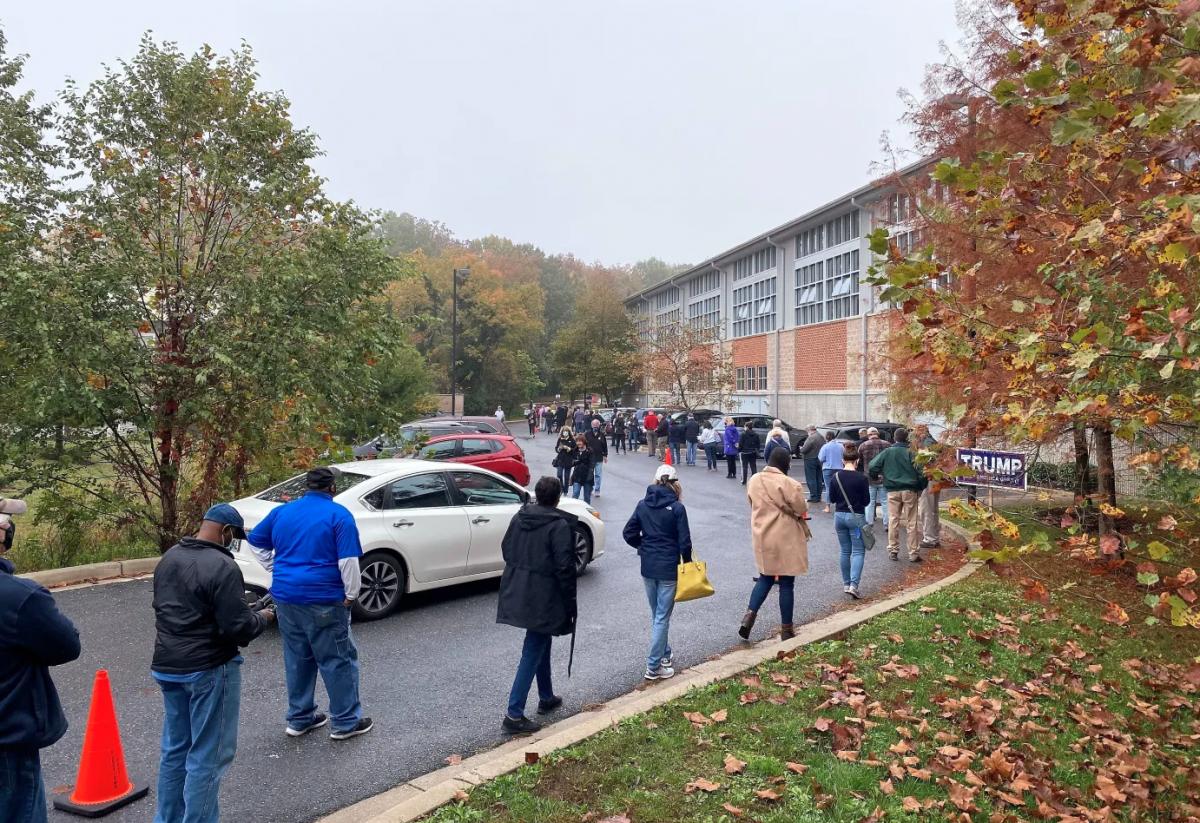
Voters waited for hours in lines at early voting centers across the state, with many lining up well before the state’s 81 early voting centers opened at 7 a.m. Monday morning. Some told Maryland Matters that worries over Postal Service delays and national rhetoric about mail-in ballots led them to vote in person.

The 2016 General Election saw a total turnout of just over 2.8 million voters. That figure includes Election Day, early voting, mail-in and provisional ballots. Advocates expect longer lines and even more voters at early voting centers going forward.

“We should expect even longer lines as we get closer to Election Day,” Common Cause Maryland Executive Director Joanne Antoine said on Monday.

Early voting will continue until Nov. 2. Voters can head to any early voting center in their jurisdiction. Those centers will be open from 7 a.m. to 8 p.m. daily, and will remain open as regular in-person voting centers on Election Day.

During the eight days of early voting, eligible voters may cast their ballots at any authorized early voting center in their jurisdiction of residence. A complete list of early voting centers is available here. Voters may also search here for early voting centers, Election Day voting centers and ballot drop box locations in their area simply by including their zip code.

For voters who missed the advance voter registration deadline, same-day registration will be available at early voting and Election Day vote centers. To prove their place of residence, Marylanders registering in person during early voting or on Election Day will need to bring their Motor Vehicle Administration-issued driver’s license, identification card or change of address card, or a paycheck, bank statement, utility bill or other government document that includes the voter’s name and new address.

“We encourage Marylanders who would like to vote in person to continue to take advantage of early voting,” Lamone said. “While many Marylanders have, and continue to, cast their votes using mail-in ballots, voting early is one way to reduce lines and limit wait times at vote centers. The best time to vote in person is on a weekday between 10 a.m. and 2 p.m.”

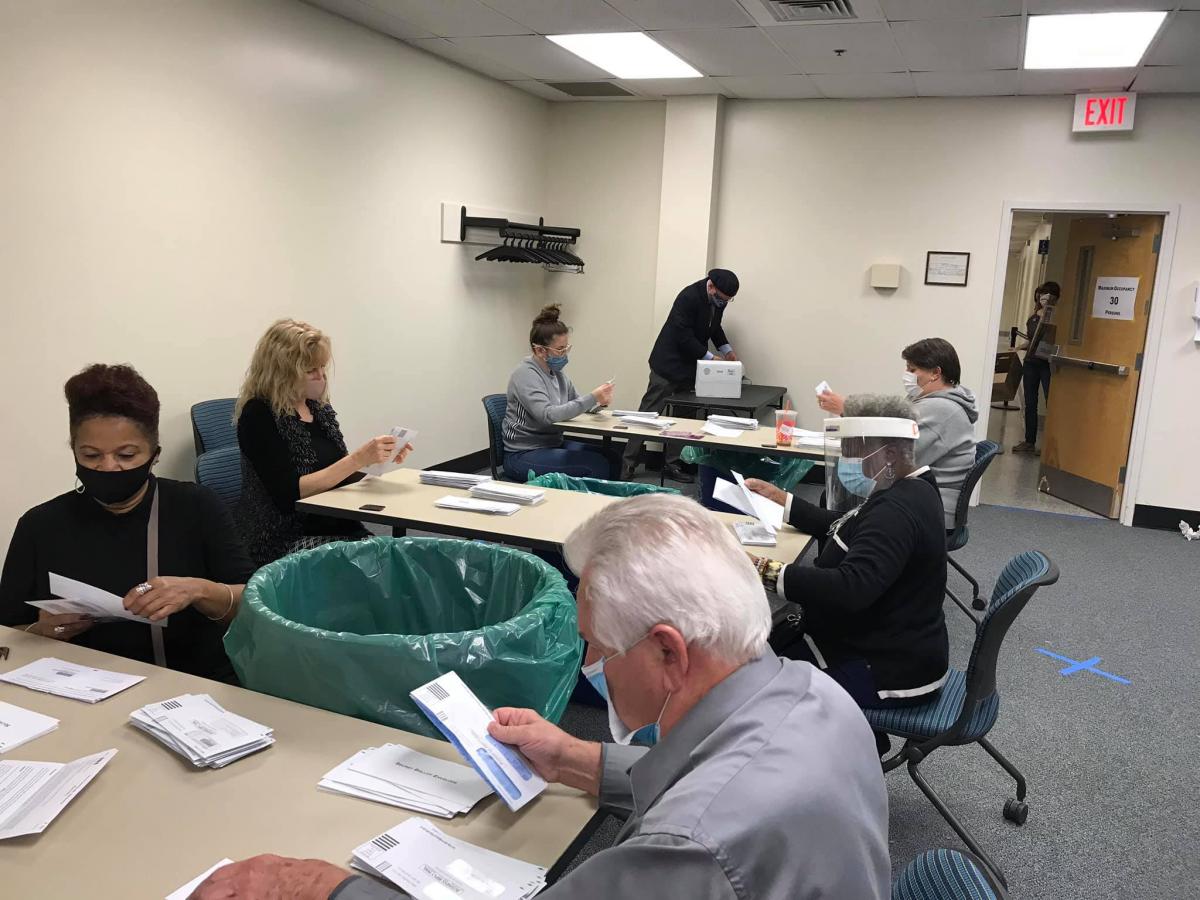
Voters who have already requested a ballot should vote the ballot they receive in the mail. Voters simply complete the ballot, sign the oath on the postage-paid return envelope that accompanies the ballot, seal the envelope and submit it by mail or at an approved ballot drop box location.

Voters may not “trade in” their mail-in ballot during early voting or on Election Day, nor can they scan their mail-in ballot at an in-person vote center. If a voter has already requested or received a mail-in ballot and wants to vote early, the voter will have to cast a provisional ballot. This ballot will be held until election officials confirm the voter did not also return a mail-in ballot. This process ensures only one ballot per voter is counted.

Voters may drop off a mail-in ballot at an early voting center, but the ballot must be properly sealed in the return envelope that accompanied the mail-in ballot. Voters must sign the oath on the return envelope in order for the ballot to be counted.

By Bennett Leckrone

The Spy Newspapers may periodically employ the assistance of artificial intelligence (AI) to enhance the clarity and accuracy of our content.

Filed Under: Maryland News Tagged With: ballots, early voting, election, Maryland, turnout, voting centers

Half of Cambridge Races Headed to Dec. 1 Run-off Elections

October 18, 2020 by John Griep

Mayor, Ward 2, Ward 3 choices will be narrowed to two

Preliminary results released Saturday night in the Cambridge city election show two clear winners in the six races. Three races will be decided in Dec. 1 run-off elections.

In the mayoral race, incumbent Victoria Jackson-Stanley leads with 40.59% of the vote.

With more than two candidates in the race, a candidate needed to have more than 50 percent of the vote to win during the Oct. 17 election. Otherwise, the top two candidates will face voters again on Dec. 1.

Preliminary results in the Oct. 17 Cambridge municipal election are seen in this printout. City of Cambridge Facebook post

Jackson-Stanley will face Andrew Bradshaw on Dec. 1. Bradshaw had 27.83% of the vote in the mayoral race, followed by 19.22% for La-Shon Banks-Foster, and 12.35% for Robert S. Larimer.

In Ward 1, Brian Roche had 61.55% of the vote and has won the seat in the first round of voting. Sharon B. Smith had 26.84% and Tom Bradley had 11.61%.

Incumbent Ward 2 Commissioner Donald Sydnor (39.16%) will face challenger Lajan Natasha Cepas (29.92%) on Dec. 1. They were trailed by Paul F. Baiers Jr. (16.87%) and Tyzann Meekins (14.06%).

In the Ward 3 race, Gary T. Gordy (39.28%) will move on to the Dec. 1 election, but his likely opponent is too close to call. Jameson Harrington had 30.57% of the vote in the preliminary Oct. 17 count, while Duane Farrow had 30.15%.

The Ward 4 race also is too close to call. Sputty Cephas is leading with 51.14% of the vote to 48.86% for incumbent Dave Cannon.

An earlier count, posted to Facebook by mayoral candidate Robert S. Larimer, had Cannon at 50.10% and Cephas at 49.90%. The timestamp on the preliminary results from the voting machine posted by Larimer was 11:11 p.m.; the timestamp on the results posted by the city was 11:33 p.m.

Chad Malkus ran unopposed in Ward 5 and was elected commissioner for that ward.

Cambridge officials, in a Saturday night Facebook post, said the results will be certified at 10 a.m. Monday.

The city also noted that 2,939 people voted in the mayoral race and 2,787 in the five commissioner races, more than tripling the turnout from the 2016 city election.

The Spy Newspapers may periodically employ the assistance of artificial intelligence (AI) to enhance the clarity and accuracy of our content.

Filed Under: 2 News Homepage Tagged With: Cambridge, commissioner, election, mayor, run-off, turnout, wards

Copyright © 2025

Affiliated News

  • The Chestertown Spy
  • The Talbot Spy

Sections

  • Arts
  • Culture
  • Ecosystem
  • Education
  • Mid-Shore Health
  • Culture and Local Life
  • Shore Recovery
  • Spy Senior Nation

Spy Community Media

  • Subscribe
  • Contact Us
  • Advertising & Underwriting

Copyright © 2025 · Spy Community Media Child Theme on Genesis Framework · WordPress · Log in