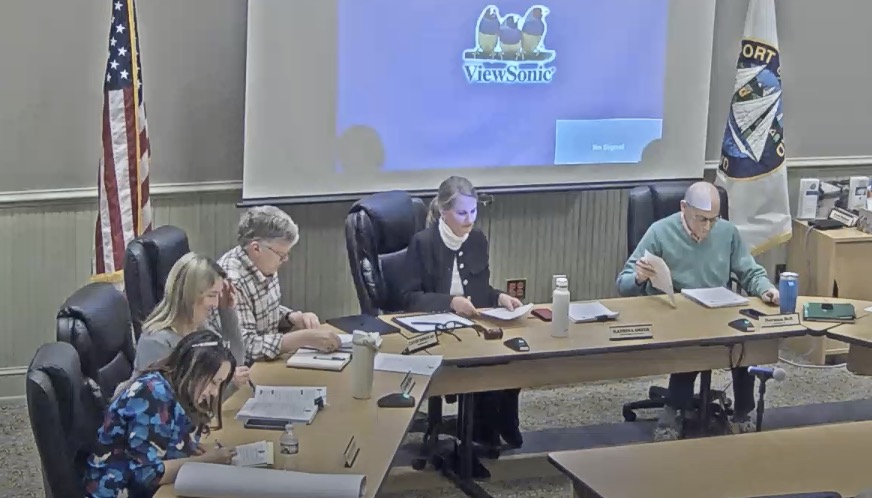


The Oxford Town Commission last night took formal action to oppose two housing bills moving through the Maryland General Assembly that town officials believe would dramatically weaken local control over development.
Senate Bill 36 and House Bill 548 are part of a statewide push to increase housing production. But in a small, built-out waterfront town like Oxford, commissioners made clear they see the measures as a direct threat to home rule.
“This takes away home rule,” Commission President Katrina Greer said bluntly during the discussion. “It takes away our judgment.”
The legislation, as written, would preempt local governments from regulating certain lot sizes, setbacks, and lot coverage limits. In some cases, setbacks between neighboring homes could be capped at five feet. The bills would also require municipalities to permit townhouses where single-family homes are permitted and would allow property owners to subdivide existing single-family lots into up to three lots.
Town Attorney Lyndsey Ryan explained that while historic districts designated before July 2025 may be exempt, large portions of Oxford outside the historic district could still be affected. She also noted that House Bill 548 would significantly change vesting rules, allowing building permits to remain valid for up to five years rather than expiring if work does not begin within six months, as is currently the case in Oxford.
“That’s a pretty substantial change,” Ryan said.
Town Manager Holly Wahl outlined the practical implications. She told commissioners the bills could alter how Oxford regulates exterior dimensions, lot coverage, and setbacks, and potentially affect how the town applies critical area, floodplain, and shoreline protections.
Earlier in the day, the Planning Commission had met to review the legislation and expressed concern that the bills could conflict with Oxford’s comprehensive plan and its emphasis on resilience and flood mitigation.
Commissioner Norm Bell pointed to the setback language as particularly troubling. “Five feet,” he said, emphasizing how narrow that distance would be in an already tight town.
The broader state effort aims to add 100,000 housing units across Maryland. Under preliminary estimates, Oxford’s share could amount to roughly twenty units over five years.
Commissioners made it clear they are not opposed to housing in principle. But they object to mandates imposed from Annapolis that override local decision-making.
Commissioner Dave Donovan said the town should actively oppose the legislation. “I’d be happy to move in favor of doing whatever we can to stop this,” he said before making the motion. The vote to oppose the bills and begin lobbying efforts was unanimous.
Greer urged residents to contact their state representatives. “Chris Adams is on the committee hearing this,” she noted, encouraging citizens to call and express their views.
As Greer framed it, the question is simple: who decides how Oxford grows — Oxford, or Annapolis?

Write a Letter to the Editor on this Article
We encourage readers to offer their point of view on this article by submitting the following form. Editing is sometimes necessary and is done at the discretion of the editorial staff.