

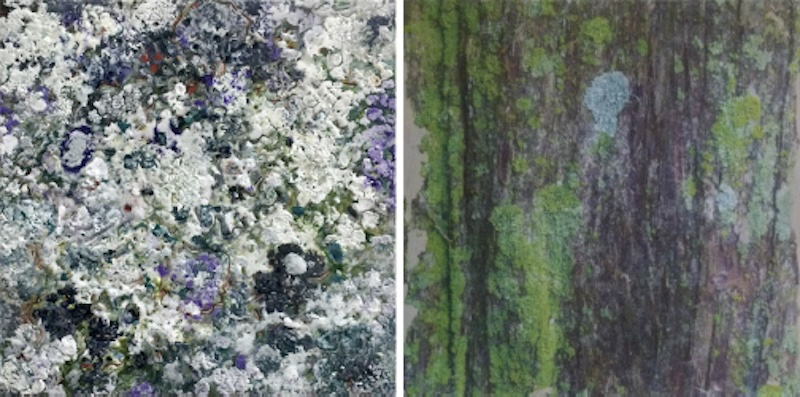
(Le ) Snow Lichen by Marilyn Banner, encaus c on wood. (Right) Tree Hugger (Cedar, Indiantown Landing, Chester River) by Mary McCoy, acrylic and photo transfer on wood.
Enticing in their intricacy and variety, the lichens in Symbiosis, an exhibition of small paintings by artists Marilyn Banner and Mary McCoy, are like miniature landscapes full of color and textures.
Accompanied by McCoy’s poems about lichens, the show is on view in the (Left) Snow Lichen by Marilyn Banner, encaustic on wood. (Right) Tree Hugger (Cedar, Indiantown Landing, Chester River) by Mary McCoy, acrylic and photo transfer on wood. Arboretum’s Visitor’s Center Art Gallery from January 6 through February 27. There will be a public reception on Saturday, January 10 from 2 to 4 p.m., to meet the artists.
Friends and colleagues for over 40 years, the two artists have exhibited their work together in galleries across the Mid-Atlantic region. Banner, who lives in Takoma Park, is an encaustic artist, while McCoy, an artist, writer and longtime volunteer on the Arboretum’s art committee, is from Centreville. During an email conversation in 2020, they were surprised to learn that each of them was making small paintings of lichens. Both had been taking closeup photographs of lichens for many years, at home and while traveling, and had independently begun using them as source materials.
Composite organisms formed by a symbiotic relationship of fungi and algae or cyanobacteria, lichens grow on outdoor surfaces on every continent. The first colonizers of naked rock, they begin the process of breaking stone down into soil allowing moss and small plants to begin to grow, ultimately creating an ecosystem where plants and animals can flourish.
“Lichens are ancient,” Banner said. “They model symbiosis, the mutual energy exchange that sustains life and growth.” McCoy said, “I’ve been taking photos of lichens on stones, trees, even on my kayaks for years, but it was when I was in Iceland for a conference that I was amazed by the lichens growing on bare volcanic rock. Somehow, they were managing to live out there in this incredibly bleak, cold, windswept environment.”
Black and white lichens growing on an alley wall in Barcelona first sparked Banner’s interest. Struck by the animated patterns of their spreading growth, she began to find lichens everywhere, especially on her walks during the pandemic, and soon was painting them with encaustics, an art medium dating back 2,500 years in which mixture of pigment, beeswax, and damar resin is painted on in many layers creating a lush, translucent effect.
“Encaustic is for me the perfect medium for painting lichen,” Banner said. “I respond strongly to texture, especially in nature. Encaustic is made of ‘nature,’ i.e. beeswax and damar. It has a ‘feel’ to it, a kind of magic for me. I can push, pull, touch, scrape, dig, carve, melt, reshape—all the physical ‘hand’ stuff I like to do.”
The artist’s hand is also highly evident in McCoy’s works, in which she used gestural strokes of acrylic medium to paint directly into photo transfers of her lichen shots. “I wanted to work with my photos of lichens in ways that would highlight their complexity and fragility and how they seem animated, full of energy, even though they grow very, very slowly,” she explained.
Several of McCoy’s poems about lichens are interspersed with the paintings. Curious about the qualities and characteristics of lichens and how they benefit life on earth, she began reading about them and took a workshop on lichens at the Arboretum.
“The more I learned about them, the more I was impressed at how primary they are to life on earth,” she said. “I think initially both Marilyn and I were just kind of enchanted by their beauty and intricacy, but it turns out they also play an essential role in soil formation, carbon sequestration and oxygen production, as well as being early indicators of air pollution.”
In choosing the title Symbiosis for their show, the two artists hope to convey the most important lesson they’ve gleaned from their focus on lichens—that these organisms survive and thrive through cooperation, embodying our growing realization that the driving force of life on earth is not competition but interdependence.
A 400-acre native garden and preserve, Adkins Arboretum provides exceptional experiences in nature to promote environmental stewardship.

Write a Letter to the Editor on this Article
We encourage readers to offer their point of view on this article by submitting the following form. Editing is sometimes necessary and is done at the discretion of the editorial staff.