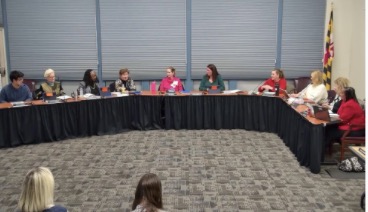


The Talbot County Board of Education received an update on Wednesday on the district’s ongoing grading policy review, a months-long effort involving teachers, administrators, parents, and community members.
Robin Werner, Director of Teaching and Learning for Talbot County Public Schools, outlined the structure and progress of the committee’s work. The grading committee was formed to review current practices and determine whether changes are needed to better reflect student learning.
The group was divided into elementary and secondary subcommittees to address grade-level differences.
At the elementary level, members focused on a central question: what should grades communicate about student learning? Marissa Carter, math coach at St. Michaels and Tilghman Elementary, said the discussion repeatedly returned to that theme as members reviewed report cards, grade-level transitions, and grading systems used in other Maryland districts.
The elementary team examined traditional letter grades, standards-based grading on a 1–4 scale aligned with academic standards, and competency-based grading models that group related skills. After identifying strengths and challenges in the current system, the group drafted preliminary recommendations to improve clarity and alignment across pre-K through fifth grade.
The secondary subcommittee conducted a similar review. Bethany Haas, a seventh- and eighth-grade science teacher, said the group studied four commonly used grading approaches: standards-based grading, a four-point scale, competency-based grading, and minimum score grading. Members analyzed current-quarter data and discussed how grading criteria, reassessment policies, and grade modifications are applied in practice.
Based on that research, the secondary group began developing a proposed hybrid model that integrates elements of multiple systems.
Joanna Robinson, International Student and Family Liaison for TCPS, described the process as collaborative and research-based, with participants representing multiple perspectives across the district.
The committee is now preparing to reconvene as a full group to review a final draft proposal. That draft will be shared with additional stakeholder groups, including equity and advisory committees, before being presented to the board later this spring.
Final recommendations are expected to come before the Board of Education in April or May, with any approved changes to be implemented in the 2026–27 school year.

Write a Letter to the Editor on this Article
We encourage readers to offer their point of view on this article by submitting the following form. Editing is sometimes necessary and is done at the discretion of the editorial staff.