

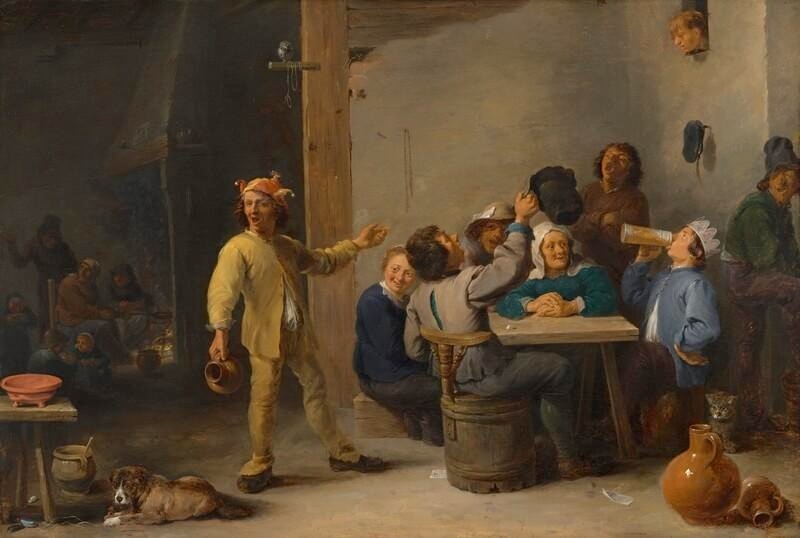
David Teniers the Younger, Peasants Celebrating Twelfth Night, 1635, oil on panel, 47.2 x 69.9 cm (18 9/16 x 27 1/2 in.)National Gallery of Art, Washington, DC, Ailsa Mellon Bruce Fund, 1972.10.1
Some years ago, I wrote a book on the celebration of the Feast of Epiphany, or Twelfth Night, known as Driekoningen in Dutch (published by the Royal Academy, Amsterdam, https://a.co/d/gUTfVdO.
This holiday on January 6th or the evening before is hardly celebrated in church (except in the Greek Orthodox Church), but traditionally — and mostly in Roman Catholic countries — it was celebrated by all classes with a festive meal at which friends and family gathered to eat, drink, and be merry.
Driekoningen (Three Kings) originated with reenactments of the biblical story of three kings or magi from the East who pay homage to the newborn Christ, thought to have happened twelve days after Christmas, hence the term “Twelfth Night.” Coincidentally, Shakespeare’s play Twelfth Night, written c. 1601–1602 as a Twelfth Night entertainment, contrasts the world of servants with the world of the nobility, all set against the backdrop of the Twelfth Night celebration.
In 17th century Holland and Flanders, Twelfth Night continued to be celebrated in homes and taverns, as seen in Teniers’s painting in the National Gallery of Art. At the feast, the king can be recognized by his paper crown on the right. He raises his tankard while his court, including the jester, salute him with shouts of “the king drinks!”
Many still today may recall from childhood, that the king was chosen by finding a bean in the “beancake.” Others may recall going from door to door singing songs for candy or pennies. The genre theme of Twelfth Night was popular as a rowdy scene in old master paintings and still admired today.
Anke Van Wagenberg, PhD, is Senior Curator & Head of International Collaborations at the American Federation of Arts in New York and lives in Talbot County, MD.

James Wilson says
Thank you for this informative piece.