

Happy Mystery Monday! Can you guess what is pictured in photo #1?

The answer to last week’s mystery is the green heron, Butorides virescens, pictured in photo #2.
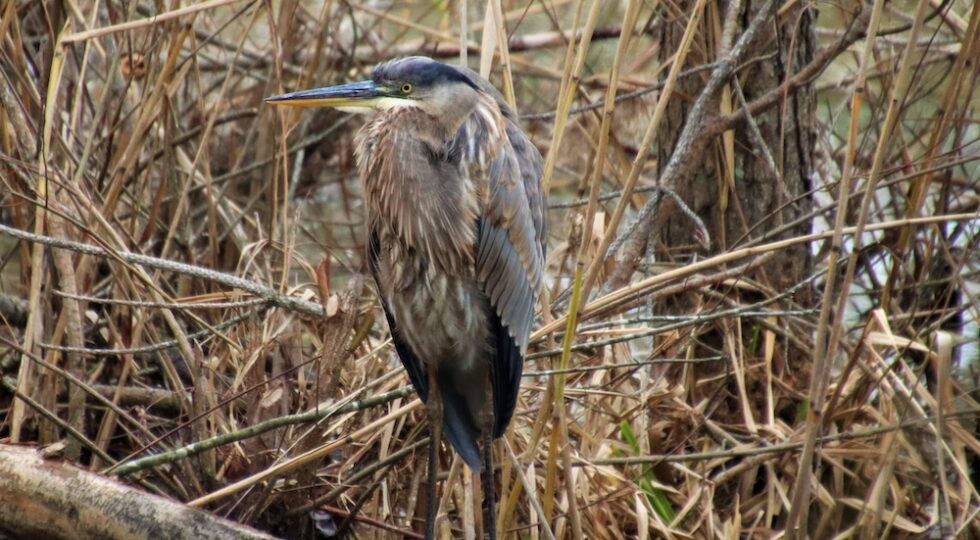
The green heron, Butorides virescens, is a small, stocky heron found throughout the eastern United States and along the West Coast. It breeds widely across Maryland, often perching hunched on low branches above wetlands. Up close, its greenish back, chestnut-striped neck, and yellow legs give it a striking look, though in flight its slow wingbeats and tailless, crowlike silhouette make it easy to overlook. Its sharp “skeow!”” call often announces it before you ever see it.
Green herons are famous for their intelligence, as well as for being one of the few bird species known to use tools. They drop feathers, insects, or even discarded bread into the water to lure fish within striking distance of their dagger-like bill. One determined bird was documented dropping its bait more than two dozen times until a fish finally took it. Their diet is diverse: fish, crustaceans, spiders, snails, amphibians, reptiles, and even rodents, and they will dive headfirst into deeper water when necessary. Green herons can be spotted at the Arboretum wetland from time to time.
During breeding season, pairs nest along both freshwater and coastal habitats, sometimes surprisingly far — up to half a mile — from water. They raise three to five chicks, which can climb trees at just a week or two old using their wings and beaks. Although still considered common, green heron populations have declined by more than 50% since the 1960s, reminding us how much these clever wetland hunters rely on healthy aquatic ecosystems.
Mystery Monday is sponsored by the Spy Newspapers and Adkins Arboretum.

Samantha McCall says
Ilex verticillata