

The National Gallery of Art (NGA) in Washington DC is one of the world’s finest museums. The collection contains works from the early Italian Renaissance through contemporary art. Masterpieces in the NGA will be the subject of a series of articles during 2026.
The NGA collection of early Renaissance art is one of the best in the world. Here are some examples.
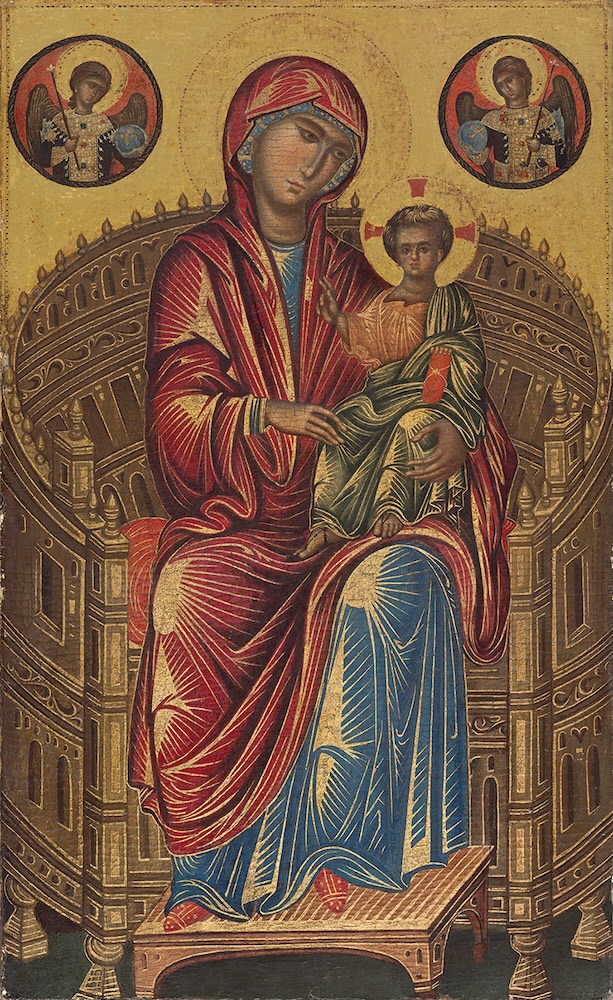
“Enthroned Madonna and Child” (1260-80)
“Enthroned Madonna and Child” (1260-80) (32’’x20’’), one of the oldest paintings in the museum, is an excellent example of the Byzantine style. The subject is the Hodegetria Madonna ”one who shows the way.” Mary looks at, points to, and presents her son, and the Christ child raises his hand in blessing. The image is believed to be similar to a painting of Mary and the Christ child attributed to St Luke. They are seated on a gilded wood throne that is set in a golden heavenly space and surrounded by archangels. Byzantine images of Mary were called Theotokos (Mother of God). The Byzantine emperors sent hundreds of these icons to Christian Europe. The icons also were exported as luxury items.
Icons were regarded as written, not painted. The icon painter went through several levels of spiritual preparation, including prayer, fasting, and meditation, because he was opening a window to Heaven. God was the true artist. The image was purposefully slanted earthward as if coming from Heaven to the viewer. The icon painter had no thought of perspective that would take the viewer into an earthly world. The bodies of the subjects were clothed with gold shot drapery in elaborate patterns. Faces and hands were repainted to appear more natural after the Italian painters began to depict physical reality.
What inspired Italian Renaissance artists to think beyond the then current Byzantine icon? The Roman Catholic Church had venerated Mary since the 3rd Century, and the Edict of Milan (313 CE) permitted the worship of Mary. During the Middle Ages, Mary’s image was softened as she was accorded the role of intercessor next to Christ at the Last Judgment. New churches built in the Middle Ages were named after the Virgin Mary.
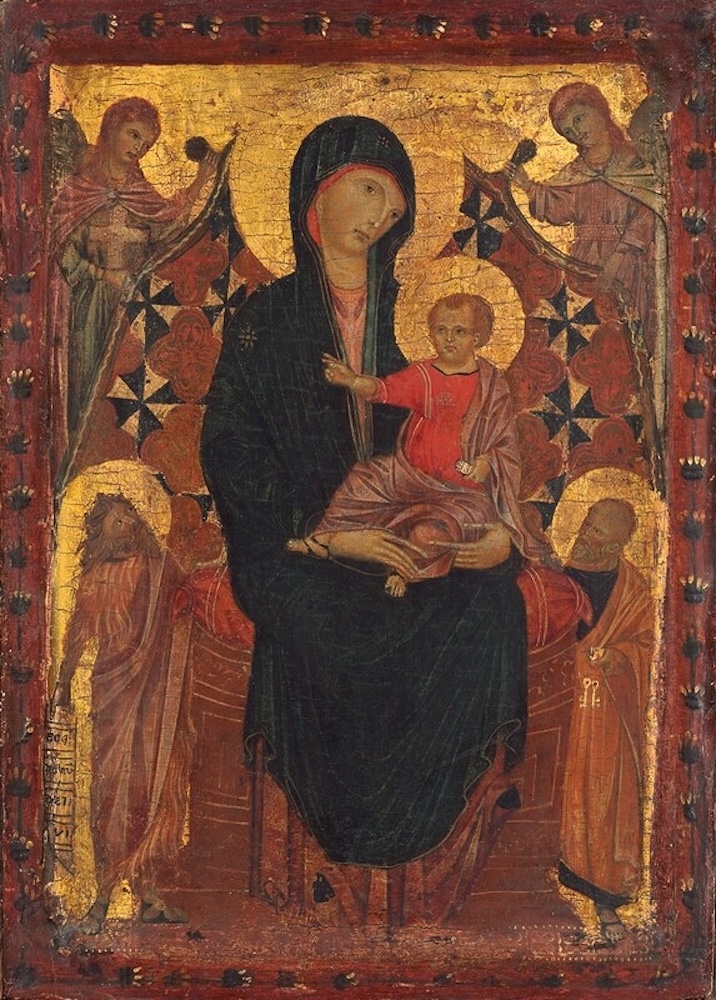
“Madonna and Child” (1290)
The NGA’s “Madonna and Child” (1290) (13.5”x10”) is thought to be by Cimabue (Cenni de Pepi, c.1240-1302). He was the first major Florentine painter to depart from the Byzantine model. In this work he maintains the Byzantine pose, but Mary’s hands hold the Christ child on her lap, not pointing to him. She appears to be looking at the viewer. The gold shot drapery is replaced by Mary’s dark blue robe with its many folds. Christ’s yellowish robe has brown folds. Gold is used sparingly on halos and in the heavenly background, perhaps as a cost saving measure. The small size of the work suggests it was a private devotional piece.
The back of the small throne, covered with black and yellow fabric and red designs, is held by two Archangels. Standing at the right side of the icon is the gray-haired and bearded St Peter, holding the gold keys to the Kingdom of Heaven. John the Baptist, with wild hair and a hair suit, stands at the left of the icon. Cimabue gave John’s face a fierce look. More natural colors for faces and hands are used, poses and proportions are more accurately depicted. Flesh tones were difficult to produce. Several layers of thin tempera paint were applied beginning with green and then covered with red. This combination of paint was used to produce a light brown color, as close to flesh as possible. As a result of many cleanings over the centuries, the greenish tinge has become more pronounced in the subjects’ flesh. Their eyes, noses, and mouths appear skewed because artists had not yet been able to create three-dimensional images.
The painted frame contains chains of white daisies. Traditionally the white daisy is a symbol of the Virgin Mary’s purity, and the “day’s eye” of faith.
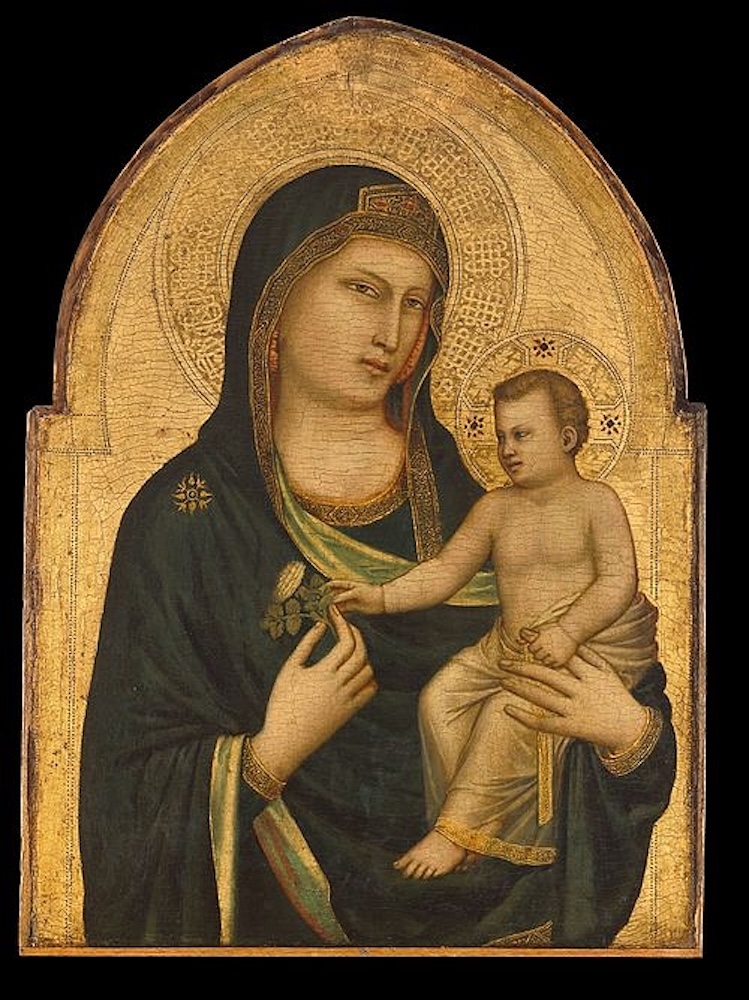
“Madonna and Child” (1320-30)
“Madonna and Child” (1320-30) (24”x24’’) was painted by Giotto di Bondone (c.1267-1337). Giotto of Florence was described by his contemporary Giovonni Villani as “the most sovereign master of painting in his time, who drew all his figures and their postures according to nature.” Giorgio Vasari (1511-1547), the first art historian, wrote in Lives of the Most Excellent Painters, Sculptors, and Architects (1550) that Giotto invented “the great art of painting as we know it today, introducing the technique of drawing accurately from life, which had been neglected for more than two hundred years.”
A student of Cimabue, Giotto was able to achieve greater realism in his painting. Gentleness of mother and child replaces the earlier imperial image. Drapery folds naturally over their bodies. Shadows are used to define the dimensionality of faces and hands, although definition of muscle is still to be perfected. Giotto has not mastered correct perspective; the positions of the eyes, noses, and mouths are not yet correct.
Mary looks at the viewer. The Christ child looks at the rose. Mary was called the rose without thorns because of her virginity. The rose was deemed the most beautiful flower in the Garden of Eden and represented God’s love and Christ’s death in order to take away the sins of the world. Mary was believed to have had the knowledge of Christ’s destiny when he was born, as he did. In reaching toward the rose, he accepted his role.
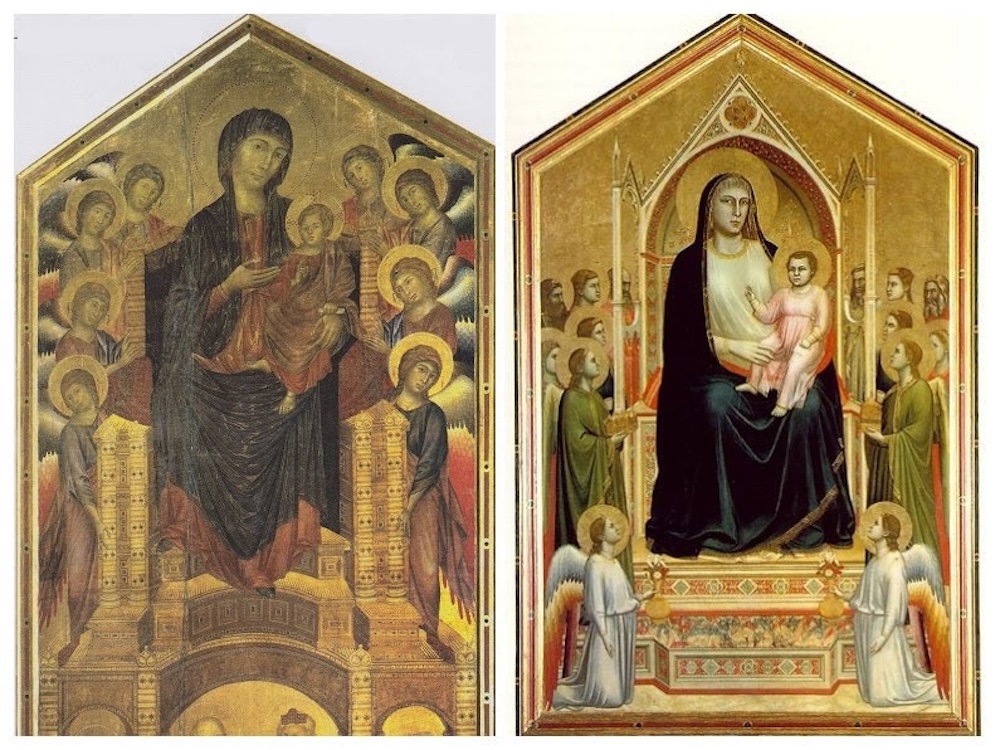
Comparing the work of Cimabue and Giotto
Both paintings are in the Uffizi museum in Florence. Cimabue’s “Madonna and Child” (1288-1292) (12.6’x7.3’) is on the left, and Giotto’s “Madonna and Child” (1306-1310) (10.8’x6.8’) is on the right. Both were church altarpieces. Both still contain a golden background, representing the light of Heaven, but the physicality of the figures in Giotto’s work was a giant step forward in the Italian Renaissance.
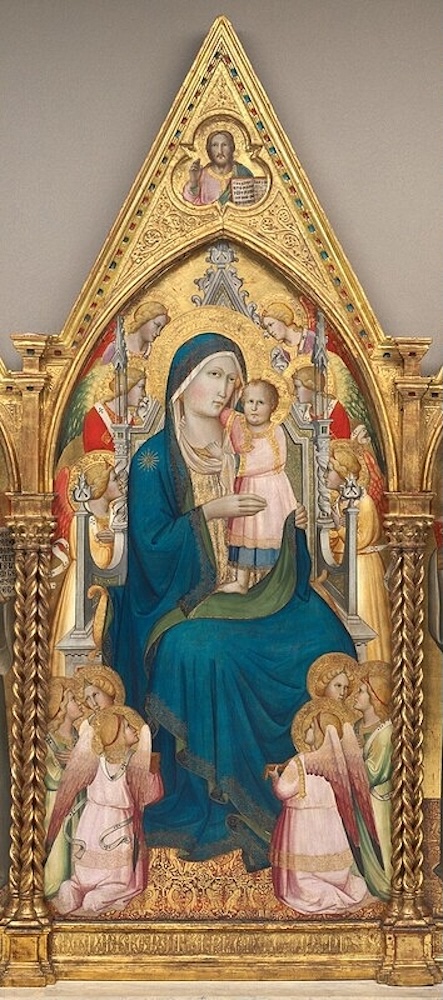
“Madonna and Child with Saints Andrew, Benedict, Bernard, Catherine of Alexandria and Angels” (c.1387) (center panel)
“Madonna and Child with Saints Andrew, Benedict, Bernard, Catherine of Alexandria and Angels” (c.1387) (central panel, 81”x32”) was painted by Agnolo Gaddi (c.1350-1396). He was the son of Taddeo Gaddi, an important pupil of Giotto. Agnolo was the most popular painter in Florence until the end of the 14th Century. His work takes realism as far as it will go. Both figures look at the viewer with calm expressions. Christ holds on to Mary’s robe with one hand and wraps his arm around her neck. He is not a baby in face or body. Artists could not paint babies until the 15th Century. The belief that Christ was born all-knowing, and physically capable, was often depicted in paintings. Mary holds the child, but she does not present or support him. He stands on his own. One of Gaddi’s best achievements is the well-developed folds of her gown which define her body and give her weight.
The imperial throne continues to be used as a backdrop. Her feet are placed on steps carpeted in gold. Groups of angels kneel at her feet, and others appear at either side of her throne. The angels do not stand on the ground, but then they can levitate.
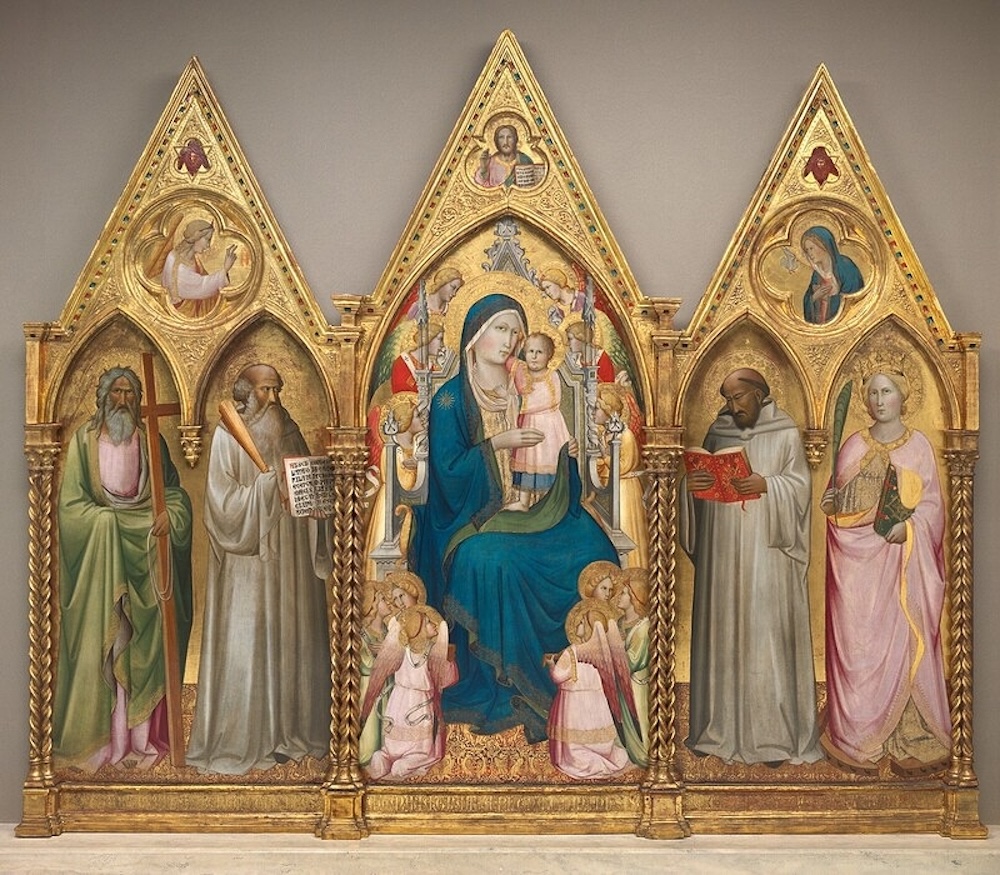
#6 “Madonna and Child with Saints Andrew, Benedict, Bernard, Catherine of Alexandria and Angels” (c.1387) (left and right panels)
The “Madonna and Child with Saint Andrew, Benedict, Bernard, Catherine of Alexandria and Angels” (left and right panels, 78”x32”) demonstrates Gaddi’s abilities to paint figures that have human proportions and mass. Robes flow realistically over their bodies. Each figure has been given a different physical description. Their faces, including the women, appear to be similar. At the left, the elderly St Andrew holds a cross and rope. He was not nailed to the cross but was bound by rope. St Benedict, the father of Western monasteries, holds the Book of St Benedict. At the right, St Bernard of Clairvaux, the Abbot of the Cistercians, holds one of his several writings that revitalized the Cistercian Order. Last is St Catherine of Alexandria, standing on the spiked wheel, symbol of her martyrdom. She holds a Martyr’s palm. Above the saints, angels in a Gothic quatrefoil offer a blessing. Above them in trefoils are Seraphim, the six-winged fiery ones. Seraphim protect the Trinity of Father, Son, and Holy Ghost, in the trefoil over Mary’s head. The elaborate gilded frame, part of the commission, was designed by the artist and executed by his carpenters.
The thought, attention to detail, and diligence brought to the creation of the work was and remains remarkable. The next step occurred in Florence in c.1415, when architect Filippo Brunelleshi discovered a mathematical system to create a three-dimensional look on a two-dimensional surface. \
Beverly Hall Smith was a professor of art history for 40 years. Since retiring to Chestertown with her husband Kurt in 2014, she has taught art history classes at WC-ALL and the Institute of Adult Learning, Centreville. An artist, she sometimes exhibits work at River Arts. She also paints sets for the Garfield Theater in Chestertown.

Joyce Stambaugh says
Thank you for sharing this magnificent collection of art.
James Wilson says
I especially enjoyed the info about icons. And … “Theotokos”, or “God-Bearer” (Mother of God).