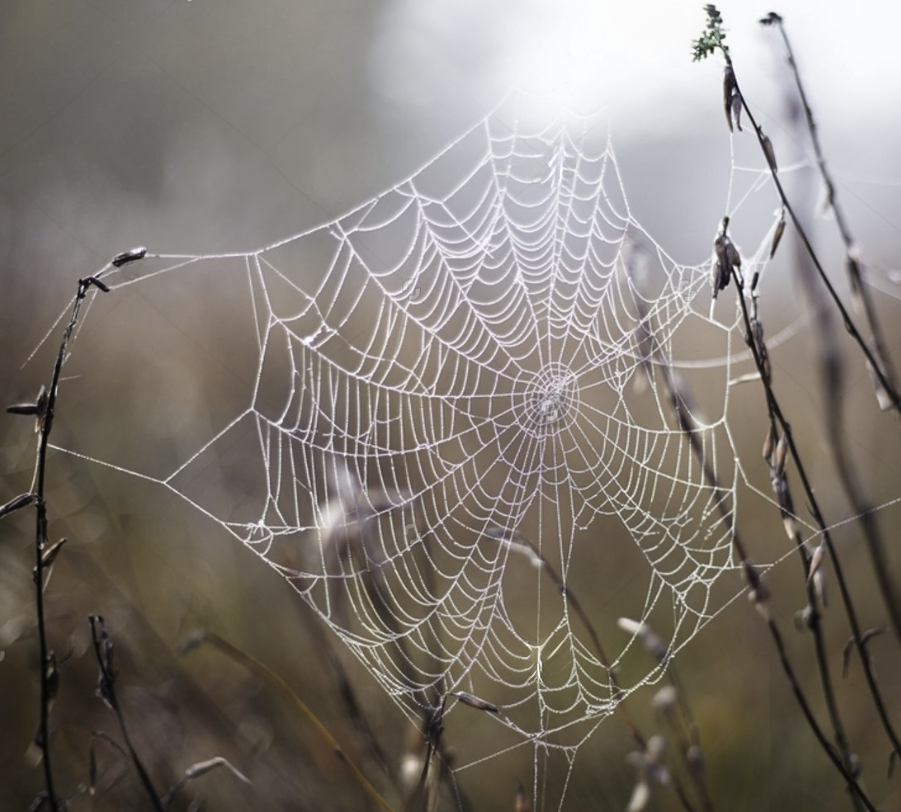


Editor’s Note: I fell in love with this poem on first reading it. Its simple yet evocative language, the subtle shift in significance and meaning of the word dust, and the unforgettable image of the spider, touched by sunlight, stepping lightly through the accumulations of her wind-blown ruins, as Wright advises us to do.
The Journey
Anghiari is medieval, a sleeve sloping down
A steep hill, suddenly sweeping out
To the edge of a cliff, and dwindling.
But far up the mountain, behind the town,
We too were swept out, out by the wind,
Alone with the Tuscan grass.
Wind had been blowing across the hills
For days, and everything now was graying gold
With dust, everything we saw, even
Some small children scampering along a road,
Twittering Italian to a small caged bird.
We sat beside them to rest in some brushwood,
And I leaned down to rinse the dust from my face.
I found the spider web there, whose hinges
Reeled heavily and crazily with the dust,
Whole mounds and cemeteries of it, sagging
And scattering shadows among shells and wings.
And then she stepped into the center of air
Slender and fastidious, the golden hair
Of daylight along her shoulders, she poised there,
While ruins crumbled on every side of her.
Free of the dust, as though a moment before
She had stepped inside the earth, to bathe herself.
I gazed, close to her, till at last she stepped
Away in her own good time.
Many men
Have searched all over Tuscany and never found
What I found there, the heart of the light
Itself shelled and leaved, balancing
On filaments themselves falling. The secret
Of this journey is to let the wind
Blow its dust all over your body,
To let it go on blowing, to step lightly, lightly
All the way through your ruins, and not to lose
Any sleep over the dead, who surely
Will bury their own, don’t worry.
James Arlington Wright was born on December 13, 1927, in Martins Ferry, Ohio. His father worked for fifty years at a glass factory, and his mother left school at fourteen to work in a laundry; neither attended school beyond the eighth grade. The poverty and human suffering Wright witnessed as a child profoundly influenced his writing, and he used his poetry as a mode to discuss his political and social concerns. He modeled his work after that of Thomas Hardy and Robert Frost, whose engagement with profound human issues and emotions he admired. Wright’s books include The Green Wall (Yale University Press, 1957), winner of the Yale Series of Younger Poets Award, Saint Judas (Wesleyan University Press, 1959), and The Branch Will Not Break (Wesleyan University Press, 1963). Wright was elected a fellow of the Academy of American Poets in 1971, and, the following year, his Collected Poems (Wesleyan University Press) received the Pulitzer Prize in Poetry. “The Journey” is from Above the River: The Complete Poems and Selected Prose. Copyright © 1990 by Anne Wright.

Write a Letter to the Editor on this Article
We encourage readers to offer their point of view on this article by submitting the following form. Editing is sometimes necessary and is done at the discretion of the editorial staff.