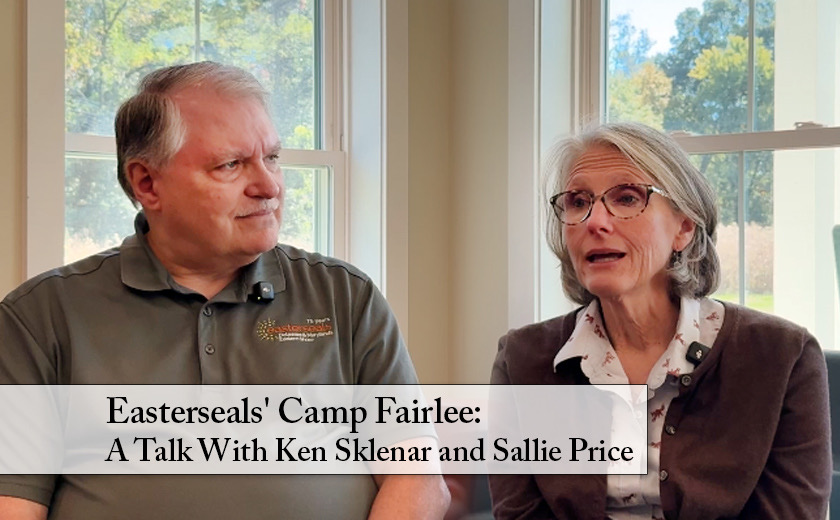


For nearly seven decades, Camp Fairlee has stood as one of the most vital and inclusive spaces on the Eastern Shore — a place where children, adults, and seniors with disabilities experience independence, friendship, outdoor adventure, and the deep confidence that comes from being seen and supported. Operated by Easterseals Delaware & Maryland’s Eastern Shore, the camp, near Rock Hall, remains a rare constant in a field where programs often come and go. And its home, the historic Fairlee Manor, carries a story as remarkable as the mission it now serves.
Ken Sklenar, president and CEO of Easterseals Delaware and Maryland’s Eastern Shore, has led this affiliate for the past 13 years, bringing with him over three decades of experience across the Easterseals network nationwide. His journey to leadership was rooted in a simple motivation: to see the mission in action.
“I get the opportunity every day to see the great work that we’re doing,” he said. “To interact with participants, to see the progress they make… that’s what it’s all about for me.” His decades with Easterseals have given him a front-row view of the organization’s evolution. “Easterseals today versus 10, 15, 30 years ago is a very different organization. We adjust our programs based on the science of supporting people with disabilities, and on what’s truly beneficial.”
That evolution began long before Sklenar arrived. Easterseals itself was born from the effort to care for children with polio in the early 20th century. After World War II, as thousands of young service members returned home with disabilities, the organization expanded to serve adults as well. Today, Easterseals is a network of 70 affiliates nationwide. Remarkably, the Delaware–Eastern Shore affiliate is one of the largest despite serving a region with a relatively small population. “That says a lot about our community,” Sklenar notes. “We continue to grow because we meet real needs.”
Sallie Price, director of Camp Fairlee, still speaks of camp with the awe of someone whose entire life reshaped around the experience.
“I worked one summer at Kentucky Easterseals as a college student,” she recalled. “It changed my life. I realized everybody should have the opportunity to go to camp, not just able-bodied or privileged people.”
That summer became the start of a vocation. Price now oversees a year-round operation that serves campers from age six into their eighties. For many, camp is not just recreation — it is their vacation, the week they plan for all year long.
Registration begins in October because preparation takes months. “Families wait for our application,” Price said. “They plan their summer around our schedule.”
Each year, the camp recruits a full seasonal workforce: caregivers, lifeguards, chefs, housekeepers, dishwashers, program specialists, nurses, and international counselors who live at the camp for three months. Staff receive eight days of intensive training before the first camper arrives.
Camp Fairlee supports participants with a wide range of abilities and medical needs. To ensure accessibility, staffing is tailored to each camper, from one-to-one assistance for people needing help with bathing, dressing, or feeding, to more independent groups operating at two-to-one or three-to-one ratios. Campers include individuals with autism, Down syndrome, cerebral palsy, brain injuries, and other physical or developmental disabilities.
They work, go to school, drive, attend day programs, and at Camp Fairlee, they paddle canoes, fish, swim, make pottery, sing around campfires, and try things they’ve never tried before.
“It’s independence, it’s confidence — that’s what camp gives,” Price said. “And it’s for everyone.”
Beyond the summer season, the camp offers weekend respite programs, rentals to mission and church groups, and year-round support services.
Like many disability-service organizations nationwide, Easterseals faces its greatest challenge in staffing. The shortage of nurses, therapists, and direct support professionals, worsened by the pandemic, continues to affect organizations everywhere.
“We’re playing catch-up as a country,” Sklenar said. “People retired or left the field during COVID, and it’s been very challenging to rebuild the workforce.”
Yet Camp Fairlee continues to attract staff who step into the work with purpose. Price asks each applicant the same question: What makes you jump out of bed in the morning?
One young woman recently answered, with all the clarity of her 18 years: “I want to help people.”
“For me,” she said, “that’s everything.”
The camp’s setting, Fairlee Manor, is itself a piece of Kent County history. The 263-acre property, part of a 1,900-acre tract laid out in 1674, includes the early 19th-century Fairlee Manor House, an unusual five-part brick-and-plank dwelling listed on the National Register of Historic Places. Built primarily between 1825 and 1840, the house reflects architectural techniques rarely seen in Maryland, including mortised plank wings and symmetrical telescoping extensions.
In 1953, philanthropist Louisa d’A Carpenter donated the farm to Easterseals, establishing a legacy of adaptive reuse that continues to benefit thousands of families.
“The house is preserved through an adaptive use that makes an important contribution to helping the handicapped,” notes its National Register documentation. Camp Fairlee remains a living example of how history can be honored not by freezing it, but by allowing it to serve.
Sklenar emphasizes that Easterseals wants every resident of the region to understand one simple truth: anyone, at any point in life, may need their services.
“We are a great resource for the communities we serve,” he said. “We want everyone to know who we are, because if they ever need us, we’ll be here, and if we can’t provide what they need, we’ll help them find it.”
To find out more about Camp Fairlee and Easterseals of Delaware go here.
This video is approximately ten minutes in length.

Write a Letter to the Editor on this Article
We encourage readers to offer their point of view on this article by submitting the following form. Editing is sometimes necessary and is done at the discretion of the editorial staff.