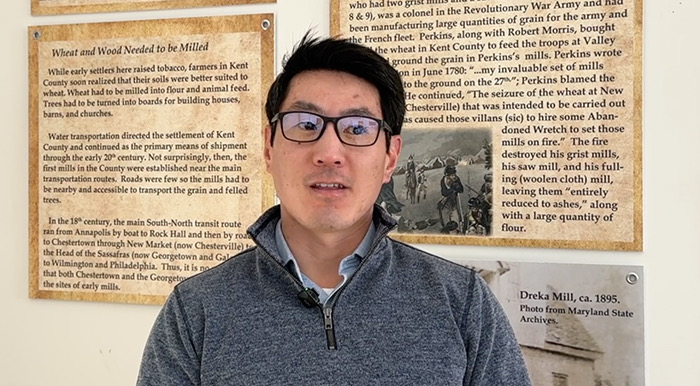


For Scott Budden, protecting Eastern Shore waterways is both professional and personal. The Chestertown native and new executive director of ShoreRivers grew up along the rivers he now works to restore.
“I grew up in Chestertown and wanted to see water quality improvements in the rivers that I grew up on,” Budden said during a recent Spy interview.
After graduating from Kent County Public Schools and attending college in Pennsylvania, Budden began his career in Washington, D.C., first working with a congressional nonprofit coalition focused on adoption issues. He later joined The Atlantic, working on the business side during a period when the magazine was working to achieve financial stability.
“After the two years I was there, we were actually breaking even,” Budden said. “That was a nice feeling to be part of a team that helped achieve that.”
Budden then spent more than six years at a global consulting and federal contracting firm, gaining experience in corporate finance and working closely with government agencies. But in 2015, he returned home to launch Orchard Point Oyster Company, an aquaculture business that has grown into a nationally distributed brand.
While the company represented an entrepreneurial opportunity, Budden said it was also driven by environmental goals.
“What we’re doing every day is actually making a difference in terms of habitat creation and water filtration,” he said.
His involvement in aquaculture led him to volunteer with the Chester River Association, one of the organizations that later merged to form ShoreRivers. He joined the ShoreRivers board shortly after the 2018 merger and now steps into leadership at a time when environmental nonprofits face complex challenges.
“We’re operating in an environment where funding is not guaranteed,” Budden said. “We fight hard to protect environmental funding because we view clean water as a fundamental right. There are public health implications besides the economic and altruistic reasons.”
Budden said ShoreRivers has remained stable despite shifting political and funding landscapes, crediting careful fiscal management and strong partnerships with state agencies, conservation organizations, and institutions including Washington College.
He noted that environmental restoration work is becoming increasingly complex as earlier conservation efforts have already addressed many easier pollution reductions.
“A lot of the low-hanging fruit has been picked,” Budden said. “As we look ahead with advances in technology and better science, we need to continue our mission in new and different ways.”
Community involvement remains central to ShoreRivers’ work. Budden encourages residents to volunteer through educational programs, advocacy initiatives, restoration projects, and tree-planting efforts. The organization also offers internship opportunities for high school and college students interested in environmental careers.
Budden said residents frequently ask about the overall health of local waterways. While challenges remain, he pointed to measurable progress in recent years.
“We have seen some improvement,” he said. “The oyster population has rebounded, and underwater grasses have started to return in areas where they hadn’t been seen in years. It’s not accidental. It’s the result of intentional effort.”
Still, he emphasizes patience and long-term commitment.
“It’s not a dramatic overnight change. It’s going to take decades of work. But that’s why we’re in this game.”
This video is approximately thirteen minutes in length.
***
See the events page here: https://www.shorerivers.org/events

Write a Letter to the Editor on this Article
We encourage readers to offer their point of view on this article by submitting the following form. Editing is sometimes necessary and is done at the discretion of the editorial staff.