

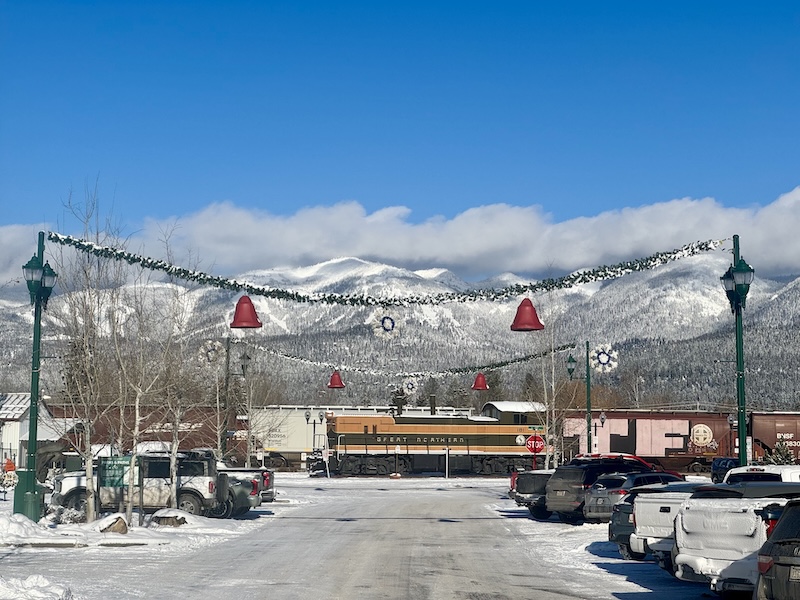
Deep in the northwest corner of Montana, Whitefish is the gateway to the jagged peaks, lakes, and glacier-carved valleys of one of America’s most pristine treasures: Glacier National Park. The town of Whitefish and its eponymous ski resort lie just west of the Continental Divide on what was once the shared ancestral hunting grounds of three Native American tribes: the Kutenai, the Bitterroot Salish, and the Pend d’Oreilles. Trappers and traders crisscrossed this remote wilderness beginning in the middle of the 19th Century, but it was the logging industry that made the country literally go BOOM in the the 1890s. And when the Great Northern Railway found a gentler route through the mountains in 1904, Whitefish—then known as Stumptown—became a new dot on the map of the American West.
This is our clan’s second visit to Whitefish. We came last year, liked it, and so now here we are, back again, “only” twenty-four of us this time, scattered among two rented houses and the local ski lodge. Twenty-three of us are out on the slopes today despite a thermometer that reported the local temperature was -2. (Insert freezing emoji here.) Me? I’m in front of the crackling fire in the great room of the lodge with my computer, a book, and my cup of black coffee. Couldn’t be happier!
It wasn’t easy getting here. In our parcel of the party, there were seven sleepy adults and seven excited kids (age range four-to-twelve) on a 4am flight to Minneapolis, a two-hour lay over there, then another three hour flight to Kalispell, Montana. You can imagine all the ski bags, checked luggage, carry-ons with stuffed animals and all manner of winter weather gear, but we made it without losing anyone or anything. I think. And by the way, a great big shoutout to all those kind and hard-working Somali folk in the MSP Airport; that place could not function without you!
Two days ago, when we arrived in Whitefish, postcard snow was gently falling, but today, the sun is shining although it’s still bitterly cold. The skiers don’t seem to care; they’re up and out as early as the chaos allows. All bundled up, it’s difficult to tell who belongs to whom, but some innate parental instinct kicks in and off they all go. I pour myself another cup of coffee and throw another log on the fire. I’ll admit that up here in the lodge, I’m once-removed from all that chaos of skis and boots, helmets and googles, but, as I’ve said before, I’m an excellent vicarious skier and prefer to listen to everyone’s adventures over our evening meal. Plus, it’s warmer here and I’m not likely to hurt myself or anyone else, for that matter.
So, here we are, three generations, separate branches on a boisterous family tree: wild and free on the mountain, cozy and close around the dinner table. There is an ebb and flow to life here, a few tears but plenty of joy and memories that will last lifetimes. Yes, I may be once-removed from the maelstrom, but then someone has to write this postcard.
Wish you were here.
I’ll be right back.
Jamie Kirkpatrick is a writer and photographer who lives on both sides of the Chesapeake Bay. His editorials and reviews have appeared in the Washington Post, the Baltimore Sun, the Philadelphia Inquirer, the Pittsburgh Post-Gazette, the Washington College Alumni Magazine, and American Cowboy Magazine. His most recent novel, “The Tales of Bismuth; Dispatches from Palestine, 1945-1948” explores the origins of the Arab-Israeli conflict. It is available on Amazon and in local bookstores. His newest novel, “The People Game,” is scheduled for publication in February, 2026. (It’s available for pre-order now on Amazon.) His website is musingjamie.net.

Bishop Joel Marcus Johnson says
Thanks for this. When my Gotlander maternal grandparents arrived in America in 1906, their first home was in Whitefish. As there were not enough Swedes for my grandfather’s medical practice, they moved to Fargo via James Jerome Hill’s Great Northern Empire Builder, its more recent orange and black diesel in your photo. Sixty years later, that train would take me to my next life at The University of Chicago.
Matt LaMotte says
It’s just as beautiful out there during Spring, Summer and Fall as well. Great fishing, too. A number of Montanans these days are East and West Coast transplants, so they can be kind of NIMBYish; which isn’t all bad. And, overall, most Montanans are friendly and accomodating.
Eugenie B Drayton says
Looks like Whitefish has changed at least at first glance!