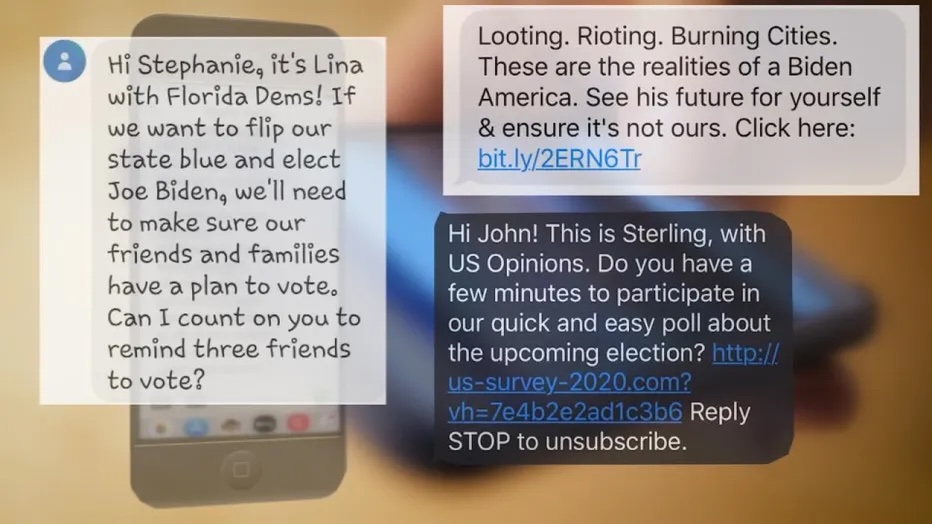


There are about eight months until Maryland’s Congressional general election. Before long, we’ll all be flooded with robocalls, polling results, texts asking for donations, podcasts, and campaign commercials.
Most of us will find it impossible to absorb all the information in them. We’ll be left confused and overwhelmed, struggling in the whitewater of conflicting messages. Which ones are factual evidence and which are propaganda? Campaigns count on confusion. They hope that we will support their candidate if they repeat their simple talking points often and loudly enough.
What defenses do we have against the sensory overload? How can we make rational decisions about the candidates in the face of this firehose of outside influences?
This essay builds on my previous column, “Prove It,” in which I said, “When we discuss politics with people from opposing camps, can we acknowledge to ourselves and each other when we feel or believe something, even if we don’t know whether it’s a fact? In many cases, there won’t be any obvious, non-controversial facts available, so discussions will be about beliefs, feelings, and suspicions.”
Each of us carries around our own values, our hopes for our future and our family’s, and an intuitive sense of right and wrong. It can be our BS detector if we listen to it, going off when we’re being lied to or conned.
Wisconsin’s 2010 state elections tested voters in new ways. I think this story may be relevant to the 2026 election on the Shore. Scott Walker was the 2010 Republican candidate for governor in Wisconsin and a member of the Tea Party. He campaigned on pledges to shrink the state government by ending unionization and cutting spending for government workers and public school teachers.
Shortly after taking office, Walker proposed Act 10, the Wisconsin Budget Repair Bill. It proposed outlawing collective bargaining for State government employees and public-school teachers, as well as increasing their required out-of-pocket contributions to health insurance and 401(k) plans. This triggered widespread protests and a campaign to recall Walker as Governor.
In 2007, Dr. Katherine Cramer, a political science professor at the University of Wisconsin-Madison, began collecting data from Wisconsin voters in low-income rural areas. She hoped to understand the tools people used to understand politics and to vote in ways that improved their lives. Did they rely on their pre-existing beliefs and attitudes, or were they swayed by mainstream media, or were there other influences that swayed their votes?
Cramer would ask to join small-town conversation circles that met in diners, gas stations, and church basements. She visited each one multiple times over the ensuing years. Her first visits to each group focused on one question: What were their major concerns? These discussions took place during the housing market collapse and the Great Recession.
The participants in Dr. Cramer’s discussions reported that the recession hadn’t had much impact on them. They said that their towns were in a perpetual state of recession; the national economic crisis barely registered with them. Jobs were always hard to find, wages were low, schools were underfunded, small family farms were failing, and storefronts were empty. The University of Wisconsin, Madison (the State’s flagship university) was out of reach for their kids. It was too expensive, and their local schools didn’t prepare them to compete for admission.
The prospects for their children’s futures were limited, and their way of life was in danger of disappearing. They believed that their school districts received less State support than wealthy districts and that the few students who managed to get accepted into U-W “fell flat on their faces.”
When she examined these beliefs, Dr. Cramer found that lower-income districts received more State funding than wealthier districts, not less. The same was true for their belief that local students always failed at U-W. Dr. Cramer found studies that showed rural and urban students have comparable success rates.
Pre-existing beliefs proved more durable than the objective evidence that was available. Their beliefs felt true to them, so they didn’t seek verification.
On subsequent visits, Dr. Cramer would ask about their views on the State government. What does it do well, and what do they do poorly? What would you like them to do differently? What about U-W?
The responses she received were variations on a single theme. People in the cities and towns of the southern part of Wisconsin were the ‘Haves,’ and the rural areas up north were the ‘Have-nots.’ Rural areas like theirs were being short-changed in terms of resources, power, and respect from the State government. People closer to Madison and Milwaukee had greater fringe benefits and discretionary income, particularly if they were unionized teachers or government bureaucrats. They didn’t work hard at manual labor like residents in rural areas, so they didn’t really deserve the easy lives they were leading.
Dr. Cramer published her book, “The Politics of Resentment: Rural Consciousness in Wisconsin and the Rise of Scott Walker,” in March 2016, less than a year after Trump announced his first Presidential run but before he had secured the Republican nomination. Neither Trump nor MAGA was mentioned in the book. The MAGA movement would replace the Tea Party during Trump’s first administration.
The 2010 election in Wisconsin saw a Republican wave for Walker and the State legislature. There was a significant shift among rural voters from Democrats to Republicans. After taking office, Act 10 became law, and collective bargaining for teachers and government workers ended. They lost benefits, their salaries dropped, teacher turnover increased, student enrollments declined, and funding for school programs decreased.
The concerns voiced in Dr. Cramer’s chat sessions were not addressed. News coverage of Walker’s impact on Wisconsin supported Dr. Cramer’s findings. Act 10 had weakened unions, reduced teacher pay and support for schools, and had shifted Wisconsin’s politics toward Republicans, at least temporarily.
Dr. Cramer’s book concluded that the dominant influence on rural voters was word-of-mouth communication among residents, not media coverage or polls. Their resentment of the Haves, state government, unions, and environmentalists had become pervasive, spreading like invasive wiregrass.
There were recall initiatives to repeal A10 and remove Walker from office, but both of them failed.
Walker was re-elected in 2014, ran unsuccessfully for the Presidential nomination in 2016, and was defeated in the 2018 gubernatorial election.
In reviewing the results of her study, Dr. Cramer said the following: Scott Walker’s public comments are suggestive of how our leaders mobilize resentment for electoral and legislative gain.
Tapping into these resentments works because members of the public have complex interpretations that are ripe for tapping into, as the analyses in this book collectively demonstrate.
“Resentment is like drinking poison and then hoping it will kill your enemies” is a saying attributed to Nelson Mandela, the first Black President of South Africa.
In Dr. Cramer’s study, resentment may have fostered a sense of solidarity among those sharing and reinforcing the idea within their communities, but it didn’t produce the desired improvements in their lives.
She reviewed local media coverage and other sources that might have contributed to this epidemic of resentment, but found none. As she completed her visits to small rural towns, she concluded that resentment grew through word-of-mouth communication.
Mandela’s wisdom and the experiences of rural Wisconsin voters can be applied to the Shore. We live in a rural area, removed from the center of political decisions. There’s significant variation among our neighbors in terms of wealth, health, and levels of education. These can fuel resentment if we allow it to grow.
It might serve each of us better to focus on the things we care about most. Which candidates are the most likely to address our concerns and protect our freedoms, and which are trying to fan the flames of resentment?
David Schindel is a retired evolutionary biologist and invertebrate paleontologist who served as Senior Scientist at the Smithsonian’s National Museum of Natural History. He previously taught at Yale and curated invertebrate fossils at the Peabody Museum. During 18 years at the National Science Foundation, he directed major research, science education, and facilities programs, and represented NSF in Europe. He retired in 2017 and continued to publish academic papers while learning to build traditional wooden boats. He moved to Hurlock in July 2023 to continue building wooden boats.

Write a Letter to the Editor on this Article
We encourage readers to offer their point of view on this article by submitting the following form. Editing is sometimes necessary and is done at the discretion of the editorial staff.