
MENU

Sections

  • Home
  • About
    • Contact Us
    • Editors and Writers
    • Join our Mailing List
    • Letters to Editor Policy
    • Advertising & Underwriting
    • Code of Ethics
    • Privacy
    • Talbot Spy Terms of Use
  • Art and Design
  • Culture and Local Life
  • Public Affairs
    • Ecosystem
    • Education
    • Health
    • Senior Life
  • Community Opinion
  • Sign up for Free Subscription
  • Donate to the Talbot Spy
  • Cambridge Spy

More

  • Support the Spy
  • About Spy Community Media
  • Advertising with the Spy
  • Subscribe
January 2, 2026

Talbot Spy

Nonpartisan Education-based News for Talbot County Community

  • Home
  • About
    • Contact Us
    • Editors and Writers
    • Join our Mailing List
    • Letters to Editor Policy
    • Advertising & Underwriting
    • Code of Ethics
    • Privacy
    • Talbot Spy Terms of Use
  • Art and Design
  • Culture and Local Life
  • Public Affairs
    • Ecosystem
    • Education
    • Health
    • Senior Life
  • Community Opinion
  • Sign up for Free Subscription
  • Donate to the Talbot Spy
  • Cambridge Spy
00 Post to Chestertown Spy News Maryland News

Transportation Officials Approve Rough Plans on Chesapeake Bay Bridge Replacement

December 23, 2025 by Maryland Matters 1 Comment

The Maryland Transportation Authority Board gave preliminary approval Thursday to a long-range plan that would replace the current Chesapeake Bay Bridge spans with two parallel spans that would add four driving lanes as well as a shoulder lane in each direction.

The “alternative C” plan would also raise the bridge height to allow for larger cargo ships to pass under and would cost between $16.1 billion and $17.6 billion if the final design includes “shared-use paths” for bicycles and pedestrians. Dropping that option would save about $1.3 billion from the final cost, according to state estimates.

Choosing the alignment and size of the replacement bridge is just another step in a years-long planning process, that kicks off several more years of hearings and planning on the project that would not begin construction until 2032 at the earliest. ButMdTA Executive Director Bruce Gartner was happy with the progress of the Bay Bridge replacement project that has been decades in the making.

“It’s been an incredibly successful development to get to this point” Gartner said. “This is just another step in the process … But this is a kick-off of really needing to get citizen input on that project.”

Melissa Williams, MdTA’s director of planning and program development, said a new bridge is needed due to the “aging infrastructure” of the current William Lane Preston Jr. Memorial Bridge. Besides the current lanes — two eastbound and three westbound — not being enough to meet current traffic demands, the lack of shoulders does not allow for emergency vehicles to access the bridge easily.

The new design would build a four-lane eastbound span parallel to the current eastbound bridge, which would then be torn down, and the process would be repeated for the westbound bridges. The bridge would also be raised to a 230-foot vertical clearance to allow larger ships through, matching the height of the proposed replacement for the Francis Scott Key Bridge in Baltimore.

Alternative C was the least costly of the seven alternative designs that were under study. Those costs, from $14.8 billion to $17.6 billion, “are planning-level costs estimated in 2025 dollars. These are very preliminary dollars,” Williams reminded the board.

The design plan under consideration also had the least environmental impact compared to other design plans presented to transportation officials. The new bridge could yield between $17 billion and $23 billion into the local economy, and bring in over 61,000 jobs during construction.

MDTA voted unanimously to focus on Alternative C. The next step will be a report on the design’s potential environmental impact, which would be released in January 2026. There will be public hearings in February where Marylanders and other stakeholders can respond to the report.

MDTA Chair Samantha Biddle and board member William Cox consider a plan to replace the Chesapeake Bay bridge. (Photo by Danielle J. Brown/Maryland Matters)

A final decision on design construction is projected to occur in Spring 2028, with construction beginning around Summer 2032. Williams said it was too early in the project to estimate when completion of the new bridge would occur.

“We are still in the planning phase,” she said. “Once we get our designers on board and our construction team on board, the details of exactly how we move forward, and what the timing would be and the construction sequencing would be, will be ironed out.”

Consideration for the Chesapeake Bay bridge replacement comes at a time when state officials are also working to replace the fallen Francis Scott Key Bridge.

“It’s rather daunting to think about taking on construction of two very large bridges in short periods of time,” said Board Member Cynthia D. Penny-Ardinger. “One due to disaster, and one that’s been in the works for a very long time.”

But she and the other board members were ready to take on the challenge.

“We have a great team, and we can do hard things,” said Chair Samantha J. Biddle. “We can walk and chew gum at the same time.”


by Danielle J. Brown, Maryland Matters
December 18, 2025

Maryland Matters is part of States Newsroom, a nonprofit news network supported by grants and a coalition of donors as a 501c(3) public charity. Maryland Matters maintains editorial independence. Contact Editor Steve Crane for questions: [email protected].

The Spy Newspapers may periodically employ the assistance of artificial intelligence (AI) to enhance the clarity and accuracy of our content.

Filed Under: 00 Post to Chestertown Spy, Maryland News

Let the Great Redrawing Begin: Redistricting Commission Votes to Move Forward on New MD Congressional Map

December 19, 2025 by Maryland Matters 1 Comment

A panel appointed by Gov. Wes Moore (D) to make recommendations on midcycle congressional redistricting voted behind closed doors Thursday to move forward with its work and solicit proposals from the public on how the state’s eight districts could be redrawn.

The 3-2 vote happened in a virtual meeting that was not listed on the Governor’s Redistricting Advisory Commission website and was not open to the public. There was no agenda posted. It was a meeting, and a vote, that Senate President Bill Ferguson (D-Baltimore City) criticized in a blistering statement that called the outcome “pre-ordained” and lacking in public transparency.

The commission, led by Sen. Angela Alsobrooks (D-Md.), met at 5 p.m. Just after 6, within minutes of the meeting’s close, Moore’s office released a statement in which Alsobrooks announced the commission would solicit maps from the public and hold two more meetings.

“Today, the Governor’s Redistricting Advisory Committee [sic] met to discuss our path forward and decided to continue our work to recommend a congressional map to the Governor and the General Assembly,” Alsobrooks said in the statement.

“After Christmas, we will make the submitted maps available publicly and hold two additional public meetings to gather feedback on the options before us. This process will remain open, transparent, and focused on ensuring Maryland’s districts reflect our communities and comply with the law,” she said.

Joanne Antoine, executive director of Common Cause Maryland, said the commission suffered from a “glaring lack of transparency,” highlighted by Thursday’s decision to move forward with redistricting after failing to release any proposed maps to the public.

Critics: ‘The entire process is a mess’

Thursday’s unannounced and unbroadcast meeting of the Governor’s Redistricting Advisory Commission raised concerns for open-government advocates about transparency and violations of the state’s Open Meetings Act.

“The commission has convened five times already without publishing a proposed map for public comment or review – a pattern that raises serious concerns about the commission’s commitment to public engagement and transparency,” said Common Cause Maryland Executive Director Joanne Antoine. “Tonight’s meeting may have also violated Open Meetings Laws for failing to provide adequate public notice.”

Previous meetings of the panel were all held in public, and virtually. None featured maps that the public or commission members could look at. Meetings were often added along the way without a clear idea whether the panel would hold in-person meetings, produce maps for comment or even if there was an expected end date to proceedings.

Nikki Tyree, executive director of the League of Women Voters of Maryland, said the commission “failed to meet the spirit or intent” of state open meetings laws. The panel “demonstrated that it is more loyal to a single party’s desire to redistrict than to the people of Maryland,” she said.

“There was no notice of today’s meeting; it was not streamed for public viewing,” Tyree said in a statement. “The Commission has not shared future meeting dates or even an outline of a process or tools for people to contribute to the development of meaningful and fair maps. While it seems like small details, it sends a clear message that says the majority party can jam through what it wants while ignoring the citizens.”

The invitation from Sen. Angela Alsobrooks (D-Md.), the redistricting commission chair, to submit redistricting plans included no details on a format or other requirements for such plans. Those interested were simply directed to “submit their map ideas for our consideration over the next two weeks by emailing [email protected].”

Antoine said she is concerned about the timing for map submissions that leave “only a few days to submit map proposals with no date for the next two meetings. The entire process is a mess.”

A spokesperson for the governor’s office did not respond to a request for comment about the private session.

“It’s unfair to ask voters to comment on what they can’t see,” Antoine said in a statement. “Ultimately, this is about transparency; it’s about whether redistricting happens in the light of day or behind closed doors. The commission should immediately release any maps under consideration so the public can provide meaningful input, instead of putting the burden on members of the public to draw their own maps during the holidays.”

The League of Women Voters of Maryland also said in a statement that it was “disturbed” to learn of the commission’s meeting and subsequent action Thursday.

Making sure maps are ‘fair’

Moore created the five-member panel in early November. He charged it with ensuring the congressional district maps approved by the state in 2022 were “fair” — a term he has repeatedly declined to define.

While Democrats in Maryland hold a 2-1 advantage over Republicans in voter registration, they hold a 7-1 advantage in the state’s congressional districts: Rep. Andy Harris (R-1st) is the sole Republican in the congressional delegation, from the 1st District, which covers the Eastern Shore and stretches into eastern Baltimore County.

Alsobrooks, in her statement, said Maryland has a “responsibility” to redistrict.

“At a moment when other states are moving aggressively to redraw maps — and with some already signaling they want the Supreme Court to weaken or effectively nullify key protections in the Voting Rights Act — Maryland cannot afford to sit on the sidelines,” her statement said. “We have a responsibility to move forward so the next Congress reflects the will of the people and can serve as a real check on this President. That’s what tonight’s announcement is about: doing the work, inviting the public in, and getting this right.”

Democratic Congressional Campaign Committee Executive Director Julie Merz said the Maryland commission “took a critical step in ensuring the voice of Marylanders are heard in the face of national efforts by Donald Trump and MAGA Republicans to rig the midterm elections in their favor through unprecedented mid-decade redistricting. We applaud the Commission for their continued work to create a firewall against extremists seeking to silence the voice of Marylanders.”

But the commission’s decision drew swift rebukes from Republican leaders in the House and Senate, with House Minority Leader Jason C. Buckel (R-Allegany) calling it  “the most corrupt process possible in an inherently corrupt endeavor.”

Ferguson flames commission before meeting

Minutes before the start of the closed-door meeting, Ferguson released a statement charging that “the outcome is already known. Clearly, the Commission’s work was pre-determined from the moment the GRAC was announced.”

Ferguson, one of the five commission members, is an outspoken opponent of hyper-partisan midcycle redistricting. He pointed to recent polling that he said showed state residents have bigger issues on their minds than redistricting.

“Our state’s residents have been clear, in front of this commission and through polling,” his statement said. “The overwhelming majority do not want a new congressional map. They want their government focused on fostering growth, affordability, and real protections against this lawless federal Administration. The Senate of Maryland remains focused on this important agenda as we continue to try to tackle a $1.4 billion budget shortfall in Maryland’s state budget.”

Commission members who attended the meeting told Maryland Matters that the bulk of the discussion centered on whether to send a recommendation to the governor to move forward with a redistricting proposal.

Cumberland Mayor Ray Morriss, in an interview early Thursday afternoon, said he expected the meeting to be “administrative” in nature, largely because of the previous lack of maps “or anything like that. So, more than anything, I think that’s what today’s meeting will be … pretty much administrative and sort of figuring out the roadmap going forward.”

Speaking again after the meeting, Morriss said the commission discussed maps but none were shown to members.

“There were discussions about about them, about maps, how they would be drawn, who would be drawing them, and whether or not we would have more hearings open public hearings about it,” said Morriss, who joined Ferguson to vote against moving forward. “I would say that there was a consensus that we would have the public draw maps, and we would have open hearings to just allow to allow the public to voice their opinions about the different maps that they’ve seen.”

But Morriss noted that part of the discussion included an option to send the issue to Moore and the legislature for public hearings.

“That was the discussion, whether we wanted to have the hearings or go directly to the to the General Assembly,” he said. “We decided that it would probably be best, since we were a commission who would ask for the public’s input, to then give them the opportunity to have input on the maps that we were considering.”

Others who attended the meeting called it “a check-in.”

“I didn’t see it as any big deal,” said Del. C.T. Wilson (D-Charles), a member of the commission who voted with the majority Thursday night. “I saw it s a check-in, like,  ‘Guys, are we going to keep doing this or what?’ There was no policy discussed.’”

Wilson said he was not privy to how the decision was made to hold the meeting in private. Morriss said after the meeting that he saw no reason why the public could not attend.

“There wasn’t anything being discussed that the public couldn’t have been a part of,” Morriss said by phone. “To be honest, initially, I thought that it was was open, and there would be people … listening. But then found out that today that it was just us.”

“I’m not a lawyer but to me, there wasn’t anything we were discussing that couldn’t have been discussed publicly,” he said.

A ‘predetermined’ outcome

Ferguson, in his statement said he agreed to sit on the commission “because we were tasked with hearing from Marylanders as to whether to move forward with mid-cycle redistricting. The cumulative oral and written testimony received to date demonstrates by a large margin that Marylanders oppose mid-cycle redistricting. Moreover, we did not engage in a thoughtful, informed conversation that would have included, at the very least, testimony from the Office of the Attorney General, or our State and local boards of elections.”

“Pushing forward a pre-ordained recommendation outside the public eye is irresponsible and lacks transparency,” his statement said

Morriss agreed that the combination of written and in-person testimony led him to believe that Marylanders were not overwhelmingly in favor of redrawing the congressional maps. He said he’s tried to keep an open mind about how the commission might act but said the makeup of the members leans one way.

“I wouldn’t say that anything is predetermined, but I think when you look at the makeup of the commission, it gives you a general idea of … what their perspective is,” he said. “I think that perspective could be obviously seen going forward from the very beginning. I haven’t seen anything to indicate that there was anybody that really changed their … perspective from from what I would have considered it to be .”

Morriss said the makeup of the commission, and the timing of the statement from Moore’s office Thursday so close to the end of the commission meeting, suggests “the commission to a great extent was selected for a specific purpose.”

Senate Minority Leader Stephen S. Hershey Jr. (R-Upper Shore) applauded Ferguson for issuing a statement in advance of the meeting “to speak candidly about what many Marylanders plainly saw from the beginning.”

“Citizens across Maryland recognized this effort for what it was: a thinly veiled attempt to advance a political outcome that had already been decided behind closed doors,” Hershey said. “Public hearings and commissions should be vehicles for transparency and trust, not performative exercises designed to legitimize predetermined decisions.”

Hershey said the commission should seek real input and not just to “rubber-stamp a political strategy already in motion.”

“I share President Ferguson’s belief that Marylanders deserve better,” Hershey said, adding: “When leaders from different parties arrive at the same conclusion, it should serve as a clear signal that this approach missed the mark and that Marylanders were right to be skeptical from the start.”

By Bryan P. Sears

The Spy Newspapers may periodically employ the assistance of artificial intelligence (AI) to enhance the clarity and accuracy of our content.

Filed Under: 00 Post to Chestertown Spy, Maryland News

The New House Speaker: Forged By Poverty, Fueled By Empathy

December 18, 2025 by Maryland Matters

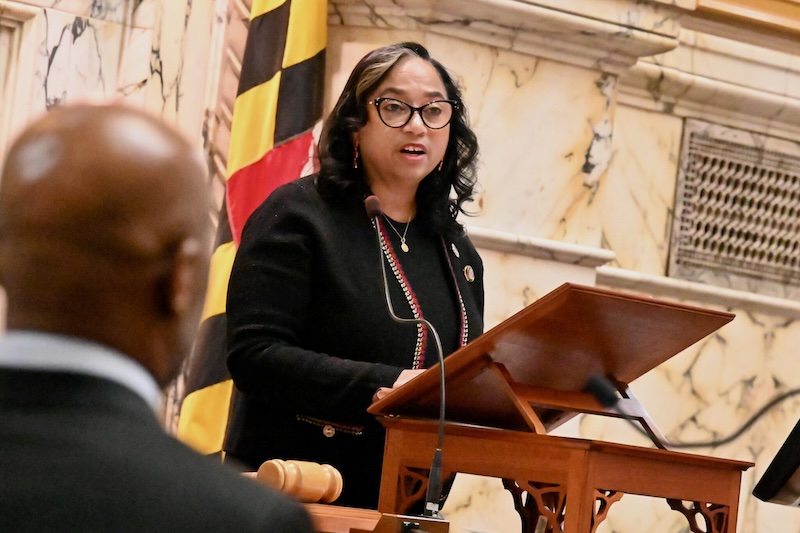
 House Speaker Joseline Peña-Melnyk (D-Prince George’s and Anne Arundel) addresses the chamber after being elected the first Afro-Latina presiding officer in the history of the Maryland General Assembly — a far cry from her childhood in poverty in the Dominican Republic. (Photo Bryan P. Sears/Maryland Matters)

When she was a small child growing up in her native Dominican Republic, Joseline Peña-Melnyk would frequently return home from school at midday to find a house packed with relatives, but not a morsel of food.

The Peña family’s home was “tiny,” she recalls, a one-bedroom wooden structure with holes in the roof and a latrine in the yard. She frequently lived with as many as 17 aunts, uncles, cousins and grandparents. They were too embarrassed to ask the proprietor of the local bodega for food on credit.

Young Joseline had no such qualms.

“I would go to the bodega,” the just-elected speaker of the House of Delegates said in a recent interview. “And I would tell the lady, ‘Muneca, my grandmother said if you can let us fiao’ — it’s a slang term, meaning to buy on credit — ‘can you give us 2 pounds of rice, a pound of beans, and some tomato paste and some cilantro and some salt? My mom, when she sends money, will pay you.’”

The shopkeeper said yes. “And then I would come home and we would eat!”

The story, which Peña-Melnyk tells now with relish, reflects the confidence that has fueled her improbable rise in politics, from election to the College Park City Council at age 37 to her unanimous choice Tuesday as House speaker.

“From early on, I was just fearless,” she told Maryland Matters. “Not ashamed. Not ashamed at all that someone would see me go [to the bodega] after other families had already eaten. So I would do that.”

The future legislator also watched her mother, the oldest of 14 children, labor to provide for her children, siblings and parents. Being around folks who worked hard but struggled to meet even their most basic needs instilled in her a strong sense of compassion.

“I learned to have empathy and to care about the things that really matter,” she said.

Peña-Melnyk first came to New York at age 7 with her mother and sister, before returning to the Dominican Republic at age 11 with her sister, while her mother stayed behind, working jobs in the garment district and sending money home. When she was 14, she returned to the U.S. for good.

Money was always tight. In the DR, her family used corn husks and newspaper for toilet paper. Uncles would pawn small appliances for cash. In New York, they relied on food stamps and other public assistance to supplement her mother’s wages. “We were very, very, very poor, and went through a lot of struggles — but we had a lot of love,” she recalled.

Peña-Melnyk began to learn English in school and from watching “Sesame Street” and “Mister Rogers’ Neighborhood.” When her mother needed help navigating the welfare system, her oldest daughter would help translate, soon translating for other Spanish-speaking mothers.

“[My mother] would volunteer me to translate for everybody that was waiting” in the welfare office, Peña-Melnyk said. “I had no business knowing people’s grown-up business. But what I did learn was that I did not want to be treated like these women — it was mostly women, women of color — were treated. [Clerks] would ask them questions that were really offensive.”

Peña-Melnyk’s mother began to refer to her daughter as “’abogadita,’ which means the little lawyer. I wouldn’t stay quiet…. At that age I knew that I wanted to do something with my life.”

In high school, Peña-Melnyk told her guidance counselor she wanted to go to college, despite having no idea what that meant. She attended Buffalo State College (a school she chose site unseen) and the State University of New York at Buffalo Law School. After a stint as a public defender in Philadelphia, she became a prosecutor in the U.S. Attorney’s office in Washington, D.C.

Law school was “transformational,” said Peña-Melnyk. Working with accused persons who struggled with disadvantaged upbringings became a particular passion. “I was like, ‘Wow, look at this law here. I can apply it. I can try to fight for fairness and justice. And I used the law to back me up — and my mouth. And my grit. [I learned] to leave it all out there.”

Del. Joseline Peña-Melnyk (D-Prince George’s and Anne Arundel). (Photo by Bryan P. Sears/Maryland Matters)

Elected to the House in 2006, she landed on the Health and Government Operations Committee, where she became steeped in issues ranging from abortion to long-term care, same-sex marriage to insurance to the pharmaceuticals industry. She grew close to Del. Shane Pendergrass (D-Howard), the long-serving committee chair whom she succeeded when Pendergrass retired in 2023.

In an interview last week, Pendergrass lavished praise on her former colleague, whom she considers a sister.

“She is the kindest, most generous, smartest and hardest-working person I have ever dealt with,” Pendergrass said. “She was my equal partner when I chaired HGO. I invited her into everything because I needed her help.

“It’s a very big job to be a chair of a committee,” Pendergrass said. “Nothing compared to being the speaker of the House, but still a big job. And I wanted her to be as educated about every issue that she could be so that she could help me make decisions. And she did.”

Peña-Melnyk was always “over-prepared” when it was her turn to defend a committee bill on the floor, Pendergrass recalled. She expects her to approach her role as speaker in the same manner.

The new speaker isn’t afraid to engage in the rough and tumble of politics. She ran against a slate of Democratic incumbents in District 21 in 2006. After publicly criticizing former Prince George’s County Executive Angela Alsobrooks (D) for not having any Hispanics in her Cabinet, Peña-Melnyk endorsed her rival, David Trone, in the 2024 U.S. Senate primary.

Pendergrass said that when a state senator was killing House bills in large number out of apparent pique, Peña-Melnyk pressed for killing his bills in retribution. Pendergrass resisted at first, but then relented. The unnamed senator got the message, she said.

“She gets politics much more than I did,” Pendergrass said last week.

When Peña-Melnyk became chair of HGO, some Republicans on the panel considered a transfer to a new committee, perhaps concerned that the new boss  would be too liberal or not as fair. Pendergrass said that one member — Del. Nik Kipke (R-Anne Arundel) — later stopped her in the hallway.

“We’re really glad we stayed,” Kipke told her. “We really like her. She’s [even] better than you are.”

She’s a liberal, I’m a conservative, but I do believe she is a good person who cares deeply about people — and she has a tremendous work ethic. She’s a workaholic. She’s just trying to get good things done for people.” – Del. Nik Kipke (R-Anne Arundel), on working with Speaker Joseline Peña-Melnyk (D-Prince George’s and Anne Arundel)

Kipke said he and Peña-Melnyk both arrived in Annapolis in 2007, and have served on the same committee the entire time. He estimates they’ve spent thousands of hours together.

“She’s a liberal, I’m a conservative, but I do believe she is a good person who cares deeply about people — and she has a tremendous work ethic. She’s a workaholic,” Kipke said. “She’s just trying to get good things done for people.”

He and Pendergrass both said they could recall numerous times when they overheard Peña-Melnyk on the phone, trying to arrange help for a constituent in need, often someone who didn’t live in her legislative district. “Not all politicians spend their time on those types of issues,” Kipke said.

Kipke said Peña-Melnyk has been particularly helpful expanding access to health care in Republican parts of Maryland.

“We’ve all talked about her being in this role, and the thing I’ve heard over and over again is you feel really welcome to disagree, to share your opinion,” he said. “She’s been very respectful to the Republicans on our committee.”

Pendergrass expects the new speaker to remember “people who have the least and need the most help…. She helps people. That’s who she is.”

Peña-Melnyk said she spent a lot of time in the lead-up to Tuesday’s vote reflecting on the many mentors she’s had over her 59 years — her mother and other relatives, that high school guidance counselor and numerous Annapolis figures, including Pendergrass, former Speaker Adrienne Jones and former lawmakers Shirley Nathan-Pulliam (the first African-Caribbean woman elected to the General Assembly), Peter Hammen, Delores Kelley and Gwendolyn Britt among them.

As one of the first Afro-Latina legislators in the nation to become a presiding officer, at a time when the federal government is targeting immigrants, Peña-Melnyk could become a go-to for national journalists. But she said her focus will remain on Maryland — and conducting herself as she always has, by doing her homework, listening with compassion and searching for consensus.

“I am famous for sitting everyone around a table, and just going around and listening. And I don’t speak,” she said. “After I have listened to everyone attentively, the answer comes to me.

“And I think that I am ready to do a good job — and to learn.”


by Bruce DePuyt, Maryland Matters
December 17, 2025

Maryland Matters is part of States Newsroom, a nonprofit news network supported by grants and a coalition of donors as a 501c(3) public charity. Maryland Matters maintains editorial independence. Contact Editor Steve Crane for questions: [email protected].
The Spy Newspapers may periodically employ the assistance of artificial intelligence (AI) to enhance the clarity and accuracy of our content.

Filed Under: Maryland News, 00 Post to Chestertown Spy

Peña-Melnyk One Step Closer to House Speaker’s Rostrum

December 16, 2025 by Maryland Matters

Del. Joseline Peña-Melnyk (D-Prince George’s and Anne Arundel) is all smiles as she leaves a meeting of the House Democratic Caucus Tuesday after being picked as the next speaker of the House. A full vote is scheduled for later in the day. (Photo Bryan P. Sears/Maryland Matters)

A quick meeting of the House Democrats on Tuesday morning cleared the way for Del. Joseline Peña-Melnyk (D-Prince George’s and Anne Arundel) to become the next speaker of the House of Delegates.

With the support of the Democratic Caucus to lead the chamber, Peña-Melnyk has more than enough votes to win an election for speaker when the House convenes for a special session that begins at noon Tuesday. Her election will make her the first Afro-Latina and first immigrant to preside over either chamber in the Maryland General Assembly.

“I really don’t have enough words to express how I feel about my colleagues trusting me with this enormous responsibility to lead,” Peña-Melnyk told reporters as she emerged from the 40-minute caucus meeting. “I’m an inclusive leader, and I’m going to lead with my colleagues. This House belongs to all of us.”

Peña-Melnyk, who serves as chair of the House Health and Government Operations Committee, quickly emerged as the leading candidate just days after former Speaker Adrienne Jones (D-Baltimore County) announced she would relinquish the gavel but remain a member of the House. Jones stepped done Dec. 4.

Peña-Melnyk’s selection was very different from Jones.

In 2019, Jones announced then withdrew her candidacy for speaker. She later emerged as a compromise candidate when the Dels. Dereck Davis and Maggie McIntosh were not able to secure enough votes to succeed Michael Busch, who died in office earlier that year. When she took office, Jones became the first woman and the first Black lawmaker to lead either chamber in Maryland.

Peña-Melnyk was one of four candidates seeking to replace Jones as speaker. She quickly secured enough votes to seal the nomination, and within days the three other candidates for the job said they would withdraw and support Peña-Melnyk.

The election in the House Democratic Caucus was punctuated with cheers that could be heard in the hall outside the closed-door gathering. It was over in less than 20 mins.

By Bryan P. Sears

The Spy Newspapers may periodically employ the assistance of artificial intelligence (AI) to enhance the clarity and accuracy of our content.

Filed Under: 00 Post to Chestertown Spy, Maryland News

Moore Pledges No Taxes in Coming Session as State Faces Another Massive Budget Gap

December 12, 2025 by Maryland Matters

 Gov. Wes Moore (D) told a gathering of county leaders Thursday that he does not plan to balance his next budget with taxes, while pledging to revisit an affordable housing proposal that local officials last year opposed. (Photo by Bryan P. Sears/Maryland Matters)

Gov. Wes Moore (D) told a gathering of county leaders in Cambridge Thursday that he will not propose tax increases to close a projected $1.5 billion budget gap in the coming fiscal year.

Moore told officials attending the winter conference of the Maryland Association of Counties that “budget decisions in front of us won’t be easy or simple.” He gave few specifics, but took at least one solution off the table.

“We cannot – and will not – balance our budget on the back of Marylanders. This is not a year where we anticipate tax increases,” Moore said. “At the same time, we must right-size programs that need to be made more sustainable.”

Moore and the General Assembly have been warned that they face about a $1.5 billion deficit in fiscal 2027. Additionally, there is about $700 million in budget deficiencies.

State fiscal leaders will get an updated look at the state’s revenue projections for fiscal 2027 when the Board of Revenue Estimates meets Friday afternoon. Friday’s forecast is the last before Moore delivers his budget to the General Assembly.

Moore diverged several times from his speech as prepared. He dropped portions that named President Donald Trump or referenced the White House, instead referring only to Washington or speaking more in more general terms. The majority of county officials in the room hail from rural jurisdictions where Republicans are the majority party.

Moore was warmly received as he was introduced. During his speech, there was some applause from pockets of the banquet room. But there were also few obvious applause lines and attendees for the most part listened quietly.

Moore went off script to talk about one issue — housing.

The governor and the association were at odds in the 2025 legislative session over an administration bill that was aimed at sparking construction of affordable housing in the state. But county officials saw the bill as overriding local authority on zoning and on where projects can be built.

Moore lost that fight and his bill was ultimately defeated. A divide remains. While the administration seems focused on bringing the bill back, county officials have complained that they have had few substantive talks with the Department of Housing and Community Development — a continuation of complaints that surfaced at the association’s summer convention.

Despite any disagreements, Moore told the audience Thursday he was “not going to stop pushing.”

“Sometimes we butt heads on this one,” Moore said. “The thing that I ask you though, is this: If we disagree on the topic of housing on Monday, the only thing I ask is … let’s get back together on Tuesday and let’s keep on working, because I’m not going to stop pushing this housing.”


by Bryan P. Sears, Maryland Matters
December 12, 2025

Maryland Matters is part of States Newsroom, a nonprofit news network supported by grants and a coalition of donors as a 501c(3) public charity. Maryland Matters maintains editorial independence. Contact Editor Steve Crane for questions: [email protected].

The Spy Newspapers may periodically employ the assistance of artificial intelligence (AI) to enhance the clarity and accuracy of our content.

Filed Under: 00 Post to Chestertown Spy, Maryland News

Field Of Hopefuls in Speaker’s Race Clears for Peña-Melnyk

December 9, 2025 by Maryland Matters

The next speaker of the House of Delegates will likely be a woman and immigrant.

Del. Joseline Peña-Melnyk (D-Prince George’s and Anne Arundel) appears to have a clear path within the Democratic Caucus to become the next speaker. A vote is scheduled for Dec. 16.

Three of the four leading candidates to succeed former Speaker Adrienne Jones (D-Baltimore County) have bowed out — Appropriations Committee Chair Ben Barnes (D-Prince George’s and Anne Arundel), Economic Matters Committee Chair C.T. Wilson (D-Charles) and Legislative Black Caucus Chair Jheanelle Wilkins (D-Montgomery) — effectively clearing the field for Peña-Melnyk, Maryland Matters has learned.

“I am really honored and very moved that Chairman Barnes … Black Caucus Chair Wilkins and the chair of the Economic Matters Committee … C.T. Wilson, have decided to support my candidacy for speaker,” Peña-Melnyk said in a brief phone interview Sunday night.

“They have decided to withdraw their candidacy to allow me to move ahead. The vote is scheduled for the 16th [of December], and at that time, I will have the opportunity to make my case to the entire caucus,” she said. “As you know, there’s 102 members, and I hope to make my case and to be able to get their support. I’m very humbled and moved, and we’ll see what happens on the 16th.”

While it’s not official until the Dec. 16 vote, Barnes left little doubt Sunday about who the next speaker would be.

“I’m 100% in support of our new speaker, Joseline Peña-Melnyk. She has the toughness, intelligence and grit to be a great speaker. I know she will be,” Barnes said. “I’m going to support her any way I can.”

Barnes, who represents the same district as Peña-Melnyk, said they came to the legislature together 20 years ago and he called her “a great friend” and “like a big sister to me. I can’t wait to get to work with her.”

Wilkins, in a phone call late Sunday, confirmed that she has withdrawn her candidacy and is supporting Peña-Melnyk.

Wilson said he didn’t want to see a repeat of the last speaker’s race, when the House was deadlocked over two candidates before picking Jones as a compromise candidate.

“I didn’t want to see the House repeat what it was last time, right, where there was division and people feared that they couldn’t support the other person,” Wilson said Sunday night, “So as soon as I found out that Ben Barnes pulled out, I stepped back as well.”

Wilson said he is backing Peña-Melnyk as the next speaker.

“We have to come out with one voice and let it be what it is,” he said.

Peña-Melnyk would become the second woman to lead a chamber of the Maryland General Assembly. She would also be the first person born in the Dominican Republic to lead either the House or Senate.

Her ascendance to the rostrum makes her the highest-ranking Afro-Latino in the history of the General Assembly.

Peña-Melnyk assumes the top House spot in the last year of a four-year term. She’ll immediately face a $1.5 billion budget deficit as well as a caucus anxious to pass midcycle congressional redistricting, despite opposition in the Senate.

She will have to guide the House as it considers overrides of vetoes issued by Gov. Wes Moore (D), including a bill on the creation of a reparations commission. Peña-Melnyk defended that bill on the floor of the House last year.

She also takes over amid growing worries among immigrants in Maryland and heightened enforcement by federal agents who are prosecuting President Donald Trump’s pledge to carry out mass arrests and deportations.

Peña-Melnyk succeeds Jones, who last week announced she would give up the position she was first elected to in 2019. Jones said she would remain in the House.

She did not give a reason for her decision. She also did not attend the meeting Thursday where her top lieutenants, the chairs of the House standing committees, were informed of her decision.

Jones’ announcement last week touched off a flurry of activity. A number of candidates expressed interest in the slot, with Barnes, Wilson and Peña-Melnyk considered the frontrunners.

Peña-Melnyk has been a member of the House since 2007. She became chair of the House Health and Government Operations Committee in 2022. Prior to that she served three years as the panel’s vice chair.

Peña-Melnyk, 59, was born in the Dominican Republic. She immigrated to the U.S. as a small child and grew up in New York, graduating from high school in the Bronx.

She earned her law degree from the University at Buffalo School of Law, State University of New York. She later worked as both a federal prosecutor and a public defender. She also worked as a child neglect lawyer.

She is the mother of three, including twins.

Her political career includes three years on the College Park City Council. She was elected to the House of Delegates in 2006.

During her time in the House she’s built a reputation as a major player on health care policy issues. During her time as vice chair of HGO she took on greater responsibility for running committee hearings and defending bills in recent years.

In 2016, she ran unsuccessfully for the 4th District congressional seat. She placed third, receiving 19% of the vote in the Democratic primary.


by Bryan P. Sears, Maryland Matters
December 7, 2025

Maryland Matters is part of States Newsroom, a nonprofit news network supported by grants and a coalition of donors as a 501c(3) public charity. Maryland Matters maintains editorial independence. Contact Editor Steve Crane for questions: [email protected].

The Spy Newspapers may periodically employ the assistance of artificial intelligence (AI) to enhance the clarity and accuracy of our content.

Filed Under: 00 Post to Chestertown Spy, Maryland News

A Cambridge Power Couple

November 19, 2025 by Zack Taylor

Bernard and Danielle Johnson in their High Street headquarters.  The couple is making a mark on Cambridge as business and civic leaders, setting an example of how to achieve success the right way.

In Cambridge, a place where people notice who shows up, who follows through, and who treats others well, Bernard and Danielle Johnson are familiar names. 

Their four businesses are a steady presence in the city’s commercial life, and their willingness to help where they are needed has made them leaders across the community.  Customers, colleagues, and local officials describe them much the same way: reliable, generous with their time, and committed to helping Cambridge thrive.

Dorchester Chamber of Commerce president Bill Christopher often brings Bernard and Danielle with him when he speaks at local schools.

“They both go on school visits with me regularly,” Christopher said.  “Bernard is great at working with the kids.  He has a compelling story about how he got to where he is in his life, and it resonates very well with students.”

Christopher has watched the couple grow from single-shop operators into employers with contracts in several states, all while taking on greater civic responsibility.

“They are a Cambridge power couple,” he said.  “A great example of what a good citizen looks like.  They run multiple businesses, but also make time to work with the community and give back whenever they can.”

Next January, Danielle will become chair of the Chamber’s Board of Directors.  While there have been Black chairs and women chairs, Christopher says he would need to check whether the position has ever been held by a Black woman since the Chamber’s incorporation in 1941.  In any case, he said, her leadership speaks for itself.

Building a foundation

The Johnsons’ business portfolio includes Johnson’s Cleaning Services, The Car Cleaning King, Mirror Mirror Salon, and The Platinum Gallery.  Johnson’s Cleaning Services is the anchor, with a growing staff and contracts that now reach into multiple states.

Bernard founded the cleaning company in 2019, drawing on what he saw growing up in Cambridge and what local families and businesses needed most.

“I opened the cleaning service in June of that year, and the car wash just a month later,” he said.  “We have been busy for a couple of years now.  We’ve had consistent momentum, growing pretty much every week.  We have never been in the red.”

Today, the company handles commercial and residential cleaning, vacation rentals, floor stripping and waxing, power washing, and large-scale industrial work.  His detailing business focuses on careful, methodical restoration rather than quick washes.

“We are not just a car wash,” Bernard said.  “We detail cars.  Every time we touch your car, we are going through it with a different level of attention.”

Danielle’s turn

After an early stint in the military, Danielle settled in Virginia Beach, then moved to the Shore. She worked as a hairdresser before meeting Bernard, and eventually joined forces with him both personally and professionally.

In 2006, she purchased and remodeled an existing salon, rebranding it Mirror Mirror.  She financed the project with a loan from the former Bank of the Eastern Shore, and paid it off two years early.

Six years later she founded The Platinum Gallery, a consulting business that helps very small and startup companies structure their operations and present themselves professionally.

“I help market new business startups.  If someone needs correspondence or promotional materials, I create them,” Danielle said. “I work with clients from the planning stage to opening, and a little bit beyond.”

Danielle takes a break from a shift at her salon Mirror Mirror to pose for The Spy amid women’s empowerment messages painted on the mirrors.

Setting their own standards

To maintain high levels of quality across their portfolio, the Johnsons created their own in house training system.

“Our staff have different levels of skill at our detail shop,” Danielle said.  “They can start as a beginner detailer, then increase to intermediate, but it all comes with hours and training.  They have to master the basics first before they can move on.  Once they master intermediate levels, then they can move up to a pro.”

They also developed written protocols, quality checks, and their own techniques that they keep close.

“We cater our procedures to our business and how we want our business to be streamlined,” Bernard said.  “We have confidentiality agreements,” Danielle added.  “We have some trade secrets.”

Marketing face-to-face

The Johnsons use social media and other modern marketing strategies, but they still rely heavily on personal contact.

“We still do guerrilla marketing,” Danielle said.  “We give people business cards at networking events. We print newsletters we write and keep them in our waiting areas. Our materials show up on people’s front steps.”

Bernard sees this as essential. “I call it the hustle work,” he said.  “Handing out business cards, handing out fliers, knocking on doors. I like that because it gives me a chance to connect with people. There is no substitute for that.”

Most of their business still comes from the old-fashioned way.  “Word of mouth, providing great service, and treating customers right.  That gets people talking.”

Danielle studied business and marketing before the rise of social media and agrees the fundamentals remain the same.  “We stick to some things that are core,” she said.  “We make use of online technology, but the basics still work.”

Cambridge’s past and a different present

Bernard grew up in Cambridge.  As a boy, he remembers being warned away from certain parts of town because of racial tensions that lingered long after segregation officially ended.  “Mom used to always tell me, do not go on Race Street.  Do not go through this or that alleyway,” he said.  “I never understood why.  As I got older I put two and two together.”

As an adult, he sees a different community, one where his business has room to grow and a loyal customer base.  “I honestly have not experienced difficulty in building a successful business here,” he said.  “People say the community does not support them.  I did not experience that.”

Bernard’s childhood memories reflect a city much more divided than it is today.  “We have a heavily slave-oriented history,” he said.  “Those houses on Race Street were slaveowner homes.  It has been a struggle, and it is real.”

Still, he rejects the idea that Black owned businesses cannot thrive in the city as it is now.  “Because we are a part of this community, we believe all the people naturally support us,” he said.

Bernard and Danielle with Bernard’s alter ego, The Car Cleaning King.

Officials take notice

Cambridge Mayor Lajan Cephas-Bey has watched the Johnsons grow into significant local employers.

“The Johnsons are a perfect example of how you can start with a dream, with something small, and develop it into something big,” she said. “They set an example not just for the Black community but for anyone in Cambridge and all of Dorchester County.”

The Mayor sees a model of inclusiveness in the couple, especially in how they support their growing workforce.  “They have employees of all different races, sizes, sex, male or female, or anyone who may identify as something else.  They truly are an example of making it to the top the right way.”

Cephas-Bey believes they are nowhere near their peak.

“I think this is really just the beginning for the Johnsons,” she said. “In them, people see that not only can you love one another, you can work together, you can grow together, and you can bring your community with you.”

Stepping into leadership

As Danielle prepares to lead the Chamber board, she is focused on outreach.  “I still believe a lot of people in the community do not know about the Chamber and how it can assist businesses,” she said. “I want to hit the pavement. I want to show up at people’s businesses and say, we are the Chamber, we are here to help you.”  She points to the Small Business Administration, Department of Economic Development, the Innovation Center as available resources to keep business owners informed. 

“If you are not involved in them, you probably do feel isolated,” she said.  “But none of them ever turned us away, and they will be there for others as well.”  Bernard adds:  “You have to seek that for yourself.”

Danielle is also preparing a six-week “boot camp” to help startup owners stay focused on what’s important.  “Anyone can be a business owner on paper, but who will be successful will be those who are disciplined, who know their ‘why,’ who have vision.”

Bernard has recently received another distinction: an invitation to deliver the keynote address at his alma mater Cambridge-South Dorchester High School this June.

“It is one of the biggest honors,” he said. “I’ve been here all my life.  I love my C-SD Vikings.  And I want to see the young kids of today stay here and win. I want them to know they can make it right here.”

Despite the importance of his message, he is determined to write the speech without any help. “Helpful as I am sure it would be, I refuse to use AI,” he said, “it’s going to be my own words.”

Bernard’s long term goal is ambitious.  He envisions a Fortune 500 company with regional divisions up and down the East Coast, expanded contract work, and possibly a franchised detailing operation.

And for all her success, Danielle is perhaps most proud of one lasting and unique mark she has left on Cambridge.  When the Beacon of Hope sculpture downtown honoring Harriet Tubman was created, she styled the hair of the young girl who posed for the artist.

Her braids and twists are now permanently cast in bronze as part of one of Cambridge’s signature artw

The Spy Newspapers may periodically employ the assistance of artificial intelligence (AI) to enhance the clarity and accuracy of our content.

Filed Under: 5 News Notes, Maryland News

City Manager Glenn Steckman Talks Cambridge

November 11, 2025 by Zack Taylor

Glenn Steckman, a native Marylander, began his career in municipal management of in-state communities such as Ocean City before rising through roles in Pennsylvania, Delaware, Rhode Island, and, most recently, Nome, Alaska. In July 2024, he was selected unanimously by the Cambridge City Council to serve as city manager.  Known for his hands-on style, Steckman believes in open communication and accessibility. He arrived at a time when Cambridge faces both opportunity and challenge: waterfront redevelopment, fiscal scrutiny, infrastructure renewal, and a desire to connect more deeply with its distinctive port-town character.  The Spy caught up with Steckman in his office last week, where he shared his perspectives on the city today.

The video is 7:46 long. 

The Spy Newspapers may periodically employ the assistance of artificial intelligence (AI) to enhance the clarity and accuracy of our content.

Filed Under: Maryland News

Low-income Marylanders, Local Officials Left to Navigate ‘Roller Coaster’ of SNAP Disruption

November 8, 2025 by Maryland Matters

The Trump administration told states Friday that it would be releasing funds to support federal food assistance during the government shutdown — just hours before winning a Supreme Court stay of lower court orders, apparently putting the payments on hold again.

It is just the latest example of the on-again, off-again policy changes that have left benefit recipients guessing on their status, and states, counties and local food aid organizations riding the policy “roller coaster” that has federal support for food assistance here one moment, gone the next.

It has also made it “difficult to know what to communicate” to recipients of the Supplemental Nutrition Assistance Program, or SNAP, for the state and county officials who administer the program.

“I think the roller coaster is really with the federal government,” said Heather Bois Bruskin, director of the Office of Food Systems Resilience in Montgomery County. “First it was that the November benefits won’t be coming. Then with the court action, they were directed to release the funds that are set aside for SNAP benefits in situations just like this.

“At this moment, it is very uncertain when and how and in what amount the federal government will be contributing to SNAP benefits for November.”

Meanwhile, state and some county officials are moving funds around in an effort to mitigate the damage, regardless of how things shake out at the federal level.

Anne Arundel, Montgomery, Baltimore counties and the city of Baltimore have allocated additional dollars to support local meal assistance networks and help provide meals for families who may be struggling to put food on the table.

For example, Bruskin said that Montgomery County plans to move an additional $3.5 million next week for the local food network, adding on to county dollars already earmarked to help food banks and pantries.

Gov. Wes Moore (D) last week declared a state of emergency that allowed him to allocate $10 million for food pantries around the state. He followed that on Tuesday with the announcement that the state would budget $62 million under the same emergency order directly to SNAP recipients in the state for their November benefits.

Maryland officials said Friday that the $62 million earmarked in that executive order will still go out, paying for about half of the monthly SNAP benefits for the more than 680,000 Marylanders in the program. Those funds will be loaded into electronic benefit transfer accounts on Monday night and will be available Tuesday for those whose benefits have already lapsed.

“Maryland families shouldn’t have to suffer because the federal government chose to pause vital benefits,” Maryland Human Services Secretary Rafael López in a written statement. “We will move urgently to get Marylanders the SNAP benefits their families depend on to put food on the table.”

Since Nov. 4, an average of 30,000 Marylanders a day have seen benefits lapse as funds that would have refreshed their accounts were tied up in court and in policy fights. That means that approximately 120,000 Marylanders this week have been waiting for their electronic benefit cards to be refilled.

“It’s tragic for those families,” Del. Emily Shetty (D-Montgomery) said. “We’ve heard anecdotally of families who have gone to the grocery store and found out subsequently that they didn’t have money on their cards.”

Shetty, who chairs the House Appropriations subcommittee that oversees social services, said she grew up in poverty. She said that the days of uncertainty about the availability of federal SNAP funds is “problematic” for families that need the extra help.

“This is a life I am very familiar with,” she said. “Poverty is something that is often forced upon families, and this is why I feel so passionate that poor people cannot be pawns in these broader political games.”

SNAP mishaps

On Friday, the U.S. Department of Agriculture told states that it was working toward releasing total funding for SNAP benefits in November. That was a reversal from the outlook from just days before, when it was uncertain if funds would come down at all following recent court challenges and social media statements from President Donald Trump (R) threatening to withhold payments to punish Democrats.

Even the Friday USDA letter that told states the agency was working to fill November SNAP benefits coincided with the Trump Administration’s effort to challenge its court-ordered requirement to fund SNAP.

The last twist in the saga came late Friday, when Supreme Court Justice Ketanji Brown Jackson granted the government’s request to temporarily block lower courts that had ordered the USDA to immediately fund 100% of SNAP benefits for the month. It was unclear what effect that would have on the government’s promise earlier in the day to start delivering the funds to states.

“It’s not something that is helpful to the communities that we serve to continue this back and forth, and to continue panicking the entire community that relies on hunger relief and hunger benefits,” Shetty said. “We were receiving an increase in constituent calls, not just from individuals who benefit from those programs. But also from our retailers and local food banks and shelters that were really concerned about the impact on the folks they were serving.

“This continued back and forth is par for the course for the administration, but it actually has a real effect on the people who are living in poverty,” Shetty said. “And we cannot continue using poor people as pawns in this political game at the national level. It’s just immoral.”

By Danielle J. Brown

The Spy Newspapers may periodically employ the assistance of artificial intelligence (AI) to enhance the clarity and accuracy of our content.

Filed Under: 00 Post to Chestertown Spy, Maryland News

Trump Administration Must Restart Snap Benefits by Wednesday, Judge Rules

November 4, 2025 by Maryland Matters

WASHINGTON — A federal judge on Saturday issued a written order saying there is “no question” that U.S. Department of Agriculture contingency funds must be used to provide food assistance for 42 million Americans during the government shutdown.

Rhode Island U.S. District Court Chief Judge John J. McConnell Jr. had said during a Friday hearing he was granting a temporary restraining order sought by cities and nonprofit groups. McConnell ordered that the government distribute payments of Supplemental Nutrition Assistance Program, or SNAP, benefits.

Because Congress is locked in a stalemate over a stopgap spending bill and did not appropriate money for the fiscal year that began Oct. 1, Trump administration officials had said the program could not provide SNAP benefits beyond Saturday.

In response to McConnell, President Donald Trump in a social media post later Friday said administration lawyers believed the funds could not legally be paid and that he needed clarification about how to distribute SNAP benefits.

“I do not want Americans to go hungry just because the Radical Democrats refuse to do the right thing and REOPEN THE GOVERNMENT,” Trump said.  “If we are given the appropriate legal direction by the Court, it will BE MY HONOR to provide the funding …”

Government lawyers also filed a brief in the Rhode Island case asking McConnell to clarify how his order could legally be carried out, noting it was delivered orally and there was no written transcript.

In his Saturday order, McConnell, who was appointed by former President Barack Obama, quoted Trump and said, “So, here’s the ORDER and here’s the legal direction from the Court.”

In a footnote, the McConnell order also said: “The Court greatly appreciates the President’s quick and definitive response to this Court’s Order and his desire to provide the necessary SNAP funding.”

McConnell said it was likely that the plaintiffs would succeed in their case. He noted that Congress appropriated funds for SNAP in an annual spending bill, and lawmakers directed that $3 billion should be put in reserve through Sept. 30, 2026. Another $3 billion in a later bill was put aside until Sept. 30, 2027.

“There is no question that the congressionally approved contingency funds must be used now because of the shutdown; in fact, the President during his first term issued guidance indicating that these contingency funds are available if SNAP funds lapse due to a government shutdown,” McConnell said.

Two options in written order

Because the $6 billion is not enough to cover the estimated $9 billion cost of November benefits, government lawyers have said it would be difficult to determine reduced benefits, McConnell said.

He said USDA then should “within its discretion, find the additional funds necessary” to fund the full $9 billion, suggesting use of $23 billion in a fund for state child nutrition programs.

If the government chooses to make full SNAP payments for November, it must do so by the end of the day Monday, he said. If instead the government makes a partial payment of SNAP funds, then it must pay out all the $6 billion in contingency funds by Wednesday, he said.

He asked the government to update him by noon Monday how it was complying with the order.

In a separate case, a federal judge in Boston also ruled Friday that the USDA plan to pause SNAP was illegal — but gave the Trump administration until Monday to respond to her finding before she decides on a motion to force the benefits be paid despite the ongoing government shutdown.

No matter what happens on Monday, experts and a key member of Congress have said that some SNAP recipients still may see delays in their benefits because changes in administration from the federal government to states to vendors take time. In states, SNAP benefits are loaded onto cards on varying dates, but the Saturday cutoff would have been effective for November benefits.


by Jane Norman, Maryland Matters
November 3, 2025

Maryland Matters is part of States Newsroom, a nonprofit news network supported by grants and a coalition of donors as a 501c(3) public charity. Maryland Matters maintains editorial independence. Contact Editor Steve Crane for questions: [email protected].

The Spy Newspapers may periodically employ the assistance of artificial intelligence (AI) to enhance the clarity and accuracy of our content.

Filed Under: 00 Post to Chestertown Spy, News

Next Page »

Copyright © 2026

Affiliated News

  • The Chestertown Spy
  • The Talbot Spy

Sections

  • Arts
  • Culture
  • Ecosystem
  • Education
  • Mid-Shore Health
  • Culture and Local Life
  • Shore Recovery
  • Spy Senior Nation

Spy Community Media

  • Subscribe
  • Contact Us
  • Advertising & Underwriting

Copyright © 2026 · Spy Community Media Child Theme on Genesis Framework · WordPress · Log in