
MENU

Sections

  • Home
  • About
    • Contact Us
    • Editors and Writers
    • Join our Mailing List
    • Letters to Editor Policy
    • Advertising & Underwriting
    • Code of Ethics
    • Privacy
    • Talbot Spy Terms of Use
  • Art and Design
  • Culture and Local Life
  • Public Affairs
    • Ecosystem
    • Education
    • Health
    • Senior Life
  • Community Opinion
  • Sign up for Free Subscription
  • Donate to the Talbot Spy
  • Cambridge Spy

More

  • Support the Spy
  • About Spy Community Media
  • Advertising with the Spy
  • Subscribe
January 21, 2026

Talbot Spy

Nonpartisan Education-based News for Talbot County Community

  • Home
  • About
    • Contact Us
    • Editors and Writers
    • Join our Mailing List
    • Letters to Editor Policy
    • Advertising & Underwriting
    • Code of Ethics
    • Privacy
    • Talbot Spy Terms of Use
  • Art and Design
  • Culture and Local Life
  • Public Affairs
    • Ecosystem
    • Education
    • Health
    • Senior Life
  • Community Opinion
  • Sign up for Free Subscription
  • Donate to the Talbot Spy
  • Cambridge Spy
Point of View Editorial Point of View Opinion

“Fail First” is a Failure Always Ali Asghar Kassamali

December 13, 2025 by Spy Daybook

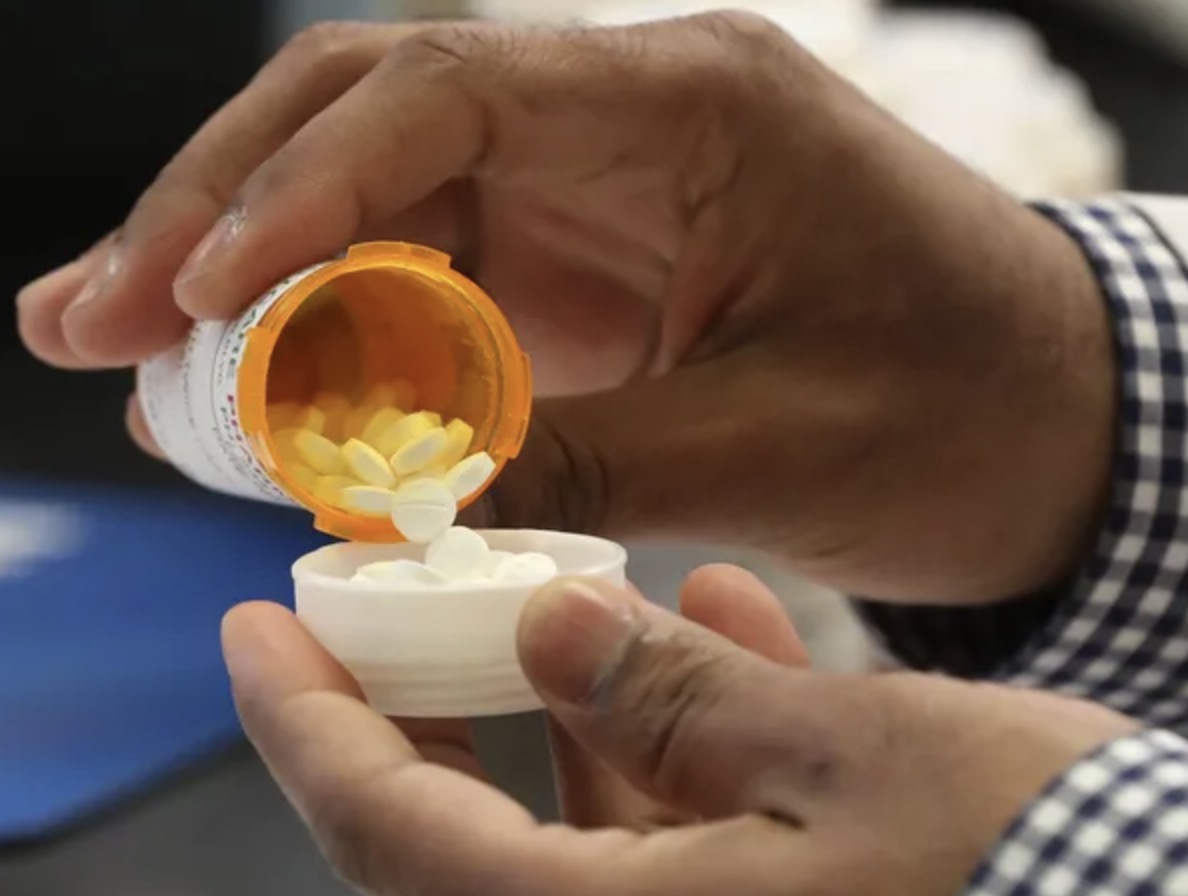
Imagine walking into a health care clinic only to find that our loved one cannot receive the medication their doctor recommends, not because it is unsafe or unproven, but because their insurance requires them to “fail first.” This practice, known as step therapy, forces patients to try cheaper medications before gaining access to the treatments their physicians know are most effective. In theory, it is meant to control costs. In reality, it delays care, worsens disease outcomes, and undermines medical judgment. 

Step therapy places bureaucracy above medicine. It compels patients to take medications that may be ineffective or even harmful, prolonging suffering and increasing the risk of irreversible complications. Worse still, protections against this practice are inconsistent across states and insurance types. As a result, many of us face uncertainty each time we switch jobs, plans, or providers, never knowing whether we will be forced to “fail first” again. 

The solution lies in passing the Safe Step Act, a bipartisan bill currently pending in both the United States Senate and the House of Representatives. The act would create a standardized process for step therapy exceptions nationwide, allowing physicians to override fail-first requirements when medically appropriate. Through this reform, patients would gain faster access to the treatments they need, doctors would face fewer administrative burdens, and insurers would ultimately save money by treating illnesses correctly the first time. 

This reform is not just practical; it is urgent. According to the Patient Access Network Foundation (2024), one in six adults in the United States reports being forced by insurance to try and fail on a cheaper medication before obtaining an effective one. Even more troubling, one in five of these patients ends up in the emergency room or hospitalized as a direct result. The American Medical Association (2024) has found that prior authorization and step therapy delay necessary care 94 percent of the time, lead to hospitalization in 19 percent of cases, cause serious adverse events in 13 percent, and even result in permanent disability, birth defects, or death in 7 percent. These are not abstract statistics. They represent real people whose lives are endangered by policies that prioritize savings over safety. 

Consider Sofia, a woman living with severe psoriasis, psoriatic arthritis, and a rare form of blood cancer. After years of pain, her doctors found a medication that controlled her skin and joint disease without worsening her cancer. She finally returned to work and regained her quality of life. 

But when she changed insurance plans, her new insurer refused to cover the medication that had restored her health. Instead, they forced her to retry a drug that had already failed. For six months, Sofia endured excruciating pain, sleepless nights, and social isolation. The damage she experienced could have been entirely prevented. Her story is one of many that show why reform cannot wait. 

If we do nothing, the consequences will deepen. More patients will suffer unnecessary harm, healthcare costs will continue to rise due to preventable hospitalizations, and trust in our healthcare system will erode further. Patients should never be collateral damage in a cost-saving experiment. 

But if we act now and pass the Safe Step Act, the outcome will be transformative. Patients will gain consistent protections across all states and insurance plans, ensuring they receive the treatments their doctors prescribe without unnecessary obstacles. Physicians will regain autonomy to make decisions in the best interests of their patients, reducing moral distress and burnout. Employers and insurers will benefit as well. When patients receive effective treatment early, they stay healthier, miss fewer workdays, and require fewer hospital visits. Preventing disease progression is not only humane; it is economically wise. 

The path forward requires unity. We, as physicians, patients, advocates, and citizens, must raise our voices together and send a clear message that every patient deserves timely, effective care, free from arbitrary barriers. This is more than a policy debate; it is a moral imperative. Passing the Safe Step Act will protect people like Sofia, ensure that future generations receive the care they need, and reaffirm that compassion, not cost-cutting, belongs at the heart of American medicine. 

We cannot allow suffering to continue when the solution is already within reach. It is time for us to act, to speak, and to demand that Congress pass the Safe Step Act so that no one has to endure preventable pain while waiting to “fail first.”

Ali Asghar Kassamali is a senior at Johns Hopkins University, where he majors in Natural Sciences. His research has been featured in scientific and medical publications across the United States. He writes from Baltimore. 


The Spy Newspapers may periodically employ the assistance of artificial intelligence (AI) to enhance the clarity and accuracy of our content.

Filed Under: Editorial, Opinion

Moving Ahead on Cambridge Harbor

September 1, 2024 by The Spy Desk

As I’m sure most of you are aware, the City recently dismissed its lawsuit against CWDI. I think I can speak for all parties involved that we are glad to have this matter behind us. We are looking forward to a “fresh start” with the City, County and State and maintaining open lines of communication with all of our partners and the community. 

With the dismissal of the lawsuit, we are now able to move forward with the sale of 2.6 acres to Yacht Maintenance for its expansion. As you may recall, maintaining a working waterfront is a key mission of the Cambridge Harbor project, and we are excited to see this project move forward. We expect settlement on the property in mid-September. 

Hotel developer, Tauhid Islam of Pinnacle Hospitality Group, presented at the most recent City Council meeting. If you were not able to attend, or watch via livestream, I encourage you to watch the livestream recording (available on the City’s website). You can see Mr. Islam’s passion for creating hotels that complement the communities they are in. CWDI will be working with the City, County and Mr. Islam in the weeks ahead as we continue our due diligence process. 

At our July board meeting, CWDI awarded the contract for the Phase I Promenade Extension project to Earth Movers, LLC. Earth Movers is a local, woman-owned company that supported the demolition work on the hospital property. Their proposal includes local subcontractors as well. This Promenade Extension project extends the walking and biking promenade from the current Wharf over to the boat ramp, encompassing the area of land that is part of CWDI’s Phase I development. Construction is planned to start in mid-September and should be completed by early summer of 2025. 

In other news, CWDI and Matt Leonard mutually agreed to part ways earlier this month. The Board thanks Matt for his tireless efforts and commitment to the organization and its mission. He has played a significant role in the success of the project to date. We enjoyed our time working together and we wish him well in his future endeavors. In the interim, absent an Executive Director, Frank Narr (Board Secretary/Treasurer) has agreed to be our day-to-day contact. 

Due to scheduling conflicts with some members of the Board, we have moved up our next Board Meeting to Wednesday, September 11 at 4:00PM in the Chamber of Commerce Conference Room (306 High Street). The public is welcome to attend the open session of the meeting. 

As always, if you have any questions or concerns, please do not hesitate to contact me ([email protected]), Frank ([email protected]), or any of the other Board Members. We will be happy to chat with you. 

Cheers, 

Angie

The Spy Newspapers may periodically employ the assistance of artificial intelligence (AI) to enhance the clarity and accuracy of our content.

Filed Under: Opinion, Editorial

Editorial: An Unnecessary and Ill-Timed Retreat from Core Values 

December 2, 2019 by The Talbot Spy

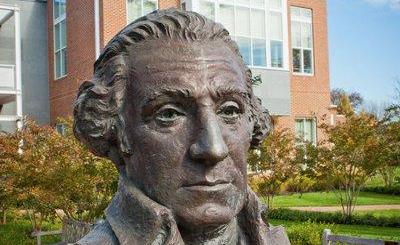
Maybe it can be taken for granted at times, but for 238 years Washington College has been a remarkable beacon of enlightenment and tolerance for the Eastern Shore.

Born as a testament of George Washington’s character and citizenship,  the 10th oldest college in the country has been a source of exceptional scholarship and distinguished alumni fulfilling the founders’ vision to provide to the new nation citizens and leaders with the gift of critical thinking. The entire Eastern Shore is and should always be grateful for its existence, proud of its accomplishments, and supportive of its centuries-old mission.

The Spy certainly does so. Indeed, to be fair, this publication is a product of Washington College alumni. To paraphrase F. Scott Fitzgerald, the Spy always has had, and will continue to have, a disproportionate bias in Washington College’s favor.

Nonetheless, the Spy must fulfill its own mission and speak critically about the institution when warranted. In fact, a review of our editorials will show a consistent concern for its future, including challenges with leadership, as it refines its mission for the 21st Century. We take no pleasure in these commentaries.

But the events and circumstances leading up to and after the institution’s abrupt cancellation of a student production of “The Foreigner” are alarming.

The use of the word “institution” is intentional here. While there is always an opportunity to point fingers at decision-makers, it is rarely helpful to the school or the community. The administrators and faculty involved in this rushed decision were well-intended. It is best to recognize that all organizations or governments (including the Spy) are capable of systemic folly of the highest order at times.

This was one of those times.

Published in 1983, the play tells a moral tale about confronting xenophobia and racism in a rural Georgia hotel against a backdrop of white supremacy and the KKK who work to take control of the lodge. The protagonists take the moral high ground and vanquish the evil ones from their lives in the final scene.

In short, if one was looking for smoke to yell “fire” in a crowded theater, this would not make the list. The College made a capital error in not allowing the play to be performed as scheduled.

The word folly may be too generous a term when recounting a series of events that led to this act of academic censorship. All of which was compounded by the fact that the play itself stands up to bigots and bullies. It stretches the intellectual imagination to see how this play would be any different from a performance of To Kill a Mockingbird with its racially charged scenes or the equally sinister Nazi characters in The Sound of Music.

Equally discouraging was the rationale that the play’s performance had become a safety issue, when the cancellation came several days before confirmed reports that a driver of a pickup truck had yelled racial slurs at students. The reports appeared to be retroactively conflated as a justification to cancel the play.

In the end, Washington College’s decision to cancel the play may be the byproduct of a complicated world of increasingly heightened political and cultural sensitivity. Nonetheless, censorship, in this case, was a sign of an institution out of sync with its core values. Every time censorship is used, it draws into question a school’s genuine commitment to the liberal arts’ highest purpose to have students think critically.

Adding to this botched process, the College has not provided any serious explanation as to why the concerns about the play were not raised during the 23-months between approval and the point at which the director, cast and crew were ready for dress rehearsal. It seems a substantial misuse of student and staff time and college treasure.

Beyond the fact that the College canceled the wrong play for the wrong reasons, it was the worst kind of intellectual retreat at the worst of times. As the school was shutting down The Foreigner, the nightly news was filled with footage of college students in Hong Kong bravely fighting in street battles to protect their right to free speech. It also came at a time when UC-Berkeley safely allowed the arch-conservative Ann Coulter to speak on campus.

As Washington College picks up the pieces from this most unfortunate moment, there is hope its leaders will share with its community what it has learned and what it must do to reinforce its commitment to liberal arts education and the training of free-thinking citizens.

Don’t miss the latest! You can subscribe to The Talbot Spy‘s free Daily Intelligence Report here. 

The Spy Newspapers may periodically employ the assistance of artificial intelligence (AI) to enhance the clarity and accuracy of our content.

Filed Under: Editorial, Op-Ed Tagged With: Chestertown, editorial, local news, The Talbot Spy, Washington College

Editorial: Mass Shootings, Mental Health Stigma, and Flags

August 5, 2019 by The Talbot Spy


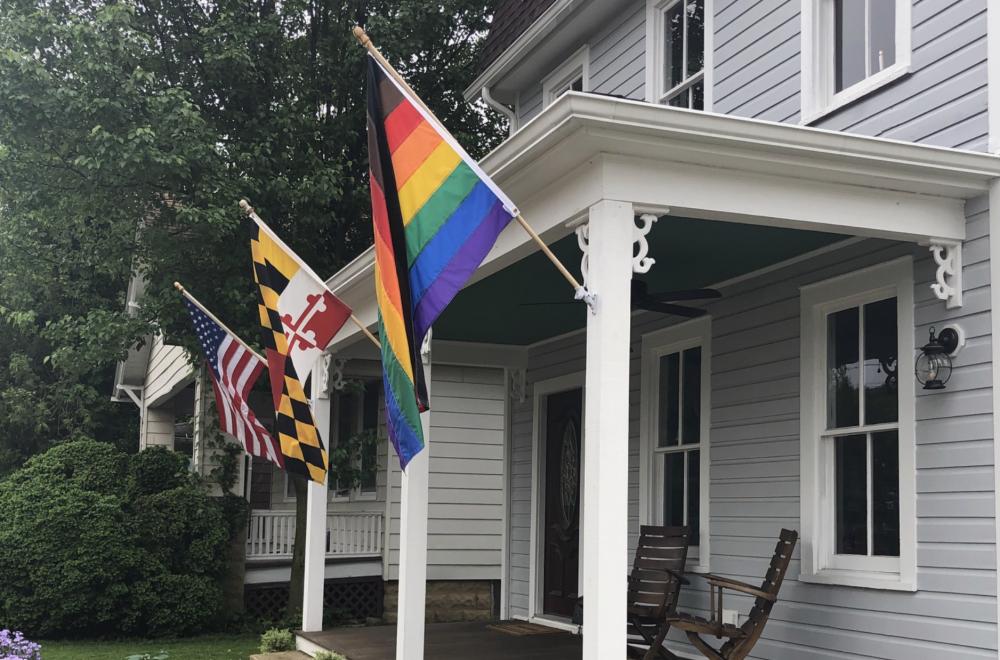
This started as a piece about flags, free speech and our community’s ability to rise above the divisive.

Then came the Gilroy Garlic Festival shooting, which likely prompted more than a few safety check texts to West Coast family and friends. Saturday brought news of the shooting of 20 persons and maiming of many more at a Walmart in El Paso, Texas. We woke on Sunday to hear of the early morning shooting of nine persons at a Dayton, Ohio nightspot.

We moved on from flags. We want to remind all of our readers that mass shootings should not fuel stigma about mental illness. And the power to prevent these tragedies starts with family, friends, co-workers and neighbors. See something, say something, and follow up.

This is confirmed in a well-time piece published in the Los Angeles Times by criminologists Jillian Peterson and James Densley of the Violence Project who summarized their conclusions and recommendations having completed an analysis of U.S. mass shooter data since 1966 funded by the National Institute of Justice. Read their entire piece here.

https://www.latimes.com/opinion/story/2019-08-04/el-paso-dayton-gilroy-mass-shooters-data
Peterson and Densley identified common traits among most mass shooters studied: exposed to trauma and violence as a child; experienced an identifiable life crisis leading up to shooting; emulated prior shooters and fed off their notoriety and public fear created; and had the means to carry out the act.

Peterson and Densley noted that most mass shooters have reached a point of having lost everything and are likely suicidal. Sadly, these persons don’t slide so far without missing the notice of someone—a family member, friend, neighbor.

Among their recommendations was the reminder we need to be proactive, not just in time of crisis, but when the trauma is first experienced. These events are a sad reminder that we owe to each other to build trust, demonstrate empathy and keep lines of communications open, particularly in times of crisis. You never know the crisis you may avert or the community you will strengthen.

The Spy Newspapers may periodically employ the assistance of artificial intelligence (AI) to enhance the clarity and accuracy of our content.

Filed Under: Editorial, Op-Ed

Publisher Notes: The Spy Welcomes New Columnist Dan Watson

March 28, 2019 by The Talbot Spy

I want to welcome our new columnist for The Talbot Spy this week, Dan Watson. Dan, a resident of this county for twenty-five years after a successful career in real estate development, will be regularly writing on a variety of subjects focusing on Talbot County, but with a particular interest in local government and our environment—both the “built” and “natural” environment.

Many of our readers will remember Dan’s role as chair of Bipartisan Coalition For New Council Leadership, a political action committee, which successfully led a campaign to vote out the former President of the County Council. Before the 2018 election, Watson was an outspoken critic of many zoning and land use decisions made by the Talbot County Council. He has been a frequent contributor to the Spy since 2013.

As with the case with all of our columnists, the Spy does not support, nor endorse Dan’s unique point of view. Some readers will undoubtedly find fault with some of his positions, and therefore, it is critical for our readers to use our comment section, or a letter to the editor format, to give fair but civil rebuttals to Dan’s positions.

The Spy expects from Dan’s columns a thoughtful analysis, insight, and persistent vigilance on what’s happening in Talbot County a useful perspective of local government. But that can be a slippery slope. At its very best, these observations can be an irreplaceable tool that profoundly improves how our government operates. It can also, without doubt, eliminate, or put a spotlight on, perceived political corruption and biased discretion in the creation of laws and policy.

But at its very worst, even with the most well-intended practitioners, the act of vigilance can lead to painful consequences for a community. A hyperfocus on personalities in particular can and does lead quickly to overreaction, paranoia, and even unfair character assassination.

And yet, on balance, the Spy believes Dan’s eye on Talbot County has the potential to produce a meaningful dialogue for our community and readers. While these conversations might be painful to have, the Spy believes they are critically important for Talbot County’s continuous commitment in finding its “true north” in protecting our special quality of life.

In that spirit, we welcome Dan and his perspective on Talbot County.

Dave Wheelan
Executive Editor and Publisher

The Spy Newspapers may periodically employ the assistance of artificial intelligence (AI) to enhance the clarity and accuracy of our content.

Filed Under: Editorial

Editorial: There Can Never Be Enough Purple on the Mid-Shore in September

August 29, 2018 by The Talbot Spy

In the field of advertising, the old saying goes that it takes at least seven uniquely different exposures to a product before the consumer actually decides to purchase it. In the marketing of awareness and prevention of the opioid crisis, one should apply a multiplier effect of a 1,000 when the aim is to reach out to young people of the fatal consequences of a drug epidemic that killed 70,000 Americans last year.

Like other public health campaigns that have came before it, including such great successes as with the war against tobacco and AIDS, the strategy for drug awareness is simple; pound on the table as much as you can for as long as you can.

And that is the power and magic of the Purple project for the Mid-Shore this September.

Started last year in Talbot County by the Sheriff’s Office and the Tidewater Rotary with modest expectations, it turned out to be remarkably successful for reasons large and small as the community responded dramatically to “Talbot Goes Purple” through rallies, games, high school programs, and most importantly, the profoundly moving sight of entire towns lit up purple on almost every porch, storefront, street lamp, or dozens of other creative ways to show solidarity with oppied prevention.

As a result of this overwhelming response, Talbot Goes Purple became a model for other Mid-Shore counties to replicate, and it is profoundly moving that Caroline, Dorchester, Kent, and Queen Anne’s counties have formed community partnerships with their schools, businesses, and neighborhoods to join “Mid-Shore Goes Purple,” including the Spy, which will become, we hope, a portal for news and stories from the five different purple campaigns.

But how do we know all this purple in September is working? Is this the most effective way to reach potential users of opioids?

The answer is an unequivocal “yes,” at least from the perspective of someone who is on the battlefield; Talbot County Sheriff Joe Gamble. In his Spy interview to be broadcast today, Gamble points to data where deaths by overdoses have been reduced, and those receiving police-administered Narcan treatment (and therefore should be counted as lives saved) has increased.

Statistics like these remain the final test for how a county on the Shore is succeeding or failing on a drug epidemic, but one can not overlook the collateral benefits that have come with Talbot Goes Purple. From the creation of group homes for recovering drug users, the widespread training in the use of the life-saving Narcan, or the creation of student awareness groups at local schools, these examples demonstrate that Talbot’s collective response to the crisis is serious and sustained.

Our region has a long way to go before we are out of harm’s way with this horrific danger. The opioid crisis will take years, perhaps more than a decade, to be totally defeated. In the meantime, there can never been enough purple in September on the Mid-Shore and the Spy is proud to turn that color.

For information on how to help, volunteer, or just where one can pick up a purple light bulb for their home, please go here


The Spy Newspapers may periodically employ the assistance of artificial intelligence (AI) to enhance the clarity and accuracy of our content.

Filed Under: Editorial

Editorial: The First Congressional District and Election 2018

May 21, 2018 by The Talbot Spy

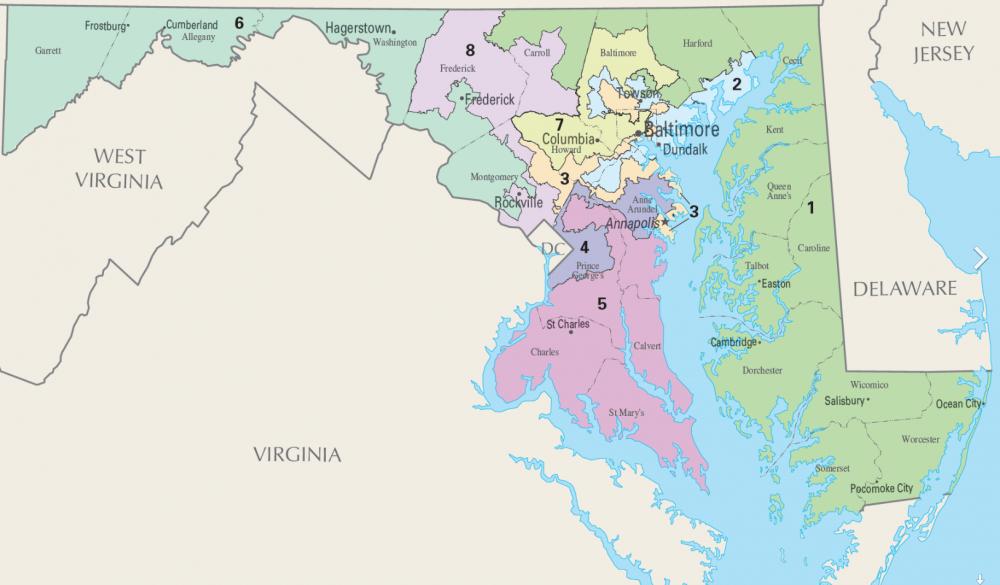
When thinking about the Eastern Shore’s historical relationship with the 1st Congressional District of Maryland, it’s important to keep one thing in perspective. The Shore, until recently, had mostly been served by one of their own residents for more than 150 years. From the election of James Stewart from “Tobacco Stick” in Dorchester County in 1854 to the defeat of Frank Kratovil from Stevensville in 2010, the 1st was always considered to be an Eastern Shore seat.

And, for the most part, the Shore had taken that responsibility seriously by electing men (no woman has yet to serve) of strong moral fiber and, at times, real political courage.

From Cecil County’s abolitionist John Creswell in 1862 to Easton’s Harry Covington, the founder of Covington & Burling, former Secretary of the Interior Rogers Morton, and more recently, Kennedyville’s thoughtful and independent Republican Wayne Gilchrest, the Shore has a record of sending some of their very best and brightest to Washington.

But that all ended in 2010.

The moderate Democrat Kratovil could not survive the anti-Obama wave that election year. While Kratovil did not vote for the Affordable Care Act, a key issue in that election, GOP conservative Andy Harris was able to attract enough new voters from the far right, many of whom were motivated by such grassroots movements as the Tea Party, to win with 54% of the vote.

The 2010 loss was a big deal for the Eastern Shore beyond the loss of Queen Anne’s Frank Kratovil. It was also the year that a decennial census took place which would make up the data used to help Maryland draw new Congressional districts for the 2012 election year.

With Democrats holding both legislative houses and the Governor’s office in Annapolis, senior party leaders drew up new boundaries in Maryland that many critics felt were designed to secure more congressional seats in Congress for Democrats. By moving high concentrations of predictably Republican voters from Carroll, Baltimore, and Harford Counties into just one district, the theory went, the odds improve for the Democrats in the other districts.

And that one district happened to be the 1st Congressional District.

Now separated from the Shore’s historically-linked sister counties of St. Mary and Anne Arundel, the new 1st arches across the top of the Chesapeake and moves west while cutting into Carroll, Baltimore, and Harford Counties to guarantee this super-safe Republican seat.

While the courts are now reviewing the constitutionality of that new districting plan, by November 2012 the results were clear. Congressman Harris beat his Democratic opponent with now 70% of the vote, which eventually placed it on the Cook Political Report’s Partisan Voter Index as the 86th most reliable Republican district in the United States.

With that kind of outcome, Maryland GOP leaders would normally not worry too much about an upcoming mid-term election, but then Donald Trump became president.

The political maverick had accomplished what experts said was impossible in 2016 by defeating more than a dozen Republicans in GOP primaries and ultimately Hillary Clinton in the general election. With majorities of both the House, and now the Senate, the Trump mandate, however modest it was, based on an electoral college victory rather than the popular vote, was seen by the winners as a rallying cry for significant social and economic change in Washington.

Some of that change has now taken place. The Trump administration has wasted little time in the dismantling of the EPA, cut thousands of regulations, provided significant corporate tax relief, introduced an “America First” foreign policy, and dozens of other actions, large and small, that cumulatively may add up to be the largest deconstruction of the federal government in our history.

If those changes turn out to be what the voters truly wanted, the Republicans would have much to crow about as they enter into the 2018 midterms, and that would include Congressman Harris.

But these policy victories have come with unprecedented collateral damage. Since taking office, the new president has used his bully pulpit to literally bully his opponents, foreign leaders, ethnic groups, a national war hero, and even celebrities through his Tweeter feed and in public appearances. He is also considered to be by most Americans, including members of his own party, highly capricious in judgment and lacking moral authority, while at the same time is the primary story of a federal investigation of 2018 campaign collusion and obstruction of justice. The fact that he is also being sued by two women he may have had affairs with would make even the most objective onlooker believe the President is a major liability in the fall election.

For Congressman Harris, this is especially problematic since he has not only been a steadfast defender of the President, his own moral compass was thrown into question when he endorsed Alabama’s Roy Moore for the U.S. Senate well after credible reports showed the former judge’s history of having intimate relationships with underaged girls.

With all that in mind, the Spy now believes that, despite the remarkable political engineering it took to guarantee a safe Republican 1st District, the projected outcome in November is hardly certain.

That is why the Spy will be taking a special interest in the 1st District throughout the rest of the year. Over the next six months, we will be profiling Democrats and Republicans from most of the counties that make up the 1st to understand these very different communities and the people that live in those communities.

We start today with our profile of Carroll County through the lens of the member of the Democratic Central Committee there. The following month will be an active Republican in another county. Our stakeholder interviews will alternate between the two parties until the election takes place.

While the Eastern Shore may never return to a time when their U.S. Congressperson is from the Eastern Shore, and we hope that is not the case, that will not limit the Shore’s real interest in the 2018 election. We can only hope that our Spy coverage will only help further a thoughtful and civil conversation about how it will be represented in the future.


The Spy Newspapers may periodically employ the assistance of artificial intelligence (AI) to enhance the clarity and accuracy of our content.

Filed Under: Editorial

Publisher Notes: Please Chip in for the Spy this Month

March 6, 2018 by The Talbot Spy

Precisely seven years ago this month, the Talbot Spy began its life as an online news source for a community I had fallen in love with as an undergraduate at Washington College in 1974.  The premise was simple enough. By using the extraordinary tools that the internet provided, such as the ability to use multimedia, easy reader access, and relatively low cost start up, the Spy could be a powerful and useful complement to a legacy newspaper of record and engage more residents in the daily affairs, the arts and culture of their region.

The business plan was also just as simple. Generate enough revenue to cover these costs and provide modest stipends for the Spy’s editors and writers.  There was no vision for media domination or commercializing the “product” to monetize investment. The payback would come with a community well informed and respectful of diverse opinion.

Nor was there any guarantee of success. While I had known Talbot County relatively well,  it was hard to predict if this was a value-added proposition for a community that prided itself on not being an early adapter to most things.

Seven years later, the Talbot Spy has 15,000 readers a month reading it on average five times a month. It has attracted over 200 sponsors and has been able to pay its editors and writers the small stipends they were promised.

More importantly, the Spy has been able to remain true to its mission and aspirations. Over 2,000 educational video programs have been produced, over 10,000 original content articles or local opinion pieces have been published, and 15,000 vetted reader comments have been posted.

With the increased awareness that the Spy was indeed a community asset worthy of philanthropic support, I made arrangements with the Mid-Shore Community Foundation to become the Spy’s fiscal partner, allowing us to receive funding from private foundations as a non-profit entity starting in 2013.

All of these ingredients have worked together to keep the Spy afloat over these years, but the reality is that we, like every nonprofit organization, must seek a highly diverse revenue flow, and must now ask you, gentle reader, to chip in.

For the balance of March, the Spy will not be shy about asking for this support. Taking a page out of the playbook of other fundraising programs online, we will have a “pop-up” appear for a few moments to beg the question of a modest monthly contribution or one-time donation to keep the Spy going.

I hope with your help the Spy can continue to serve Talbot County for many decades to come with your help.

Please make a contribution here.

Dave Wheelan
Publisher


The Spy Newspapers may periodically employ the assistance of artificial intelligence (AI) to enhance the clarity and accuracy of our content.

Filed Under: Archives, Editorial

Editorial: Not so Wild a Notion – A Small Grocery Store Can Work in Easton

February 14, 2018 by The Talbot Spy

There is probably not a day that goes by in downtown Easton when at least a few of the pedestrians that pass the now abandoned Safeway on Harrison Street don’t shed a tear for that missing food store. While a few might have some affection for the food store chain itself, it is more than likely that much of the grief is felt for the end of an era when walking or biking to a grocery store was an real option.

Since Safeway’s departure, a solid core of downtown residents now must now pile into their cars (if they have one) to head off to the larger food stores off the Bypass or Route 50, adding to Easton’s traffic pressures and rush hour congestion.

What makes this a particularly melancholy affair is the growing feeling that the old Safeway will not be occupied anytime soon with a replacement. In fact, it is more likely that no large food chain, even if permitted to locate there, would find it cost-effective to establish a such a small footprint venue.

This predicament is not unique to our community. With a return on investment in doubt and competition severe, these corporations are electing to drop their small stores and expand the number of “superstores” outside downtowns, allowing more parking and easy access for cars.

The result for Easton, sadly enough, is a substantial retail gap in our downtown district and, more importantly, quality of life.

But maybe it is not so wild a notion to imagine a return to a smaller scale, traditional grocery store (think of the beloved Todd’s on Aurora Street) capable of serving Easton’s growing pedestrian community and provide a modest profit.

The fact of the matter is that there are several models, in all different types of settings, that show that one does not need a 50,000 square-foot grocery chain store to succeed.

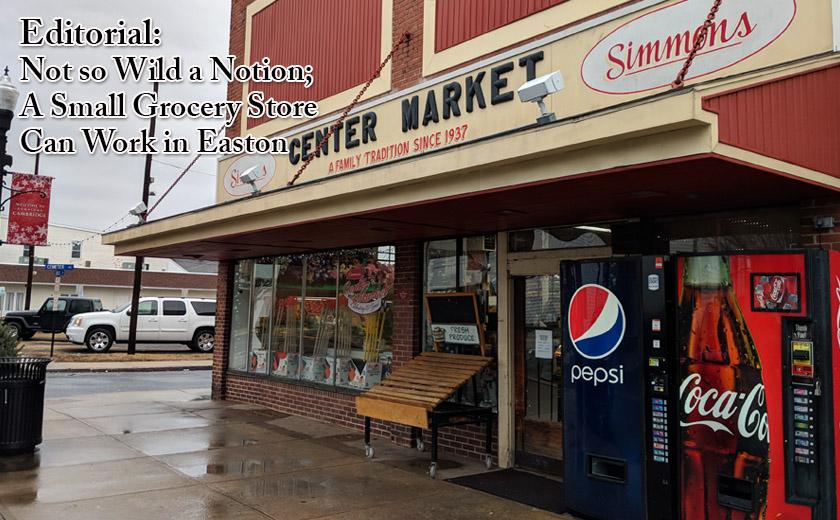
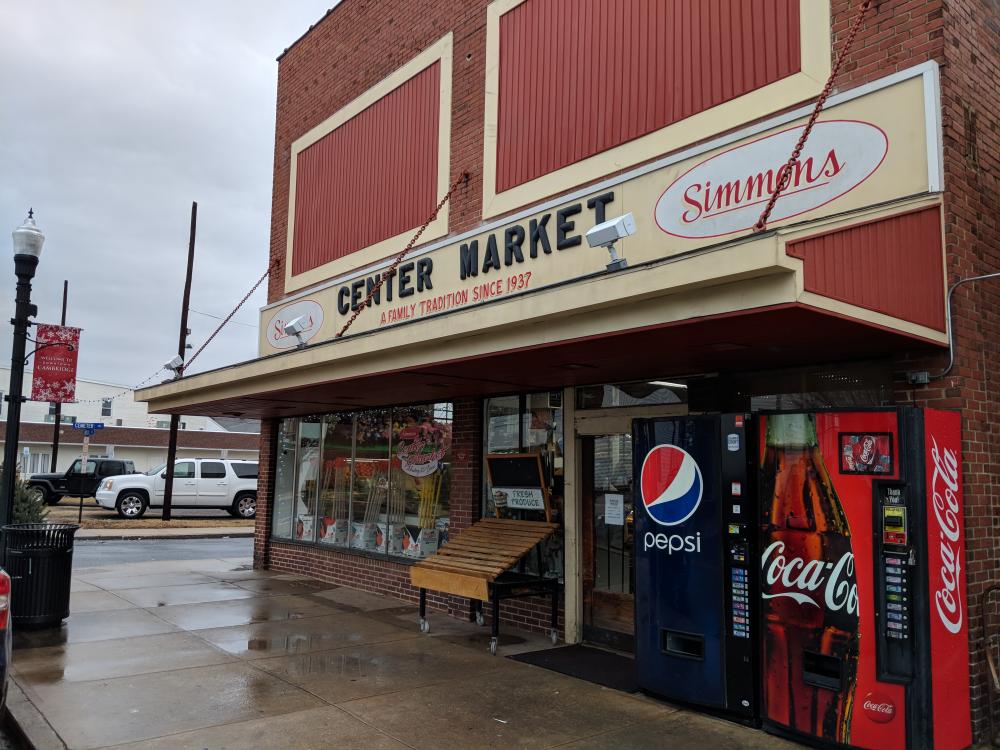
One remarkable example can be found on Race Street in downtown Cambridge. The Simmons Center Market has been serving its community since 1937 with marginal parking and a less than a convenient location for motorists. But with a regional reputation for quality meats and reasonable prices, the Central Market continues to strive notwithstanding its proximity to a Walmart Superstore and Food Lion chain store in the same town.

Looking beyond the Eastern Shore is the extraordinary story of the Bi-Rite grocery store in San Francisco, which provides no parking in a community without parking, and yet yields $4,000 per square foot. By contrast, traditional supermarket revenues are said to produce $200 to $300 per square foot while a Whole Foods store brings in $900 to $1,000 per square foot.

A four minute mini-documentary on Bi-Rite Market

It is with these kinds of case studies that should encourage one of our many local entrepreneurs (and their potential investors) to see a way forward to offer a similar experience for Easton’s downtown. We can only keep our fingers crossed that they do.


The Spy Newspapers may periodically employ the assistance of artificial intelligence (AI) to enhance the clarity and accuracy of our content.

Filed Under: 1 Homepage Slider, Editorial

Editorial: The Color of Purple in Talbot County

October 20, 2017 by The Talbot Spy

It’s hard to think that those of us who live in Talbot County can ever go back to what the color purple meant to us after the last thirty days. Gone forever are the associations of that color with the Baltimore Ravens, ecumenical symbols, Purple Heart citations, or even an artist formerly known as Prince.

No, the color purple now stands out as strikingly different to thousands of us in the community because of the flawless launch of the “Talbot Goes Purple” awareness campaign, sponsored by the Talbot County Sheriff’s Office and Tidewater Rotary, which powerfully drew attention to the horrific opioid crisis on the Mid-Shore.

The selection of the color for such use is remarkable in itself. Purple is considered the most complex on the color spectrum. Before a dye was accidentally created in a chemistry lab a few hundred years ago, purple could only be produced by using rare sea snails, leaving it to be the exclusive property of the very rich or religious orders of the times.

Perhaps because of this rarity, purple has always been historically linked to royalty, magic, and mystery, but more recently it has been seen to represent spiritual awareness, physical and mental healing, strength and abundance.

The latter might explain why it was the perfect color to use in Talbot County last month. As one of Alice Waters characters said in her classic novel, The Color Purple, “I think it pisses God off if you walk by the color purple in a field somewhere and don’t notice it.”

And notice it, we did.

From bumper stickers to grids of purple lights glowing nightly in downtown Easton, the community could not avoid the color nor what it represented for local families overwhelmed by the most savage drug epidemic in our country’s history.

And yet even with this sad connotation, it is a feeling of hope that remains purple’s best quality. In can move us beyond hopelessness and remind the community of what ties us together. As demonstrated over the last month, it has become a sign of compassion and support to all those impacted by this cruel and evil force. As more and more residents of Easton replaced their traditional exterior lighting for purple bulbs throughout the last four weeks, there was a glowing sense of a county sharing something very much in common.


The Spy Newspapers may periodically employ the assistance of artificial intelligence (AI) to enhance the clarity and accuracy of our content.

Filed Under: Editorial

Next Page »

Copyright © 2026

Affiliated News

  • The Chestertown Spy
  • The Talbot Spy

Sections

  • Arts
  • Culture
  • Ecosystem
  • Education
  • Mid-Shore Health
  • Culture and Local Life
  • Shore Recovery
  • Spy Senior Nation

Spy Community Media

  • Subscribe
  • Contact Us
  • Advertising & Underwriting

Copyright © 2026 · Spy Community Media Child Theme on Genesis Framework · WordPress · Log in