
MENU

Sections

  • Home
  • About
    • Contact Us
    • Editors and Writers
    • Join our Mailing List
    • Letters to Editor Policy
    • Advertising & Underwriting
    • Code of Ethics
    • Privacy
    • Talbot Spy Terms of Use
  • Art and Design
  • Culture and Local Life
  • Public Affairs
    • Ecosystem
    • Education
    • Health
    • Senior Life
  • Community Opinion
  • Sign up for Free Subscription
  • Donate to the Talbot Spy
  • Cambridge Spy

More

  • Support the Spy
  • About Spy Community Media
  • Advertising with the Spy
  • Subscribe
January 21, 2026

Talbot Spy

Nonpartisan Education-based News for Talbot County Community

  • Home
  • About
    • Contact Us
    • Editors and Writers
    • Join our Mailing List
    • Letters to Editor Policy
    • Advertising & Underwriting
    • Code of Ethics
    • Privacy
    • Talbot Spy Terms of Use
  • Art and Design
  • Culture and Local Life
  • Public Affairs
    • Ecosystem
    • Education
    • Health
    • Senior Life
  • Community Opinion
  • Sign up for Free Subscription
  • Donate to the Talbot Spy
  • Cambridge Spy
00 Post to Chestertown Spy Point of View Opinion

Donald the Red: The Modern Viking by Jim Bruce

January 16, 2026 by Opinion 5 Comments

Donald Trump is a 21st-century throwback to Erik the Red, the Viking chieftain and explorer who first claimed Greenland and established settlements there one thousand years ago. When President Trump was asked recently if he saw any checks on his power on the world stage, he replied, “Yeah, there’s one thing: my own morality, my own mind. It’s the only thing that can stop me.”

His assertion is consistent with the view expressed by his Domestic Policy Advisor, Stephen Miller, who insists that the world is governed fundamentally by strength, by force, by power, what he calls the “iron laws of the world since the beginning of time,” as if all other laws matter not. The Vikings believed similarly that the strong are destined to overcome and rule the weak, to plunder and even enslave them.

Erik the Red’s sphere of influence was a tiny northern slice of the globe — Norway, Iceland, and Greenland. President Trump’s new National Defense Strategy extends the 18th-century Monroe Doctrine to assert that the entire Western Hemisphere is the domain of the United States, so other great powers should stay out, the so-called “Donroe Doctrine.” Thus, Trump is asserting his claims on Venezuela, Greenland, Cuba, Colombia, Mexico, and even Canada. Trump’s real goal in the western hemisphere is not interdicting illegal drugs in speedboats, nor regime change in Venezuela, nor spreading democracy, but rather old-fashioned plunder. His intent to plunder Venezuela’s resources is now obvious as he takes control of their oil. He also covets rare earth minerals in Greenland and Canada for starters and wants to deny Russia and China any opportunity to plunder in the western hemisphere. It is not enough to add U.S. military bases to Greenland, which the U.S. is free to do under existing treaty. Trump insists that he must own Greenland. We have never before seen a modern President unabashedly plunder other sovereign nations, including our own allies.

Erik the Red and Trump are surprisingly similar. Ancient texts describe Erik as having strikingly red hair with a fiery temper, and a penchant for naming landmarks after himself in Greenland to stake his claim on the land. Trump’s hair color is a chromatic shade off red, but red nonetheless, along with an incendiary temper.

Both Erik the Red and Trump the Red operated boldly and comfortably outside the law. In fact, both Erik the Red and Trump were banned from their homelands — Erik was banned from Iceland for murder twice, and Trump was banned from doing business in New York state. Erik the Red moved to Greenland and Donald moved to the White House.

Both were slick marketers. Erik named the land “Greenland” not because it was green, but because it wasn’t. The name Greenland would lure settlers in hope of lush pastures, better than the truth. Donald’s marketing brand color is gold — gold lettering, interiors, ballrooms, a Golden missile defense shield, a golden class of ships, and gold gifts.

Neither Erik nor Donald cared about what the people already living in Greenland want for their future. Erik sought to create new Viking settlements over which he would reign as chieftain. Donald’s purpose is to own Greenland and plunder it by conquest or by inexorable economic pressure.

Erik’s settlements in Greenland lasted 500 years, but probably climate change, specifically the Little Ice Age, ended the settlements in Greenland. Donald is just as blind to climate change as Erik the Red, who had no science advisors.

Given the world in which he lived, we can still honor the legend of Erik the Red, ten centuries later, as a Viking chieftain, explorer, and colonizer. Donald gets no such pass from history.

Those 1,000 years of civilization since have repealed Stephen Miller’s “iron laws of the world since the beginning of time.” We have learned to respect the sovereignty of nations and their right to self-determination. In 1789 we adopted a Constitution that substituted the rule of law for these “iron laws.” Beginning a century ago, two world wars established the well-recognized principle that conquering another nation just because it might make yours more secure, or wealthier, is condemnable. Donald the Red is a dangerous anachronism.

Jim Bruce
St. Michaels
The Spy Newspapers may periodically employ the assistance of artificial intelligence (AI) to enhance the clarity and accuracy of our content.

Filed Under: 00 Post to Chestertown Spy, Opinion

Election 2026: Heather Mizeur and Rick Hughes on Respectful Civic Engagement

January 9, 2026 by Opinion 1 Comment

As Americans continue to grapple with deepening political and cultural divides, a new kind of gathering is taking root on the Eastern Shore—one aimed not at debate, but at dialogue.

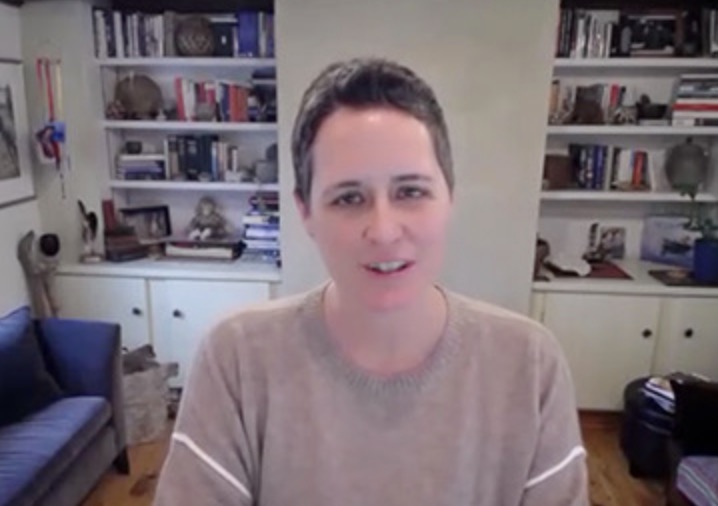
On Thursday, January 29, from 5:30 to 7:30 PM, the Talbot County Free Library will host a community conversation led by Rick Hughes, local community organizer, and Heather Mizeur, former congressional candidate and founder of the We Are One Alliance.

“The one question that kept coming up,” says Hughes, “was: what can we do? People in Oxford, St. Michaels, and Easton have formed citizen groups precisely because they’re alarmed by the division in our society. They wanted a safe space where people from all walks of life and political persuasions could actually talk, and listen, to one another.”

Hughes, familiar with Mizeur’s work, reached out with an invitation. “She has one of the answers to that question. The old way of talking isn’t working anymore.”

Mizeur, who now leads the We Are One Alliance, sees this polarization as a national emergency.

“Our polarization is our greatest national security threat,” she says. “According to a recent New York Times/Siena poll, 64 percent of the country believes we’re too divided to solve our problems. After the economy, the number two issue was the division itself. That’s historic.”

Her response? A new framework for civic dialogue, one that emphasizes curiosity over conflict and connection over judgement.

“Most of us have been trained to lead with our talking points,” she explains, “to win an argument rather than understand a perspective. Democracy was never meant to be a zero-sum game. It’s a daily act of faith in one another.”

Mizeur will introduce tools used by the We Are One Alliance, including those she developed during her own campaign in Maryland’s First Congressional District. Attendees will hear about her journey, engage in practice dialogue, and explore techniques for transforming conflict into collaboration.

A key part of the approach includes internal work. “It’s not just about how we talk to others—it’s how we show up to ourselves. One of the most popular resources we offer is a free online course centered on gratitude, which draws on ‘The Four Agreements’ by Don Miguel Ruiz: be impeccable with your word, don’t take things personally, don’t make assumptions, and always do your best.”

Mizeur emphasizes that the work is nonpartisan. “We’re not promoting an ideology. We’re promoting a way of being. We teach that in the pause between stimulus and response, we have power. Real leadership starts with that pause.”

With space limited to 100 seats, the event has already generated strong interest.

“We aren’t here to prove each other right or wrong,” says Hughes. “We’re here to try something different. And Heather has the tools to guide us.”

The event is free and open to all. To register, go here.

This video is approximately 10 minutes long.

The Spy Newspapers may periodically employ the assistance of artificial intelligence (AI) to enhance the clarity and accuracy of our content.

Filed Under: Opinion

Horn Point Cuts Put Chesapeake Oyster Recovery at Risk by Sarah Gavian

January 2, 2026 by Opinion

Everybody on the Eastern Shore knows oysters matter. They clean the waters of the Chesapeake Bay, support watermen and oyster farmers, and sustain working waterfronts. After decades of effort, oyster populations in Maryland waters have roughly tripled since 2005, and Bay states recently met long-term goals for restoring reefs in key tributaries. That progress did not happen by accident — and it will not continue by accident.

Recent reporting in The Baltimore Banner detailed how the Trump administration, through the National Oceanic and Atmospheric Administration (NOAA), is cutting federal funding to the Horn Point Laboratory. Horn Point, on the Choptank River just outside Cambridge, operates the largest oyster hatchery on the East Coast and is part of the University of Maryland Center for Environmental Science. Over the past two decades, it has produced more than 18 billion juvenile oyster seed used to rebuild reefs across the Chesapeake and to support both sanctuary restoration and commercial oyster farming, with roughly a quarter of its production going to farms.

This is not a niche operation serving one county. Horn Point’s work has been studied and emulated by restoration efforts from Virginia to New York Harbor and beyond. It is applied science infrastructure, built here in Dorchester County, that supports a regional ecosystem and economy.

I have seen this work up close. In past seasons, I partnered with ShoreRivers and the Chesapeake Bay Foundation to grow oysters at my dock for sanctuary reefs, using spat set at Horn Point on recycled shell. The baby oysters were raised through their most vulnerable stage and returned in spring for planting on protected reefs. Like many volunteers, I spent cold winter weeks hauling cages out of the water and cleaning them so the juveniles could survive. It was hard, repetitive work — and a point of pride to support the Bay’s recovery in a tangible way.

NOAA has now reduced Horn Point’s annual federal support by about $340,000 — nearly a 45 percent cut from the roughly $740,000 it has received in recent years. Those dollars largely pay for the skilled staff who spawn oysters, run larval tanks, culture algae, and move spat onto reefs. The reduction hits in the final year of a four-year grant, and Horn Point scientists worry deeper cuts could follow. The hatchery now operates with what staff describe as a skeleton crew of eight full-time employees, and managers have warned that without replacement funding, layoffs may be unavoidable.

Some argue Maryland should simply replace the money, or that waterman fees should cover more of the cost. That misunderstands what Horn Point is. Oyster restoration in the Chesapeake has long been designed as a federal–state partnership because the Bay is a multi-state waterbody with national ecological and economic importance. NOAA’s Chesapeake Bay program funds work that benefits Maryland watermen, Virginia fisheries, upriver communities that depend on cleaner water, and downstream economies across the region. Treating Horn Point as a purely local subsidy ignores the broader public value it creates.

That is why this cut cannot be dismissed as “Maryland’s problem.” When Washington pulls back from shared investment in science and restoration, it leaves a few rural counties to absorb costs for work that benefits many. The result is not efficiency — it is erosion of a system that has taken decades to build.

That brings us to our congressional representative. Rep. Andy Harris supports an administration whose budget priorities include deep cuts to environmental and science agencies. When those priorities land on the Eastern Shore, he has chosen not to meet them with visible public opposition. Reporting indicates his office helped arrange a meeting between NOAA officials and Horn Point leadership after the cut became known, but there has been no public statement opposing the reduction, no announced effort to restore funding in Congress, and no clear plan to mitigate the harm locally. When asked for comment, his office did not respond.

Members of Congress do not sign every grant, but they do shape budgets and decide when to defend critical institutions in their districts. Fewer staff at Horn Point means fewer oysters produced, fewer sanctuary reefs rebuilt, and fewer opportunities for commercial growers who rely on hatchery seed — undercutting the work of volunteers, watermen, nonprofits, and state partners alike. At a moment when scientists believe the Bay’s oysters may be approaching a tipping point toward self-sustaining recovery, federal support is being pulled back from one of the institutions that made that possibility real.

Eastern Shore residents have invested too much — in tax dollars, time, and hard work — to watch that progress quietly erode. Silence, in the face of cuts like these, is not neutrality. It is a governing choice. And it carries real consequences for the Bay we are trying to restore.

Sarah Gavian lives in Dorchester County and has participated in oyster restoration efforts with ShoreRivers and the Chesapeake Bay Foundation.

The Spy Newspapers may periodically employ the assistance of artificial intelligence (AI) to enhance the clarity and accuracy of our content.

Filed Under: 00 Post to Chestertown Spy, Opinion

This Bears My Love to You Pooh by David Wheelan

December 26, 2025 by Spy Daybook

One of the great, little-known crimes against humanity in 2025 was the BBC’s decision to block access to its radio broadcasts outside the United Kingdom. The stated reason was copyright concerns and the threat of litigation, which effectively shut down the BBC Sounds app for international listeners. Whatever the legal rationale, the result has been the loss of access to some of the most enriching and engaging programming in radio—particularly the documentaries and series produced by BBC Radio 3 and Radio 4.

There is, however, a simple workaround. By using a VPN to make your computer or phone appear as though it is located in England rather than, say, the Eastern Shore of Maryland, full access is restored. I encourage Spy readers to do just that and hear for themselves some of the best moments of our shared Western culture. I’ve included a brief “how-to” link below for anyone with a bit of holiday time and curiosity to spare.

There are countless programs to recommend, but the one I have been listening to over the past two days, which has given me so much personal joy, is BBC Radio 4’s series celebrating the 100th anniversary of the publication of A. A. Milne’s Winnie-the-Pooh, entitled Who Are You in Winnie-the-Pooh?

Illustration by Albertine Randall Wheelan

It includes interviews with well-known British children’s writers who spoke about why A. A. Milne’s stories still matter and why every human being should love this bear.

While I can’t recall any parental readings of the classic during my childhood, my family had a well-established love of bears, starting with one of our most cherished family objects: my great-grandmother’s illustration in St. Nicholas magazine in February 1909, long before Pooh ever existed.

I’ve had a soft spot for bears ever since.

In the early 1980s, during long drives through rural New England with my then-wife’s friend Karen, we often found ourselves without radio reception. To pass the time, we took turns reading aloud to each other and quickly agreed that humor was important. It was Karen who suggested we read Winnie-the-Pooh. Upon revisiting it as an adult, I discovered that it contains some of the sharpest, kindest, and most enduring humor imaginable, regardless of age.

Like many readers of the stories and guests on the show, I aspire (but rarely succeed) in being a bit like Pooh. Humble in intellectual capacity (“I am a Bear of Very Little Brain”), devoted to his friends (“We’ll be friends forever, won’t we, Pooh?” said Piglet. “Even longer,” Pooh answered), ready for revelry (“Nobody can be uncheered with a balloon”), and yes, always finding time for a “little something” to eat (“I wasn’t going to eat it; I was just going to taste it.”)

The ideal Pooh moves through the world without edge or pretense. He doesn’t judge, doesn’t scheme, and rarely rushes.

And Pooh gives us advice as we grow older and friends depart.

“Pooh, promise you won’t forget about me, ever. Not even when I’m a hundred.”

Pooh thought for a little.

“How old shall I be then?”

“Ninety-nine.”

Pooh nodded.

“I promise,” he said.

Still with his eyes on the world, Christopher Robin put out a hand and felt for Pooh’s paw.

“Pooh,” said Christopher Robin earnestly, “if I—if I’m not quite——” he stopped and tried again—“Pooh, whatever happens, you will understand, won’t you?”

“Understand what?”

“Oh, nothing.” He laughed and jumped to his feet. “Come on!”

“Where?” said Pooh.

“Anywhere,” said Christopher Robin.

So they went off together. But wherever they go, and whatever happens to them on the way, in that enchanted place on the top of the Forest, a little boy and his Bear will always be playing.

In the end, Winnie-the-Pooh endures not because it is clever, but because it is kind. It reminds us that friendship matters, that joy can be found in small rituals, and that being present for one another is its own form of wisdom. As the world grows louder, faster, and more certain of itself, Pooh offers a quieter example—one rooted in patience, affection, and the simple grace of showing up. Returning, even briefly, to the Hundred Acre Wood is not an escape from adulthood, but a way of remembering what makes it bearable.

You can learn how to get BBC radio in the United States by watching this video. 

The Spy Newspapers may periodically employ the assistance of artificial intelligence (AI) to enhance the clarity and accuracy of our content.

Filed Under: Opinion, 00 Post to Chestertown Spy

When Money Buys the Right to Be Heard, the People’s Voice Is Drowned Out by Tom Dennis

December 24, 2025 by Opinion

For much of modern American history, political access functioned as a competitive but human-scale system. Some interests undeniably carried more sway than others, but access was still constrained by time, attention, and institutional norms. Elected officials and senior policymakers invariably faced pressure from many directions—constituents, civic organizations, advocacy groups, and subject-matter experts—all competing for limited space on the agenda.

No voice was guaranteed priority, and persuasion still depended, in significant part, on evidence, credibility, and public interest.

That balance has been fundamentally altered.

In its 2010 Citizens United decision, the Supreme Court held that limits on independent political expenditures violated the First Amendment, reasoning that greater spending produced more “speech” in the marketplace of ideas. Central to that logic was an assumption: that such spending—so long as it was not coordinated directly with candidates—would not corrupt government or distort democratic access, particularly in a system supported by transparency and disclosure.

Fifteen years later, that assumption no longer matches reality.

A recent New York Times investigation, “Hundreds of Big Post-Election Donors Have Benefited From Trump’s Return to Office” (Dec. 22), documents how just 346 donors—fewer people than a single high-school graduating class—directed more than half a billion dollars into political spending that produced immediate and tangible rewards, including pardons, senior appointments, and direct policy influence.

This is not simply “more speech.” It is speech amplified to such a degree that it drowns out everything else in the room.

Government has a finite capacity to listen. When a small number of individuals can speak so loudly—through massive financial expenditures—that they dominate attention, they effectively drown out everything else in the room. The result is not a richer marketplace of ideas, but a distorted one in which ordinary citizens, local communities, and civic institutions struggle to be heard at all.

In that environment, the constitutional right to petition the government for redress of grievances remains intact in theory but erodes in practice. The door to participation is not formally closed—but it is effectively overwhelmed. When officials’ schedules, priorities, and political survival are dominated by the demands of a narrow donor class, the average citizen no longer has a meaningful chance to be heard.

This is more than a political complaint. It reflects a breakdown in the factual assumptions that once justified the Supreme Court’s decision in Citizens United. Citizens across the country should be asserting—civically and publicly—that those assumptions no longer hold. Disclosure has proven porous, donor anonymity widespread, and access increasingly concentrated in the hands of a few.

This is not a call to silence speech, but to restore balance. A democracy cannot function if its leaders hear only those who can afford to shout the loudest. This concern should not depend on whether one is a republican, a democrat, or an independent, a liberal, or a conservative; it goes to the basic rights of citizens in a functioning democracy.

If the First Amendment protects the right to speak, democracy requires something just as essential: the right to be heard.

When money is allowed to drown out everything else in the room, that promise rings hollow.

Tom Dennis is a retired Washington lobbyist and a resident of Easton, Maryland.

The Spy Newspapers may periodically employ the assistance of artificial intelligence (AI) to enhance the clarity and accuracy of our content.

Filed Under: Opinion

“Fail First” is a Failure Always Ali Asghar Kassamali

December 13, 2025 by Spy Daybook

Imagine walking into a health care clinic only to find that our loved one cannot receive the medication their doctor recommends, not because it is unsafe or unproven, but because their insurance requires them to “fail first.” This practice, known as step therapy, forces patients to try cheaper medications before gaining access to the treatments their physicians know are most effective. In theory, it is meant to control costs. In reality, it delays care, worsens disease outcomes, and undermines medical judgment. 

Step therapy places bureaucracy above medicine. It compels patients to take medications that may be ineffective or even harmful, prolonging suffering and increasing the risk of irreversible complications. Worse still, protections against this practice are inconsistent across states and insurance types. As a result, many of us face uncertainty each time we switch jobs, plans, or providers, never knowing whether we will be forced to “fail first” again. 

The solution lies in passing the Safe Step Act, a bipartisan bill currently pending in both the United States Senate and the House of Representatives. The act would create a standardized process for step therapy exceptions nationwide, allowing physicians to override fail-first requirements when medically appropriate. Through this reform, patients would gain faster access to the treatments they need, doctors would face fewer administrative burdens, and insurers would ultimately save money by treating illnesses correctly the first time. 

This reform is not just practical; it is urgent. According to the Patient Access Network Foundation (2024), one in six adults in the United States reports being forced by insurance to try and fail on a cheaper medication before obtaining an effective one. Even more troubling, one in five of these patients ends up in the emergency room or hospitalized as a direct result. The American Medical Association (2024) has found that prior authorization and step therapy delay necessary care 94 percent of the time, lead to hospitalization in 19 percent of cases, cause serious adverse events in 13 percent, and even result in permanent disability, birth defects, or death in 7 percent. These are not abstract statistics. They represent real people whose lives are endangered by policies that prioritize savings over safety. 

Consider Sofia, a woman living with severe psoriasis, psoriatic arthritis, and a rare form of blood cancer. After years of pain, her doctors found a medication that controlled her skin and joint disease without worsening her cancer. She finally returned to work and regained her quality of life. 

But when she changed insurance plans, her new insurer refused to cover the medication that had restored her health. Instead, they forced her to retry a drug that had already failed. For six months, Sofia endured excruciating pain, sleepless nights, and social isolation. The damage she experienced could have been entirely prevented. Her story is one of many that show why reform cannot wait. 

If we do nothing, the consequences will deepen. More patients will suffer unnecessary harm, healthcare costs will continue to rise due to preventable hospitalizations, and trust in our healthcare system will erode further. Patients should never be collateral damage in a cost-saving experiment. 

But if we act now and pass the Safe Step Act, the outcome will be transformative. Patients will gain consistent protections across all states and insurance plans, ensuring they receive the treatments their doctors prescribe without unnecessary obstacles. Physicians will regain autonomy to make decisions in the best interests of their patients, reducing moral distress and burnout. Employers and insurers will benefit as well. When patients receive effective treatment early, they stay healthier, miss fewer workdays, and require fewer hospital visits. Preventing disease progression is not only humane; it is economically wise. 

The path forward requires unity. We, as physicians, patients, advocates, and citizens, must raise our voices together and send a clear message that every patient deserves timely, effective care, free from arbitrary barriers. This is more than a policy debate; it is a moral imperative. Passing the Safe Step Act will protect people like Sofia, ensure that future generations receive the care they need, and reaffirm that compassion, not cost-cutting, belongs at the heart of American medicine. 

We cannot allow suffering to continue when the solution is already within reach. It is time for us to act, to speak, and to demand that Congress pass the Safe Step Act so that no one has to endure preventable pain while waiting to “fail first.”

Ali Asghar Kassamali is a senior at Johns Hopkins University, where he majors in Natural Sciences. His research has been featured in scientific and medical publications across the United States. He writes from Baltimore. 


The Spy Newspapers may periodically employ the assistance of artificial intelligence (AI) to enhance the clarity and accuracy of our content.

Filed Under: Editorial, Opinion

Remembering Mike Hiner by Robbie Gill

October 27, 2025 by The Spy Desk

I was heartbroken to hear that Mike Hiner passed away last week. He was an incredible individual, and I was grateful to have the opportunity to work with him for over 20 years.

As one of the principal owners of Willow Construction, Mike’s work can be seen not only throughout Talbot County but across the entire Eastern Shore. He had a profound impact on the YMCA—going all the way back. Mike wasn’t just a member; he was a kind, steady force for good in our community.

When we decided to build the Thomas E. Hill Center for Youth Development, his team was right there to help us with that massive renovation project in 2007. When we expanded into St. Michaels, Willow—and Mike and Andy—were there for us again. The same was true when we moved into Caroline County, and later Queen Anne’s
County. Willow Construction has been a partner with the YMCA from the very beginning, always with a can-do attitude and a spirit of service.

Mike believed deeply in the Y, as he did in so many other local charities, and treated our mission as if it were his own. People like him are rare. His loss is a tremendous
one for our community, and I hope you’ll keep his family in your prayers. The work of Willow Construction—and the legacy Mike built—will continue to have a lasting impact for generations to come.

Robbie Gill is the CEO of YMCA of the Chesapeake

The Spy Newspapers may periodically employ the assistance of artificial intelligence (AI) to enhance the clarity and accuracy of our content.

Filed Under: Opinion

Character Is Policy by Johnny O’Brien

October 6, 2025 by Opinion

Perhaps you—like me and most of my friends—have a grave difficulty discussing politics in our hyper-partisan nation. We often report that civil debates with right-leaning friends are off-limits for fear of destroying valued relationships. When we try, too often the opening response sounds something like, “I agree that Trump is an ogre…but I like his policies!” or “His character stinks, but I love his programs!”

That sounds rationa,l but is actually a cop-out to squash all further conversation. And it is highly irrational.

Why? Because it is extremely difficult to dislike a leader’s character while liking their policies. They are inextricably linked. A leader’s character (like our own) consists of core values and central beliefs that determine how we behave and the key choices we make (like positions and policies).

If a leader is kind, honest, and generous, his policies will be rooted in integrity, care for others, and the common good. A leader who is vengeful, greedy, and dishonest will adopt policies that are vindictive, untruthful, and self-serving. It is impossible to separate the baggage from the bag.

Character drives a leader’s policy and behavior in fundamental ways. To separate the two (as happens in our debates across the aisle) would be like saying, “I don’t care if the coach or teacher of my grandkids is dishonest, mean, and selfish—as long as he wins games and my child gets good grades!” Character determines how we do things. And moral makeup matters.

One of my favorite quotes during my 40-year career in Leadership and Character Development is:

“Character is who you are in the dark.”

It is how we behave when we know nobody’s watching. To be a true leader—or even lead a good life—we have to confront our demons and cover-ups. At least that was once true.

Now we have a President who boasts about his vile character in the light of day. His greed, vengeance, and vanity are broadcast in public to be seen and praised by those who fear him and those who can gain from his bribes and handouts. Or it could be confronted. Given that this President has unprecedented control of all three branches of government—and the recently granted “complete immunity while governing” from the Supreme Court—it needs to be confronted now.

It is clear that serious damage has been done to our democracy by President Trump in just eight months. Americans who care about our sacred Republic must establish some checks and balances soon. The midterm election, roughly one year away, is the best way to do that.

That means not only getting all citizens who are terrified by this self-proclaimed “Dictator” out to vote—it also means getting some of our center-right Republican friends to join us. And that requires reopening the dreaded political debate with friends we know are good and principled people, which is most of them. The ones who dislike the constant bragging, lying, hurting of vulnerable people, abandoning of allies, while amassing huge personal wealth.

We must risk the discomfort of raising the “character question” and tying this President’s moral makeup to his destructive policies. And our ask is not that large: that one of the three branches of government (the House) gain a slight Democratic majority so it can provide a small measure of restraint on this dangerous “King.” All significant power would remain with Republicans.

The wolf is at the door. We must rise up and defend democracy.

Clearly, our resistance should include active protest (like “No Kings”), speaking or writing opinion pieces (like this one), and stumping for honest candidates. But we all have decent friends who do not want our hateful President to go unchecked. It is not too early to reopen a caring, candid exchange with Republican friends one year out from the Midterms.

Trump announces daily how destructive and vindictive he intends to be. The most shocking example occurred recently at the funeral of Charlie Kirk. His grieving widow, Erika, said that she forgave her husband’s killer:

“I forgive him because it is what Christ did and what Charlie would do.”

In reply, Donald Trump declared:

“I hate my opponent and I don’t want the best for them.”

What kind of policies and executive orders do we expect from this character?

Johnny O’Brien is a former president of the Milton Hershey School and the institution’s first alumnus to lead it. Orphaned at a young age, he was raised at the school and graduated in 1961 before earning a degree from Princeton University and pursuing graduate studies at Johns Hopkins. O’Brien later founded Renaissance Leadership, a firm that coached executives at major corporations. In 2003, he returned to Hershey as its president. He is also the author of Semisweet: An Orphan’s Journey Through the School the Hersheys Built, and currently lives in Easton.

The Spy Newspapers may periodically employ the assistance of artificial intelligence (AI) to enhance the clarity and accuracy of our content.

Filed Under: Opinion

Trump Policies Disrupt the Eastern Shore Soybean Market by Wilson Dean

October 4, 2025 by Opinion

Last November, voters expressed a strong preference for President Trump’s ability to manage the economy over that of his opponent. However, the first 10 months of the new Administration have prompted strong concerns from both sides of the political aisle. Farmers have been adversely affected more than most by Trump’s decisions. A good example of this is how his policies are affecting the soybean market, which is extremely important to Maryland’s Eastern Shore.

Soybeans are the second most important crop grown in Maryland, exceeded only by corn in value of production. The Maryland Eastern Shore is the stronghold of the state’s soybean production, with the most prominent counties being Queen Anne’s, Caroline, Talbot, Kent, and Somerset.

President Trump has taken action in two separate policy areas that have had a negative impact on the soybean market. First, one of his first steps as President was to allow Elon Musk (in his own words in February) to “spend the weekend feeding USAID into the wood chipper,” referencing the roughly 90 percent cuts in contracts for non-military foreign aid that the U.S. offers to needy countries.

The U.S. has long supported American farmers by purchasing and sending soybeans abroad to help nations unable to support themselves because of such factors as droughts and poverty. Soybeans sent as aid are used to address worldwide hunger and malnutrition, as well as to provide feed for livestock. The precise numerical impact on soybean exports for this purpose is not yet known, but soybeans are a major component of the U.S. foreign aid system.

The second source of President Trump having upended the soybean market is through his highly controversial tariff policies. His approach to tariffs has been widely criticized by both liberal and conservative economists as inconsistent and erratic, without any measurable strategy or goal. Trump’s aggressive approach towards China–amounting to more than a 57 percent average tariff on Chinese goods–has created very serious repercussions for U.S. soybean producers. 

China is responsible for purchasing 52 percent of U.S. soybean exports, accounting for $12.6 billion to U.S. farmers last year. In turn, soybean exports represent more than half of US production, so changes to the overseas picture have a profound effect on the total soybean market. Retaliating against Trump’s moves against it, China had been cutting its purchases of U.S. soybeans almost in half since Trump initiated his attacks on the country. Since May, China has totally stopped U.S. soybean purchases, in addition to instituting a 37 percent tariff on U.S. soybean imports. 

It gets worse. Even though Trump has agreed to bail out Argentina’s flagging economy with $20 billion as a means of supporting the country’s far-right President heading into an election, Argentina has turned around and dropped its tax on its own soybean sales, prompting China to make a massive one-million-ton purchase from that nation. This move signals China’s attempt to vastly reduce, if not simply drop, the U.S. as a soybean supplier on a permanent basis. In response, Trump’s Agriculture Secretary, Brooke Rollins, has said American farmers need to stop selling to “a country that isn’t aligned with our values,” promoting a dubious economic plan to place ideological constraints on America’s farmers.

How badly Eastern Shore soybean producers will be hurt by Trump’s aid and trade policies remains to be seen, but the outlook is not positive. Even though Maryland Eastern Shore soybean farmers benefit from high demand from nearby domestic poultry producers, the harm to farmers will likely be significant. Why? Because U.S. soybean exports to China flow from both the East and West coasts of the U.S., Eastern Shore soybean farmers will now likely see greater competition from producers in nearby states. For example, soybeans are Virginia’s top agricultural export, valued at more than $1.4 billion. 

Furthermore, this competition will put downward pressure on already low prices for this commodity, which has fallen from $13/bushel a few years ago to $10 in the current market. Farmers’ profit picture at this moment is somewhere between minimal to non-existent. Further darkening the picture ahead, Trump’s new tariffs on foreign steel and fertilizer are simultaneously raising production costs for soybean farmers. 

Soybean production is at a high level this year, with storage facilities nearly full and there is increasing concern that exporting firms will stop purchases in light of the declining market.

President Trump has said that he wants to help farmers out with funds collected by the U.S. on foreign imports subject to his tariffs. The Trump Administration has said it soon will make an announcement to this effect. Sources also indicate that this plan is still under discussion at this writing. Trump spokespersons claim that it will take several months before any money might be forthcoming.

The bottom line for Maryland Eastern Shore soybean farmers is that even if bailout money materializes, it is not what is needed. American Soybean Association President Caleb Ragland has called the offer a “Band-Aid.”  Besides, it being an insufficient amount to account for losses already incurred, he indicated that American soybean producers need additional markets and higher prices–exactly what the Trump trade and aid policies are closing off. 

As for our own Representative Andy Harris, there is no evidence he has made any attempt to formulate a solution to assist Eastern Shore soybean farmers (or, if he has, there is no evidence he has been effective in doing so).

Both President Trump and Representative Harris frequently claim to support relieving agricultural (and other) markets from government interference. Ironically, in the case of soybeans, the government programs they have initiated are, in fact, the cause of a powerful negative predicament for Eastern Shore farmers and their markets.

Wilson Dean was the Owner/President of a publishing and consulting firm for 34 years, providing economic, energy, and environmental policy and pricing forecasts for global clients.  He lives in Talbot County, enjoying kayaking, wildlife, and spending time with his grandchildren.   

The Spy Newspapers may periodically employ the assistance of artificial intelligence (AI) to enhance the clarity and accuracy of our content.

Filed Under: Opinion

As the Supreme Court Term Begins… Some Reflections by Margaret Andersen

October 3, 2025 by Opinion

As the U.S. Supreme Court begins its new term and at a time when public confidence in all national institutions, including the Supreme Court, is at an all-time low, I am heartened by remembering how one letter, sent long ago to Associate Justice Harry Blackmun, can remind us of the heart beneath a justice’s robe, even at a time when a justice was under vicious attack by political opponents. I am also reminded of what it can mean to bring joy to a justice’s chamber. And I am thinking about my long-gone dogs. 

I named my two dogs, who were abandoned as puppies by their owners, after Justices Thurgood Marshall and Harry Blackmun, two giants in judicial history. Thurgood Marshall, the first African American to serve on the Court (appointed in 1967), was touted for his long-standing commitment to civil rights, including early cases that prohibited racially restrictive real estate covenants. In another of his decisions, he invalidated the white primary, long a method by which southern Democrats maintained their political power. He is, though, best known for arguing the landmark case Brown vs the Board of Education before the Supreme Court in 1954.  A staunch advocate for people who had too long been denied legal protections in the United States, Marshall retired from the Court in 1991 and died in 1993. 

Likewise, Associate Justice Harry A. Blackmun left an indelible mark on U.S. judicial history. Appointed to the Court by President Richard Nixon in 1970, Blackmun’s early decisions on the Court were most aligned with conservative justices. Over time, however, his decisions became more in tune with those of more liberal justices. He was passionate in this support for abortion rights and defended affirmative action. Writing in the 1978 Regents of the University of California vs. Bakke decision, allowing some consideration of race in university admissions but disallowing racial quotas, Blackmun wrote, “In order to get beyond racism, we must first take account of race. There is no other way. And in order to treat some persons equally, we much treat them differently.” 

Blackmun’s support for abortion rights was unyielding. The very week we adopted our dogs (in 1989), Blackmun wrote a scathing dissent on the case Webster v. Reproductive Health Services, the first Supreme Court case to chip away at the constitutional right to abortion established in Roe v. Wade. In his dissent, Blackmun wrote, “For today, the women of this Nation still retain the liberty to control their destinies. But the signs are evident and very ominous, and a chill wind blows.” 

How prescient that dissent—one of the reasons I so admired Justice Blackmun. How did two photos of my dogs ended up in Harry Blackmun’s papers housed in the Library of Congress? 

Very few dogs find themselves memorialized in the Library of Congress. Dogs included famous people, such as TV host Ed Sullivan, singer Billie Holiday, actress Joan Caulfield, and actor Jimmy Durante mostly own those. Also included are some photos of national dog show winners. The Library of Congress is the largest library in the world, housing documents that tell the history of the United States by documenting and preserving some of the nation’s most important records. These are treasured archives, a repository of national civilization and creativity.

The Library of Congress hardly seems a place where ordinary neighborhood dogs would be seen. I am not a celebrity, nor a Washington insider, nor have my dogs ever been in a competitive dog show. Yet, sure enough, my dogs’ photographs are included in the hundreds of boxes that archive the work of Supreme Court Associate Justice Harry A. Blackmun: Box 1445, Folio #9.

When my husband and I took in these puppies, the house next door to us was a concrete block shack, owned by a notoriously obnoxious absentee landlord. The tenants, seemingly living on the margins of poverty, absconded in the middle of the night, probably owing back rent and fearful of the landlord’s well-known violent temper. Left behind were the mother dog and four newborn puppies. A reclusive neighbor who lived in the woods across the street took in the mother dog, but the puppies were left to fend for themselves. One poor pup was hit and killed in the road. A second pup was adopted by a neighbor’s friend. Left behind were two little black lab puppies.

Even before the tenants fled, the two puppies had been frisky, though largely ignored by their owners. The puppies liked scampering around on the riverbank, occasionally falling into the Chesapeake Bay where our house is located. My husband would jump in our rowboat, row to their rescue, drag them out of the water, and bring them back home. Later, they never seemed to like water—odd since they were mostly black labs, though not purebreds.  

When the dogs’ owners fled, we took in the two puppies, thinking we could find a home for them. We already had two cats and never intended to add dogs to our household, certainly not two of them! We tried to find people who would adopt the two puppies, preferably as a pair because they were brothers. We considered posting a “free puppies” sign at the local market but rejected that plan when we heard that puppies so publicly advertised might be picked up by an unscrupulous puppy mill operator. 

Once they were living on our porch, we became very attached. After a few weeks of trying to find a new home for them, we relented and decided to keep them. Like other dog owners, we tried to find fitting names for our newly adopted pups. It was 1989. The nation was emerging from the Reagan years—a time when many hard-fought civil rights were being retracted. George Bush Sr. was the President. Roe v. Wade had established the constitutional right to reproductive freedom in 1973, but the movement to overturn Roe was simmering. As someone who was teaching university courses on racial and gender inequality, I was keenly aware of the backlash against women and people of color that our nation was facing. 

I told my husband that, given the times, we had to name these two dogs for men who had done something good for women. I had long admired U.S. Supreme Court Associate Justice Thurgood Marshall, then retired from the Court. Our two dogs became Blackmun and Marshall.

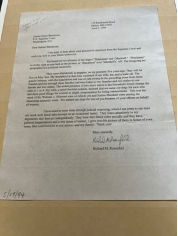
I often thought about writing to the two justices about their namesakes, but life was busy and I didn’t do it until 1994. Moved by Blackmun’s announcement of his pending retirement, my husband and I drafted a letter to Justice Blackmun explaining why our dogs bore his and Thurgood Marshall’s names. The letter we sent, signed by my husband, included two pictures of the dogs together on our front lawn.

Our letter said:  

I didn’t really expect a response, but only a few days later, and much to our surprise, a letter on embossed Supreme Court stationery showed up in our mail! Written with wry humor, the grace of a gentleman, and with a subtle reminder of his positions on conception, Blackmun’s letter to us was hand-signed. 

We cherished that letter and our two amazing dogs, but life went on. Then, in 2004, things took an unexpected turn.

In honor of the fiftieth anniversary of the Brown v. Board court decision, the University of Illinois College of Law, like many academic institutions that year, sponsored a symposium about the impact of the Brown decision and invited me to present a paper. I gladly accepted and wrote an article on the implications of the Brown decision for different groups. I had presented many conference papers prior to this commemorative event. Still, I had never spoken at a law school or to a room packed with mostly law professors and other legal scholars. I am a sociologist. That is my usual audience. I was nervous and felt very out of my element. I knew no one on the featured panels and hardly anyone in the audience. But I knew my paper was solid, despite my anxiety about its reception. 

As I wrapped up my presentation, I thought it had gone well and considered adding that I had named my two dogs for the two justices I so admired. It seemed a little corny to bring up my dogs in such an esteemed and unaccustomed, for me, place, but oh well…I did it. The audience seemed to appreciate it. I sat down to a round of applause.

The next speaker was introduced as a law professor at Duke University. When she began her remarks, she expressed her appreciation for being with known colleagues and meeting new people…a common way speakers warm up their presentations. She then said, “And I am especially pleased to meet someone I have a special connection to…Maggie Andersen.” I was floored! I had never met her, did not follow her field of legal study, and could not imagine how she thought she knew me. She continued, “Years ago I was a clerk in Justice Blackmun’s chambers. One morning, he called all his clerks together because he had received a letter from ‘some professor in Maryland,’ and he wanted to share it with us. Treating his clerks to breakfast, he read the letter out loud.” She then said, directly to me, “You will never know how happy your letter made him!” She proceeded to deliver a very good analysis of the impact of the Brown decision on disability rights. 

As we sat at the symposium on Brown, the release of Blackmun’s papers to the Library of Congress was very much in the news. Blackmun had died five years earlier (in 1999) but had arranged for a quick release of his papers to the Library of Congress. His papers were released only five years after his death, which is unusual because most justices do not have their papers released until 50 years after their death. 

Because of the prominence of Blackmun’s papers in the daily news, I asked the former clerk if she thought our letter—and the photos of our dogs—would then be in the Library of Congress. She said, “No doubt! That’s how important your letter was to him.” As the session ended, she said she wanted to rush right out and call Justice Blackmun’s former secretary because she knew the secretary would be excited to know she had met me! 

I later learned, by reading Juan Williams’ excellent biography of Justice Blackmun, that at the time Blackmun received our letter, he was besieged by hate mail from those who strenuously objected to his more progressive opinions—particularly his defense of Roe. Our letter was a rare praise song!

Now, even more years later and with both dogs long gone, Blackmun’s fears have come to pass. More than a chill wind blows today. There is a full-blown hurricane toppling women’s rights, smashing civil rights, and crushing institutions themselves. The assault on reproductive rights is no longer directed at one man, but, rather, at entire institutions. Confidence in the judicial system, including the Supreme Court, has hit an all-time low, as has public faith in all national institutions. Even when under attack by the right, probably overwhelmed by case work, and fearful for women in America, Harry Blackmun found the time to pen a letter, honoring not only our dogs, but also the best of America: national institutions that adhere to American values, the cherished connection between public servants and citizens, and the protection of civil and constitutional rights of all Americans. How I long for the values and graciousness that Justice Blackmun demonstrated. My next dog, if a female, will be named Sonia. Or, should we acquire a litter, maybe Sonia, Ketanji, and Elena—women who are speaking truth to power. I miss Blackmun’s wisdom on the Court, and I miss my dogs.

With thanks to Patrick Kirwin, Manuscript Reference Librarian, Manuscript Division, Library of Congress and to Connie Cartledge, Senior Archivist, Library of Congress

Dr. Margaret L. Andersen is the Elizabeth and Edward Rosenberg Professor Emerita and Founder and Executive Director of the President’s Diversity Initiative at the University of Delaware, who resides in Oxford.

The Spy Newspapers may periodically employ the assistance of artificial intelligence (AI) to enhance the clarity and accuracy of our content.

Filed Under: Spy Journal, Opinion

Next Page »

Copyright © 2026

Affiliated News

  • The Chestertown Spy
  • The Talbot Spy

Sections

  • Arts
  • Culture
  • Ecosystem
  • Education
  • Mid-Shore Health
  • Culture and Local Life
  • Shore Recovery
  • Spy Senior Nation

Spy Community Media

  • Subscribe
  • Contact Us
  • Advertising & Underwriting

Copyright © 2026 · Spy Community Media Child Theme on Genesis Framework · WordPress · Log in