
MENU

Sections

  • Home
  • About
    • Contact Us
    • Editors and Writers
    • Join our Mailing List
    • Letters to Editor Policy
    • Advertising & Underwriting
    • Code of Ethics
    • Privacy
    • Talbot Spy Terms of Use
  • Art and Design
  • Culture and Local Life
  • Public Affairs
    • Ecosystem
    • Education
    • Health
    • Senior Life
  • Community Opinion
  • Sign up for Free Subscription
  • Donate to the Talbot Spy
  • Cambridge Spy

More

  • Support the Spy
  • About Spy Community Media
  • Advertising with the Spy
  • Subscribe
February 20, 2026

Talbot Spy

Nonpartisan Education-based News for Talbot County Community

  • Home
  • About
    • Contact Us
    • Editors and Writers
    • Join our Mailing List
    • Letters to Editor Policy
    • Advertising & Underwriting
    • Code of Ethics
    • Privacy
    • Talbot Spy Terms of Use
  • Art and Design
  • Culture and Local Life
  • Public Affairs
    • Ecosystem
    • Education
    • Health
    • Senior Life
  • Community Opinion
  • Sign up for Free Subscription
  • Donate to the Talbot Spy
  • Cambridge Spy
Education Ed Homepage Education Ed Portal Lead

Gunston Gearios Wrap Up Historic Robotics Season with Awards

February 5, 2026 by Gunston School

Blake Algier ’26 cheers at a recent FTC Competition, where the Gunston Gearios were honored with the Judges’ Choice Award, a prestigious nod to a team whose unique efforts and dynamics stand out beyond standard categories. Also pictured are Logan Brock ’28 and Connor Joyce ’26.

After five months of intensive engineering, coding, and strategic collaboration, the Gunston School’s robotics team, the Honey Nut Gearios (Team 9530), concluded their most successful season to date. Running from September to February, the season was defined by a record-breaking roster, a commitment to systematic engineering, and back-to-back award wins at regional qualifiers.

The team competes in the FIRST Tech Challenge (FTC), a global program where students in grades 7–12 are tasked with designing, building, and programming a robot to compete in a complex, themed game. Unlike traditional science fairs, FTC operates like a professional sports league: teams must form strategic alliances in 2 vs 2 matches, support STEM efforts in their local community, and present a professional “engineering portfolio” to a panel of expert judges. To succeed, students must master both “soft skills”—like public speaking and project management—and technical skills like Java programming and mechanical CAD (Computer-Aided Design). The Gunston Gearios are the only team from the Eastern Shore of Maryland to compete.

The Gearios tested their mettle at two major FIRST Tech Challenge (FTC) Qualifiers. In Alexandria, Va., on January 18, the team ranked 12th out of 24 teams. Their meticulous documentation earned them the 2nd Place Think Award, which recognizes teams that masterfully use an engineering portfolio to track their design and optimization process. In their final competition on February 1 at the Johns Hopkins Applied Physics Laboratory, the team climbed to 10th place out of 28 teams. They were honored with the Judges’ Choice Award, a prestigious nod to a team whose unique efforts and dynamics stand out beyond standard categories.

This year, the Robotics team expanded to 23 students, the largest group in the program’s history. Led by Team Captain and Hardware Leader Connor Joyce ’26, Software Leader Lucas Watkins ’26, and Task Manager Lia Schut ’26, the team represented a diverse cross-section of the student body. Most notably, the entire hardware team consisted of “rookies,” and the roster featured more new students—a demographic shift that promises a bright future for Gunston’s STEM initiatives. “I’m incredibly proud of what the team accomplished this year,” said lead advisor Dr. Ken Wilson. “With the entire hardware team being FTC rookies, the experience they’ve gained is invaluable for next year.”

Members of the Gunston Gearios at a recent competition, from left to right, Ben Joyce ’29, Leo Forloney ’29, Kasiah Telligman ’29, Atticus Forloney ’29, Blake Algier ’26, Connor Joyce ’26, Lucas Watkins ’26, and Ben Perez ’26.

The team’s success was built on a rigorous schedule, including Dr. Wilson’s fall robotics class, dedicated homework periods, and an “After School Crew.” Most impressively, the “Weekend Crew” logged 15 weekends of work from 10 a.m. to 2 p.m., fueled by a steady rotation of donuts and pizza. The season was bolstered by a dedicated group of mentors and volunteers. Matt Joyce, P’29 provided engineering expertise, pushing the students to adopt a quantitative, systematic approach to building. Jerome Brock, P’28 assisted in preparing students for the high-pressure judges’ meetings, while Adam Grant, P’27 provided logistical support. Additionally, Technology teacher Ryan Redding and science teacher Dr. Mariah Goodall supported the team through the Science and Engineering Club.

With a solid foundation of young talent and a proven track record of award-winning documentation and design, the team is already looking toward the 2026-2027 season! Congratulations to the Gunston Gearios:

Connor Joyce ’26, Lucas Watkins ’26, Lia Schut ’26, Annie Geng ’26, Caden Quirion ’26, Willem Grant ’27, Charlie Hartman ’27, Sam Ellis ’29, Ben Perez ’29, Ben Joyce ’29, Atticus Forloney ’29, Jake Hanlon ’27, Logan Brock ’28, Maggie Lindsay ’29, Kasiah Telligman ’29, AJ Fridrich ’27, Blake Algier ’26, Leo Forloney ’29, Ben Watkins ’28, Jed Cohen ’26, Sasha Wilson ’29, Brody Schultz ’29, and Brady Luongo ’29.

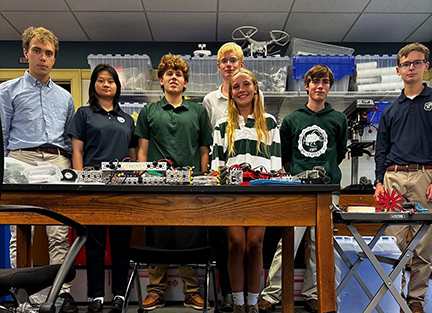
Lead photo: Members of the Gunston Gearios Robotics Team include (l-r) Caden Quirion ’26, Annie Geng ’26, Charlie Hartman ’27, Lucas Watkins ’26, Lia Schut ’26, Connor Joyce ’26, and Willem Grant ’27.

•••

Founded in 1911 and currently enrolling 256 students, The Gunston School is an independent, nonprofit, nonsectarian, coeducational, college preparatory high school located in Centreville, Maryland. Visit gunston.org for more information.
The Spy Newspapers may periodically employ the assistance of artificial intelligence (AI) to enhance the clarity and accuracy of our content.

Filed Under: Ed Homepage, Ed Portal Lead

Good News and Not So Good News: Talbot County Schools Gets their 2025 Report Card

November 5, 2025 by Spy Staff

The Maryland State Department of Education (MSDE) has released the 2025 Maryland School Report Card, offering a detailed look at how schools across the state—and in Talbot County—are performing under the Maryland Accountability System.

Statewide, the outlook shows steady improvement. Forty-three percent of Maryland schools earned the top two ratings of four or five stars, up from 41 percent the previous year. In total, 86 percent of schools received at least three stars, reflecting a growing trend of improvement over the past three years.

“These results reflect the hard work happening in Maryland classrooms every day,” said Dr. Carey M. Wright, State Superintendent of Schools. “The Maryland School Report Card reinforces our commitment to high-quality educational opportunities for every student.”

In Talbot County, results show a familiar pattern: strong graduation rates and student engagement, but continued struggles in academic performance—especially in math and among English learners.

Talbot County’s elementary schools earned 9.1 out of 20 points in academic achievement and 19.5 out of 35 for academic progress. English language proficiency was moderate at 5.3 out of 10, while the “School Quality and Student Success” score—measuring attendance and engagement—was higher at 25 out of 35.

These numbers suggest that while younger students are active and involved, many are still below grade-level expectations in core subjects.

Middle schools earned 8.1 out of 20 points for academic achievement and 16.6 out of 35 for progress. English language proficiency dropped to just 2.6 out of 10, one of the weakest spots in the county data. School quality and student success scored 20.9 out of 35, showing that while schools are maintaining engagement, academic growth remains limited.

At the high school level, the data show both promise and concern. Academic achievement scored 14.2 out of 30 points, but the graduation rate reached an impressive 14.6 out of 15—equal to a 97 percent graduation rate. That rate holds steady across racial and economic groups.

However, readiness for college or career earned only 6.7 out of 10 points, suggesting that while students are finishing high school, not all are fully prepared for what comes next.

Math remains a major weakness for Talbot County students, with only 29.5 percent of elementary, 13.8 percent of middle, and 20.9 percent of high school students proficient. English Language Arts scores are higher—41.9, 43.3, and 59.7 percent—but still uneven.

Large gaps persist across racial and economic lines. White students continue to outperform other groups, while Black, Hispanic, and economically disadvantaged students show proficiency rates often below 10 percent in math.

Maryland’s Accountability Advisory Committee is currently reviewing the state’s system to improve transparency and fairness. The committee, guided by the Center for Assessment, will present new recommendations to the State Board of Education later this year.

For Talbot County, the takeaway is clear: the system is working to keep students in school and involved, but the next step is ensuring every graduate is academically ready for life beyond the classroom.

The Spy Newspapers may periodically employ the assistance of artificial intelligence (AI) to enhance the clarity and accuracy of our content.

Filed Under: Ed Homepage, Ed Portal Lead

Washington College President Michael Sosulski Steps Down

July 8, 2025 by Washington College News Service

Washington College announced Monday that President Michael J. Sosulski will step down later this summer to become president of Lake Forest College in Lake Forest, Illinois. Sosulski will continue to serve through July. Trustee emeritus and former Board Chair Steve Golding ’72 will assume the role of provisional Chief Operating Officer while the Board of Visitors and Governors finalizes interim leadership plans and prepares for a national search for Sosulski’s successor.

Sosulski was appointed as the College’s 31st president in the summer of 2021, arriving at a pivotal moment. Like many small liberal arts colleges, Washington faced a challenging financial landscape, including an $11 million deficit. Under Sosulski’s leadership, the College worked to stabilize its finances and revitalize enrollment through improved recruitment and marketing strategies. Since 2021, applications have risen by 120%, and the College’s endowment has reached an all-time high of more than $330 million.

Sosulski’s tenure leaves a considerable imprint on the institution. In 2022, the College invested $20 million in first-year residence hall renovations and campus-wide Wi-Fi upgrades. Other notable campus improvement projects include the redesign of the Owings Library Terrace and student-inspired renovations to the Western Shore residence halls. The College also began the process of removing three outdated residence halls—Dorchester, Cecil, and Talbot—to make way for the new home of the Warehime School of Global Business, Economics, and Social Impact. Funded by a $15 million gift from Beth Warehime Rizakos ’13—the largest single donation from an individual in the College’s history—the facility is scheduled to open in January 2028.

In 2023, Washington College received a $54.7 million gift from the Hodson Trust, significantly enhancing its ability to make a college education more accessible and affordable to students from diverse backgrounds.

Sosulski also oversaw the launch of the Innovation Plant, an entrepreneurship center that will be located at 800 High Street in one of the former Dixon Valve Company warehouse buildings. The project—currently in the design phase—has secured approximately $5 million in public and private support. Once completed, the Innovation Plant will support both Washington College students and local entrepreneurs in launching and growing businesses on the Eastern Shore.

Other key initiatives during Sosulski’s presidency include:

  • Launching the Washington College Principles of Free Expressionto foster open dialogue and debate;
  • Reinvigorating alumni relations with initiatives such as a fall homecoming and the relaunch of Washington College Magazine;
  • Introducing a sophomore-year experience to boost student retention;
  • Strengthening civic engagement through the creation of the Thomas V. Mike Miller Jr. Director of Civic Engagementrole; and
  • Expanding athletics by adding men’s and women’s golf teams and reinstating cross country and track and field.


The Spy Newspapers may periodically employ the assistance of artificial intelligence (AI) to enhance the clarity and accuracy of our content.

Filed Under: Ed Homepage, Ed Portal Lead, WC

Nonprofit’s report calls for broad-based approach to improving reading scores

April 16, 2025 by Maryland Matters

Alex Arianna during a reading lesson at Lincoln Elementary School. (Photo courtesy Frederick County Public Schools)


Alice Tickler tries to stay positive when it comes to educating young children, but the longtime teacher admits there are some things that can make it hard — and it’s not anything the students do.

Things like the legislature’s failure to fund a training program, specifically for reading and math teachers. As a teacher for 28 years, she’s seen the benefits of what educators call a “coaching program.”

“Seeing other teachers in action, having a mentor teacher that knows how to teach reading alongside of you or coaching you, that’s huge,” said Tickler, a first-grade teacher in Queen Anne’s County public schools. “That coaching model would really benefit teachers.”

Tickler’s comments echo recommendations in a report being released Tuesday morning by Maryland READS, a nonprofit focused on the improvement of reading instruction. Providing consistent funding for teachers is just one of the recommendations in “The State of Reading in Maryland 2025: It’s Time for a Comeback after a Decade of Decline.”

While the General Assembly approved the Excellence in Maryland Public Schools Act last week without funding for a training program, it did approve funding for a national teacher recruitment campaign and a $2,000 relocation grant to “incentivize an out-of-state licensed teacher to move to the state.”

The report’s not all about funding, however, and acknowledges the state’s financial difficulties. Similar to a report produced last year, Tuesday’s document outlines recommendations to improve literacy, such as businesses providing employees time to serve as local tutors, and state and local leaders organizing town halls on digital education for families.

Because of the state’s fiscal challenges, the report suggests philanthropists provide financial and other resources to help create “thriving, reading ecosystems.”

A chart shows per pupil spending increased in comparison to test scores for fourth- and eighth-grade students in Maryland. (Chart courtesy of Maryland READS)

According to the report, per pupil spending increased by 37% since 2013 through last year. During that time, National Assessment of Educational Progress math scores have constantly declined.

“Everything the state has done to put a system of support in place … gives us hope,” Trish Brennan-Gac, executive director of Maryland READS, said in an interview. “But I think the legislature needs to get on board a little bit more and trust her [State Superintendent Carey Wright] leadership because she has a proven track record, and I don’t think they did that this time around.”

‘Make sure children can read’

Tuesday’s document notes a report last year from the National Council on Teacher Quality. It gave Maryland and 19 other states an overall “moderate” rating on teacher training programs based on five policy actions to strengthen implementation of the “science of reading,” which Wright utilized as public schools leader in Mississippi and pushed to incorporate in Maryland.

The council gave three ratings – strong, moderate and weak – not only for the total assessment of training programs, but also separate reviews of each policy action. On the policy statement, “Reviews teacher-preparation programs to ensure they teach the Science of Reading,” Maryland received a “weak” rating.

Maryland READS recommends the state Department of Education “should immediately exercise authority, including limiting grants and contracts, and hold Maryland teacher preparation programs accountable for aligning to Science of Reading by 2028.”

According to the report, what will help teachers with literacy instruction is an agreement the department made last year to implement a four-year, $6.8 million grant from the nonprofit Ibis Group of Washington, D.C.

About $5.3 million of that grant will be used for free online training in the science of reading for at least 30,000 paraprofessionals, teachers and other staff. The remaining $1.5 million would be for Johns Hopkins University and the department to research the impact of teacher efficacy, teacher background knowledge and literacy.

But Brennan-Gac said additional and consistent support is needed.

“Having a coach in the classroom actually helps the teacher change their practice,” Brennan-Gac said. “While it’s wonderful that we’ve brought these training programs into the state, [but] if they don’t get the coaching, we’re not really leveraging that wonderful resource we have and this whole movement that we’re doing.”

Some other recommendations from the report to improve literacy include:

Starting July 1, the department should collaborate with educators and organizations to begin work on drafting an adolescent literacy policy;The legislature should tie future funding to data related to proficiency rates at community schools, those that receive high concentration of poverty grants which provide a variety of wraparound and other services; andState, local and community leaders should educate parents and guardians on limiting the use of electronic devices for their children.

“We should do everything that we can to make sure that our children can read,” said Tickler, who serves on a statewide teacher advisory council created by the department this year. “We don’t want our children to enter that pipeline that takes them to jail or drugs. We want our kids to be successful and we want our kids to be literate.”


by William J. Ford, Maryland Matters
April 15, 2025

Maryland Matters is part of States Newsroom, a nonprofit news network supported by grants and a coalition of donors as a 501c(3) public charity. Maryland Matters maintains editorial independence. Contact Editor Steve Crane for questions: [email protected].

The Spy Newspapers may periodically employ the assistance of artificial intelligence (AI) to enhance the clarity and accuracy of our content.

Filed Under: Ed Portal Lead

Maryland faces $418 million ‘catastrophic’ loss in pandemic-era relief funds

April 1, 2025 by Maryland Matters

 State Superintendent Carey Wright, second from left, at a September news conference at the Maryland State Department of Education building. Board of Education President Joshua Michael, left, listens. (File photo by William J. Ford/Maryland Matters)

The U.S. Department of Education told states Friday that it was canceling previous approvals to spend down remaining COVID-19 recovery funds, a change that could mean $418 million to the Maryland Department of Education.

The change was announced in a letter from U.S. Education Secretary Linda McMahon that was dated Friday at 5 p.m., and said the decision to cancel the pandemic funding was effective — Friday at 5 p.m.

“Shock does not begin to describe our reaction when we received the notification late Friday evening,” Maryland State Superintendent Carey Wright said Monday. “This jeopardizes over $400 million in funding.”

Wright called the federal agency’s decision “catastrophic,” noting that the money has already been spent or at least committed to the state’s 24 school systems. She said the money is being used for tutoring, reading materials, after-school programming, even some construction projects such as repairs for heating and air conditioning units, among others.

State officials said about $305.2 million has already been spent but not reimbursed by the federal department. Another $112.8 million is in “encumbered” funds not paid out by the state, which means school systems must immediately stop any ongoing work on capital projects, or educational programs.

“It may be a tutoring program that’s going on right now in schools that was intended to go through this school year, or it might be an improvement to a health room in a school,” said state Board of Education President Joshua Michael. “There’s going to be significant disruption.”

Officials said it remains unclear if the state would need to cover costs for ongoing programs, or if the local school systems may have to return any money already spent.

“The federal government is breaking the trust that it has once held strong with states across America,” Michael said.

School officials said they are consulting with the Office of the Attorney General on the possibility of filing suit against the federal department.

“I think it’s fair to say that we are exploring all legal options at this time given the severity of this action,” Michael said.

He said the majority of the money comes from the American Rescue Plan’s Elementary and Secondary School Emergency Relief, or ARP ESSER, program.

The state last year requested and received approval for an extension on how it would draw down the ESSER funds it  had left over. Wright said the state sought extensions because of supply chain issues and construction delays.

The approval was given before a Jan. 28 deadline set by former President Joe Biden (D) before he left office that month. But in her letter Friday, McMahon dismissed the approvals by the previous administration.

“The extension approval was issued recently, so any reliance interests developed are minimal,” McMahon wrote. “Moreover, an agency may reconsider its prior decision. So you could not rely on the Department adhering to its original decision. That is especially true because the extension was a matter of administrative grace.”

She said that extending deadlines to allocate “COVID-related grants … years after the COVID pandemic ended is not consistent with the Department’s priorities and thus not a worthwhile exercise of its discretion.”

But McMahon also wrote the department would reconsider funding for states if the could explain “how a particular project’s extension is necessary to mitigate the effects of COVID on American students’ education, and why the Department should exercise its discretion to grant your request.”

Wright said ending the program at 5 p.m. Friday and offering to consider appeals from states “seemed to be contradictory,” but she said her department plans to send a letter to justify why money for Maryland is necessary.

A U.S. department spokesperson said that specific projects would be assessed if funds are used directly to mitigate the effects of COVID-19.

“COVID is over. States and school districts can no longer claim they are spending their emergency pandemic funds on ‘COVID relief’ when there are numerous documented examples of misuse,” said Madi Biedermann in a statement Monday afternoon.

“The Biden Administration established an irresponsible precedent by extending the deadline for spending the COVID money far beyond the intended purpose of the funds, and it is past time for the money to be returned to the people’s bank account,” Biedermann’s statement said.

In part because of the Education Department’s decision, the Maryland Senate approved an amendment to a budget bill Monday that would require the governor’s budget team to track federal cuts and, if they hit $1 billion, recommend state spending cuts to the General Assembly’s Legislative Policy Committee.

“If we have a $1 billion problem from combined actions by the federal government, we would begin a process of review through our policy committee, and work with the governor to come up with solutions,” said Sen. Guy Guzzone (D-Howard), chair of the Budget and Taxation Committee. “We have to be wide-eyed open about what could be happening because it is happening.”

Sen. Chris West (R-Baltimore and Carroll) asked if any recommendations that may come from the policy committee would be for the legislature next year.

“Could very well be,” Guzzone said.


by William J. Ford, Maryland Matters
March 31, 2025

Maryland Matters is part of States Newsroom, a nonprofit news network supported by grants and a coalition of donors as a 501c(3) public charity. Maryland Matters maintains editorial independence. Contact Editor Steve Crane for questions: [email protected].

The Spy Newspapers may periodically employ the assistance of artificial intelligence (AI) to enhance the clarity and accuracy of our content.

Filed Under: Ed Portal Lead

MD Senate Panel’s vote on Blueprint bill straddles House, Administration Versions

March 22, 2025 by Maryland Matters

Senate Budget and Taxation Committee voted Friday for amendments to the Blueprint for Maryland’s Future that splits the difference between House and administration versions. (Photo by William J. Ford/Maryland Matters

A Senate committee advanced parts of Maryland’s sweeping education reform plan Friday, splitting the difference between versions of the bill advanced by the House and the Moore administration and setting up a showdown in the waning days of the legislature.

The Senate Budget and Taxation Committee approved a four-year pause in the start of funding for teacher “collaborative time” — something the administration supports — but also voted to keep funding for community schools — something the House insisted on.

Senate Bill 429 still needs to be taken up by a second Senate panel, the Education, Energy and the Environment Committee, which is scheduled for Monday. That gives lawmakers just two weeks to approve a Senate bill and hammer out differences with the House before the April 7 end of the General Assembly session.

The so-called “Excellence in Maryland Public Schools Act” was sparked by the state’s fiscal crisis and by the repeated call from local school officials for flexibility in the implementation of the Blueprint for Maryland’s Future, the sweeping 10-year, multibillion-dollar education reform plan.

Gov. Wes Moore introduced a bill that keeps the goals of the plan largely intact, but delays funding and implementation of some portions.

One portion is the proposal for an increase in teacher “collaborative time,” or time that teachers spend on planning, training and working with individual students, as opposed to time in front of a classroom. The Blueprint calls for teachers’ classroom time to be cut from 80% of their day to 60%; the administration bill would delay the start of that for four years, in part because it would require the hiring of at least 12,000 new teachers at a time when the state faces a teacher shortage.

The House rejected that plan, and set collaborative time to begin in 2026. But the Senate went with the governor’s version in what Budget and Taxation Committee Chair Guy Guzzone (D-Howard) called a “pacing” of the initiative.

“Whenever you don’t extend the full amount, if, in fact, you want to get to the full amount, by definition, it has to go out further,” Guzzone told reporters after the committee’s vote.

The committee did agree with the House version and rejected the administration’s call for a two-year freeze on funding for community schools, those located in low-income neighborhoods Sen. President Bill Ferguson (D-Baltimore City) has said such a delay would negatively affect students.

The Senate committee also agreed with the House to “hold harmless” funding for multilingual learners, students in poverty and those in special education — exempting those students from any per pupil funding reductions that might come down. The committee on Friday also added students at the Maryland School for the Blind, Maryland School for the Deaf and the SEED School of Maryland.

The committee was more generous than either the House or the administration when it comes to Consortium on Coordinated Community Supports, a part of the Blueprint plan that deals with mental health, behavioral and other wraparound services for students. The House agreed with the governor that it should be cut from $130 million this year to $40 million in fiscal 2026, but senators want to cut the fund to $70 million next year and raise it to $100 million in fiscal 2027 and each year after.

But senators sided with the administration on “foundation” funding, or per pupil spending. Under the Blueprint, it was slated to grow from $8,789 per pupil this year to $9,226 next year, but the administration proposed reducing the growth to $9,063 next year and slowing the pace of growth for several years after. The Senate committee agreed, but the House voted to keep the original Blueprint funding levels.

With an eye toward looming cuts to the federal government, another Senate amendment made Friday would freeze funding increases if federal funds or revenue projections by the state’s Board of Revenues in December decrease by 3.75%.

Senate Majority Leader Nancy King (D-Montgomery), a member of the Budget and Taxation Committee, earlier this week defended delays in Blueprint goals for the time being.

“There’s a lot of good that’s already come out of the Blueprint, and a lot more that is going to come as we go,” King said Tuesday. “I don’t think it would be a bad thing if we just slowed it [collaborative time] down a bit.”

The Senate Education, Energy and the Environment will review, and possibly vote on, the other parts of the bill Monday that deal with teacher programs, initiatives and other incentives before sending it to the full Senate for consideration and then back to the House.

Del. Vanessa Atterbeary (D-Howard), chair of the House Ways and Means Committee, said during a press conference Thursday to announce a framework for the overall fiscal 2026 budget, that negotiations on the Blueprint are ongoing. But Atterbeary said she and Del. Ben Barnes (D-Prince George’s and Anne Arundel), chair of the Appropriations Committee, have made their positions “pretty clear.”

“Where we stand and where the House stands in … protecting those that are most vulnerable, particularly those in community schools,” she said. “So we’ll see what the Senate does, and we’ll link up with them and negotiate that in the days to come.”

By William J. Ford
Creative Commons License

The Spy Newspapers may periodically employ the assistance of artificial intelligence (AI) to enhance the clarity and accuracy of our content.

Filed Under: Ed Homepage, Ed Portal Lead

House approves Blueprint education bill that rejects most cuts proposed by governor

March 13, 2025 by Maryland Matters

As expected, the House of Delegates approved an amended, comprehensive education plan Tuesday night that rejected cuts proposed by Gov. Wes Moore (D).

The 100-39 party-line vote sets up a potential showdown with the Senate over the Excellence in Maryland Public Schools Act. Senate leaders have indicated that, in the face of a projected $3 billion deficit for fiscal 2026, they may be more sympathetic to the governor’s version of the bill to amend the state’s multiyear, costly Blueprint for Maryland’s Future.

House Democratic leaders have consistently pushed back against the governor’s plan, saying that any cuts would negatively affect the Blueprint, now in its third year of implementation. But House Ways and Means Committee Chair Vanessa Atterbeary (D-Howard) said after Tuesday night’s floor vote that the House and the governor agree on the goals of the plan, but disagree on how to get there.

“He [Moore] was looking at the Blueprint also as a means to solve budgetary issues, and we did not,” Atterbeary said. “I think in large part we disagreed when it comes to funding. But I think policy wise, we agreed primarily with the governor.”

The debate put House Republicans in the unusual position of defending the governor’s bill against Democratic amendments.

“Didn’t agree with everything in it, but it was a compromise that suggests we can, in future years, account for the realities that we will not have to spend as much we’ll amend, in particular, the collaborative time,” said House Minority Leader Jason Buckel (R-Allegany), before voting against the amended House version of the bill.

“I think that we would have been best served to support Gov. Moore’s bill, rather than the bill as amended currently before the House,” he said.

Three Republicans – Dels. Kevin Hornberger (R-Cecil), Susan K. McComas (R-Harford) and Chris Tomlinson (R-Frederick and Carroll) – who signed on as co-sponsors of the previous version from the governor, asked to have their names removed from the amended bill, which opposed.

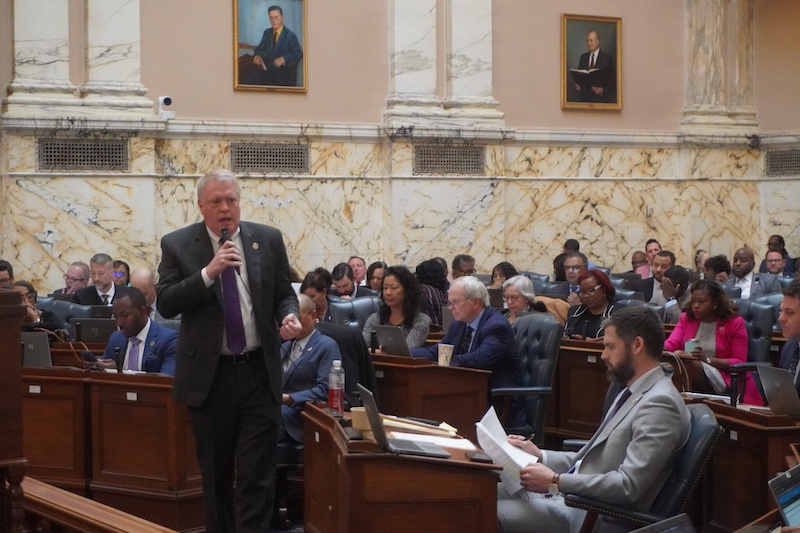
Del. Vanessa Atterbeary (D-Howard) talks about her support for the Blueprint for Maryland’s Future education reform plan. (Photo by William J. Ford/Maryland Matters)

Some of the proposals in the original bill included a four-year pause in the phase-in of collaborative time for teachers, a freeze in funding for community schools located in low-income neighborhoods and a lower increase in per pupil funding.

Atterbeary’s committee and the Appropriations Committee amended the governor’s bill to restore funding to community schools and to reduce the four-year delay in collaborative time to a one-year pause to give the state’s 24 school systems time to prepare for a fiscal 2027.

The House did keep language from the governor’s version that would allow for the state Department of Education to establish a national teacher recruitment campaign to start in July and end by July 1, 2029. It also kept a $2,000 relocation grant that would be provided to “incentivize an out-of-state licensed teacher to move to the state,” in an effort to reduce the teacher shortage and the number of conditionally licensed teachers.

Administration officials defended their position during a joint hearing last month, saying it would be impractical to institute the increase in collaborative time next school year because it would require the hiring of at least 12,000 teachers at a time when the state and nation face a teacher shortage.

The administration’s proposal sought to hold community school at current levels for the next two years, instead of allowing it to increase as the Blueprint calls for.

On the House floor Tuesday, a few Republicans said the Blueprint plan is a vehicle the state can’t afford right now.

“If this is the Mercedes of education C class, it feels a little bit more like a Pinto that we’re selling for a Mercedes price,” said Del. Lauren Arikan (R-Harford), who voted against the bill.

Meanwhile, the Senate’s Budget and Taxation Committee — which took part in a joint hearing on the bill last month with the Senate Education, Energy, and the Environment Committee and the two House panels — could vote on the Senate version of the bill this week.

Senate Majority Leader Nancy King (D-Montgomery), a member of the Budget and Taxation Committee, has said she supports a pause in collaborative time, especially with the teacher shortage in the state. And Sen. Mary Beth Carozza (R-Lower Shore), a member of the “Triple-E” Committee, has said the Blueprint needs some restructuring that provides more autonomy to local school systems.

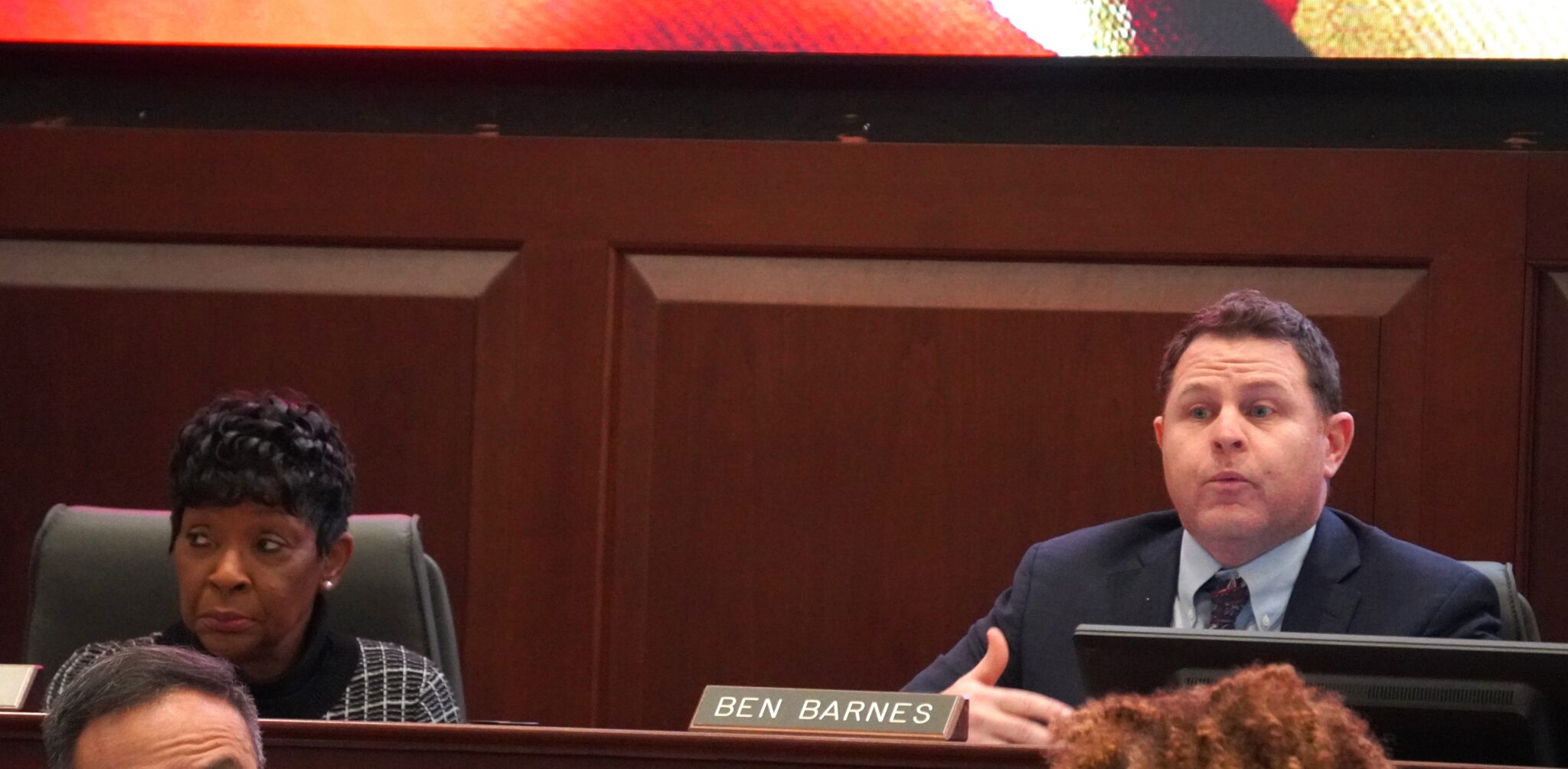
Del. Ben Barnes (D-Prince George’s and Anne Arundel), who chairs the Appropriations Committee, told reporters Tuesday night he’s confident the two chambers will find a solution.

“I think it’s because we all share the same values. We want to certainly protect these kids and make sure the funding is there and the policies are there,” he said. “We’ll get to a compromise in the end.”


by William J. Ford, Maryland Matters
March 11, 2025

Maryland Matters is part of States Newsroom, a nonprofit news network supported by grants and a coalition of donors as a 501c(3) public charity. Maryland Matters maintains editorial independence. Contact Editor Steve Crane for questions: [email protected].

The Spy Newspapers may periodically employ the assistance of artificial intelligence (AI) to enhance the clarity and accuracy of our content.

Filed Under: Ed Portal Lead

Governor’s education bill slows growth of per pupil funding, worrying advocates

January 23, 2025 by Maryland Matters

 House Appropriations Committee Chair Ben Barnes (D-Prince George’s and Anne Arundel) gives opening remarks at Wednesday’s joint briefing with the Ways and Means Committee on the Blueprint for Maryland’s Future. House Speaker Adrienne Jones, left, listens. (Photo by William J. Ford/Maryland Matters)

A comprehensive education bill unveiled Wednesday by the Moore administration would slow the growth of per pupil spending beginning next year and continuing for the next eight years, raising concerns among advocates and lawmakers.

The reductions begin in fiscal 2026, when the per pupil “foundation” funding was scheduled to grow from $8,789 per student to $9,226; the administration’s bill calls for it to grow next year to $9,063 instead, a reduction in growth of $163 per student.

Instead of growing between 4% and 5% a year for the next eight years, the Excellence in Maryland Public Schools Act calls for growth from 2% to 3% in the same period.

From fiscal years 2034 through 2037, the per pupil amount would increase by 3.5% each year, ultimately reaching $13,259 per pupil.

Still, the slow-down in growth represents an estimated $234 million less for state schools than was originally forecast, said Mary Pat Fannon, executive director of the Public School Superintendents’ Association of Maryland. The revised level of funding “is not a historic investment,” she said.

“Funding matters for student achievement,” Fannon said. “We need to advocate and explain that you do need funding in order to get the outcomes that you’re expecting.”

Del. Ben Barnes (D-Prince George’s and Anne Arundel), chair of the Appropriations Committee, said lawmakers are aware of the change in per pupil spending, which he said will likely cause problems in the House.

“That’s something we’re very aware of. I don’t think you’ll see that coming out of the House. Just put it that way,” Barnes said.

When asked to comment on the revised number, a spokesperson for Gov. Wes Moore (D) pointed to a prepared statement released Tuesday, in which the governor was quoted as saying that the state will still work toward the goals of the Blueprint for Maryland’s Future, the state’s 10-year education reform plan, but that it must do so “while making it fit our current needs and realities in a post-pandemic environment.”

“Through the Excellence in Maryland Public Schools Act, we propose strategic investments designed to lay out the foundation for effective implementation of key components of the Blueprint, including recruiting and supporting educators and building partnerships between schools and communities,” the Tuesday statement said.

The bill, House Bill 504, was just part of the discussion at Wednesday’s briefing on the status of the Blueprint for the House Appropriations and House Ways and Means committees, at a time when the state is struggling with a budget deficit that is projected to be close to $3 billion in fiscal 2026.

Moore has proposed closing that gap with a combination of increased revenues and budget reductions next year, but he and legislative leaders have said the education reform plan is fully funded for the next two years.

One goal of the Blueprint is to increase the teacher pipeline, which is also an element touched on in the administration’s bill.

With more than half of the state’s teachers coming from other states, according to the state Department of Education, one part of the bill calls for an interstate teacher mobility compact, to let Maryland enter into agreements with other states that have comparable licensing standards and accept teaching credentials from those states. The bill also proposes supporting relocation of eligible military spouses.

The state teachers’ union agrees with that part of the plan. Maryland State Education Association Vice President Nikki Woodward said a few states with student populations and curriculums similar to Maryland include Massachusetts, New York and Pennsylvania.

“We unfortunately do not graduate enough students from our education programs across the state,” Woodward said in an interview after the briefing. “This allows for an easier transition for educators to come into the state and immediately begin to receive their licensure, to begin working.”

The bill would allow the department to start a national teacher recruitment campaign “to bring licensed and prospective teachers to the state” that includes up to $2,000 in relocation costs. If approved, that campaign would start July 1 and run through July 2029.

 State Board of Education President Joshua Michael, left, and Tenette Smith, the Maryland Department of Education’s interim deputy state superintendent in the Office of Teaching and Learning, testify Wednesday. (Photo by William J. Ford/Maryland Matters)


Other provisions

The governor’s proposal is slated to go before the Senate Budget and Taxation and Education, Energy, and the Environment committees. No bill hearing has been scheduled. A joint hearing on the House version before Appropriations and Ways and Means could be held next month.

Some of the other items in the bill include allowing school officials to apply for grants, beginning next year, to fund expanded “collaborative time” for teachers. That is time outside of class that teachers use for training, analyzing student data, identifying students who may need help and spending time, one on one or in groups, to get students back on track.

The Blueprint plan calls for collaborative time to be expanded from the current 20% of a teacher’s workday to 40% within the next eight years. But that proposal has run up against the state’s current teacher shortage: In order to start expanding collaborative time next school year, the state would need up to 15,000 more teachers. The number doesn’t account for the 6,000 current teachers who are conditionally approved.

“The purpose of the grant is to provide funds to establish innovative models that can be replicated for teacher collaboration at the school or local school system level that improve teacher retention and student learning,” according to the bill’s language. Initial awards for the $48 million program would start to be distributed March 1, 2026.

The bill also proposes a school system training program and school leadership academy.

The 12-month training program would be for high-ranking school officials, such as the state and local superintendents and school board chairs and vice chairs.

Some of the work would include reviewing data and other education information from top-performing school systems in this country and others, researching the benefits of high-quality and diverse teachers and implementing career ladders for teachers.

A leadership academy would target those who seek to remain or become school principals or other school-based leaders. This academy would also last 12 months and include work on data-informed instruction, utilize teachers on the career ladder and strategies for peer mentorship.

State Board of Education President Joshua Michael said this week the governor’s proposal would provide a $134 million investment to boost the state’s Grow Your Own teacher initiative. He said Wednesday that initiative will help with the Blueprint plan “to deepen and strengthen our teacher pipeline.”

“We stand deeply committed to the promise and vision of the Blueprint,” Michael said to the House committees. “The Blueprint is truly a once-in-a-generation opportunity and represents our nation’s biggest bet on public education.”

William “Brit” Kirwan, vice chair of the Accountability and Implementation Board that oversees the 10-year Blueprint plan, had a few words for any concerns about its future: “Keep the faith. We’re going to get there.”

The Spy Newspapers may periodically employ the assistance of artificial intelligence (AI) to enhance the clarity and accuracy of our content.

Filed Under: 7 Ed Notes, Ed Portal Lead

Spy Survey Summary on Learning for a Lifetime on the Mid-Shore

September 23, 2024 by The Spy

Every year, the Spy selects one nonprofit organization or school on the Mid-Shore that we admire, then we reach out to our 8,000 daily subscribers with a survey designed to inform all of us about a particular issue or initiative.

Recently, as a Spy reader, you were invited to participate in a survey about lifelong learning programs.  Thanks to all of you who participated. The views you shared will help our partner in this, the Chesapeake Forum, as they develop their plans for the future.

A few thoughts should be of interest to all our readers and the community.

First, we recognize that this survey was completed by people who have an interest, indeed a passion, for lifelong learning.

Ninety-five percent of those who responded knew of one or more lifetime learning programs in their area.  Only three percent did not.

Thus, we started with a well-informed group, and this was not a random survey.

With regard to actual involvement in lifelong learning, forty-five percent indicated they are currently involved in a program with an additional twenty-one percent indicating they have been involved withing the past two years, but not currently.  An impressive thirty percent are not involved but are interested in learning more about lifelong learning.

When given alternatives, most people shared a preference for lifelong learning programs that are held in person with small groups of people.  The least desired was online learning.

People were asked to indicate topics of greatest interest.  Among the most frequently mentioned topics were:  history, art, literature, gardening, music and cooking.

It was encouraging to see that after answering a number of questions about lifelong learning, ninety-one percent of the respondents indicated it was very (57%) or somewhat (34%) important to them.

The communities on the Eastern Shore are fortunate to have a number of options when it comes to lifelong learning programs.

While not a complete list, these organizations were mentioned most frequently on the survey in addition to Chesapeake Forum:

Academy Art Museum
Avalon
BAAM
Chesapeake Bay Maritime Museum
Chesapeake College
Talbot County Historical Society
Washington College 

If you wish further information, the good folks at Chesapeake Forum, Academy for Lifelong Learning (WC-All) in Chestertown, and the Institute of Lifelong Learning.

The Spy Newspapers may periodically employ the assistance of artificial intelligence (AI) to enhance the clarity and accuracy of our content.

Filed Under: Ed Homepage, Ed Portal Lead

Talbot County STEM Camp Completes Another Excellent Summer

September 4, 2024 by Henley Moore

Like many communities throughout the country, the summer can be an essential time for young students to catch up on critical cognitive skills and be on equal footing with their peers by the fall. That is certainly true on the Mid-Shore, where children take advantage of a unique STEM Camp for 1st through 5th-grade youngsters in Talbot County.

This camp might be more unique because the instructors are all area high school students. That might be part of the special sauce that makes this summer school fun and successful for some 30 students yearly.

These older students not only can relate well to their young wards while studying tough subjects like math and science, but they run every aspect of the camp.

From developing the curriculum to planning field trips or deciding on meals, a core group of 30 staff members comes together to make the four-day program one of the most memorable experiences for their younger peers. But another part of this magical formula is that those older kids are learning as well.

Given the responsibility (and the risks associated with it) of running a full-scale program from soup to nuts, these teens find within themselves core leadership skills that are just as impactful life lessons as those they provide to the smaller children.

The Spy sat down with three of those young leaders last week to talk about the program.

This video is approximately four minutes in length. For more information about STEM Camp in Talbot County please go here.

The Spy Newspapers may periodically employ the assistance of artificial intelligence (AI) to enhance the clarity and accuracy of our content.

Filed Under: Ed Homepage, Ed Portal Lead

Next Page »

Copyright © 2026

Affiliated News

  • The Chestertown Spy
  • The Talbot Spy

Sections

  • Arts
  • Culture
  • Ecosystem
  • Education
  • Mid-Shore Health
  • Culture and Local Life
  • Shore Recovery
  • Spy Senior Nation

Spy Community Media

  • Subscribe
  • Contact Us
  • Advertising & Underwriting

Copyright © 2026 · Spy Community Media Child Theme on Genesis Framework · WordPress · Log in