MENU

Sections

  • Home
  • About
    • Contact Us
    • Editors and Writers
    • Join our Mailing List
    • Letters to Editor Policy
    • Advertising & Underwriting
    • Code of Ethics
    • Privacy
    • Talbot Spy Terms of Use
  • Art and Design
  • Culture and Local Life
  • Public Affairs
    • Ecosystem
    • Education
    • Health
    • Senior Life
  • Community Opinion
  • Sign up for Free Subscription
  • Donate to the Talbot Spy
  • Cambridge Spy

More

  • Support the Spy
  • About Spy Community Media
  • Advertising with the Spy
  • Subscribe
December 7, 2025

Talbot Spy

Nonpartisan Education-based News for Talbot County Community

  • Home
  • About
    • Contact Us
    • Editors and Writers
    • Join our Mailing List
    • Letters to Editor Policy
    • Advertising & Underwriting
    • Code of Ethics
    • Privacy
    • Talbot Spy Terms of Use
  • Art and Design
  • Culture and Local Life
  • Public Affairs
    • Ecosystem
    • Education
    • Health
    • Senior Life
  • Community Opinion
  • Sign up for Free Subscription
  • Donate to the Talbot Spy
  • Cambridge Spy
Education Ed Homepage Education Ed Portal Lead

Talbot County Library Hosts Youth STEAM Program

August 19, 2024 by Matt LaMotte

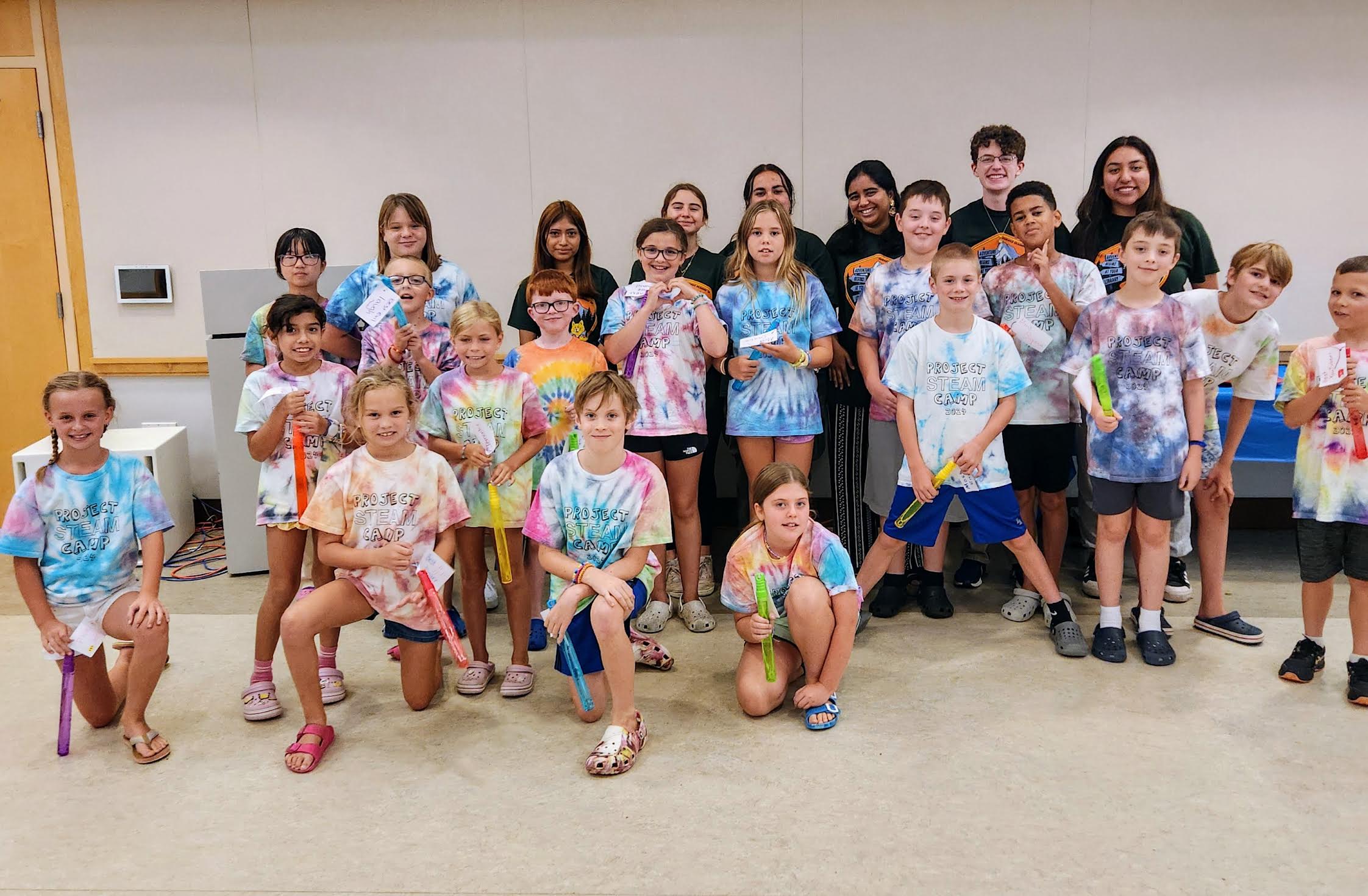
This summer, the Easton branch of Talbot County Free Library hosted two week-long sessions of ‘STEAM’ camp for elementary and middle school students. Designed and conducted by three area high school students and funded by a grant from the Council of Friends of the Talbot County Library, the STEAM camp sessions were offered free of charge to area elementary and middle school students.

STEAM programs integrate science, technology, engineering, arts, and mathematics to foster a more holistic approach to education. The interdisciplinary approach encourages creativity and critical thinking, enabling students to engage in hands-on, real-world problem-solving. 

“In the Easton library’s STEAM camp, volunteer youth leaders Vivi Morris, Van Tran and Mia Mazzeo, who created the program, blended artistic expression with analytical skills to make learning fun,” said Easton Library Youth Coordinator Laura Powell. “The children who participated learned to collaborate across various disciplines, nurturing both their logical reasoning and creative potential.”

Starting with a traditional STEAM approach, Morris, Tran and Mazzeo adapted and designed the program to best suit the youngsters who were attending each week of camp. The first session hosted 20 six- to eight-year-olds and the second had 20 nine- to twelve-year-old attendees. Both sessions were at capacity. 

Over the course of each week, the camper groups tackled a number of projects that required individual effort as well as cooperation within each camper team. Each day brought a new menu of activities – everything from tie-dyeing shirts and print-making tote bags to pass and paint or creating fruit art.

“The strategy of our STEAM program was to break the campers up into small groups so they could learn to both interact effectively with each other and apply the skills each camper had,” stated Alanna Peerman, library staff assistant. “Each table of five campers had at least one volunteer High School assisting the campers.

“The campers particularly enjoyed making slime, as well as piecing together a Hex bug maze and racing the Hex bugs, said Mia Mazzeo. Two “cooking through chemistry” exercises were the highlights of each week. “To watch each camper make ice cream by hand and cook s’mores using the sun was so much fun for all of us!” commented Van Tran.

Vivi Morris agreed. “The collaboration and teamwork was so ‘chill’,” she said. “By the end of each week, we saw a community of learners, helping each other, enjoying each other’s company, and being so excited as each group completed their activities and projects.”

Two STEAM participants, Charlotte and Emmett McGrogan, of St Michaels, loved every minute of their camp experience. Emmett, 9, attended the second session and especially enjoyed making slime. “Doing crafting stuff was my most favorite activity”, said Emmett. “I can’t wait to come back to STEAM Camp next summer!”

The McGrogans’ mom, Katie Willis, also gave the program rave reviews. “As with many full-time working parents, my kids have been in a variety of summer programs – STEAM camp, which was free of charge, was hands down one of the very best,” Willis said. “The structure of STEAM camp each week was age-appropriate, well organized, and kept my kids engaged and busy the whole time. They want to go again next year, most definitely!” 

Matt LaMotte, a native of the Eastern Shore, has a diverse background. He grew up in Baltimore but spent much time in Easton and Chestertown. After college, he returned to the Mid Shore and worked in insurance and finance while raising his two sons. He then pursued a teaching and coaching career in independent schools across different states. In 2018, he chaired the History Department at Sts. Peter and Paul High School in Easton before retiring in 2021. Matt is now focused on conservation, outdoor education, and staying engaged with local and global affairs.

The Spy Newspapers may periodically employ the assistance of artificial intelligence (AI) to enhance the clarity and accuracy of our content.

Filed Under: Ed Homepage, Ed Portal Lead

Bay Climate Adaptation: The TNC Guide in Finding the Money for Major Infrastructure Change

August 12, 2024 by Henley Moore

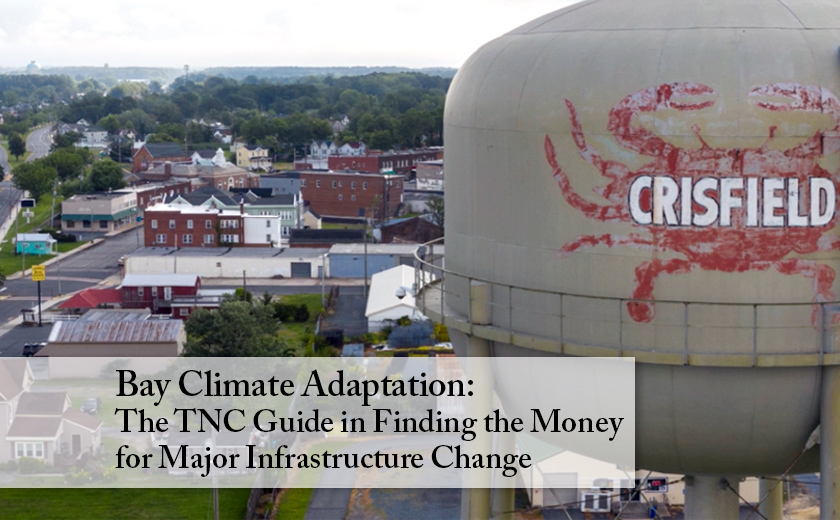
A few months ago, The Nature Conservancy released a report that could solve one of the major obstacles facing climate adaptation: finding the money to do things.

Many towns, particularly on the Eastern Shore, are facing an increasingly long list of infrastructure projects, but funding those expensive undertakings has become harder. That’s where TNC’s report, SEAFARE, could make a huge difference to those municipalities.

Through workshops with various stakeholders, including local residents, environmental justice leaders, and government officials, the report identifies barriers like complicated funding processes. It provides a toolkit to help decision-makers improve access to those dollars.

The Spy’s Dave Wheelan spoke to Human Sharif, TNC’s climate adaptation manager, to understand more.

This video is approximately five minutes in length. For more information about this report please go here. 

The Spy Newspapers may periodically employ the assistance of artificial intelligence (AI) to enhance the clarity and accuracy of our content.

Filed Under: 1 Homepage Slider, Eco Lead, Eco Portal Lead, Ed Portal Lead

Maryland’s pre-K expansion plan proves to be unpopular with child care providers

August 1, 2024 by Maryland Matters

Maryland is counting on private child care providers to take part as the state expands its pre-K program — but many providers don’t plan on becoming involved.

In a survey of the state’s childcare providers conducted this spring by the Local News Network, only 12.9% of respondents said they plan to or were already involved in the pre-K program created under the Blueprint for Maryland’s Future, the state’s expansive education reform plan.

More than a third of the 256 respondents said they were unsure whether they will participate in the pre-K expansion — and nearly 40% said they would not participate.

Under the 10-year Blueprint for Maryland’s Future, the pre-K expansion plan aims to expand pre-K enrollment to all 4-year-olds and all lower-income 3-year-olds through a “mixed delivery system” involving both public schools and private child care operations.

However, many childcare providers who responded to the survey said they are reluctant to take part in the program. Some said they would have trouble finding staff for a pre-K operation. Others said they didn’t want to get the additional education required to qualify for the program. Still, others said they didn’t want the Maryland State Department of Education to be more involved in their businesses than it already is.

Patti Smith, the director of Greenway Learning Center in Greenbelt, said she’s concerned that developmental differences between 3- and 4-year-olds would make managing a pre-K program difficult.

Asked if she would take part in the pre-K expansion, Smith said: “It’s more ‘no’ than ‘maybe,’ just for the first year because I want to see what other providers do. And I don’t have faith in MSDE. You know, I don’t think they have all the answers — so I’m not ready to be that guinea pig.”

The mixed delivery system

The Blueprint for Maryland’s Future, which the General Assembly passed in 2021, calls for widespread changes throughout the state’s public schools.

Related stories:

Child care is scarce in Maryland, the nation – and the pandemic made matters worseFinding child care in Maryland is hard; finding the right child care is even harderMaryland’s pre-K expansion plan proves to be unpopular with child care providersOn child care, a search for local solutions to a national problem

One of the most wide-ranging changes is a vast expansion of early childhood education. The plan calls for state-funded pre-K to be available to all low-income 4-year-olds by the 2025-26 fiscal year. Pre-K will be free to all 3- and 4-year-olds from families that earn up to 300% of the federal poverty level. A sliding scale will determine how much families with incomes between 300% and 600% of the federal poverty level will pay for pre-K, while higher-income families will pay in full.

“This is another step in the right direction to ensure pre-kindergarten programs continue to grow and create more opportunities for our children and families, especially those who have been historically underserved,” Clarence Crawford, then-president of the Maryland State Board of Education, said in 2023.

While 40% of the state’s eligible youngsters were enrolled in pre-K in the 2022-23 school year, the Blueprint aims to double that percentage in a decade. Given that 30,718 young Marylanders were enrolled in pre-K in 2022-23, the change means tens of thousands of additional children would be enrolled in pre-K in the coming years.

State officials have set a goal of having private providers fill half the state’s pre-K slots by the 2026-27 school year.

“And part of the reason for that is … there is not enough space in the public schools to actually provide all those slots for pre-K,” said Rachel Hise, the executive director of the Blueprint’s Accountability and Implementation Board, at a conference of school principals late last year.

Hise acknowledged, though, that the mixed-delivery effort faces some major challenges, including one that haunts the state’s entire child care system.

“The pandemic really drove a number of child care providers out of business,” she said.

A widespread reluctance

On top of a statewide shortage of child care providers, education officials face another significant challenge in creating that mixed delivery system. The Local News Network survey this spring found many of the remaining child care providers are either reluctant to participate in the pre-K expansion or are refusing to take part.

Several child care providers said joining the pre-K program would make a hard job even more difficult.

Blueprint blues: Local leaders cite school reform plan’s progress, problems

“I’m overwhelmed with the day-to-day operational issues,” such as staff turnover and increased operating costs, said Dana Miller of Little Smiling Faces Childcare in Mitchellville. “Having to find a qualified (pre-K) teacher would just add more issues.”

Under the Blueprint, by the 2025-26 school year, pre-K teachers will have to be state-certified in early childhood education or have a bachelor’s degree and be taking part in an alternative educators training program. Pre-K teaching assistants will be required to have an associate’s degree, whereas now they only need a high school diploma.

Those requirements automatically block some child care providers from offering pre-K.

“It’s my understanding that you have to have a bachelor’s to participate, and I do not,” said Danielle Zulauf, owner of Tiny Trailblazers Daycare in Preston.

Michele Stritch, owner and operator of Michele Stritch Family Child Care in Dundalk, said in response to the survey that she is reluctant to participate in the pre-K because she doesn’t know what it entails. She also noted her center faces financial challenges and concerns about state regulations.

“I am inclined to not participate because I do not want the state being even more involved in how I run my business,” Stritch said.

On top of all those issues, state education planners face one more challenge: The LNN survey showed the percentage of child care providers who want to take part in the pre-K program — 12.9% — is exactly the same as the percentage of those who had never heard of it.

“I would love to participate but have never heard of the program,” said Charnetta Bailey, owner and operator of Children Learning Wonders in Ellicott City.

A publicity push?

Told about the survey results, Maryland Department of Education spokesperson Raven Hill indicated better publicity is the key to making sure more child care providers decide to offer pre-K.

“MSDE continues to invite private providers to participate in Push to Pre-K webinars to increase awareness of publicly funded Pre-K and provide accurate information and support regarding Pre-K grant opportunities and requirements,” Hill said in a written response to questions.

“MSDE will continue to encourage local education agencies to engage private providers in their areas about pre-K opportunities and the pre-K grant program benefits to children and families,” she said.

In addition, the state is tweaking its grant awards program to make more child care facilities eligible for pre-K funding, Hill said.

Tiffany Jones, owner of Precious Moments Family Childcare  in Rockville, said she plans on participating in the expansion program. But she said it’s difficult for many child care providers to understand the state’s pre-K effort.

“The requirements to participate in pre-K expansion are very challenging for the average family child care provider,” she said. “So while pre-K is a wonderful program, they need the spaces in family child care for the system to really work — but there are a ton of requirements for providers (that are) very difficult.”

Even so, some child care providers said they plan on taking part in the pre-K expansion because doing so is important for the survival of their business. After all, if they lose 3- and 4-year-olds to either public schools offering pre-K or to other providers, that means fewer enrollees and lower revenue.

“I feel the school is taking all of the 4-year-olds and some of the 3-year-olds,” said Laurie Arnold, owner of Laurie Arnold Home Daycare in Frederick, who plans to take part in the pre-K program. “In order to keep my numbers up, I have to adjust.”

In time, despite the fact that she said she doesn’t want to be a “guinea pig,” Patti Smith of the Greenway Learning Center may end up adjusting, too.

She said she’s taking a wait-and-see attitude toward joining the pre-K expansion and may join it eventually. But she said she’s afraid those providers who decided to take part starting this year may have a difficult confrontation with reality when the next school year starts.

“Come September, they’re going to go: ‘Oh, we don’t have enough room. We don’t have enough teachers,’” Smith said. “I do think they’ve bitten off more than they can chew.”

– Local News Network director Jerry Zremski contributed to this report.


by Capital News Service, Maryland Matters
July 31, 2024

By Audrey Keefe and Mira Beinart

Maryland Matters is part of States Newsroom, a nonprofit news network supported by grants and a coalition of donors as a 501c(3) public charity. Maryland Matters maintains editorial independence. Contact Editor Steve Crane for questions: [email protected]. Follow Maryland Matters on Facebook and X.

The Spy Newspapers may periodically employ the assistance of artificial intelligence (AI) to enhance the clarity and accuracy of our content.

Filed Under: Ed Portal Lead, 7 Ed Notes

The CBMM PATRIOT’s Dynamic Duo: A Chat with Joyce and Matt Gauthier

July 19, 2024 by The Spy

For PATRIOT Capitan Matt Gauthier and his partner and wife, Joyce, the transition from a private boat service to one under the umbrella of a nonprofit museum was surprisingly effortless. While the decision was made after two years of running the sightseeing vessel under private management, both Matt and Joyce realized that under the Chesapeake Bay Maritime Museum’s management, nothing really would change since the whole point of the PATRIOT was to get people out on the water and enjoy the wonders of the Miles River.

In fact, with CBMM as its owner, the PATRIOT now sees its mission as expanding. Beyond its daily tours at 12:30 PM and 2:30 PM for its traditional historic cruises of this unique part of the Chesapeake Bay, Matt and Joyce note in their recent interview with the Spy that their new partnership with the museum’s curatorial staff and educators has significantly expanded programming as well as chartering out the PATRIOT for special events, weddings and almost any other kind of celebration.

We asked Joyce and Matt to stop by the Spy studio a few weeks ago to hear more.

This video is approximately four minutes in length. Photography by Focus Photography. For more information about the PATRIOT and the Chesapeake Bay Maritime Museum, please go here.

The Spy Newspapers may periodically employ the assistance of artificial intelligence (AI) to enhance the clarity and accuracy of our content.

Filed Under: Ed Homepage, Ed Portal Lead

Dr. Susan Morgan Resigns from Dorchester Board of Education

June 15, 2024 by The Spy

Dr. Susan Morgan wrote to her supporters yesterday to inform them that she has resigned from the Dorchester Board of Education. This is her email:

It is with a heavy heart that I write this letter.

After much thought and consultation, I have decided that I am not seeking re-election to the Board of Education.  After the debacle that was on display last night at the Board of Education meeting, I don’t feel that my continued tenure on the Board would be fruitful or productive, and I will tender my resignation forthwith.

I will not engage in name calling and derogatory comments as Mr. Wheedleton, one of the (unelected members of the Board (appointed by the County Council), did last night.   I encourage you to watch his statements last night on Town Hall Streams, beginning at approximately 1.42.45 into the meeting. (https://townhallstreams.com/stream.php?location_id=121&id=60877)

I wish the system well.

Susan Morgan

The Spy Newspapers may periodically employ the assistance of artificial intelligence (AI) to enhance the clarity and accuracy of our content.

Filed Under: Ed Homepage, Ed Portal Lead

Blueprint Blues: Mid-Shore and State School Leaders Cite School Reform Plan’s Progress and Problems

June 3, 2024 by Maryland Matters

Maryland public school students are approaching their summer vacations, but some school officials won’t get the same break, as they continue plugging away on the state’s huge education reform plan.

School officials from the state’s 24 districts filed updated documents last month detailing their progress on, and problems with, the Blueprint for Maryland’s Future.

The latest filings are a follow-up to brief March reports, of a dozen pages or fewer, in which school officials responded to at least five questions and prompts from the state on the top challenges they are facing implementing the Blueprint. Those documents and the ones filed last month are on the website of the Blueprint’s Accountability and Implementation Board (AIB).

School officials in the latest reports cited progress, but they also said they still face challenges that range from funding, to meeting diversity goals and implementing full-day prekindergarten, among others.

Many were like Harford County Superintendent Sean Bulson, a Blueprint supporter who acknowledges challenges.

In a recent interview, Bulson said the Blueprint has helped his district in several areas such as higher pre-K enrollment, youth apprenticeships and high school students taking courses at a community college, a program called dual enrollment.

But while schools receive state funding and additional resources as part of the Blueprint, Bulson and other school and county leaders have expressed concerns over a need for funding and a lack of flexibility in implementation of the plan.

For instance, Bulson said certain funding requirements could cause cuts to specialty programs and elective courses such as art and physical education.

He said one bright spot, however, has been collaboration with the Maryland State Department of Education (MSDE), particularly Superintendent Carey Wright.

“In the last few months, we’ve seen that begin for the first time. I’m very encouraged by Dr. Wright’s work,” Bulson said. “But they [state officials] have to stay on track with that because we can do great things with this Blueprint.”

Wright said in a recent interview that she held a four-day meeting to review all 24 school district Blueprint documents, along with state education officials, local school leaders and officials with the AIB, the independent unit that oversees and approves all Blueprint plans.

The reports from each school district are based on the Blueprint’s five priorities: early childhood education, hiring and retaining high-quality and diverse teachers, preparing students for college and technical careers, providing additional resources for students in need and governance and accountability.

Wright said her staff will compile data and other information into one document including some of the challenges cited by local schools and present that report to the state Board of Education. In addition, she said state officials will provide feedback to school officials.

“It informs us if is there something else we could be doing to help facilitate that implementation. That gives us a better idea of what’s happening across the state,” Wright said.

“I think that everybody is invested in the Blueprint. I think that everybody’s trying to do the very, very best that they can to help children learn,” she said.

The Mid-Shore 

Caroline

 “CCPS (Caroline County Public Schools) has 7 out of 22 instructional assistant positions that meet the Blueprint requirement based on their associate degree or higher. There are 6 out of 22 instructional assistants enrolled in the CDA (Child Development Associate) cohort. These assistants should earn the endorsement by the end of the 23-24 school year. Overall, CCPS continues to face the barrier of finding certified staff or current staff that are willing and want to pursue a higher degree or CDA credential. CCPS mitigates challenges by attending more recruitment events at institutes of higher education including additional states.”

Dorchester

“We did see an increase of 3.04% in our minority professional staff. We increased our recruitment fairs to include areas as far as Mississippi. Our strategy to include a more diverse group of recruiters has paid off as we have been able to offer on-the-spot interviews and contracts for the first time. Our number of conditional teachers has decreased from 60 to 46. This is due to an aggressive approach towards meeting twice a year with these staff to monitor their efforts’ progress towards certification and/or licensure. As we acquire certified teachers, these conditional positions will be replaced, especially ones that are not making progress towards their certification.”

Kent

“KCPS (Kent County Public Schools) is committed not only to minimizing the disparity between students and teachers of diverse backgrounds but also to ensuring that school leaders represent the diversity of the student body. The MSDE data file demonstrates that over the last three years, the percentage of Black school administrators increased by 9.7% while the percentage of Hispanic school administrators decreased by 12.5%. The percentage of white school administrators has remained fairly constant, increasing by 2.8% over the past three years. Through its partnership with BSU (Bowie State University), 14 KCPS staff members are pursuing their doctorate degree in Educational Leadership through the BSU doctoral cohort.”

Queen Anne’s

“QACPS (Queen Anne’s County Public Schools) offers opportunities for the private partner to participate in all professional development offered by the district. However, attending the professional development is challenging for private providers as they do not have extra staff available to cover the care of children while they attend. The strategies to be continued in School Year 2024-2025 in order to increase the number of private partners to reach the Blueprint expectation include private providers will be invited to observe a pre-k classroom(s) to view how instruction is delivered and how the classrooms are physically arranged to support the Accreditation Standards.”

Talbot

“For FY 2025, the most significant challenge we face in implementing the necessary pay increase is a small per-pupil increase coupled with declining enrollment, which will reduce our FY 2025 Foundation Aid funding by $11,981. Thus, we do not project having additional Blueprint funding to pay for the mandated Blueprint salary increases. This coincides with the fiscal cliff (loss of COVID relief funding) which has supported many needs, including technology and coaching/mental health positions, that are now competing for resources in our FY 2025 budget along with the unfunded salary increase.”

Maryland

Allegany

“The latest New Permanent Staff Data shows no progression in diversifying leadership roles, with 98% of new staff members for the 2023-2024 school year being white, marking an increase compared to the previous two years. ACPS (Allegany County Public Schools) intends to reverse this trend by increasing marketing efforts, collaborating with organizations such as DIVERSITY in Ed, and maintaining strong partnerships with institutions of higher education such as Frostburg State University. Despite having the aforementioned strategies in place, ACPS must also consider the potential impact and resulting challenges that the Career Ladder could pose on the system’s ability to recruit and retain aspiring leaders.”

Anne Arundel

“We have seen an increase in the total number of applicants applying to positions in our county from 12,206 in the 2022-2023 hiring season to 13,744 in 2023-2024. AACPS (Anne Arundel County Public Schools) continues to use numerous strategies to recruit educators that reflect the diversity of our student population. AACPS recruiters completed 70 recruitment trips this hiring session, 20% of which were diversity-focused events at:

  • Historically Black Colleges and Universities (HBCUs);
  • Hispanic Serving Institutions;
  • community events; and
  • two hiring events in Puerto Rico focusing on recruiting bilingual educators to support our growing English Learner (EL) population.”

Baltimore City

“Providing specialized services and supports to students with disabilities is an area where historic inequities and underfunding have acutely impacted City Schools. While the Blueprint is bringing much needed increases in dedicated funding for special education, we will not reach full funding until 2033, and costs will continue to far exceed dedicated revenue for many years. Projected special education costs for FY25 (fiscal year) to provide City Schools’ students with disabilities with all the services to which they are entitled and deserve are around $300 million, while dedicated funding is expected to be only about $125 million.”

Baltimore County

“Teacher certifications at the elementary level do not typically require training in mathematics. This creates significant challenges for teachers (particularly in the intermediate Grades 3–5) as they plan for and execute mathematically sound lessons grounded in the rigor of the content and practice standards. To address, BCPS (Baltimore County Public Schools) plans to include a focus around Common Core domain specific capacity building of school-based math teams through intentional Professional Learning Communities; implementation of an ongoing strand of professional learning around content development for targeted standards, the Major Work of the Grade & Required Fluency standards for Grades 3, 4, and 5.”

Calvert

“As the Career Ladder is finalized and we define the characteristics (e.g., roles, responsibilities, and key attributes) of leaders across the system (including teachers), current and to-be-developed professional learning opportunities will support professionals to move through the teacher and leadership levels. Leadership development begins with hiring and recruitment (as described in the question); however, our focus is on building leaders within our system – to build an internal pipeline of leaders – rather than relying on recruitment of leaders from outside. Our strategies … include partnering with IHEs (Institutes of Higher Education), professional learning through a Next Level Leadership Academy, mentoring and leadership development, and leveraging the career ladder leadership tracks.”

Carroll

“While there has been growth in the percentage of CCPS (Carroll County Public Schools) minority teachers since 2018, a drop from October 2022 to October 2023 (4.9% to 3.4%) was reported in the October 2023 MSDE Professional Staff by Assignment, Race/Ethnicity and Gender report. The hiring of minority teachers continues to be extremely competitive due to the shortage of certificated applicants in Maryland and across the United States. All applicants for CCPS teaching positions must first and foremost provide documentation that they are eligible for Maryland teacher certification to move forward in the hiring process.”

Cecil

“Funding is a concern as we have only one elementary coach for our 17 schools and zero secondary coaches or specialists to facilitate PD (professional development). Overall, there is still no formal way for CCPS (Cecil County Public Schools) to assess a teacher’s training needs. In the 2024-2025 school year, CCPS will implement a new platform to capture professional learning opportunities. One solution for the 2024-2025 school year is to repurpose our current ‘lead teachers’ to provide PD once per month at the secondary level. The PD will be on techniques for analyzing student work in a manner that leads to better use of real-time formative data to guide instruction.”

Charles

“With the Southern Maryland Summit: Teacher Preparation Pipeline held less than a week prior to the deadline of the May 2024 Blueprint submission, CCPS (Charles County Public Schools) has already started its planning to help address the teacher shortage in the district. CCPS is also looking into pathways for educators to become licensed through new pathways established by MSDE including approved alternative programs and in-district training. CCPS is also working with Calvert and St. Mary’s to create these programs together, recognizing that the collective work of the three districts could result in sustainable change and supports leading to less workforce shortages.”

Frederick

“Another ongoing challenge is refining eligibility for accessing the DE (dual enrollment) pathway, as there is currently an incongruence in what FCC (Frederick Community College) requires and the state CCR (college and career readiness) standard. As it currently stands, some students can be eligible for credit-bearing courses at FCC without having met the CCR standard (e.g., course grades in English or math). While FCPS intends to continue allowing access to as many students as possible, funding restraints require a closer examination of when students are able to take advantage of dual enrollment opportunities.”

Garrett

“GCPS (Garrett County Public Schools) places high value on ensuring a quality administrative workforce. To meet the minimum teaching salary of $60,000 on July 1, 2026, GCPS has committed to providing a 15% increase in salary for teachers over the next three years. The GCPS Board of Education made this same commitment for the administrator unit. This is a substantial local investment that elevates the importance of quality administrators. GCPS feels that this investment will allow GCPS to remain competitive locally and ensure quality candidate pools for administrative positions.”

Harford

“HCPS (Harford County Public Schools) has a two-year plan to transition all half-day Pre-K programs to full day by 2025-2026. The Early Childhood Office worked with Facilities to assess space in each elementary school. Five of eleven half-day programs have already become full day without reducing student numbers, doubling classroom spaces. Three more programs will expand in 2024-2025, and the final three by 2025-2026. Initial funding comes from the FY 2024 local Capital Improvement Programs (CIP). Projects include adding bathrooms, modifying playgrounds, and using temporary learning cottages (portable classrooms). Schools facing space challenges are evaluating adjacent sites for expansion.”

Howard

“HCPSS (Howard County Public School System) Teacher Academy of Maryland (TAM) educators are in the process of being trained to implement Child Development Associate (CDA) course offerings. HCPSS has added CDA as an alternate pathway within the TAM Program of Study and it will be offered starting with SY24-25. This pathway increases the early education pipeline for future educators who may wish to work as paraprofessionals in public and private Pre-K programs. Current HCPSS paraprofessionals who wish to pursue an AA (Associate in Arts) are eligible for reimbursement of up to 24 credits at higher education institutions, including Howard Community College.”

Montgomery

“Some challenges MCPS (Montgomery County Public Schools) continues to face in serving children with disabilities include:

  • Lack of highly qualified staff;
  • Specialized transportation needs; and
  • Availability of classroom space throughout the county.

MCPS is committed to providing professional learning and job-embedded coaching to support staff in serving our students receiving special education services. Two curriculum coaches use a support model that provides group and individual coaching for new teachers. In addition, MCPS convenes a new special educator professional learning community, quarterly, to provide additional professional learning on topics related to implementation of specially designed instruction.”

Prince George’s

“An insufficient pool of qualified teachers, specifically Hispanic/Latino teacher candidates, continues to be a challenge for PGCPS (Prince George’s County Public Schools). Based on the PGCPS Blueprint Implementation Plan submission in March 2023, below are adjustments made to a few of the district’s current strategies to mitigate challenges and to ensure continued progress:

  • Transition from virtual to in-person college recruitment fairs, which host Hispanic Serving Institutions (HSIs) to identify and recruit a potential untapped pool of Hispanic/Latino student teachers.
  • Change of subscription from National Association for Bilingual Education (NABE) to the Hispanic Association of Colleges and Universities (HACU) in order to reach a larger candidate pool.”

St. Mary’s

“One of the major challenges SMCPS (St. Mary’s County Public Schools) has faced is the change of guidance provided by MSDE regarding the requirements of the comprehensive literacy plan. Two committee meetings were canceled as SMCPS waited for MSDE to provide feedback and share the rubric that would be used to evaluate our district’s plan. While the guidance has helped us clarify our mission and goals in writing the comprehensive literacy plan, the delay/timing of the new requirements caused frustration amongst committee members and district staff. It also increased the scope of the project and will require more time than originally planned. To mitigate this challenge, our timeline for completing the comprehensive plan has been adjusted.”

Somerset

“For the past two years we have been unsuccessful in hiring an intervention teacher at one of the high schools and at the middle school. Beyond financial and scheduling difficulties, the underlying issue is the lack of teachers with the mathematical and pedagogical knowledge to teach math. Without someone skilled and knowledgeable in mathematics, the student can become even more confused. This has been a challenge in providing intervention for students who are struggling. This year at the high school, which does not have an intervention teacher, teachers in 8th grade, Algebra 1, Geometry, and Algebra 2 have been trying to incorporate intervention within their courses, which has not been very successful …”

Talbot

“For FY 2025, the most significant challenge we face in implementing the necessary pay increase is a small per-pupil increase coupled with declining enrollment, which will reduce our FY 2025 Foundation Aid funding by $11,981. Thus, we do not project having additional Blueprint funding to pay for the mandated Blueprint salary increases. This coincides with the fiscal cliff (loss of COVID relief funding) which has supported many needs, including technology and coaching/mental health positions, that are now competing for resources in our FY 2025 budget along with the unfunded salary increase.”

Washington

“WCPS (Washington County Public Schools) and Hagerstown Community College (HCC) have developed a robust partnership focused on enhancing dual enrollment opportunities for students. Challenges within the partnership include addressing the needs of students who are not CCR, inconsistent messaging, and lack of established protocols. For example, systems lack guidelines on integrating students who do not meet the MCAP (Maryland Comprehensive Assessment Program) or 3.0 GPA criteria into the dual enrollment program. To tackle these issues, WCPS has instituted an MTSS (multi-tiered system of support) support plan for students who are not CCR. To improve timely communication between stakeholders, WCPS and HCC are creating parent/student handbooks and adding additional information to both websites to ensure clarity and accessibility.”

Wicomico

“The expansion of transportation options represents a significant step forward in enhancing student access to Career and Technical Education (CTE) programs, particularly those not available at all comprehensive high schools. Notably, efforts will focus on facilitating access to programs like Interactive Media Production, currently offered at only one school site. However, amidst this progress, a notable obstacle arises: the need to develop systems to support students who are not currently enrolled in CTE programs in accessing apprenticeship opportunities. This challenge will be addressed through collaboration with school-based career coaches, who play a pivotal role in guiding students towards career pathways.”

Worcester

“WCPS (Worcester County Public Schools) still faces challenges in forming a highly collaborative relationship with local childcare providers, due to low participation in professional development programs. Although WCPS has positive two-way communication practices in place, professional development opportunities offered by the public school are still not within reach for childcare partners. WCPS continues to offer training related to shared curriculum on weekends, evenings, and even independently paced, but lack high participation levels from childcare providers. To address this challenge, the Early Childhood Coordinator (ECC) is designing a survey to identify barriers to attendance, with results intended to inform future training opportunities. This survey will be distributed by the end of FY24, and the data obtained will be used to plan FY25 opportunities.”

BY: WILLIAM J. FORD

The Spy Newspapers may periodically employ the assistance of artificial intelligence (AI) to enhance the clarity and accuracy of our content.

Filed Under: Ed Portal Lead, 2 News Homepage

Washington College Receives $15 Million for New School Focusing on Interdisciplinary Approach to Global Business

May 13, 2024 by Washington College News Service

Washington College announces largest individual donation in the College’s 242-year history.

Washington College announced today the largest individual donation in the College’s 242-year history: a $15 million gift from Elizabeth (Beth) Warehime which will enable the launch of The Warehime School of Global Business, Economics, and Social Impact — a new school aimed at fostering a unique interdisciplinary approach to business education. With the goal of transforming business education by focusing on interdisciplinary partnerships, the liberal arts, the global nature of business, and social impact, the school will foster and utilize collaborations between Washington College’s business management, economics, world languages and cultures, and international studies programs.
“This generous gift from Beth Warehime showcases the lasting impact Washington College has on its graduates. We are so thrilled to have the continued support, investment, and valued insights that Beth continues to bestow upon us,” said President Michael (Mike) Sosulski. “This new school will serve our students well as they embark on a true liberal arts education that encourages a global approach to business. I’m hopeful and excited for the great work that will certainly come from the Warehime School of Global Business, Economics, and Social Impact.”
Planning for the new school will move forward within the coming year. The idea for the school, which will focus on ethics and social responsibility, critical thinking, and real-world applications, has been in the works for some time now, however.
“The support of Beth Warehime and her family has transformed our vision for business education at Washington College,” said Caddie Putnam Rankin, business management department chair. “Her continued support allows us to envision a future where we will activate the liberal arts to transform business education through interdisciplinary partnerships and global contexts. Together we seek to inspire students to create lasting social impacts in our world.”
“I am so excited to bring this idea to life for the college; after hearing the thoughts and plans from Caddie and Micheal, I knew this absolutely had to happen,” said Warehime of her generous gift. “This business school will give Washington College a ‘big school’ offering while maintaining the interdisciplinary theme and experience that comes with a small liberal arts institution. My own experience at Washington College was incredibly interdisciplinary, and I can’t wait for others to have an even better experience within the Warehime School.”
As a 2013 graduate of Washington College, Warehime has a long history of support and innovation with her alma mater. In 2019, Warehime directed a $1 million grant to Washington College from the JHC Foundation, a Warehime family foundation. The gift established the Warehime Fund for Student Excellence in Business, which provides the department with $50,000 a year to support student research, entrepreneurship, professional networking, and other initiatives. That support includes funding student participation in professional conferences and other experiential learning activities; start-up funds for student entrepreneurial projects; and a Warehime Fellows program. Warehime became a member of the Washington College Board of Visitors and Governors in 2020.
To learn more about the business management program and other degrees available through Washington College visit washcoll.edu.

About Washington College
Washington College, Maryland’s premier small college, enrolls approximately 1,000 undergraduates from more than 39 states and territories and 23 nations. Washington is known for outstanding academics in more than 50 academic programs. With an emphasis on experiential learning opportunities across the disciplines, ranging from internships and research to international study and civic engagement, Washington prepares students for successful careers and lives after graduation. The College is home to nationally recognized centers of excellence in the environment, history, and writing as well as the 5,000-acre river and field campus which provides unique research opportunities for students and faculty. Learn more at www.washcoll.edu.

The Spy Newspapers may periodically employ the assistance of artificial intelligence (AI) to enhance the clarity and accuracy of our content.

Filed Under: Ed Portal Lead, 7 Ed Notes, Portal Highlights

Washington College Receives $15 Million for New School Focusing on Interdisciplinary Approach to Global Business

May 13, 2024 by Washington College News Service

Washington College announced today the largest individual donation in the College’s 242-year history: a $15 million gift from Elizabeth (Beth) Warehime which will enable the launch of The Warehime School of Global Business, Economics, and Social Impact — a new school aimed at fostering a unique interdisciplinary approach to business education. With the goal of transforming business education by focusing on interdisciplinary partnerships, the liberal arts, the global nature of business, and social impact, the school will foster and utilize collaborations between Washington College’s business management, economics, world languages and cultures, and international studies programs.

“This generous gift from Beth Warehime showcases the lasting impact Washington College has on its graduates. We are so thrilled to have the continued support, investment, and valued insights that Beth continues to bestow upon us,” said President Michael (Mike) Sosulski. “This new school will serve our students well as they embark on a true liberal arts education that encourages a global approach to business. I’m hopeful and excited for the great work that will certainly come from the Warehime School of Global Business, Economics, and Social Impact.”

Planning for the new school will move forward within the coming year. The idea for the school, which will focus on ethics and social responsibility, critical thinking, and real-world applications, has been in the works for some time now, however.

“The support of Beth Warehime and her family has transformed our vision for business education at Washington College,” said Caddie Putnam Rankin, business management department chair. “Her continued support allows us to envision a future where we will activate the liberal arts to transform business education through interdisciplinary partnerships and global contexts. Together we seek to inspire students to create lasting social impacts in our world.”

“I am so excited to bring this idea to life for the college; after hearing the thoughts and plans from Caddie and Micheal, I knew this absolutely had to happen,” said Warehime of her generous gift. “This business school will give Washington College a ‘big school’ offering while maintaining the interdisciplinary theme and experience that comes with a small liberal arts institution. My own experience at Washington College was incredibly interdisciplinary, and I can’t wait for others to have an even better experience within the Warehime School.”

As a 2013 graduate of Washington College, Warehime has a long history of support and innovation with her alma mater. In 2019, Warehime directed a $1 million grant to Washington College from the JHC Foundation, a Warehime family foundation. The gift established the Warehime Fund for Student Excellence in Business, which provides the department $50,000 a year to support student research, entrepreneurship, professional networking, and other initiatives. That support includes funding student participation in professional conferences and other experiential learning activities; start-up funds for student entrepreneurial projects; and a Warehime Fellows program. Warehime became a member of the Washington College Board of Visitors and Governors in 2020.

To learn more about the business management program and other degrees available through Washington College visit washcoll.edu.

The Spy Newspapers may periodically employ the assistance of artificial intelligence (AI) to enhance the clarity and accuracy of our content.

Filed Under: 7 Ed Notes, Archives, Ed Portal Lead, WC

In Memoriam: Professor Frank Creegan

May 7, 2024 by Spy Desk

Frank J. Creegan, 84, of Chestertown, MD, passed away peacefully on Saturday, May 4, 2024 at The Barnett Hospice Center in Centreville, MD.   

Frank was born December 16, 1939, in Lowell, MA, the second child of the late Mary Cecilia McDonald Creegan and Thomas Alexander Creegan. He attended Keith Academy, in Lowell, and graduated with a B.S. in Chemistry from Merrimack College in North Andover, MA in 1961, and a Ph.D. in Organic Chemistry from Fordham University in 1966.  He held an NSF-funded Post-Doctoral Fellowship with James A. Moore at the University of Delaware, where he went on to hold a one-year appointment as Visiting Assistant Professor of Chemistry.    

Frank joined the faculty of Washington College in 1967 as Assistant Professor of Chemistry.  He swiftly moved through the academic ranks and was promoted to Full Professor in 1974, and appointed W. Alton Jones Professor of Chemistry in 1982.  He retired from Washington College in 2007, after 40 years of service, which included many years as Chair of the Department of Chemistry. During his four decades of tenure at Washington College, Frank was awarded three sabbatical leaves, at what he jokingly called three foreign universities (1979 at the University of Konstanz, Germany; 1992 at the University of St. Andrews in the Kingdom of Fife, Scotland; and 2003-2004 at the University of California, Berkeley) to advance his research, in bio-organic chemistry, and new student-centered classroom and laboratory approaches to learning.  

In 1992, he joined with chemistry colleagues from thirteen regional undergraduate colleges to found the Middle Atlantic Discovery Chemistry Project, MADCP, which sought to change the undergraduate chemistry laboratory experience from a set of verification activities to true experiments in which results were unknown to the student.  Initial funding of MADCP came from the U.S. Department of Education through its Fund for the Improvement of Post-Secondary Education (FIPSE).

In 2002, with a $1.5 million grant from the National Science Foundation, MADCP expanded into POGIL (Process Oriented Guided Inquiry Learning), a student-centered, learning cycle-based, team-learning approach to both classroom and laboratory instruction that is based on research on how students learn best. Frank was a Co-Project Investigator for the initial NSF grant. Today, POGIL is implemented in a wide range of subjects in more than 1,000 high school and college courses worldwide.   

Frank earned a number of teaching awards, including the Christian R. and Mary F. Lindback Award for Distinguished Teaching (1970) and the American Chemical Society, Northeastern Section, James Flack Norris Award for Outstanding Teaching of Chemistry (2015).   

In 2011, with a $2 million gift from an anonymous donor, Washington College established the Frank J. Creegan Chair in Green Chemistry in recognition of Frank’s “40-year service to the college and his longstanding development and oversight of the chemistry program.”  

In retirement, Frank continued to be involved in POGIL and in the Division of Chemical Education of the American Chemical Society as chair of the Regional Meetings Committee.   

Throughout retirement, he and Barbara traveled extensively, first to Russia, then Egypt, then Turkey, Hungary, Austria, Ireland, France, England, Spain, and Portugal. He remained active throughout his life in Chestertown with Sacred Heart Church, where over the course of 57 years he served in a host of ministries.  For many years he was a member of All Seasons Garden Club, serving as Treasurer and as President. 

Along with his parents, Frank was preceded in death by his brother Paul G. Creegan and sister Patricia A. Creegan Kelley. Frank is survived by his wife of 57 years, Barbara Markert Creegan; his children, Frank Joseph Creegan of Easton, MD and Thomas Alexander Creegan II of Baltimore, MD and his spouse Felicia Shakman; nieces Leann Kelley Weibel (David), Coleen Kelly Thurber (Craig), and Stacey (Cristain) Martins all of Colorado; nephews Paul G. Creegan (Suzanne) and Joseph Creegan of Lowell, MA, as well as five grand nephews, and five cousins and their offspring..

The family will receive friends and relatives on Friday evening, May 10, 2024 from 5:00 p.m.-7:00 p.m. at Fellows, Helfenbein & Newnam Funeral Home, 130 Speer Road, Chestertown, MD 21620.  A Mass of Christian Burial will be held on Saturday, May 11, 2024 at 11:00 a.m. at Sacred Heart Catholic Church, 508 High Street, Chestertown, MD 21620 to be followed by a Reception in Emmanuel Episcopal Church Hall, 101 North Cross Street, Chestertown, MD.  

In lieu of flowers The Creegan Family ask anyone who is able to give, to please make a donation to The Compass Regional Hospice Barnett Center, 255 Comet Drive, Centreville, MD 21617 or to the Frank and Barbara Creegan Foundation, c/o Washington College, 300 Washington Avenue, Chestertown, MD 21620.    

Internment will be in St. Paul’s Cemetery at a later date.  


The Spy Newspapers may periodically employ the assistance of artificial intelligence (AI) to enhance the clarity and accuracy of our content.

Filed Under: Ed Homepage, Ed Portal Lead, WC

Maryland’s School Superintendent Announces Accountability Task Force

April 30, 2024 by Maryland Matters

Maryland State Interim Superintendent Carey Wright, center, speaks with reporters April 29, 2024, several days after the state Board of Education unanimously approved Wright to become the permanent public schools leader. Beside Wright is sitting beside Clarence Crawford, left, president of the board, and board Vice President Joshua Michael. Photo by William J. Ford.

Five days after the Maryland State Board of Education unanimously voted to appoint Carey Wright as the state’s permanent superintendent of schools, she held a news conference on Monday to announce the creation of a task force to assess academic achievement.

Wright said members of this group will include local superintendents, principals and higher education representatives to provide recommendations on how to better assess how students are doing in the classroom. The group will be led by the Center for Assessment, a national education nonprofit that designs, implements and evaluates accountability systems to see how students are learning.

Part of this initiative stems from the Maryland Comprehensive Assessment Program (MCAP), which measures a student’s proficiency in math, English and science.

The Maryland Report Card uses a rating system from one to five stars to measure overall school performance such as graduation rates, attendance and academic performance.

MCAP results are among the factors that determine the state’s report card and school star rating system.

Although 76% of Maryland schools received at least three out of five stars on the state’s report card released in December, only 47% of all students in third to eighth grades scored on a proficient level in English language arts. The percentage was even lower in math, at nearly 25% proficiency.

“That’s doesn’t ring true,” Wright said. “You can’t have three quarters of your schools being rated as excellent, if you will, and then not seeing student achievement, almost commensurate with that.”

The task force, which will meet about twice a month, will begin its work Thursday and provide recommendations by December to the state Board of Education. Because this accountability system to assess student achievement is in state statute, any proposed changes would need to be done before the Maryland General Assembly convenes for its 90-day legislative session in January.

There’s also a plan to update the online report card to make it easier for parents, guardians and students to comprehend.

“The report card website needs to be a lot more accessible for folks to understand and be able to access data for their schools in their districts,” said Joshua Michael, vice president of the school board. “So delighted that Dr. Wright will be leading that portion of the accountability [measure].”

Wright, who will begin her tenure without the interim title July 1, said conversations “have to start now” on trying to diversify the state’s teacher workforce.

That’s part of the priorities in the Blueprint for Maryland’s Future education reform plan, but some local school leaders have documented challenges in hiring and retaining qualified teachers, and even recruiting teachers of color.

Although Maryland is one of the most diverse states in the nation, a September 2023 report from The Century Foundation noted that 70% of the teachers in the state were white in 2022. In comparison, about 19% were Black and 4% were Latino.

The percentages of the student population at the time: About 40% white, 33% Black and 21% Latino.

Wright recalled a program in place while she was schools superintendent in Mississippi that she would like to replicate in Maryland.

During her nine-year tenure in Mississippi, which ended with her retirement in 2022, the state became the first in the nation to launch a state-run residency teacher program to fill teaching positions and lack of diverse teachers.

“I think we need to do a better job of campaigning and outreach,” Wright said Monday about boosting Maryland’s teacher workforce. “It’s looking to see how we are helping districts recruit at specific areas. Children need to see somebody that looks like them standing in front of the classroom.”

By William J. Ford

The Spy Newspapers may periodically employ the assistance of artificial intelligence (AI) to enhance the clarity and accuracy of our content.

Filed Under: Ed Homepage, Ed Portal Lead

« Previous Page
Next Page »

Copyright © 2025

Affiliated News

  • The Chestertown Spy
  • The Talbot Spy

Sections

  • Arts
  • Culture
  • Ecosystem
  • Education
  • Mid-Shore Health
  • Culture and Local Life
  • Shore Recovery
  • Spy Senior Nation

Spy Community Media

  • Subscribe
  • Contact Us
  • Advertising & Underwriting

Copyright © 2025 · Spy Community Media Child Theme on Genesis Framework · WordPress · Log in