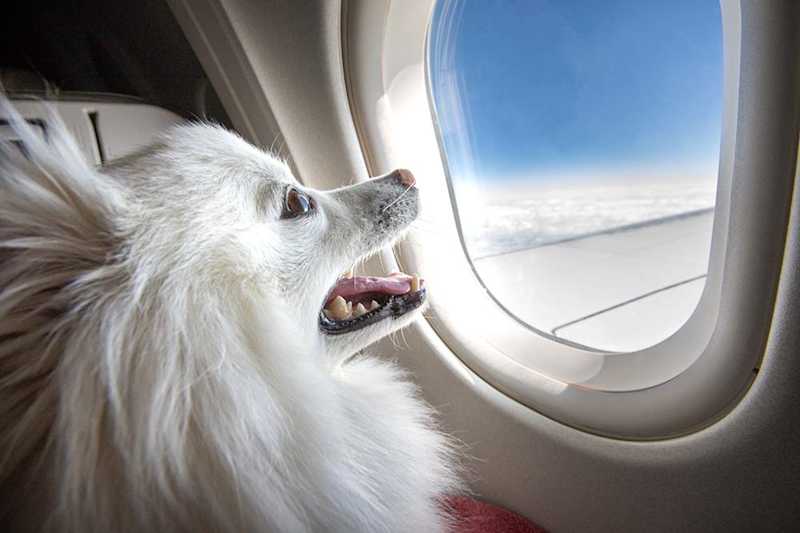


I headed south for the winter this week. The cold weather let me know that it was time. When I travel to Florida, I fly with two sweet little dogs. Small dogs are allowed to fly in the cabin, under the seat, but American Airlines has a very strict policy of a 20-pound weight maximum (including the crate). The dogs must remain in their carriers through the duration of the flight. Since our flight was delayed by several hours it was a lot to ask of these poor little guys.
Watching them and marveling at how well they behaved (okay one had to be medicated, but the other was flawless), I wondered how their cousins, the wolves, would have handled this.
Recent research has discovered that almost two-thirds of modern dog breeds have some wolf ancestry from breeding within last few thousand years. Wolves and dogs genetically split around 20,000 years ago. But 61% of all dogs contain enough wolf DNA to reveal that they have bred with wolves since the split. The obvious ones with greater wolf DNA are shepherds, sled dogs, hunting dogs, huskies, and malamutes. However, the chihuahua also contains some recent wolf DNA. Researchers found that 264 modern dog breeds have wolf ancestry from an average of 2,600 years ago.
There are also some ancient breeds that broke from the family tree of dogs very early that do not have wolf DNA, some should be familiar to you. Probably the best known is the Basenji which has the most ancient lineage and is at the very base of the dog family tree. It is more related to “primitive” dogs like the Dingo and African Wild Dogs. Genetically distinct from other dogs, Basenjis diverged early from the wolf ancestor. The Basenji was a pack hunter and watchdog of native tribes in Africa. It’s thought that Egyptian Pharaohs owned Basenjis.
The Pharaoh Hound is another ancient breed, and has been hardly altered in the last 5,000 years. With features similar to the dogs seen across Egyptian and Greek art, the Pharaoh Hound is a medium-sized breed with a long, lean body and a short coat that is colored tan or chestnut. Pharaoh Hounds were bred to hunt rabbits in North Africa.
The Xoloitzcuintli (pronounced shoh-loyts-kweent-lee), also known as the “Mexican hairless dog,” dates back to the time of the Aztecs (3500 years). The Xolo has made a bit of a comeback since the 1950s.
Another ancient breed is the Saluki. The Saluki can be traced to early Egypt, where it was used to run down foxes, hares, and gazelles in the desert. Salukis are beautiful, graceful, and fast. They are known for endurance and strength, which allowed them to hunt in deep sand or rocky terrains.
Greyhound-like dogs are depicted in hieroglyphs from Egyptian, Greek, and Roman times. The ancient greyhound breed became popular with the English. Known for their ability to run after and catch game at a very quick pace, Greyhounds sadly became racing dogs in America in the 1900s. Despite their racing credentials, greyhounds are calm and well behaved.
Many of the ancient breeds are known for being aloof, loyal, and sometimes difficult to train. But my little poodle and Maltese mixes clearly have no wolf DNA, nor do they have the characteristics of an ancient breed. My little guys are likely a modern breed, bred only to be cute, to snuggle, and demand lots of attention. Which is what they are getting now after their tiresome flight.
Angela Rieck, a Caroline County native, received her PhD in Mathematical Psychology from the University of Maryland and worked as a scientist at Bell Labs, and other high-tech companies in New Jersey before retiring as a corporate executive. Angela and her dogs divide their time between St Michaels and Key West Florida. Her daughter lives and works in New York City.

Write a Letter to the Editor on this Article
We encourage readers to offer their point of view on this article by submitting the following form. Editing is sometimes necessary and is done at the discretion of the editorial staff.