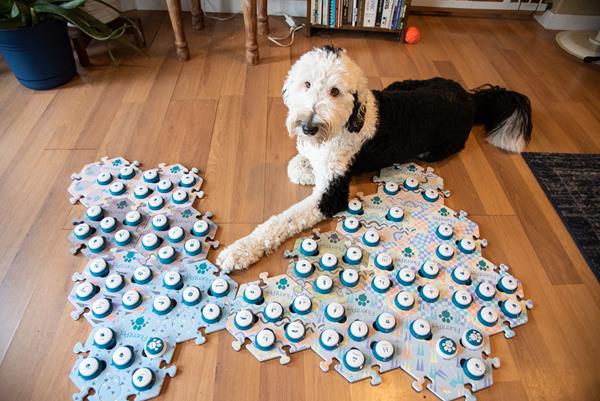


PBS NOVA recently aired an episode “Can Dogs Talk?” about whether dogs had the ability to learn our language.
Using paw-sized push buttons placed on the floor (usually attached to a mat and labeled), dogs can communicate with their humans by pressing the button with their paw. Their humans label the buttons by speaking a word for each. Then their dogs can press a button to communicate their need. For example, the human creates a “potty” button, and dog presses that button when it needs to go out.
A dog’s ability to communicate nonverbally with humans is well documented and every dog owner will attest to the fact that there are communications that are mutually understood. For example, when dogs have to go out to “potty,” they may scratch the door to indicate that they need to go outside. When it is time for food, usually dogs exhibit some behavior to let their human know that it is dinnertime. Dogs understand commands that they have been trained on, for example, “sit.”
But the dogs in this series have gone far beyond “sit.” They use buttons to communicate their needs. For example, they press a button that says “treat” to get a treat from their human. This is called associative learning. They associate a word or symbol with a particular object. For example, the dog will get a toy from their owner when they press the word “toy.”
Some dogs can also distinguish between items. A famous dog named Chaser could distinguish between 1,000 different toys (of course, who would have so many toys in the first place, but that is a different conversation). The NOVA program featured a dog named Gaia who knows 215 different toys by name. Her owner can call out the name of the toy and Gaia will select it from all of her toys. Since she is such a bright dog, researchers tried to see if she understood how the toy is used. She was given two toys, one for fetch and another for tug. When the owner asked the dog for the tug toy, she selected the toy that she associated with tug (she repeated this behavior for her fetch toy). She is one of 50 dogs that has been recognized as having that superior memory.
Some dogs communicate using more than a single button. One dog, Stella, indicated by pressing the words “yes,” “park,” “want” that she wanted to go to the park instead of bedtime. When the human indicated that it was too late to go to the park, she asked the dog if she wanted to go for a walk instead and the dog then pressed “yes,” “want,” “outside.” This particular dog has a command of 29 words.
Another dog pressed “ouch,” and the human asked where her problem was, she pressed “paw” and in fact, the dog had a thorn in her paw. To the researcher, this sounded like a dialog between the dog and her human.
Researchers are now collecting data on 10,000 dogs in 50 countries which are using buttons to communicate. Not all are as successful as the dogs that I mentioned, but their owners believe that these dogs are communicating with them. Most of the owners in this group are using 5 words or less. But there are a number of owners who are using more than 20 words and 30 dogs who use more than 50 words. Researchers have identified almost 800 dogs who use more than one word when communicating with their dog parents (e.g., “want” “outside”).
Researchers are trying to determine if these dogs actually have some rudimentary understanding of our language, especially those that use multiple words (one dog, when her “beach” button was broken used “outside,” “water” to indicate she wanted to go the beach).
No matter if dogs are capable of understanding our language, what is interesting to me is how connected these humans are with their dogs. So much so that they would take the time to teach and work with them to use these buttons. It is surely a source of joy for both. Now, on the other hand, there are my dogs, who will not be in any study, I guarantee that. Our level of communication remains rudimentary, and I love them just as much.
Angela Rieck, a Caroline County native, received her PhD in Mathematical Psychology from the University of Maryland and worked as a scientist at Bell Labs, and other high-tech companies in New Jersey before retiring as a corporate executive. Angela and her dogs divide their time between St Michaels and Key West Florida. Her daughter lives and works in New York City.

Write a Letter to the Editor on this Article
We encourage readers to offer their point of view on this article by submitting the following form. Editing is sometimes necessary and is done at the discretion of the editorial staff.