MENU

Sections

  • Home
  • About
    • Contact Us
    • Editors and Writers
    • Join our Mailing List
    • Letters to Editor Policy
    • Advertising & Underwriting
    • Code of Ethics
    • Privacy
    • Talbot Spy Terms of Use
  • Art and Design
  • Culture and Local Life
  • Public Affairs
    • Ecosystem
    • Education
    • Health
    • Senior Life
  • Community Opinion
  • Sign up for Free Subscription
  • Donate to the Talbot Spy
  • Cambridge Spy

More

  • Support the Spy
  • About Spy Community Media
  • Advertising with the Spy
  • Subscribe
January 7, 2026

Talbot Spy

Nonpartisan Education-based News for Talbot County Community

  • Home
  • About
    • Contact Us
    • Editors and Writers
    • Join our Mailing List
    • Letters to Editor Policy
    • Advertising & Underwriting
    • Code of Ethics
    • Privacy
    • Talbot Spy Terms of Use
  • Art and Design
  • Culture and Local Life
  • Public Affairs
    • Ecosystem
    • Education
    • Health
    • Senior Life
  • Community Opinion
  • Sign up for Free Subscription
  • Donate to the Talbot Spy
  • Cambridge Spy
Spy Highlights 00 Post to Chestertown Spy Point of View From and Fuller Spy Journal

Maryland Caucus with Foxwell and Mitchell: The 3 Top Maryland Issues to Watch in 2026

January 7, 2026 by Len Foxwell and Clayton Mitchell Leave a Comment

Every Wednesday, Maryland political analysts Len Foxwell and Clayton Mitchell discuss the politics and personalities of the state and region.

This week, Len and Clayton list their top three issues that Maryland voters will be looking at as the state enters what promises to be one of the most intensive midterm elections in its history.

This video is approximately 25 minutes in length.

The Spy Newspapers may periodically employ the assistance of artificial intelligence (AI) to enhance the clarity and accuracy of our content.

Filed Under: Spy Highlights, 00 Post to Chestertown Spy, From and Fuller, Spy Journal

A Preview of Maryland Politics in 2026

January 2, 2026 by Len Foxwell 1 Comment

The Christmas gifts have all been distributed, the tree now sits slumped and desiccated, and our attention now turns to seasonal matters such as postseason football, tax preparations and hearty Sunday stews.

For the political and cultural commentariat, this is the time when we can veer into one of two directions. Either we can look back at the year that was, or offer a glimpse, with speculation and predictions, at the one in the on-deck circle.

This writer cannot think of anything less appealing than revisiting a year that, from beginning to finish, has been shrouded in darkness. Rather than wasting time enumerating the American values that have been assaulted, the constitutional passages that have been shredded, the societal institutions that have lost legitimacy and the beloved souls who have been taken from us, let us just agree—if only within the confines of this space—never to speak of 2025 ever again.

Which leaves us looking ahead with trepidation to 2026. Which, potentially, will be one of the more fascinating years in the recent history of Maryland politics and government, with no end of issues, personalities and developments to watch in the coming year.

Gov. Wes Moore

As our ebullient governor heads into his re-election year, he is faced with both good and bad news. The most obvious good news is that he appears primed to win re-election by a decisive margin. The governor has sufficiently traveled throughout the state to deepen relationships with an electorate that is still getting to know him.

He has also earned intra-party plaudits for speaking out, with customary eloquence, against the poisonous policies of Donald Trump and their consequences. The only plausible GOP contender, former Gov. Larry Hogan, has done nothing to reassemble his political machine aside from occasional Facebook posts teasing a comeback.

While Republican hopeful Ed Hale’s messaging has been highly effective at tapping into the frustrations of Maryland’s minority party, he simply doesn’t possess the political experience or persona needed to upend a Democratic governor in a state where Democrats still outnumber the GOP by more than 2-1.

On the other hand, a poll conducted by UMBC’s Institute of Politics and its estimable pollster-in-residence, Mileah Kromer, indicate that while his approval ratings remained steady in 2025, his disapproval ratings have experienced a substantial uptick. The Governor’s relationship with the Democratic-dominated legislature has steadily devolved over time – over everything from reparations and redistricting to the sale of beer and wine in grocery stores – and can fairly be described as icy.

To add to this drama, a multibillion-dollar state budget deficit that had been slain in 2025 with a painful blend of service cuts and tax increases has now re-emerged, like Glenn Close from the bathtub in Fatal Attraction, to the tune of more than $1.4 billion. This, with a hefty balloon payment from the Blueprint for Maryland’s Future education plan looming a year from now.

And Marylanders were startled last month by the new cost estimates for the new Francis Scott Key Bridge, which have jumped from less than $2 billion to as much as $5 billion. This has cast a fresh round of doubts upon the commitment of the federal government to wholly finance its construction, and to do so in a timeframe under which the new bridge would be open for service within the next five years.

How will the governor manage these and other landmines?

Can he harness his once-in-a-generation political talent to unify his restive party? Will he and legislative leaders find solutions to Maryland’s resurgent fiscal challenges that jeopardizes neither his anticipated margin of victory in 2026, nor his rising star on the national political stage?

Or will this session simply be the start of a desultory campaign toward a Pyrrhic victory that inflicts lasting political wounds? As was William Donald Schaefer’s in 1990?

For that matter, will he be the latest in a long, distinguished history of Democratic incumbents and frontrunners to deal with an annoying primary challenger? One who has no chance of winning but exists merely to dredge the latent disquiet within the party’s rank and file?

Many Annapolis insiders still recall the lonely campaign waged by grocery store clerk Bob Fustero against Kathleen Kennedy Townsend in 2002 – one which raised less than $2,000 but carried 20 percent of the statewide primary vote.

The Next Madam Speaker

Joseline Peña-Melnyk, a cerebral and highly respected lawmaker from Prince George’s County, brings more than her share of “firsts” to a new position.

The Dominican-born Peña-Melnyk, 59, is the first Afro-Latina and the first immigrant to be elected speaker of the Maryland House of Delegates. She is also the first speaker to hail from the Washington suburbs since the abbreviated reign of Hyattsville’s Perry O. Wilkinson from 1959–63.

Perhaps more importantly, the new speaker offers a portent of philosophical, administrative and generational change within the “People’s Chamber.” In less than three weeks, she has already overhauled the House’s leadership ranks and rearranged its organizational chart by subdividing one committee into two.

Peña-Melnyk has also demonstrated a willingness to fly outside the Democratic Party’s prescribed V-formation. In 2016, she mounted a surprisingly energetic and appealing challenge to longtime party stalwarts Anthony Brown and Glenn Ivey for the 4th District seat in Congress. Six years later, she bucked Prince George’s County’s vaunted Democratic establishment—one of the few remaining bastions of vertical machine-politics in Maryland —to support U.S. Rep. David Trone over her County Executive, Angela Alsobrooks, in the Democratic primary for the U.S. Senate seat being vacated by Ben Cardin.

What does all of this mean for the composition and flow of Democratic House priorities in 2026? It remains to be seen. What we do know is that Peña-Melnyk takes the gavel riding a wave of genuine enthusiasm, affection and goodwill from her colleagues, one that is truly uncommon in this grim political age. We know from her personal story that she is undaunted by challenges of the moment, and we have seen from her political life that she does not feel beholden to her party bosses.

Energy Crisis

Maryland’s energy policies are a mess, an exploding meth lab of illogic and wish-fulfillment fantasy.

In the laudable pursuit of clean energy, our state leaders have depressed electricity support by closing three coal-powered electricity plants in the past five years. This, even as local growth and economic development policies, coupled with the inevitable ravages of climate change, have caused demand to spike.

As a result of a ruptured balance between supply and demand, we are now forced to import 40 percent of our state’s electricity from out-of-state. Which is literally bought at an auction and is, therefore, prohibitively expensive. In a holiday spirit, this writer was almost tempted to omit the fact that this gold-plated electricity is generated at the same type of coal-fired plants that we have shut down. Note that I said almost.

Now, BGE—financially fortified by state laws that allow it to reward its investors with record profits, pass its mandatory costs down to the ratepayers, and operate in a literal market monopoly—is under the microscope. As are the governor and General Assembly, who must now brace for angry ratepayers brandishing unprecedented monthly bills, and who don’t want to hear hollow excuses, incremental policy reforms or yet another spate of “studies” that simply confirm the obvious.

Donald Trump’s War on Maryland

Of all the uninformed, asinine political rhetoric that has infected our civic discourse over the past year, perhaps the dumbest are the utterances of those who—motivated either by legitimate fears or bad-faith partisanship—have begged Gov. Moore to please stop poking the bear, because he might just retaliate against US.

Respectfully, those who would actually say something like this in a public forum have no business managing their own finances. Indeed, one can imagine this graceless vulgarian rising out of bed and wondering how his national policies can work specifically to the disadvantage of the State of Maryland.

His DOGE-fueled crusade to dismantle the U.S. government has already cost Maryland about 15,000 federal jobs. According to one George Mason University study, as many as 50,000 public and private sector jobs have already been lost.

Trump’s war on scholarship resulted in an $800 million loss of funds at Johns Hopkins University, which in turn has led to more than 2,000 layoffs while placing lifesaving or life-changing research at risk. More than $2.3 billion was slashed at the National Institutes of Health in Bethesda, threatening jobs, careers and the fundamental mission of the agency.

His administration has reneged on a deal to build the new FBI headquarters in Greenbelt, has paused offshore wind projects in places such as Ocean City, and inexplicably refused to authorize federal disaster aid to communities in Western Maryland that were destroyed by floods last spring.

To top it off, the three most visible, highest profile victims of this administration’s ethnic cleansing, perpetrated under the rubric of immigration reform, happened to be Maryland residents – Miguel Abrego Garcia, Pastor Daniel Fuentes Espinal and Melissa Tran.

How will our state’s leaders respond in 2026?

Will there be new laws proposed to, if not curb, at least expose the barbaric behavior of sworn ICE agents on Maryland streets and in school drop-off lanes? Will they impose deep financial sanctions upon those counties that have established agreements to cooperate with ICE?

How, and to what extent, will our state, federal and local leaders challenge these and other ruinous policies in the courts?

We, The People

Amid all of this dystopia, Marylanders can be excused for their mood as we head into 2026. According to a UMBC-Kromer poll, we believe the following conditions will be even worse in the coming year than in the hellish one we are about to mercifully discard:

  • Social divisiveness

  • American democracy

  • Our quality of life

  • Our daily sense of stability

That doesn’t leave much room for optimism. And it begs a question of existential importance: Given the pervasive gloom that Marylanders feel about the current state of our politics, and the sense that things are not going to get better in the near future, how will that affect the civic engagement that is the lifeblood of any healthy system of government?

Bereft of the opportunity to vote against Donald Trump in this gubernatorial election year, will people be motivated to volunteer and vote for the local candidates? Burdened by a sense of fatalism about daily existence, will they still summon the will to advocate for legislation that will make their communities better, and challenge those bills that would have the opposite effect? Will our political leaders, many of whom have been appointed to their elected offices and are insulated by the comfort of districts that were drawn for maximum partisan advantage, do whatever they wish in 2026 simply because they can?

Or will they have the humility to have an honest conversation with constituents who simply believe the system no longer works for them – and actually listen to what they have to say?

The answers to these questions will begin to take shape in a mere matter of days, as the Maryland General Assembly will convene once again on January 14. Ready or not, business is about to pick up.

Len Foxwell is the principal of Tred Avon Strategies, a communications and political consulting firm in Annapolis.  A Johns Hopkins lecturer and HopStart director, Len previously served as Chief of Staff to Maryland Comptroller Peter Franchot. He holds a B.A. in Political Science from Salisbury University, where he also served as Special Assistant to the President.

The Spy Newspapers may periodically employ the assistance of artificial intelligence (AI) to enhance the clarity and accuracy of our content.

Filed Under: 00 Post to Chestertown Spy, 3 Top Story, Spy Journal

Those Winter Sundays by Robert Hayden Read by Sue Ellen Thompson

December 23, 2025 by Spy Daybook

Those Winter Sundays

Sundays too my father got up early
and put his clothes on in the blueblack cold,
then with cracked hands that ached
from labor in the weekday weather made
banked fires blaze. No one ever thanked him.

I’d wake and hear the cold splintering, breaking.
When the rooms were warm, he’d call,
and slowly I would rise and dress,
fearing the chronic angers of that house,

Speaking indifferently to him,
who had driven out the cold
and polished my good shoes as well.
What did I know, what did I know
of love’s austere and lonely offices?

—Robert Hayden
Robert Hayden was an American poet born in Detroit in 1913 and known for his clear, thoughtful poems about Black history, family, and moral struggle; he died on February 25, 1980. His best-known books include A Ballad of Remembrance, Words in the Mourning Time, and Angle of Ascent. He was the first African American Poet Laureate of the United States, appointed in 1976.
Sue Ellen Thompson is the author of six books of poetry—most recently SEA NETTLES: NEW & SELECTED POEMS. She has taught at Middlebury College, Binghamton University, Wesleyan University, Central Connecticut State University, and the University of Delaware. A resident of Oxford, MD for the past 18 years, she mentors adult poets and teaches workshops for The Writer’s Center in Bethesda. In 2010, the Maryland Library Association awarded her its prestigious Maryland Author Award.

The Spy Newspapers may periodically employ the assistance of artificial intelligence (AI) to enhance the clarity and accuracy of our content.

Filed Under: Spy Highlights, 00 Post to Chestertown Spy, Spy Journal

Looking at the Masters: Edvard Munch

December 18, 2025 by Beverly Hall Smith

Expressionist painter Edvard Munch (1863-1944) was born in Loten, Norway. He perhaps is best known for “The Scream” (1893), a painting that reveals his anxiety, alcoholism, and depression. He was weighed down by family members’ deaths when he was very young. Additional factors were his poor health and his father’s religious zeal and harsh discipline. As an expressionist he almost always chose emotion over realism.  Munch also painted many portraits and landscapes. He spent his life in Norway, with trips to Paris and Germany. 


“Winter in the Woods, Nordstrand” (1899)

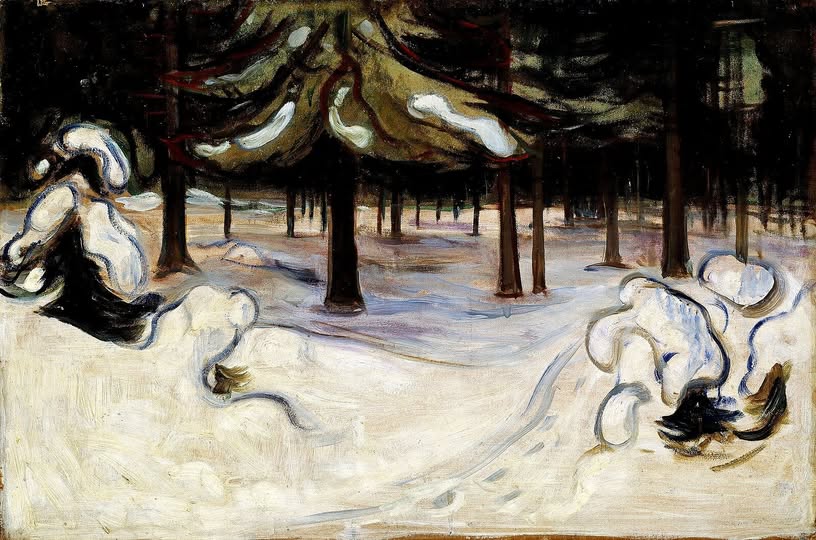
This article on Munch’s lesser-known landscapes, winter settings in particular, explores a unique side of his work. By the time “Winter in the Woods, Nordstrand” (1899) (24”x 35”) (oil on cardboard) was painted, Munch had become known internationally. From 1899 through 1901, he painted several winter landscapes of the fjords at Nordstrand, south of Oslo. The setting of this piece is a dark spruce forest in the snow. No people are present, but footprints in the snow indicate that people recently had come this way. The heavy clumps of snow on the trees are fresh. The wind has not yet dislodged them. Munch used thick strokes of paint, but he let the tan cardboard show through in places. Like the Impressionists, whom he admired, he painted shadows in shades of blue. However, he also had a heavy hand with black. He was creating his personal style. 

The painting, often described as melancholy, is a close-up view of the forest, the sky not included in the scene. But the sun shines across the exposed ground and causes the snow to glow. Munch depicted nature as raw and powerful with his use of broad sweeping brushstrokes. He explained, “Painting picture by picture, I followed the impressions my eye took in at heightened moments. I painted only memories, adding nothing, no details that I did not see. Hence the simplicity of the paintings, their emptiness.”

“White Night” (1901)

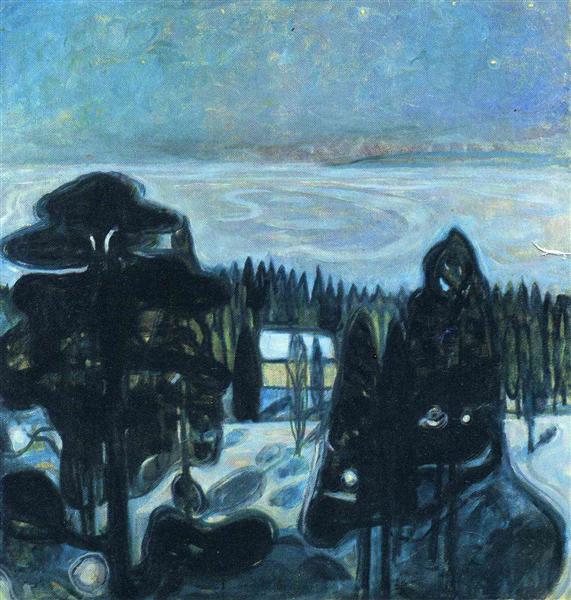
In winter in Norway, “polar night,” the scientific term for the phenomena, occurs when the Sun remains below the horizon. The title of the painting, “White Night” (1901) (45’’x44”), actually refers to the same phenomenon that occurs during the summer. The whiteness of the snow prevents the winter polar night from becoming completely dark. Munch painted the dark silhouette of the trees in the foreground, the snow and tree shadows in the middle ground, a tan barn with a snow-covered roof, another stand of spruce trees, and the swirling waters of the fjord and coast in the distance. The sky is sunless, but not dark.  Munch’s use of black and cool blue colors produces the chill of the scene. Not at all depressing, the work is an expression of the beauty, power, and vast scope of nature’s many attitudes.


“Winter Landscape” (1901)

Munch painted numerous winter scenes, and like music, they are a theme and variations. “Winter Landscape” (1901) (32”x48”) focuses more on the field of white snow and the blue shadow cast by the spruce tree. Large red, brown, and black rocks stand out against the white snow. A row of shorter and taller trees in the distance also calls attention to the stars in the blue sky. Munch never tired of painting winter scenes


”New Snow” (1900-01)

“New Snow” (1900-01) (29’’x23’’) presents another view of a spruce forest. A wide road leads the viewer’s eye through the forest. It was well-used, but covered in fresh snow. Brown tree trunks are scattered through the forest and the spruce trees are painted fresh green. The stylized trees have just been covered by the stylized clumps of snow. Munch transformed the forest into something dreamlike, poetic, and timeless. 

Munch suffered a physical and mental breakdown sometime during the period of 1908 through 1909, and he checked himself into a private sanitarium. On recovering, he declared he had become a teetotaler and a vegetarian. He returned to the town of Kragero and settled in there. He wrote, “I am now working full time, I feel, it now seems as if I am at my artistic peak. Never has my work given me so much joy.”  He was honored in a Sonderbund exhibition in Copenhagen that included works by Van Gogh, Gauguin, and Picasso. Munch wrote, ”All the wildest things that have been painted in Europe are collected here–I am practically a pale classicist.”

Munch moved in 1916 to a country home in Ekely, near Oslo. The house, with a view of the city, sat on 11 acres that included an apple orchard. He built several studios. He lived a fairly isolated life and continued to paint landscapes. He nearly died during the 1919 Spanish flu epidemic.  During that time, he had several exhibitions in major European cities.


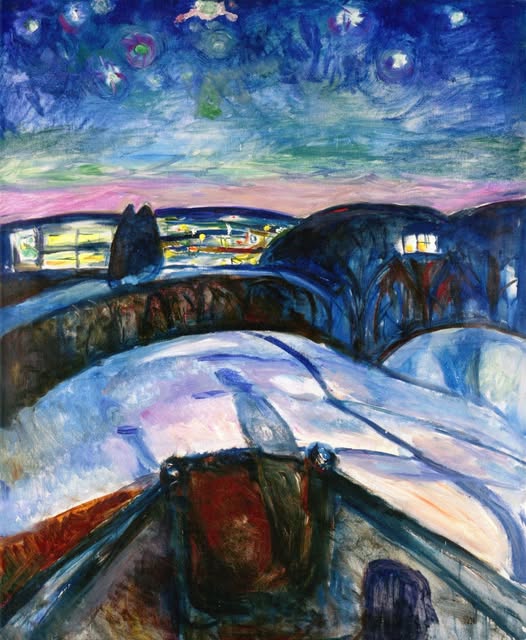
“Starry Night” (1922-24)

“Starry Night” (1922-24) (47”x39”) was one of the night sky series Munch painted from the top steps of his veranda. He often depicted himself as a lone shadow on the snow as he does here. Munch, the only figure in some of his paintings, is interpreted as loneliness and solitude which he preferred. He does include a view of the distant city. It is in the vastness of nature that human fragility, his own and humans in general, can be felt. There is a sense of life and time passing. 

In this later style, Munch used more varied and more vivid colors. The color red carries through the work: the red of the veranda in the foreground, the red in the bridge, the red house with the white windows in the middle ground, the pink sky created by the Sun’s position below the horizon, and the reds and pinks in the stars set in the dark blue heaven. He often depicted the constellations of Jupiter or the Pleiades that intensified his sense of the celestial world.

The expressionism of Van Gogh’s “Starry Night” (1889) and Munch’s “Starry Night” often have been compared. Both works are considered masterpieces.


“Winter in Kragero” (1925-31)

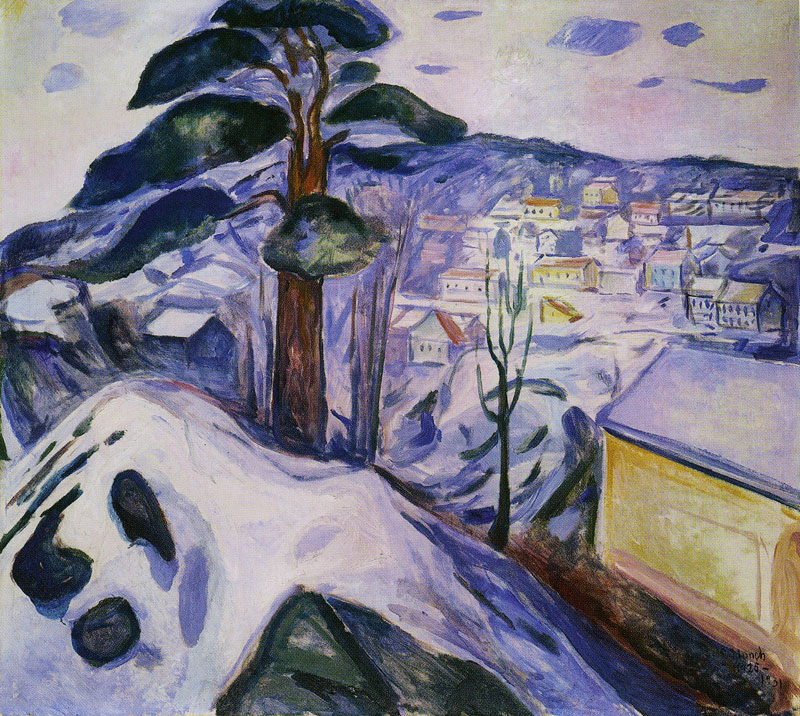
Munch moved to Kragero in 1908 after his nervous breakdown. He found the light and environment stimulating. He began painting urban scenes in 1909. “Winter in Kragero” (1925-31) (54”x59”) is a depiction of the city from a distance. The large yellow building at the right of the canvas is set next to the snow-covered roof of a house, neither painted in detail. A tall tree and a very slim tree stand on the diagonal slope that leads to the city. Kragero’s buildings rise up the hillside, and behind them are mountains. Although he frequently included scenes of towns in his work, these later paintings place the town at a distance.   

The Nazis designated Munch’s work as “degenerate art” in 1937, seized 82 of his paintings, and sold them to raise money.  The paintings were taken from German museums and Jewish collections.  A lost and then found Munch work “Dance on the Beach” (1906) sold at auction in 2023 for $22 million. Munch painted until he died on January 23, 1944. He willed to the city of Oslo his artwork and his collection of texts: 1150 paintings, 17,800 prints, 4,500 watercolors and drawings, 13 sculptures, his notebooks, and the plays and poems that he had written. The writings were unavailable to the public until January 1, 2015.  Munch was a major catalyst in the development of the Expressionist style that continues to be of major significance in the progress of 20th and 21st Century art. 

“Nature is not only all that is visible to the eye…it also includes the inner pictures of the soul.” (Edvard Munch)


Beverly Hall Smith was a professor of art history for 40 years. Since retiring to Chestertown with her husband Kurt in 2014, she has taught art history classes at WC-ALL and the Institute of Adult Learning, Centreville. An artist, she sometimes exhibits work at River Arts. She also paints sets for the Garfield Theater in Chestertown.

The Spy Newspapers may periodically employ the assistance of artificial intelligence (AI) to enhance the clarity and accuracy of our content.

Filed Under: 00 Post to Chestertown Spy, Looking at the Masters, Spy Journal

Food Friday: On Your Marks!

December 5, 2025 by Jean Sanders

I stopped by the post office early yesterday morning, before 9:00, before the counter was open, to pick up some stamps from the machine in the lobby, and already there was a queue of grim folks, their arms full of awkwardly shaped holiday parcels. That was on December 4th – and Christmas is still a couple of weeks away. The U.S. Postal Service has announced we should have all our packages in the system by December 17th if we have even the vaguest hope that they will arrive by the 25th. There can be no more dilly-dallying. It’s time to get cracking. To echo The Great British Bake Off – “On your marks. Get set. Bake!”

I’ve given up perusing all the gift ideas foisted on us by magazines and websites – even Consumer Reports wanted to tell me what to buy over Black Friday. Ordinarily I like a good time waster; I love looking at the luxury items I will not be buying for myself. The New York Times has its Wirecutter – an excellent resource – they review porch furniture, laptop computers, steak knives and linen sheets among scads of important life choices. New York Magazine’s Strategist is a little more frivolous and light-hearted: life-altering mascaras, the best inexpensive underwear, scented candles, and the shoe sales of a lifetime. These are both enjoyable rabbit holes. But this year I am busy protesting corporate greed, so our Christmas gifts will have a distinctly homemade vibe. Cookies and books R Us in 2025. Plus we are about to move again in two weeks, and I won’t have the stamina for elaborate presents this year. Sorry, grandchildren! Nothing frivolous for you this year.

This weekend I am having a bake-a-thon, and will be whipping up batches of Christmas cookies, so I can go join the queue at the post office on Monday with my boxes of home-baked Christmas cookies. I won’t be a sour puss, though. I will have my arms full of sweetness for my loved ones.

I love fancy cookies. Give me a fistful of fancy, store-bought, pastel-colored macarons any day. Let me enjoy artfully piped royal frosting. Show me an abundance of tooth-cracking silver dragées, and glittery dusting sugars. And now – let’s talk reality. The best home-made cookies remind us of our own childhoods. We baked homely cookies that always looked a little wonky, but the best part was sampling them as we went along. Remember all those tiny tastes of dough and batter and icing? Ostensibly, we were learning how to decide if there was enough salt or vanilla or ginger in our mixtures. The reality was a sticky advance sampling of forbidden sweets. Remember smelling those cookies as they baked? Or that terrible aroma of burnt sugar cookie? There were so many lessons to be learned in a single wintery afternoon.

Production and assembly-line cookies are the easiest cookies for children, and consequently their adults. Mix, scoop, bake, repeat. Think of Mr. Gilbreth and Cheaper by the Dozen. And think of chocolate chip cookies, and gingersnaps, and slice and bake cookies. Chocolate chip cookies call for uniform scoops of dough onto parchment paper-covered sheet pans. I bake a couple of batches of chocolate chip cookies every month. The dough freezes nicely, so there is never a cookie shortage in this house. I scoop all the batter, freeze the balls, and can dip into the freezer whenever there is a situation that calls for chocolate. This is my favorite recipe. I consider that the addition of oatmeal makes it health food. Oatmeal Chocolate Chips

I always thought this was my mother’s recipe, but it turns out it is her sister’s. Either way, I am related to it. And I share it here every year.

Gingersnaps

Makes approximately 3 dozen cookies
Pre-heat the oven to 350°F

2 cups all-purpose flour
1 tablespoon ground ginger
2 teaspoons baking soda
1 tablespoon cinnamon
1/2 teaspoon salt
Sift together the dry ingredients above. This is crucial – follow the steps here.

Add the dry ingredients to:
3/4 cup softened butter
1 cup sugar
1 egg
1/4 cup molasses

Mix thoroughly. Roll mixture into small balls and then roll the balls in a bowl of granulated sugar. Flatten the balls onto parchment paper-lined cookie sheets with a small glass. Bake for 12-15 minutes. Cool on racks. They are quite delicious with a nice cold glass of milk. We just loved rolling the balls in the little Pyrex bowls of sugar, and then flattening the balls with jelly jars. Sometimes we would get creative, and use a drinking straw to make a hole in the flattened cookie – so we could use a ribbon and hang it from the Christmas tree.

Like many of the best secret family recipes, Snowball Cookies come from the Land O’Lakes test kitchens. They are tasty, reliable, and easy to make: Snowball Cookies

This is another family stalwart: Fudge. I love watching fudge being made in shops, on long marble-topped tables. At home, I prefer the easiest and most reliable method: following the recipe on the Carnation Sweetened Condensed Milk label. This year I am crushing some candy canes to add for a colorful, minty-fresh topping:Fudge

Baking cookies is therapeutic. You can relive some childhood memories, while creating some new ones, too. And you can share the holiday love. Leave some cookies for your letter carrier. Bring a plate across the street. We live in stressful times, and sometimes it is nice to pour a glass of milk, and sit down with a plate of crisp, sugary indulgence, and flip through some gift guides.

“Even when freshly washed and relieved of all obvious confections, children tend to be sticky.”
–Fran Lebowitz


Jean Dixon Sanders has been a painter and graphic designer for the past thirty years. A graduate of Washington College, where she majored in fine art, Jean started her work in design with the Literary House lecture program. The illustrations she contributes to the Spies are done with watercolor, colored pencil and ink.

The Spy Newspapers may periodically employ the assistance of artificial intelligence (AI) to enhance the clarity and accuracy of our content.

Filed Under: 00 Post to Chestertown Spy, 1 Homepage Slider, Food Friday, Spy Journal

Food Friday: Thanksgiving Redux

November 28, 2025 by Jean Sanders


This is a repeat of our almost-annual Food Friday Thanksgiving column, because we are still trying to recover from yesterday’s holiday feast. NPR still has Susan Stamberg’s Cranberry Relish recipe, although Susan died recently. We will remember her mother-in-law’s recipe fondly every Thanksgiving. Mama Stamberg’s Cranberry Relish

Somewhere on the internet yesterday you heard Arlo Guthrie singing Alice’s Restaurant for its 58th year. (Farewell to, Alice, too. “And flights of angels sing thee to thy rest”.) The Spy’s Gentle Readers get to enjoy the annual rite of leftovers as engineered when my son was in college. In in these fraught times it feels reassuring to remind ourselves of the simpler times. Here’s a wish for a happier, kinder world next Thanksgiving!

And here we are, the day after Thanksgiving. Post-parade, post-football, post-feast. Also post-washing up. Heavens to Betsy, what a lot of cleaning up there was. And the fridge is packed with mysterious little bundles of leftovers. We continue to give thanks that our visiting college student is an incessant omnivore. He will plow systematically through Baggies of baked goods, tin-foiled-turkey bits, Saran-wrapped-celery, Tupperware-d tomatoes and wax-papered-walnuts.

It was not until the Tall One was in high school that these abilities were honed and refined with ambitious ardor. His healthy personal philosophy is, “Waste not, want not.” A sentiment I hope comes from generations of hardy New Englanders as they plowed their rocky fields, dreaming of candlelit feasts and the TikTok stars of the future.

I have watched towers of food rise from his plate as he constructs Jenga arrangements of sweet, sour, crunchy and umami items with the same deliberation and concentration once directed toward Lego projects. And I am thankful that few of these will fall to the floor and get walked over in the dark. We also miss Luke the wonder dog, and his Hoovering abilities. What a good dog.

I have read that there may have been swan at the first Thanksgiving. How very sad. I have no emotional commitment to turkeys, and I firmly belief that as beautiful as they are, swans are mean and would probably peck my eyes out if I didn’t feed them every scrap of bread in the house. Which means The Tall One would go hungry. It is a veritable conundrum.

The Pilgrim Sandwich is the Tall One’s magnum opus. It is his turducken without the histrionics. It is a smorgasbord without the Swedish chef. It is truly why we celebrate Thanksgiving. But there are some other opinions out there in Food Land.

This is way too fancy and cloying with fussy elements – olive oil for a turkey sandwich? Hardly. You have to use what is on hand from the most recent Thanksgiving meal – to go out to buy extra rolls is to break the unwritten rules of the universe. There are plenty of Parker House rolls in your bread box right this minute – go use them up! This is a recipe for fancy pants folks. Honestly. Was there Muenster cheese on the dining room table yesterday? I think not.
Pilgrim Sandwiches

And if you believe that you are grown up and sophisticated, here is the answer for you. Thanksgiving leftovers for a grown up brunch: After Thanksgiving Brunch

Here are The Tall One’s ingredients for his signature Pilgrim Sandwich, but please feel free to embellish:
Toast (2 slices)
Turkey (2 slices)
Cranberry Sauce (2 teaspoons)
Gravy (2 tablespoons)
Mashed Potatoes (2 tablespoons)
Stuffing (2 tablespoons)
Barbecue Sauce (you can never have too much)
Bacon (if there is some hanging around)
Mayonnaise (if you must)
Lettuce (iceberg, for the crunch)
Celery stalk (more crunch)
Salt, pepper
A side bowl of potato chips

And now I am taking a walk before I consider making my own sandwich.

“Leftovers in their less visible form are called memories. Stored in the refrigerator of the mind and the cupboard of the heart.”
-Robert Fulghum


Jean Dixon Sanders has been a painter and graphic designer for the past thirty years. A graduate of Washington College, where she majored in fine art, Jean started her work in design with the Literary House lecture program. The illustrations she contributes to the Spies are done with watercolor, colored pencil and ink.

The Spy Newspapers may periodically employ the assistance of artificial intelligence (AI) to enhance the clarity and accuracy of our content.

Filed Under: 00 Post to Chestertown Spy, 1 Homepage Slider, Food Friday, Spy Journal

Chicken Scratch: The Subtitle of Life — by Elizabeth Beggins

November 23, 2025 by Elizabeth Beggins

The night sky with stars and the pink glow of the Northern Lights

It started with the lady in the red pickup.

White hair like a full-fledged dandelion, or maybe a freshly groomed poodle, head just peeking over the steering wheel. She was zipping down the road like she had a coupon about to expire. For a second I thought I was seeing things. But no. She was absolutely real, probably on her way to meet someone exciting, and I suddenly understood that it was my worldview that needed adjusting.

Turns out, things are almost never what they seem. The subtitle of life.

A red pickup truck moving down a highway

Photo by Dan Williams on Unsplash

Her hair and determination somehow reminded me of Buffy, the patriarch of my childhood’s two-toy-poodle dynasty. Late one night, in the twilight of his life, Buffy didn’t get up from his usual spot by the patio door. Distraught, mom found dad in the bedroom, in a T-shirt and boxers. What is it with dads and underwear in times of crisis? Anyway, he was a big man whose anger could scare the stripes off a zebra. With my whimpering mother behind him, he loomed over the dog.

“BUFFY!” he thundered, stamping his foot.

The dog shot up like a furry Lazarus—clearly no longer dead. We still say he left the Pearly Gates behind in fear of my father.

Miracles aside, often it’s the details of existence that bedevil us most. The other night, my husband spent extra minutes scrubbing a takeout lid that refused to come clean. Baffled by the laws of grease and physics, he laughed when he realized he’d been washing two tops stuck together. He was working twice as hard to accomplish nothing. Welcome to the domestic version of modern life.

Like the time he came home complaining that either his jeans had shrunk or his body had expanded. Neither was true. The jeans were mine. He’d worn them all day, never processing that the zipper was on the scenic route and the waistband was cutting him in half. At the time, I questioned both his powers of observation and the realities of my mom-body. Years later, it feels like a reminder of how uncomfortable it is when we try to squeeze our lives into proverbial pants never meant for us. Confusion, apparently, is our love language.

Then there was the duel I fought at a weekend beach house. Each time I used the bathroom, the toilet paper roll was running the wrong way, so I flipped it around. Someone else clearly disagreed, because every time I returned, it was reversed again. Three days of silent combat, two invisible opponents waging war over the orientation of the two-ply. I never discovered my challenger, but I’m sure we both walked away feeling victorious.

If I can get that riled up about toilet paper, no wonder the rest of the world can’t agree on anything. Perhaps that’s why I’ve grown wary of ever thinking I have the final answer. We live in a time when every argument escalates quickly. The distance between deciding there’s a right way to hang toilet paper and believing there’s a correct way to think at all is surprisingly short. And oh, how quickly we dig in when someone rolls the other way!

That stubborn need to be right seeps into every nook like spilled milk. I sit down meaning to write about love, or laughter, or aging, and somehow end up in the thicket of politics. It’s strange to live in a country where truth depends on the channel, and outrage feels like the national pastime.

A wild violet plant with small purple flowers grows in the corner of a cement step

Photo by Brian Stalter on Unsplash

I’m not a political writer, and I have no appetite for shouting matches. But I do know this much: I’m tired of watching decency get filibustered. I believe in the rule of law. I think money should never outweigh morality, and that cruelty is not a governing strategy. Both major parties—and the movement convinced it’s purer than either—fail us in ways that go deeper than policy. We’ve allowed a few people with deep pockets and deeper insecurities to convince us we are small, fragile, and owned. But we aren’t. We’re the Wi-Fi that works in the basement, the wool sweater that’s survived a lifetime of winters, the wildflowers growing in concrete.

One thing that keeps me going is the conviction that there’s more to humanity than the people in power. When the systems meant to support us fall short, we show up for each other. It’s messy, inefficient, and it doesn’t reach everyone, but it’s all we have to offer. So we do.

Sometimes a reassessment, an attitude adjustment inspired by dandelion hair, is the best place to start. Which brings me to Ireland.

Seven months after my father died, my mother took me there. It would have been their 59th anniversary, and she wanted something else to think about. A seasoned traveler at 82, she booked a bus tour—no logistics, no stress, just along for the ride. The guide, by his own accounting, didn’t drink, didn’t swear, but regularly summoned his pals.

“Jesus, Mary, and Joseph!” he’d exclaim at roads too narrow for either a bus or a confession.

I was not yet 50 and, except for one couple with a teenage son, I was the youngest on the bus. From the looks of them, Leslie and Betty were closer in age to my mother. They sat in the front seats, fingers entwined. When we stopped to explore Yeats’s grave, Donegal Castle, and the Cliffs of Moher, they held hands, whispered, and smiled at each other.

A smiling older couple sit close together on a bus

The real Betty and Leslie. He went by Les.

I admired them and found myself hoping my husband and I would be like that someday, if we were lucky enough to live that long.

On the last day of the trip, I squatted down in the aisle beside them and said, “I just have to tell you—you two are adorable. How long have you been married?”

They giggled, looked at each other, and said in unison, “Six months.”

Of course. Of course the people I envied for their years of devotion had barely figured out whose turn it was to do the laundry. The universe cracks itself up, doesn’t it?

Somebody’s always scrubbing the wrong lid, wearing the wrong jeans, fighting silent toilet paper wars, electing people who promise more than they deliver. And yet, amid the swirl of daily personal mishaps and colossal political betrayals, I keep finding reasons to be hopeful.

Recently, the Northern Lights were visible where I live and all the way around the globe. Light pollution in my town kept them from my view, but the camera saw what I couldn’t. Meanwhile, friends from near and far shared pictures in a group chat, all of us on a device that can be as problematic as it is purposeful. One wrote: “How miraculous to instantly see, on this magic little box in my hand, the Aurora Australis from a friend’s yard on the other side of a giant ball we are flying on around the sun and our home galaxy. One of billions.”

Life is rarely just as it seems. It’s always more—so much more.


An audio version of this essay, read by the author, is available here.

Elizabeth Beggins is a communications and outreach specialist focused on regional agriculture. She is a former farmer, recovering sailor, and committed over-thinker who appreciates opportunities to kindle conversation and invite connection. On “Chicken Scratch,” a reader-supported publication hosted by Substack, she writes non-fiction essays rooted in realistic optimism. To receive her weekly posts and support her work, become a free or paid subscriber here.

The night sky with stars and the pink glow of the Northern Lights


The Spy Newspapers may periodically employ the assistance of artificial intelligence (AI) to enhance the clarity and accuracy of our content.

Filed Under: 3 Top Story, Spy Highlights, Spy Journal

Food Friday: Green Beans, Reimagined

November 14, 2025 by Jean Sanders

I have never bought a can of cream of mushroom soup. I have never willingly consumed it. I will never buy a can of cream of mushroom soup. That is my mantra. If I could embroider I would probably have a cross-stitched pillow or two that announced this aversion. It might be genetic – my mother never used that staple of 1960s cooking, although she was fond of Jell-o molds. I doubt if my children have ever cooked with mushroom soup – although I have never asked them directly – I am employing delicate generational diplomacy: some things are private.

Not willingly eating mushroom soup has never made me popular at Thanksgiving, when everyone in the United States whips up their secret family recipe for Green Bean Casserole, which involves cooking perfectly delicious and crunchy green beans in a white Corning Ware casserole dish, smothered in a chemical septic field of gray mushroom slop, topped with canned fried onions. At Thanksgiving we should be giving thanks for the wonderful bounty of nature – not for PFAS, sodium nitrates, and other preservatives.

As a child I did not care for cooked vegetables, with the exception of corn and potatoes. And pizza. I have always preferred the crisp snap of fresh beans, the cool orbs of peas as they slide out of their pods, and cold, peppery radishes, floating in Pyrex bowls of iced water. It was one of my mother’s super powers that she assigned vegetable duties to me and my brother on the back porch steps in the summertime. It might take us forever to shell the peas, or string the beans, or shuck the corn, but we were quiet, and out of her hair. The price she paid was we might not fill the cooking pot with peas, because we had gobbled a few handfuls as we performed our task: one pea for me, one pea for the pot. The same technique worked with the string beans. We’d break of the ends, eat a few beans, throw the rest into the colander. We ate the greens without Mom hectoring us. Genius. And deelish. Who could eat hot, slimed green beans, dripping with mushroom soup after that childhood exposure to healthy eating?

I almost overlooked an obituary in the New York Times a few years ago. Dorcas Reilly died in New Jersey at 92. Reilly invented the almost ubiquitous Green Bean Casserole that appears on so many Thanksgiving dinner tables. Modestly, Reilly asserted she was just part of the team that developed the dish at Campbell’s Soup in Camden, New Jersey in 1955. They were looking for a tasty, economical side dish. This has just six ingredients, and it can be easily assembled by anyone. It became an institutional classic; it was America at its most homogenous and bland. Campbell’s estimated once that 20 million green bean casseroles would be prepared annually in the United States at Thanksgiving. Imagine being the person who was responsible for such a legacy. Will you have a green bean casserole on your table? Dorcas Reilly obituary

The Original: Campbell’s Green Bean Casserole
1 10 3/4-ounce can of Campbell’s cream of mushroom soup
1/2 cup milk
1 teaspoon soy sauce
A dash of pepper
4 cups cut green beans
1-1/3 cups of French fried onions

Mix soup, milk, soy, pepper, beans and 2/3 cup onions in 1-1/2-quart casserole.

Bake at 350°F for 25 minutes, or until hot. Stir. Sprinkle with remaining onions. Bake five minutes. Serves six.

Here is an alternative: This is a labor-intensive recipe, best brought to a potluck Thanksgiving, when you can boast about making the mushroom sauce from scratch. No sodium-riddled canned soup for you! Green Bean Casserole

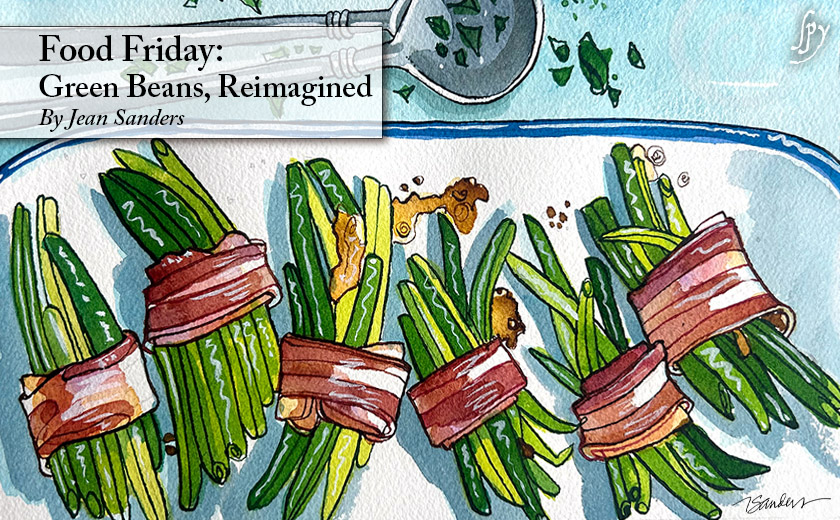
I just love these bundles of beans trussed up with ribbons of bacon: Green Bean Bundles

This recipe can be made in advance, but it eliminates all the fun of the French fried onions, and it makes you make bread crumbs! Shocking! Another Green Bean Casserole

Get organized! The Thanksgiving clock is ticking down!

In two short weeks Thanksgiving will be over – except for the best part with the Pilgrim sandwiches, and some leftover pumpkin pie, smuggled cold from the fridge and eaten hastily while standing at the pantry window, looking out over the swirl of black leaves in your childhood home’s back yard.

“As we express our gratitude, we must never forget that the highest appreciation is not to utter words, but to live by them.”
—John Fitzgerald Kennedy


Jean Dixon Sanders has been a painter and graphic designer for the past thirty years. A graduate of Washington College, where she majored in fine art, Jean started her work in design with the Literary House lecture program. The illustrations she contributes to the Spies are done with watercolor, colored pencil and ink.

The Spy Newspapers may periodically employ the assistance of artificial intelligence (AI) to enhance the clarity and accuracy of our content.

Filed Under: 1 Homepage Slider, 00 Post to Chestertown Spy, Food Friday, Spy Journal

Looking at the Masters: Chrysanthemums

November 13, 2025 by Beverly Hall Smith

The chrysanthemum was noted as early as the 15th Century BCE in China. The boiled roots of the plant were used in a remedy for headaches. Chrysanthemum sprouts and petals were included in salads and soups. The sweet odor and beautiful colors made the flower a popular component of garlands and bouquets. Since the chrysanthemum bloomed late when other flowers were fading, it became a popular fall flower. By 1630 CE, 500 cultivars had been created, and the estimated number of Chinese cultivars by 2014 was 7,000.  More than 20,000 varieties of the chrysanthemum are recognized world-wide. 

The chrysanthemum has been associated with fall for hundreds of years because it blooms in the cooler weather of fall and early winter when other flowers have faded or died. It also is associated with strength against harsh conditions. It is associated with longevity because it grows in abundance every year, fidelity and optimism because it returns year after year, and joy because it blooms in such a variety of colors.

“White Chrysanthemums” (1654)

Chinese poet Qu Yuan (340-278 BCE) was one of the first to write poetry about mums. In his poem “Li Sao” he wrote, “Drink dew from the magnolia in the morning and take autumn chrysanthemum’s falling petals as food in the evening.” Xiang Shengmo’s “White Chrysanthemums” (1654) (31”x15.5’’) (hanging scroll) illustrates the beauty of the flowers, leaves, stems, and buds of the mum. The upright strength of the mum is depicted in the composition. No stem breaks or bends, and buds branch out at all points. 

Xiang Shengmo was born during the Qing dynasty (1644-1911), founded by the Manchus. Art and literature flourished during the period, but European art was beginning to influence traditional Eastern art. Xiang was fortunate to have grown up with his grandfather’s huge collection of historic Chinese painting and calligraphy.

“Chrysanthemums” (1723-35)

Lang Shining (1688-1766) was born Guiseppe de Castiglione in Milan, Italy. He entered the Society of Jesus (Jesuits) in Genoa at age 19. He remained a lay brother rather than becoming a priest. He worked in Lisbon for several years until Qianlong, the Emperor of China in the Qing dynasty, became interested in employing European Jesuits in China to train Chinese people in various fields, one of which was painting. Qianlong’s reign is considered to be the Golden Age of China. Castiglione reached Macau in August 1715 and Beijing a year later. He served the next three Qing emperors. He adopted the Chinese name Lang Shining.     

Castiglione/Shining’s “Chrysanthemums” (1723-35) (silk with tempera) is one of hundreds of his paintings of flowers, birds, landscapes, battle scenes, and portraits. Shining uses the Chinese style of composition, the delicate balance between objects and empty space. His details of the flowers, leaves, and birds are more specific without being overwhelming. Shining used the technique of chiaroscuro, strong contrast between light and dark, to create depth, for example, in the rendering of the leaves from light to dark greens The white chrysanthemum petals are delineated with light gray paint. Shining mastered the difficult process of painting on silk with tempera, a water-based paint. With too much water, the color runs through the silk, and there is no way to save the work. He died in Beijing in 1766 and is buried there. His obituary was written by the Emperor Qianlong, and a stone monument was erected.

“Chrysanthemums in a Deep Ravine in China” (1840s)

The chrysanthemum arrived in Japan in the 5th Century CE, and the popularity of the plant spread throughout Japan, including royalty and commoners alike. The chrysanthemum was a symbol of autumn, harvest, longevity, rejuvenation, and good will. White chrysanthemums were used at funerals. Many families incorporated the chrysanthemum into their seals. The yellow chrysanthemum, the color of the sun, was adopted as the symbol of the Imperial family.  It is used in the Imperial Seal of Japan, and the Japanese throne is known as the Chrysanthemum Throne. The Supreme Order of the Chrysanthemum is the highest honor the government can award.

“Chrysanthemums in a Deep Ravine in China” (1840s) is a woodcut print on a fan by the famous Japanese artist Utagawa Hiroshige (1797-1858). Hiroshige detailed the separate petals of the flowers, and they are large blossoms typical of the flowers cultivated in Japan. Hiroshige also includes a reference to a Japanese tale. The seated figure in the yellow box is a favored young attendant of the Emperor Mu Wang (1007-947 BCE) who was forced into exile by jealous rivals at court. Before the attendant was exiled, the Emperor taught his servant a Buddhist verse. It was said the young attendant wrote the verse on petals of chrysanthemums so he would not forget them. The petals became known as an elixir of eternal youth.

“White and Yellow Chrysanthemums in the Garden at Petit Gennevilliers” (1893)

Pierre Louis Blancard, a French merchant, brought chrysanthemums from China in 1688. Scottish botanist Robert Fortune brought 250 new varieties from China and Japan in 1846. The Chrysanthemum became a symbol of friendship and love in France, England, and America. 

“White and Yellow Chrysanthemums in the Garden at Petit Gennevilliers” (1893) (29’’x34’’) was painted by Gustave Caillebotte. He and Claude Monet, both well-known painters, were great friends, drawn together by art and gardening. Caillebotte made six large, close-up paintings of chrysanthemums in 1893. The Victorians’ obsession with flowers led to the development of the language of flowers. White chrysanthemums, often included in funeral bouquets and wreaths, became associated with mourning. They also are associated with loyalty, honesty, and innocence. Golden yellow mums represent wealth, the sun, happiness, celebration, and longevity.  Pink mums represent attraction and romance–red mums, love and passion.  Violet mums were given to the ill, as a wish for return to health. Caillebotte delineates the individual petals, uses bright colors, and portrays sunlight light dancing across the canvas.  

“Chrysanthemums in the Garden at Giverny” (1897) was painted by Caillebotte’s fellow flower and garden enthusiast Claude Monet. Monet’s obsession with waterlilies is well-known, but he also was drawn to Japanese woodcuts made by Hokusai and others, who did not use European perspective. This piece is one of several in Monet’s “Large Flower” series, through which he experimented with the Japanese style. Monet’s garden was his pride and joy, and he designed his garden by color and contrast. He does not delineate each petal in each flower, but paints just enough to let the viewer know the flowers are mums. The painting is a luscious riot of colors.


Beverly Hall Smith was a professor of art history for 40 years. Since retiring to Chestertown with her husband Kurt in 2014, she has taught art history classes at WC-ALL and the Institute of Adult Learning, Centreville. An artist, she sometimes exhibits work at River Arts. She also paints sets for the Garfield Theater in Chestertown.

The Spy Newspapers may periodically employ the assistance of artificial intelligence (AI) to enhance the clarity and accuracy of our content.

Filed Under: 00 Post to Chestertown Spy, Looking at the Masters, Spy Journal

Maryland Caucus with Foxwell and Mitchell: Maryland Redistricting Gets Serious and How the 1st District Could be Cut Up

November 12, 2025 by Len Foxwell

Every Wednesday, Maryland political analysts Len Foxwell and Clayton Mitchell discuss the politics and personalities of the state and region.

This week, Len and Clayton discuss the increasing pressure on Maryland Senate President Bill Ferguson to change his opposition to Governor Wes Moore’s plan to eliminate the state’s only Republican congressional district and what that might mean for the 1st District on the Eastern Shore.

This video is approximately 16 minutes in length.

The Spy Newspapers may periodically employ the assistance of artificial intelligence (AI) to enhance the clarity and accuracy of our content.

Filed Under: Spy Highlights, 00 Post to Chestertown Spy, Maryland Caucus, Spy Journal

Next Page »

Copyright © 2026

Affiliated News

  • The Chestertown Spy
  • The Talbot Spy

Sections

  • Arts
  • Culture
  • Ecosystem
  • Education
  • Mid-Shore Health
  • Culture and Local Life
  • Shore Recovery
  • Spy Senior Nation

Spy Community Media

  • Subscribe
  • Contact Us
  • Advertising & Underwriting

Copyright © 2026 · Spy Community Media Child Theme on Genesis Framework · WordPress · Log in