
MENU

Sections

  • Home
  • About
    • Contact Us
    • Editors and Writers
    • Join our Mailing List
    • Letters to Editor Policy
    • Advertising & Underwriting
    • Code of Ethics
    • Privacy
    • Talbot Spy Terms of Use
  • Art and Design
  • Culture and Local Life
  • Public Affairs
    • Ecosystem
    • Education
    • Health
    • Senior Life
  • Community Opinion
  • Sign up for Free Subscription
  • Donate to the Talbot Spy
  • Cambridge Spy

More

  • Support the Spy
  • About Spy Community Media
  • Advertising with the Spy
  • Subscribe
November 10, 2025

Talbot Spy

Nonpartisan Education-based News for Talbot County Community

  • Home
  • About
    • Contact Us
    • Editors and Writers
    • Join our Mailing List
    • Letters to Editor Policy
    • Advertising & Underwriting
    • Code of Ethics
    • Privacy
    • Talbot Spy Terms of Use
  • Art and Design
  • Culture and Local Life
  • Public Affairs
    • Ecosystem
    • Education
    • Health
    • Senior Life
  • Community Opinion
  • Sign up for Free Subscription
  • Donate to the Talbot Spy
  • Cambridge Spy
2 News Homepage

Residents Raise Funds for Return of K-9 Max, Leading to Questions About Why St. Michaels Police Dog was Retired

July 14, 2021 by John Griep

Although he retired June 30, the issue of St. Michaels Police Department K-9 Max is on the agenda for tonight’s town meeting after residents collected donations to fund his continued service and questions were raised about why the dog was retired.

Max retired June 30 — the end of the town’s fiscal year — and was going spend his retirement with his handler, Cpl. Jason Adams, and his family.

In a July 1 Facebook post, the police department said Max had conducted more than 240 narcotics scans, leading to more than 120 arrests, since joining the force in March 2015. Many of those scans and arrests occurred while assisting other law enforcement agencies in Talbot County.

During public comments before a July 7 closed session, Paulette Florio said funds had been donated to pay for Max to return to service as a police dog.

“I just have some good news that I wanted to present to the commission,” Florio said. “And it has to do with the retired canine officer. Apparently it was a budget cut from what I understood from my investigation of the matter.

“And the town came together and we have a group of citizens who want the dog back and have the money to bring him back in full,” she said. “So we just don’t know where to send the money.

“So congratulations, you still have a canine officer to do his job. And he’s apparently good for another three years in canine officer world,” Florio said. (According to the National Police Dog Foundation, police dogs normally retire “around 10 years of age,” depending on health.)

“So where can we send the money? And how do we get him back?” Florio asked July 7.

Commission President Michael Bibb said the commissioners would have to discuss the proposal, but said “(t)he dog was not retired due to budget cuts.”

Bibb’s comment prompted St. Michaels Police Chief Anthony Smith to respond, with Smith saying Florio likely got some of her information from him “because I was led to believe that to some degree.”

The chief said Bibb, in fact, had been the one to tell him that Max would be retired and that one reason for the dog’s retirement “was because it was part of an agreement with the salary increase that we were going to get as police officers.

“So once I learned that information, to me, it became a budget issue,” he said. “And that’s what you informed me in my office about two weeks ago.

“So to me, if if it’s getting around that it’s a budget issue, that’s the impression that I got when you when you informed me that one of the reasons why we got a pay raise or (were) going to get a pay raise, (was) because Max is going to be retired,” Smith said.

The chief said he was opposed to retiring the K-9, but it was ultimately the decision of the town commissioners.

“We had a discussion in several of the meetings and I voiced my opinion that I wanted to keep the canine,” he said. “I think at one meeting, Commissioner DuPont … asked me what my thoughts was on Officer Max and I said he’s a good deterrent. And absolutely he is a deterrent.”

“Now, if the commissioners as a body want to get rid of the canine, that’s fine,” Smith said. “But certainly there should be a process where it should have went through the chief … because I was dead set against it from the very beginning.”

Commissioner David Breimhurst thanked the chief for his comments and the private citizens for offering the funds and asked that the issue be added to the agenda for the July 14 meeting.

Smith said a decision would need to be made soon because Max is required to have a certain amount of training each year.

“I know that’s an issue. I know it’s expensive. And I know that’s an issue with part of wanting to retire him but he’s got to get back and train, he said. “He can’t miss too much training. So thank you very much if you’re going to give us some consideration, but we do not want to go too much past July 14.”

Resident asks four commissioners to resign

Town resident John Garland, speaking before the July 7 closed session, asked for the immediate resignations of Commissioners Bibb, Breimhurst, DuPont, and Harrod.

“Last year, commissioners Bibb, DuPont, Breimhurst, and Harrod, who were collectively supported by St. Michaels Action Committee, known as SMAC, campaigned against two commissioners running for reelection by making unfounded claims,” Garland said. “They defeated those two commissioners by peddling lies and fear.

“Now it seems these same four commissioners did not follow Maryland’s open meeting laws in order to fire long term town manager,” he said. “Regardless of the closed meeting topic, the simple fact that four of our five commissioners sought to disregard open meetings laws is by far their worst behavior to date, in my opinion, and stands in direct irony to their campaign promises.

Garland did not specify how the commissioners may have violated the Maryland Open Meetings Act in connection with the June 24 closed session in which they voted 4-1 to dismiss longtime Town Manager Jean Weisman.

“Accountability is a two-way street,” Garland said July 7. “These four commissioners have broken their trust obligation with residents. And this doesn’t even include their other behaviors such as micromanaging town staff, effectively grinding down operations to a crawl and engaging in day-to-day town management activities which is not a function of their role as commissioners.

“As a town resident, I formally request the immediate resignations of Commissioners Bibb, DuPont, Breimhurst, and Harrod for legal negligence, dereliction of duty, and loss of public trust. I also request the proper process be followed to fill their seats.”

Following the public comments, the town commissioners voted 4-1 to go into closed session July 7 to discuss personnel matters. Commission Vice President Jaime Windon voted against the closed session, saying, “I’m not comfortable without a town attorney here today and I requested that.”

July 9 closed session discussed temporary town manager

The commissioners held a second closed session last week on Friday, July 9, and noted there would be no public comment before that closed session.

Bibb, Breimhurst, and DuPont voted July 9 in favor of a closed session for personnel matters. According to an audio recording of that vote, Windon apparently was attending remotely and her vote on closing the meeting could not be heard by her fellow commissioners and town staff. Harrod apparently was absent.

The written closing statement for the July 9 meeting identifies the reason for the closed session as “temporary town manager” and indicates that four commissioners voted to close the session (it appears the number 3 has been written over as the number 4) and one commissioner was absent.

SM070921closingstatement

The written closing statement for the July 7 meeting identifies the reason for the closed session as “temporary employment and attorney retainment.”

SM070721closingstatement

The town commissioners meet at 6 p.m. tonight for a regular monthly work session. The public may attend using Zoom.

To join the meeting by computer or smart phone, click this link: https://us02web.zoom.us/j/3264261778. The meeting ID is 326 426 1778. To join by phone with audio only, call 1-301-715-8592 and enter meeting ID 326 426 1778.

The Spy Newspapers may periodically employ the assistance of artificial intelligence (AI) to enhance the clarity and accuracy of our content.

Filed Under: 2 News Homepage Tagged With: budget, canine, commission, commissioners, k-9, max, police, St. Michaels

St. Michaels Budget Set for Wednesday Night Public Hearing

May 11, 2021 by John Griep

St. Michaels will hold a virtual public hearing Wednesday night on a proposed $3.5 million budget that includes a cut to the property tax rate and a smaller reduction in marketing spending than originally suggested.

The Fiscal Year 2022 budget, proposed by St. Michaels Commissioner Tad DuPont and introduced by Commissioners David Breimhurst and Mike Bibb, would set the property tax rate at 49 cents ($0.49) per $100 of assessed value. The town’s current rate is 52.4 cents ($0.524) per $100.

DuPont, selected by the town commissioners as treasurer, said during a May 4 budget work session that the commissioners are elected by town residents and “it’s their interest that we need to look after.

“They’re the ones that pay significant portion of the bills, and it’s our duty to ensure public continuity and safety and look after their interest, as well as everybody else’s,” he said.

He said the budget was a compromise, with departments being adequately funded, but not getting everything they wanted.

“We listened to public works. They got most of what they asked for but they didn’t get it all. We listened to the police department. They got a lot of what they wanted, they got what they needed, but they also didn’t get everything that they’d like to have. The same thing happened with the administration office. They got some of what they wanted, but they didn’t get it all,” DuPont said.

“The other thing that we’ve been able to accomplish in this budget is we’ve been able to separate the water department…. The water department will stand on its own and it will be able to pay off its debts in roughly three years. The way it currently is budgeted, it will be approximately $71,000 to the plus … this year.

“So that all being said, I feel that the commissioners have done a great job in trying to balance everybody’s needs, everybody’s wants, including the taxpayer,” DuPont said.

Using the current rate and a projected tax base of $307.6 million, the town would have collected $1,611,824 in property taxes. The proposed 49-cent rate will bring in $1,507,240, reducing the town’s revenues by about $100,000.

With the lower rate, property owners would save $34 on a $100,000 property, $68 on a $200,000 property, $170 on $500,000, $340 on $1 million, $1,700 on $5 million, and $3,400 on a property valued at $10 million.

The minimal savings to individual taxpayers while the town commissioners are debating $50,000 in spending prompted Commissioner Jaime Windon to oppose the tax cut during a May 4 budget work session.

“A few weeks ago we had a kind of a general philosophical discussion about some people are of the mindset that we should always be working to reduce taxes and so that’s an admirable goal if that’s what your end result is.

“The problem for me and the reason that I’m so resistant to it after you know trying to look at it from all angles — and I promise you I have — is that it’s just that cut just doesn’t amount to that much for the individual taxpayer, even those who own a massive amount of property,” she said.

“And I just feel that we’re still debating hotly $5,000, $10,000, $20,000 decisions — which I’m not saying we shouldn’t debate every fiscal decision that comes before the town — but until we’re in a place where we have more than enough money to make all of those decisions that make this town a town that we’re all proud to live in, and that we all feel is thriving, then I don’t … personally feel motivated to make a tax cut, which is why I’m opposed to it,” Windon said.

Commissioner David Breimhurst said the budget included “safety valves” and “we’re still in the midst of a pandemic,” with restaurants required to maintain six-foot distancing.

“So, if worse comes to worse and things do look like they’re going down the drain, we still have the reserve and the ability to kick in,” he said. “(W)e’ve done a lot of hard work on this budget and it’s been painful … because we’ve really … sliced and diced it every which way we possibly can. And we’re trying to give something to everyone and if it’s three cents for the taxpayers, that’s great.”

The most controversial issue in the budget had been a proposal to cut the marketing spending from the $140,000 originally proposed to $40,000.

The money for marketing and advertising comes from two revenue sources — the accommodations tax and the amusement and admissions tax. The biggest portion comes from the accommodations tax, which is paid by guests staying at hotels, B&Bs, inns, and short-term rentals.

St. Michaels typically has used about 75% of the revenue from those two taxes to pay for town services related to tourism, including trash pickup and police. The town has used the remaining 25% for advertising and marketing and the $140,000 in the initial draft budget was about 23% of the expected accommodations and amusement taxes for FY22.

During the May 4 budget work session, numerous business owners spoke against any cuts to the marketing budget.

Kim Hannon, president of the St. Michaels Business Association, noted “the money that is used for advertising is from the accommodations and amusement tax…. (T)he accommodations tax and amusement tax is paying for this. So … if you cut that, you’re basically biting off the hand that feeds you. It just doesn’t make any sense to do that.”

Restaurateur Chris Agharabi said St. Michaels residents and businesses depend on tourism and the town should be spending more on marketing, not less.

With a budget of $3.5 million, the town is spending about 2.5% on marketing, much lower than the recommended 7 to 8%, he said.

“So, yeah, we’re all gonna save a couple hundred bucks on property tax, whoop-de-do. A couple hundred dollars. Terrific. Why don’t you take that money (and) put some flowers in front of my building that I paid for?” Agharabi said. “So get a grip, get control of your $3.5 million budget, think a little bit, stop worrying about two cents on $100 and do something productive ….”

The budget as introduced during that meeting provides nearly $91,000 for marketing, about 15 percent of the $610,000 revenue expected from the accommodations and amusement taxes.

The proposed budget includes another $64,000 reserved for marketing and/or trash services. If half of that reserve is approved for marketing during the fiscal year, the total spending for marketing would be $123,000, about 20 percent of the expected revenue from the two taxes.

The virtual meeting using Zoom begins at 6 p.m. Wednesday, May 12. If you have not used Zoom, please take a few minutes to download the free app to your computer or smart phone prior to joining the meeting.

Join meeting by computer or smart phone by clicking link below:
https://us02web.zoom.us/j/3264261778
Meeting ID: 326 426 1778

Join by phone with audio only:
1-301-715 8592
Meeting ID: 326 426 1778

The Spy Newspapers may periodically employ the assistance of artificial intelligence (AI) to enhance the clarity and accuracy of our content.

Filed Under: 2 News Homepage Tagged With: accommodations tax, budget, cut, marketing, property tax, public hearing, rate, St. Michaels

St. Michaels May 4 Budget Talks to Focus on Marketing, Trash

May 4, 2021 by John Griep

This video is about 33 minutes long.

St. Michaels commissioners will hold a budget work session this afternoon, as the town grapples with two major issues — marketing and trash.

A suggestion to drastically cut the amount of money the town spends on marketing has drawn heated opposition from business owners and tourist attractions.

The debate also has led to two commissioners publicly apologizing to two local business owners for suggesting they had supported the cuts to the town’s marketing budget.

The money for marketing and advertising comes from two revenue sources — the accommodations tax and the amusement and admissions tax.

The accommodations tax is paid by guests staying at hotels, B&Bs, inns, and short-term rentals. The money is collected by the lodging industry and then paid to the county.

Talbot County keeps up to 5% for administrative expenses, then sends the tax revenue to the towns in which the tax was collected.

Any accommodations tax paid for lodging that is outside the incorporated towns is kept by the county, which has dedicated its use for economic development and tourism. However, the county law allows towns to use accommodations tax revenue to “alleviate costs related to tourism.”

The amusement and admissions tax is “imposed on the gross receipts from admissions, the use or rental of recreational or sports equipment and the sale of merchandise, refreshments or services at a nightclub or similar place where entertainment is provided,” according to the state comptroller’s office.

St. Michaels typically has used about 75% of the revenue from those two taxes to pay for town services related to tourism, including trash pickup and police. The town has used the remaining 25% for advertising and marketing.

During an April 16 budget session, Commissioner Tad DuPont, the town’s treasurer, suggested the proposed marketing budget for Fiscal Year 2022 be cut from $140,000 to $40,000.

Several business owners spoke against any cut during the town’s April 27 meeting, noting advertising is responsible for making the town and its attractions so well known.

In addition to the marketing budget, commissioners also are awaiting information on whether it would be more cost effective to out-source trash collection to a private firm.

During the April 27 meeting, Donna Hunt, a former town commissioner, said that issue had been extensively studied in the past and the town determined costs would be lower and services would be better if town crews collected trash.

Hunt noted that a private firm likely would pick up trash later in the day, meaning trash containers would remain on the streets and sidewalks all day until residents returned home from work and were able to put the containers away.

Today’s virtual budget work session is set to begin at 5 p.m. For information on how to view and/or listen to the meeting by computer or phone, click here.

The Spy Newspapers may periodically employ the assistance of artificial intelligence (AI) to enhance the clarity and accuracy of our content.

Filed Under: 2 News Homepage Tagged With: accommodations tax, advertising, budget, commissioners, marketing, St. Michaels, tourism

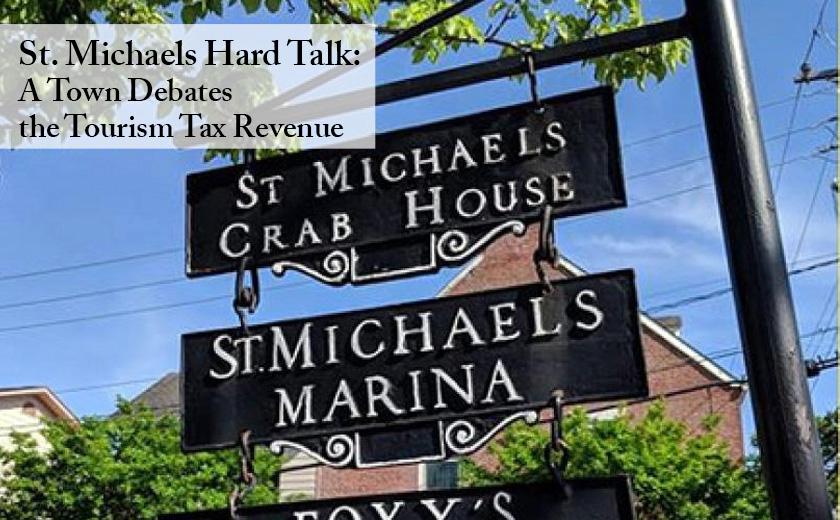
St. Michaels Hard Talk: A Town Debates the Tourism Tax Revenue

April 21, 2021 by John Griep

This video is about 30 minutes long.

A proposed 70% cut to the town’s advertising budget during a recent budget work session has St. Michaels business owners concerned.

During the April 16 virtual session, St. Michaels Commissioner T. Coleman “Tad” DuPont suggested reducing advertising spending from $140,000 to $40,000 in the proposed Fiscal Year 2022 budget.

DuPont, the commission’s treasurer, said the town should not be encouraging more visitors when businesses are unable, due to the COVID-19 pandemic, to accommodate current visitors.

He later suggested the savings could be used to fund other costs associated with tourism, such as an additional police officer and Saturday trash pickup.

The funds for advertising do not come from town taxpayers, but from the accommodations tax paid by guests staying at hotels and other lodging.

Talbot County collects the tax, then disburses it to the towns where the money was collected (after deducting up to 5% for administrative costs).

County law requires towns to use accommodations tax revenue “to alleviate costs associated with tourism.”

St. Michaels currently allocates 25% of its accommodations tax revenue “directly to advertising,” 5% to the volunteer fire department, and the remaining 70% throughout its budget “to help support the cost of tourism to the town, ie. Personnel, restroom maintenance, weekend trash pickup, a small portion of dump fees, park maintenance, a portion of Liability Insurance, infrastructure repairs and maintenance, a portion of capital improvements, etc.,” Town Manager Jean Weisman said in response to an information request.

If the town commissioners were to adopt DuPont’s proposal, St. Michaels would only be committing about 8 percent of its accommodations tax revenue directly to advertising to promote tourism to the town.

DuPont’s proposal led to a lengthy and occasionally heated discussion among town commissioners, with Vice President Jaime M. Windon questioning such a drastic cut.

Windon said town business owners would be “aghast” to hear the proposal.

In an April 19 email, Kim Hannon, St. Michaels Business Association president, informed members about the proposed cut.

“Hi, I am writing to let all of you know that the Commissioners of St. Michaels have been discussing slashing the annual advertising budget from $140,000 to $40,000! YES, slashing it $100,000 – 70% CUT,” Hannon wrote.

Town commissioners did not reach a consensus on the cut during the April 16 budget work session and are waiting to learn how much it would cost to outsource trash pickup before setting the next work session.

A public hearing on the budget will be held after it is officially introduced.

The town’s current draft budget, which includes other changes town commissioners accepted by consensus during the April 16 work session, is below.

St. Michaels FY22 Budget 4-16 DRAFT

The Spy Newspapers may periodically employ the assistance of artificial intelligence (AI) to enhance the clarity and accuracy of our content.

Filed Under: 1 Homepage Slider, 2 News Homepage, News Portal Lead Tagged With: accommodations tax, advertising, budget, business, Economy, St. Michaels, tourism

Talbot Council Proposes $112.5M FY22 Budget

April 16, 2021 by John Griep

This video is about 31 minutes long.

The county council has introduced a $112.5 million budget for the coming fiscal year, up substantially from this year’s $96.5 million budget.

But much of the increase is slated for long-delayed capital projects, including $5 million set aside for a new public safety center. The center would house the Talbot County Sheriff’s Office and related agencies.

All five members of the Talbot County Council introduced the Fiscal Year 2022 budget. Public hearings on the budget, which is Bill 1473, are set for 2 p.m. Tuesday, May 4 (to be held virtually) and 7 p.m. Tuesday, May 4, in the Easton Elementary School cafeteria at 307 Glenwood Ave.

Written public comments may be emailed to [email protected] or mailed to County Council, Courthouse, South Wing, 11 N. Washington St., Easton, MD 21601. The public is encouraged to submit written comments by Monday, May 3.

The budget includes a 1-cent increase above what is allowed under Talbot’s property tax cap. Voters okayed a measure allowing for the rate increase in the November election.

The county’s proposed real property tax rate (outside of incorporated towns) is $0.6529 per $100 of assessed value. The county rate is slightly lower for properties in the town limits of Easton, Oxford, Queen Anne, St. Michaels, and Trappe.

Angela Lane, the county’s finance director, said Tuesday that the general fund budget is 16.56% higher than this year’s, but most of the $16 million increase is for capital projects, capital outlay, and equipment purchases.

Operating expenses would increase less than 4%, she said.

Talbot County Manager Clay Stamp said the strategy for the FY2022 budget included capital projects and retention and recruitment of county staff, particularly in public safety — the sheriff’s office, detention center, and emergency medical services.

“When you look at the budget, we’re looking at a … modest increase in the operational line item of the budget, and clearly an investment in our capital improvement projects,” Stamp said. “(T)he capital improvement program is an investment into our future and frankly a number of the projects in this are long overdue and need to be addressed, and just merely by engaging this level in this program we are trying to … stimulate economic development as well.”

Council Vice President Pete Lesher said the county council made a commitment when asking voters to change the tax cap.

“And we said, where there is a critical need is in … public safety, and it’s both in the capital needs with the construction of the sheriff’s office on the horizon, but also … the recruitment and retention of our officers and the aspects of this budget that have to do with public safety salaries, not only sheriff’s office but in emergency services and so forth, all of those public safety functions,” he said. “We’re making a real commitment.

“(T)his I believe is a responsible and sustainable budget, and is fulfilling — as we made that commitment to the public — those critical functions and funding them going forward,” Lesher said. “We heard from the public that these are important, these need to be funded. And we’re true to our word here, this is where this money is going.”

Councilman Frank Divilio said he was nervous about such a big increase.

“I know that we’re making some huge improvements, both in traffic and safety and in all departments, but it comes at a time when money isn’t just freely flowing, if you look around and businesses are either closed or hiring right now, it’s a very odd time,” he said. “And I am very nervous because I know we still have the road to recovery to come out of this and we’re not … there yet.

Councilman Corey Pack said council members knew that long-delayed capital projects needed to be funded.

“Several of us knew that these capital expenses were going to come due, and we’re going to have to step up and pay for them,” he said. “I think the way that this budget is set up, yes there is a large increase, but we look at the operational side … less than a 4% (increase)…, and that’s the part that keeps eating, the operational side.

“But it’s not reckless spending, and it’s not an increase just for the sake of increase…. We had to do some things on the capital side that we knew that we’re gonna have to pay,” Pack said. “We had to do some things on the operational side when it comes to retention and recruitment and keeping good quality people here. So, this is the price you have to pay to do business in the 21st century.”

Councilwoman Laura Price recalled her first year on the council “when we had to cut a budget and slice and dice and it was painful because the county had, … in the two years prior, … used $17 million in fund balance.”

She noted capital projects require separate approval after budget passage.

“(P)eople need to know that any capital spending requires a whole separate bill to truly authorize the expenditure,” Price said. “So it’s ready to go, but we haven’t, you know, spent that yet.”

Bill 1473

The Spy Newspapers may periodically employ the assistance of artificial intelligence (AI) to enhance the clarity and accuracy of our content.

Filed Under: 2 News Homepage Tagged With: budget, council, Talbot County, tax rate

Md. Voters Back Statewide Ballot Questions

November 6, 2020 by John Griep

Maryland voters said state lawmakers should have more say over the annual budget and voted for the legalization of sports and events betting.

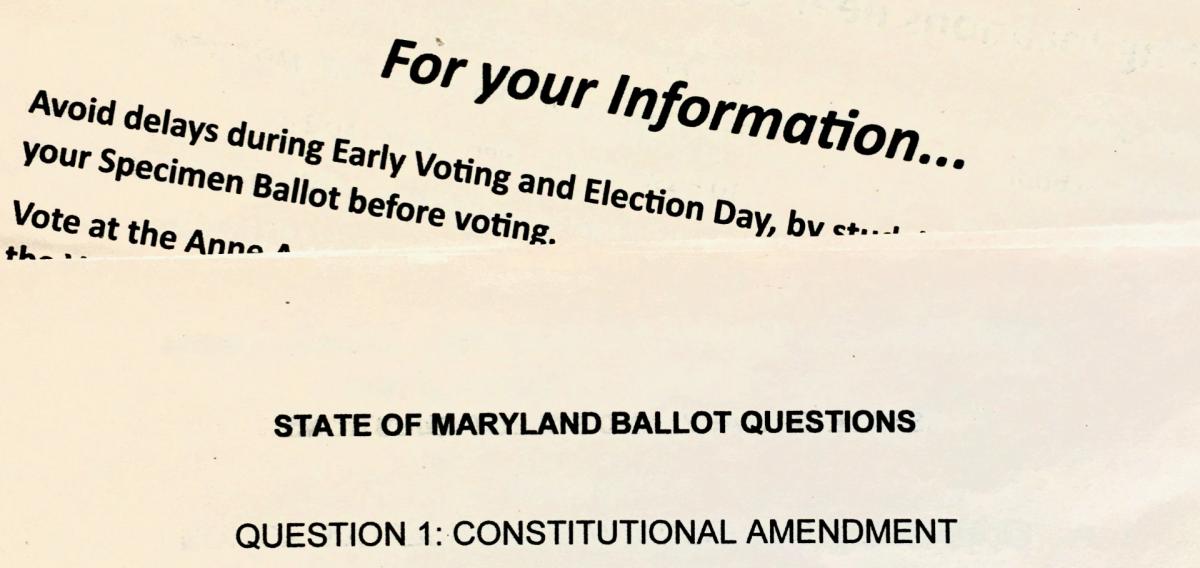
There were two statewide ballot questions up for vote on Nov. 3.

Question 1 will allow the Maryland General Assembly to make changes to the budget proposed by the governor as long as the total does not exceed the governor’s proposed budget.

Currently, state lawmakers may not increase budget items or add new items to the governor’s proposed budget. Once the budget is passed, it cannot be changed or vetoed by the governor.

With passage of Question 1, state lawmakers could move spending between agencies and/or add spending for new items as long as the total budget doesn’t exceed the governor’s proposed budget.

The governor would be able to veto items added or increased by state lawmakers.

The change will begin with the 2024 budget, presented during the 2023 legislative session.

Maryland voters approved the constitutional amendment by 74% for to 26% against.

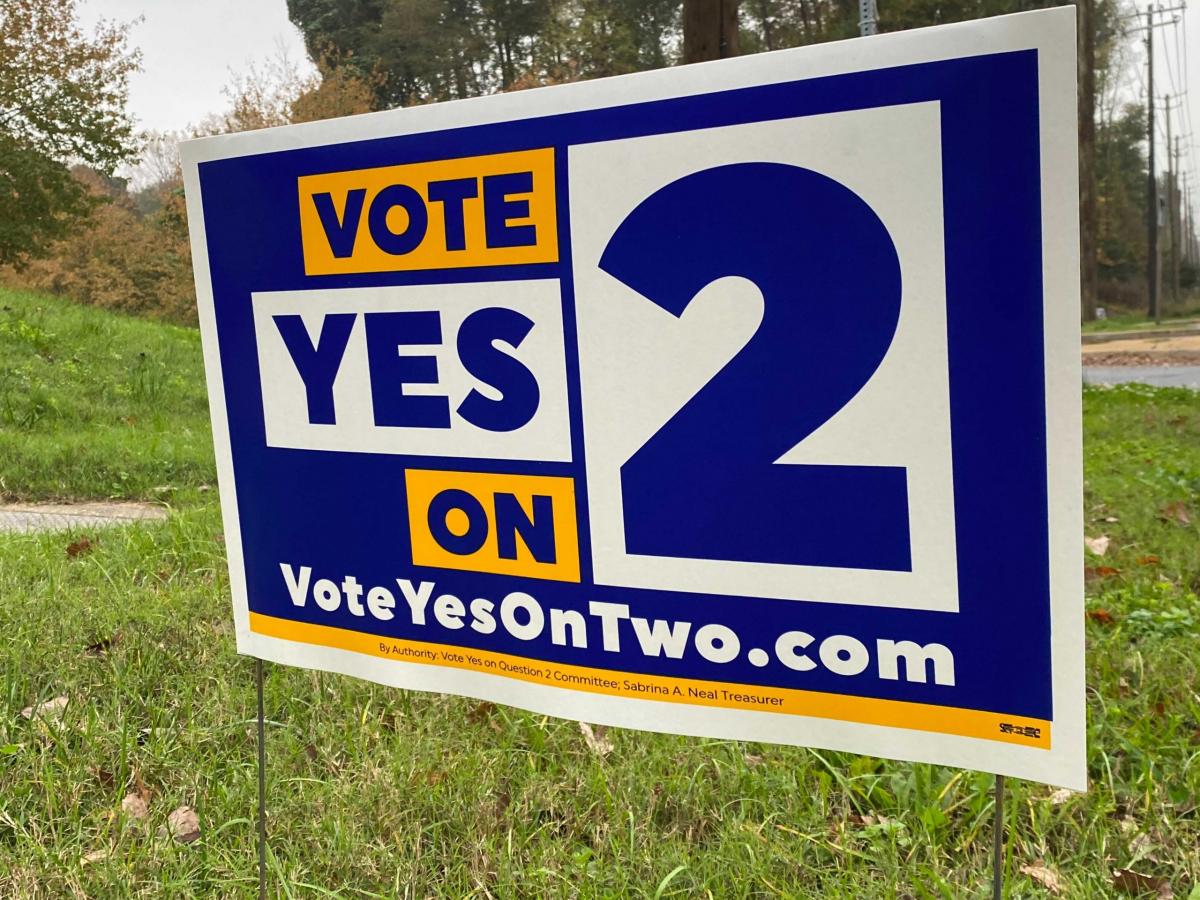
Question 2 asked voters whether commercial gaming should be expanded to sports and events betting “for the primary purpose of raising revenue for education?”

Maryland voters approved the measure 67% to 33% against.

Maryland will join Washington, D.C., as well as nearby states of New Jersey, Delaware, Virginia, Pennsylvania, West Virginia and New York in legalizing sports gambling.

Lawmakers are expected to discuss and vote on additional details like who should get sports wagering licenses after the state legislature convenes in January.

Sen. Craig Zucker, D-Montgomery, and other lawmakers envision casinos and racetracks to be able to obtain sports wagering licenses, which could allow Marylanders to place bets on professional and college sporting events.

Zucker told Capital News Service that the Washington Football Team could obtain a sports betting license if owner, Daniel Snyder, keeps the organization in Maryland.

According to Zucker, sports betting would generate between $20 million and $40 million per year that would likely go into public schools.

“It’s a pretty non-political, non-partisan issue that both parties agree is good for the state of Maryland in terms of capturing that lost revenue especially during this global pandemic,” Zucker said. “The economy has been hurt and sports betting would help fill in some of the holes that we’ve seen with education funding.”

Capital News Service reporters Philip Van Slooten and Ryan McFadden contributed to this article.

The Spy Newspapers may periodically employ the assistance of artificial intelligence (AI) to enhance the clarity and accuracy of our content.

Filed Under: Maryland News Tagged With: ballot question, budget, commercial gaming, election, events betting, general assembly, governor, Maryland, spending, sports betting

Question 1: Md. Voters Will Weigh in on Increased Budgetary Power for State Lawmakers

October 24, 2020 by Capital News Service

With early voting set to begin Monday, Marylanders will consider a proposed constitutional amendment granting the legislature the ability to increase, decrease and add items to the state budget.

Legislators advanced the measure in March, largely along party lines, with lead sponsors arguing it seeks to balance the budget process while opponents say it removes a check on lawmakers.

If approved by voters, ballot question 1 would authorize the General Assembly to make changes to the state budget as long as those changes do not cause the budget to exceed the total amount submitted by the governor.

“To my knowledge, there is not another legislature that is limited in its ability to be able to change the budget, other than decrease amounts,” Stella M. Rouse, associate professor and director of the Center for Democracy and Civic Engagement at the University of Maryland emailed Capital News Service on Oct. 9. “This is a bit unique.”

The legislature’s budget authority was limited by a constitutional amendment approved by voters in 1916 in an effort to avoid a financial crisis. A balanced budget amendment in 1974 set further restrictions on Maryland’s “unique” budgetary process.

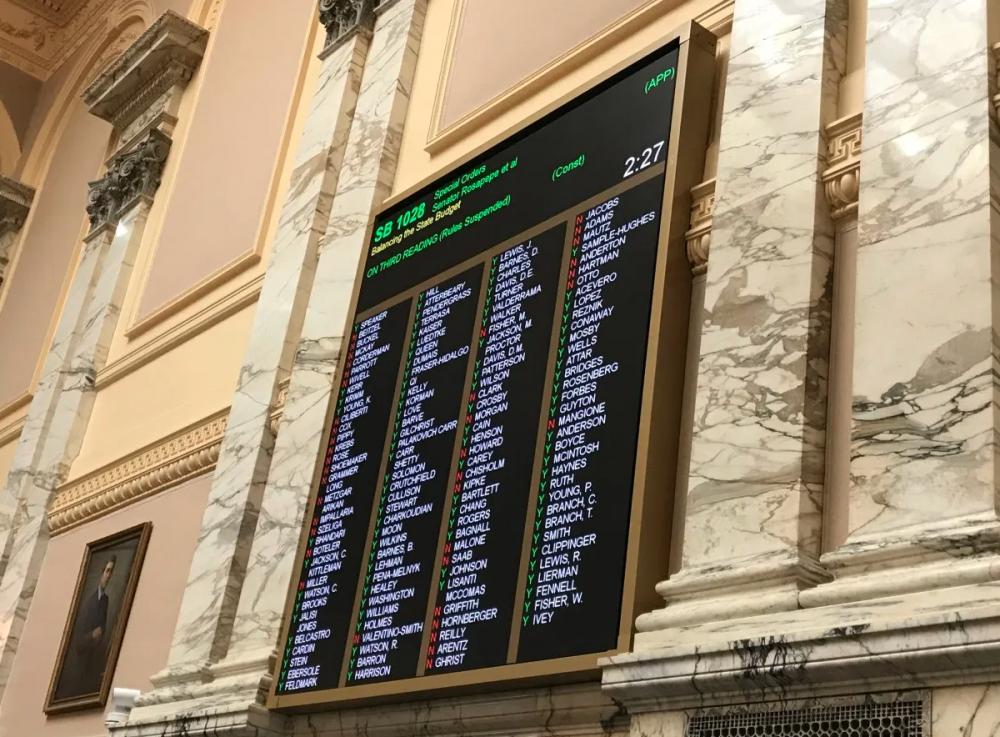
“Under the current Maryland constitution, unlike every other state legislature in the country,” Sen. James C. Rosapepe, D-Prince George’s and Anne Arundel, told the Senate Budget and Taxation Committee when introducing Senate Bill 1028 on March 4. “We have an extremely limited ability to make decisions about how money is spent in the current year’s budget.”

Currently, Article III, section 52 of the Maryland constitution prevents the state legislature from increasing funding or adding any new appropriations to the governor’s executive budget, but lawmakers can decrease funding.

Over the years, legislators developed budgetary tools, which former Senator P.J. Hogan, an early sponsor of similar budget amendments, told the Senate committee back in March were ineffective. One of these is a process of earmarking money known as “fencing off.”

Another way lawmakers direct spending is to mandate it through legislation passed by the majority-Democrat General Assembly.

“What has not worked is ‘fencing’ as an example,” P.J. Hogan said. “Think about the number of times you have fenced off money and said it can only be spent for ‘this’ and a governor says, ‘I’m not going to release the money for that.’ Or you go the other route for mandating spending and that causes problems because you are trying to predict the future.”

Rosapepe explained to the committee that the bill’s title, “Balancing the State Budget,” referred not only to ensuring the state’s finances remain fiscally balanced, “but also balanced between the responsibilities of the governor and the responsibilities of the legislature.”

“One way different groups get a voice in government is through the legislature, through the budget process,” Rosapepe recently told Capital News Service. “Since 1916, the voice of the people does not have a role in allocating money in the budget. It limits the voice of the people in setting priorities in the budget.”

He said one goal of the amendment is to give state lawmakers the same authority that other legislatures across the country and even city councils across the state have when allocating funds toward constituent priorities and giving them a role and a voice in government.

“This is actually a fairly simple change,” Delegate Marc A. Korman, D-Montgomery, said in an email to the Capital News Service. “That provides the Maryland legislature a power 49 other states have, and most Marylanders believe we already have, to let the people’s branch of government fund the people’s priorities.”

While Rouse was not willing to go so far as to say the Maryland General Assembly’s current limited budget authority was unprecedented among other states, a detailed assessment of Maryland’s budget process conducted in 2003 by the Department of Legislative Services, using materials prepared by the National Conference of State Legislatures, found “in most states the governor’s proposal establishes a framework for budget discussion.”

But the study reported in Maryland, Nebraska and West Virginia the legislature had limited power to increase or decrease budget items. Korman, Rosapepe and other amendment supporters argue this limits Marylanders’ ability to influence the budget.

However, a Goucher College Poll released this week revealed how complex ascertaining the public’s funding priorities could be, as shown in Marylanders’ “mixed” responses to questions on police funding.

“Maryland residents are largely supportive of key police reforms that are currently being discussed by state lawmakers and have dominated our national discourse,” said Mileah Kromer, director of the Sarah T. Hughes Field Politics Center at Goucher College in a statement released with the poll results.

“But there’s a mixed message on police budgets,” she added. “Residents support both increasing funding to hire more or better trained police officers and reducing police budgets to allocate more money to social programs.”

Republican opponents of the budget amendment say the governor is in the best position to interpret Marylanders’ priorities.

Sen. Bryan W. Simonaire, R-Anne Arundel, who recently assumed the position of Senate Minority Leader, told Capital News Service it was appropriate for the governor to have his current role in the budget process because his responsibilities are to the entire state and not just a district.

“The people of Maryland elect the governor for a statewide office,” he explained. “I’m elected by 1/47th of the population of the state while the governor has to have the perspective of the whole state.”

The Maryland Department of Budget and Management, in an opposition letter submitted on March 4 to the Senate Budget and Taxation Committee, stated the proposed amendment weakens the executive budget system put into place by voters in 1916.

“The rationale for the Executive Budget Amendment,” the statement reads. “Is that the Governor is the official best suited to preparing a comprehensive plan of expenditures because he has daily responsibility for the administration of State government.”

Simonaire added that Marylanders have shown they prefer a divided government through a Republican governor and a Democratic legislative majority. He believed a new budget amendment could offset this power balance.

He also cautioned that if legislators had more power over the budget process they could use it to benefit their districts, particularly larger ones. A few other Republicans agreed.

Back in 2014, the state’s less-populous yet reliably Republican jurisdictions helped propel Hogan into the governorship, while denser jurisdictions such as Montgomery and Prince George’s counties and Baltimore tend to vote more Democratic. These more populous districts have more representation in the General Assembly.

Delegate Kathy Szeliga, R-Harford and Baltimore counties, who is also opposed to the amendment, wrote in an email to her constituents on Oct. 8 that she would vote against expanding “the legislature’s ability to spend tax dollars and increase spending.”

“The current system creates a check and a balance on the legislature’s desire to centralize funding to the urban areas of Maryland,” she stated.

Delegate Susan W. Krebs, R-Carroll, also mentioned the current system as a check on legislative budgetary power in an email to her constituents this week. She stated she would be voting against the amendment as well.

“The current system creates a check and a balance on the legislature and forces compromise with the governor,” she wrote. “And I think that is good for the entire state.”

But other legislators, Democrats, disagreed.

“This is a restoration of our role. This is not us imposing ourselves on any gubernatorial power,” Delegate Gabriel Acevero, D-Montgomery, who sponsored the House version of the bill told the Appropriations Committee on March 18. “This is a restoration of the legislature’s role to ensure Maryland does not continue to be the weakest state legislature in the union as it relates to the budget. And we’re doing it in a democratic fashion by putting it to the people.”

The Maryland Center on Economic Policy wrote in their statement of support that the limits placed on the General Assembly in 1916 were “in response to a problem that no longer exists,” and that the current amendment “offers a better way to share decision-making authority between the branches.”

Henry Bogdan of the Maryland Association of Nonprofits further testified before the committee in March that the public is currently cut out of the budget process because “You, their representatives, have no power to advance any particular thing that needs to be done.”

“It’s much harder for a constituent or community group to get the attention of the governor on a problem than it is for the constituents or community groups in your districts,” Bogdan said. “You all tend to be much more responsive to people, and you should be able to respond to issues where people want to advance causes in the budget.”

Ultimately, as Delegate Maggie McIntosh, D-Baltimore, chairman of the Appropriations Committee pointed out on March 18, it is up to the people of Maryland to decide what happens next.

“This bill, if it goes to the ballot,” she told the committee before the measure passed, “your constituents have just as much power as you do. Equal power. Their vote is just as powerful as yours.”

By Philip Van Slooten

The Spy Newspapers may periodically employ the assistance of artificial intelligence (AI) to enhance the clarity and accuracy of our content.

Filed Under: Maryland News Tagged With: ballot, budget, constitutional amendment, election, general assembly, governor, Maryland, question 1

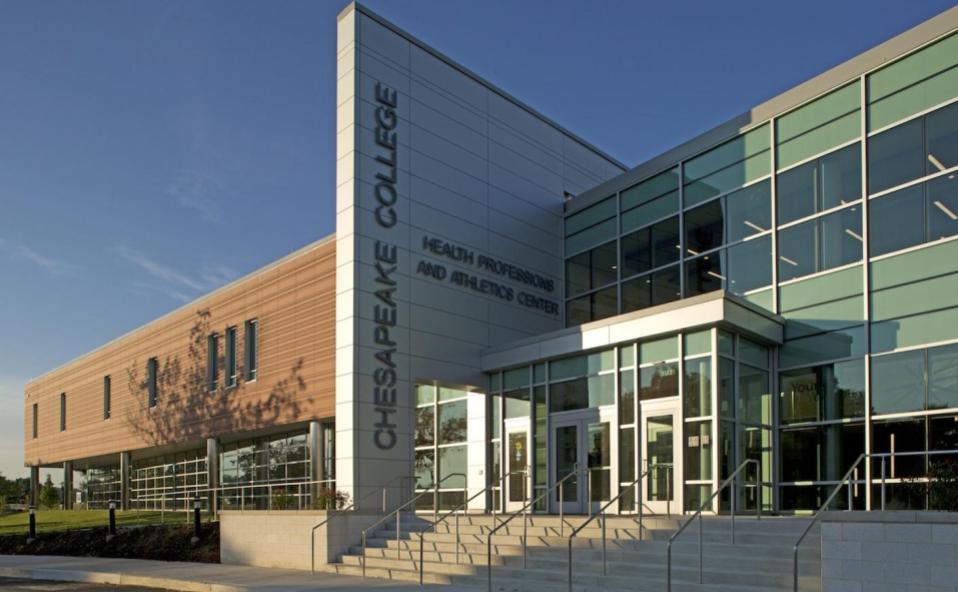
Mid-Shore Counties OK Level Funding for Chesapeake College

April 21, 2020 by John Griep

Mid-Shore counties voted Monday night to provide level funding to Chesapeake College for the next fiscal year.

The college initially had sought a 3 percent increase over this year’s funding, but the COVID-19 pandemic has county governments tightening belts in anticipation of lower revenues.

Clifford Coppersmith, Chesapeake College’s president, said the proposed budget reflected the college’s strategic plan and touched briefly on effects of the pandemic.

Dr. Clifford P. Coppersmith, Chesapeake College president

“We are doing everything we can to maintain the college and our workforce,” Coppersmith said.

With the campus closed for social distancing, the college moved all instruction online that could be, he said, and plans for summer courses to be online as well.

The college also is preparing for distance learning for the fall semester if required.

Coppersmith said the college had been working on plans to improve its workforce education and training programs and would be ready with those courses when the economy is ready to go again.

In its initial budget process before the pandemic, the college had called for a tuition increase of $3 per credit hour, but that increase has been rescinded, he said.

Caroline, Dorchester, Kent, Queen Anne’s and Talbot counties allocated a total of $6.5 million to the college for Fiscal Year 2020, which ends June 30. Four of the five counties voted unanimously Monday night to provide the same funding for next year; Dorchester County did not have a quorum on the call.

The total funding from the Mid-Shore counties is divvied up based on the ratio of student enrollment. If Chesapeake College students, for example, came equally from each county, the counties each would fund 20% of the total $6.5 million.

Talbot County Council President Corey Pack said Talbot had budgeted about $1.65 million for the college for next year. The county also has put about $50,000 for the college in its contingency fund, representing the 3 percent increase the college had sought.

If the economy and tax revenues are better than expected, the county council could vote to allocate that money to the college.

Caroline County officials said that county would be allocating about $7,000 more than last year due to changes in the enrollment ratio.

Queen Anne’s County Commission President Jim Moran said that county’s share would be about $1.88 million.

Queen Anne’s was the only county to support the 3 percent increase, with Moran noting the county would be paying less next year as a result of enrollment changes.

Kent and Talbot county officials said those counties were planning on flat county budgets for FY21 as well,

“We’ve done that with all our departments,” Kent County Commissioner Ron Fithian said in the conference call. “We’re letting everybody know it will be the same as last year.”

The counties also unanimously approved the college’s total operating budget of about $23.1 million by category and nearly $400,000 from the counties for maintenance and repair costs.

Tina Jones, the college’s chief financial officer, said the counties provide about a third of the college’s total budget with other sources, including tuition, providing the remainder.

With a bad economy as a result of the COVID-19 pandemic, college officials said Chesapeake could see increased enrollment, which means additional revenue from tuition, but also higher instructional costs.

Approving the total budget by category allows the college to make decisions based on enrollment, revenues, and expenses without having to return to the five counties for approval, Jones said.

The Spy Newspapers may periodically employ the assistance of artificial intelligence (AI) to enhance the clarity and accuracy of our content.

Filed Under: 2 News Homepage, Ed Portal Lead, News Portal Lead Tagged With: budget, Chesapeake College, Education

Citing Estimated $2.8B Revenue Loss, Hogan Freezes State Budgets, Hiring

April 12, 2020 by Maryland Matters

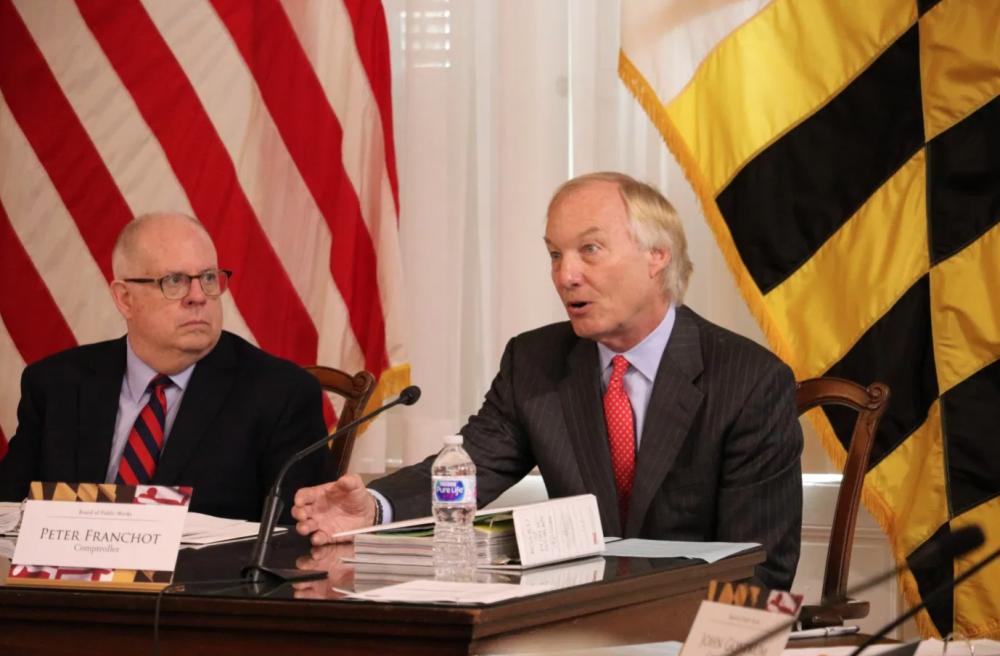
Budgets are frozen and new employees aren’t being hired, Gov. Lawrence J. Hogan Jr. (R) said Friday afternoon, moments after the state’s comptroller painted a grim picture of the Maryland’s financial future in light of dramatic revenue losses caused by the COVID-19 pandemic.

In the space of three months, state revenues are estimated to contract by about $2.8 billion, according to new estimates released Friday by Comptroller Peter V.R. Franchot (D) and the Bureau of Revenue Estimates.

Both income tax revenues and sales tax revenues are expected to fall by almost $1 billion before June 30, according to the new predictions. Other smaller pots of revenue, like lottery sales and court fees, have also contracted.

The losses since March and estimated through the end of June amount to about 15% of the state’s overall annual revenues.

The state has never before seen such a steep decline in revenues so close to the end of a fiscal year, officials said.

“The stay-at-home order as well as social distancing are absolutely creating the steepest economic nosedive in modern history,” Andrew Schaufele, director of Maryland’s Bureau of Revenue Estimates, said during a virtual news conference on Friday. “But in their absence, the final economic impacts would be far greater and playing out over a much longer period of time.”

The state will continue to meet payroll expenses and allow necessary increased spending to respond to the novel coronavirus, Hogan said. But his Department of Budget and Management will soon make recommendations for budget cuts, which will be required in all state agencies.

The state will also be tapping into and “spending much of, perhaps all of” the $6-billion-plus Rainy Day Fund to cope with revenue losses, Hogan said.

The state’s three-member Board of Public Works ― which includes Hogan, Franchot and Treasurer Nancy K. Kopp (D) ― is empowered to cut the state’s budget in real-time.

Franchot said the process of trimming the state’s budget by more than $1 billion during the Great Recession was likely easier than the fiscal stress the board will soon be forced to reckon with during the pandemic.

“That period, as awful as it was ― and it was just horrendously painful ― is going to be like a picnic compared to what we’re going to go through with this coronavirus impact on our state budget,” Franchot said.

Hogan noted that the fiscal estimates released Friday were a “worst-case” scenario that he hoped would not come to fruition.

“Hopefully we will not have to make the kind of cuts [the comptroller] was envisioning,” Hogan said later in the afternoon.

With much of the private sector shut down in Maryland to stop the spread of COVID-19, the state is grappling with never-before-seen figures when it comes to losses in tax revenue and employment.

In a matter of weeks, the state’s new unemployment filings have increased by nearly 5,200%, with more than 235,000 people filing new unemployment claims in just the last three weeks.

“We’ve never seen such a decline. Never,” Schaufele said.

By contrast, it took about 10 months during the Great Recession for the state to see 240,000 job losses.

Even with the sobering numbers, there are some things that may blunt the impact to Maryland’s economy.

While state income tax withholdings are expected to drop by 22%, Schaufele said it was a testament to the strength of the state’s workforce and close ties to the government that the number is not larger.

Maryland will see some financial relief from a federal stimulus package, about $4.9 billion, but that funding is generally intended to enhance safety net programs and cover new expenses, not backfill lost revenues.

The lost revenues and economic downturn will almost certainly have an impact on Democrats’ top priority this year ― a decade-long multi-billion-dollar effort to reform the state’s education system.

That bill, along with more than 650 others passed during the 2020 General Assembly session, were formally sent to Hogan’s office for consideration earlier this week. While his office has not yet reviewed the bills, Hogan said Friday “that it is very unlikely that any bills that require increased spending will be signed into law.”

In response, state Senate President Bill Ferguson (D-Baltimore City) agreed with Hogan that “we will be forced to make hard choices about priorities and values. COVID-19 has changed the world and it has changed Maryland.”

But without specifically referring to the Blueprint for Maryland’s Future, the ambitious education spending and reform plan that the legislature passed last month, Ferguson suggested that it would be wrong for state leaders not to look ahead and bolster the state’s education system.

“This crisis will end, and the cost of containing this crisis cannot be the foreclosure on hope for a better future,” Ferguson said. “Now, more than ever, our decisions about who we are and what we believe about every individual’s God-given potential must continue to be our guide.”

Public health will dictate ‘return to normalcy’

The estimated revenue losses released Friday assume that a stay-at-home order remains in place at least through June 30.

In recent interviews, Hogan and the state’s public health professionals have expressed reluctance to begin lifting social-distancing measures too early, fearing that could cause a new spike in the number of COVID-19 diagnoses in the state.

As of Friday morning, there were 6,968 confirmed coronavirus cases in the state, and 171 Marylanders have died since mid-March.

All officials have said advice from public health experts will dictate the end of measures intended to stop the spread of the virus.

“To be clear, the timeline and pace for when we return to normalcy should and must be dictated by our public health experts, and must be influenced by the health dangers this virus may continue to pose to our citizens,” Franchot said.

By Danielle E. Gaines

The Spy Newspapers may periodically employ the assistance of artificial intelligence (AI) to enhance the clarity and accuracy of our content.

Filed Under: Maryland News Tagged With: budget, Covid-19, Economy, franchot, Hogan, loss, Maryland, revenue

House Dems Push Through Proposed Constitutional Change, Strip Dissenter of Leadership Post

March 19, 2020 by Maryland Matters

Retribution came swiftly and publicly for a member of the House of Delegates Wednesday following a heated vote on a proposal to give the General Assembly more power over the state budget.

In the final hours of the 2020 legislative session, the House was debating a proposed amendment to the Maryland Constitution, which originated in the state Senate, that would grant the legislature the power to move funding around in the state budget.

Several Republican lawmakers rose on the House floor to oppose the measure, arguing that giving the legislature more say over the budget — Maryland’s chief executive has more power over state spending than just about any governor in the U.S. — would invariably lead to more government spending and higher taxes.

They were also incredulous that the House would vote on a Senate bill that hadn’t had a hearing in a House committee — at a time when the State House is on lockdown and the public is having trouble watching legislative proceedings on livestream.

“That’s tyranny, Madame Speaker,” said Del. Robin L. Grammer Jr. (R-Baltimore County).

Del. Geraldine Valentino-Smith

Then Del. Geraldine Valentino-Smith (D-Prince George’s) rose to oppose the vote. She too questioned the wisdom of ramming the bill through when there had been no House hearing, fretting about “the integrity of the process.”

The bill wound up passing, 95-39. Only one Democrat voted against it: Valentino-Smith.

Seconds later, as the House prepared to recess for half an hour, Speaker Adrienne A. Jones (D-Baltimore County) called for a quick vote on an appointment: Del. Michael A. Jackson (D-Prince George’s), she indicated without explanation, would be the new House chairman of the legislature’s Spending Affordability Committee, which studies revenue projections and the state economy.

The previous committee chairman: Valentino-Smith.

“Have you ever seen them strip a man [of a leadership position]?” Valentino-Smith asked a reporter minutes after the vote. “I’m disappointed. I have never seen that type of retribution taken against someone who has spoken out against a committee.”

Jeremy Baker, a spokesman for the Jones, said the speaker’s office had no comment.

A handful of House members privately referred to the removal of Valentino-Smith from the Spending Affordability Committee as “gangster.”

The proposed constitutional amendment itself appears to be gaining traction after several unsuccessful attempts through the years.

Under rules in place for more than a century, Maryland legislators have been limited in their budgetary power. Lawmakers can reduce or eliminate appropriations from governors’ proposed budgets, but are not allowed to increase funding.

The proposed constitutional amendment, if approved by voters in a November ballot initiative, would allow lawmakers to increase, decrease and move money around in the budget, within the restraints of an overall budget cap proposed by the governor.

Despite Republicans’ vehement objections as the bill moved through the legislature this session, the push for a constitutional amendment change giving lawmakers more say over state spending has been championed by Republican legislators in the past — including David R. Brinkley, who is now Gov. Lawrence J. Hogan Jr.’s Budget secretary.

The legislation heads now to Hogan’s desk.

By Josh Kurtz

The Spy Newspapers may periodically employ the assistance of artificial intelligence (AI) to enhance the clarity and accuracy of our content.

Filed Under: Maryland News Tagged With: budget, constitution, Maryland General Assembly

Next Page »

Copyright © 2025

Affiliated News

  • The Chestertown Spy
  • The Talbot Spy

Sections

  • Arts
  • Culture
  • Ecosystem
  • Education
  • Mid-Shore Health
  • Culture and Local Life
  • Shore Recovery
  • Spy Senior Nation

Spy Community Media

  • Subscribe
  • Contact Us
  • Advertising & Underwriting

Copyright © 2025 · Spy Community Media Child Theme on Genesis Framework · WordPress · Log in