
MENU

Sections

  • Home
  • About
    • Contact Us
    • Editors and Writers
    • Join our Mailing List
    • Letters to Editor Policy
    • Advertising & Underwriting
    • Code of Ethics
    • Privacy
    • Talbot Spy Terms of Use
  • Art and Design
  • Culture and Local Life
  • Public Affairs
    • Ecosystem
    • Education
    • Health
    • Senior Life
  • Community Opinion
  • Sign up for Free Subscription
  • Donate to the Talbot Spy
  • Cambridge Spy

More

  • Support the Spy
  • About Spy Community Media
  • Advertising with the Spy
  • Subscribe
January 15, 2026

Talbot Spy

Nonpartisan Education-based News for Talbot County Community

  • Home
  • About
    • Contact Us
    • Editors and Writers
    • Join our Mailing List
    • Letters to Editor Policy
    • Advertising & Underwriting
    • Code of Ethics
    • Privacy
    • Talbot Spy Terms of Use
  • Art and Design
  • Culture and Local Life
  • Public Affairs
    • Ecosystem
    • Education
    • Health
    • Senior Life
  • Community Opinion
  • Sign up for Free Subscription
  • Donate to the Talbot Spy
  • Cambridge Spy
News Maryland News

Democratic Gubernatorial Candidates Outline Housing Policies At Forum

September 22, 2021 by Maryland Matters

Six Democratic gubernatorial candidates laid out their plans to tackle housing insecurity and protect tenants at a Tuesday night forum, coalescing around reforms like access to counsel in eviction cases and rent stabilization.

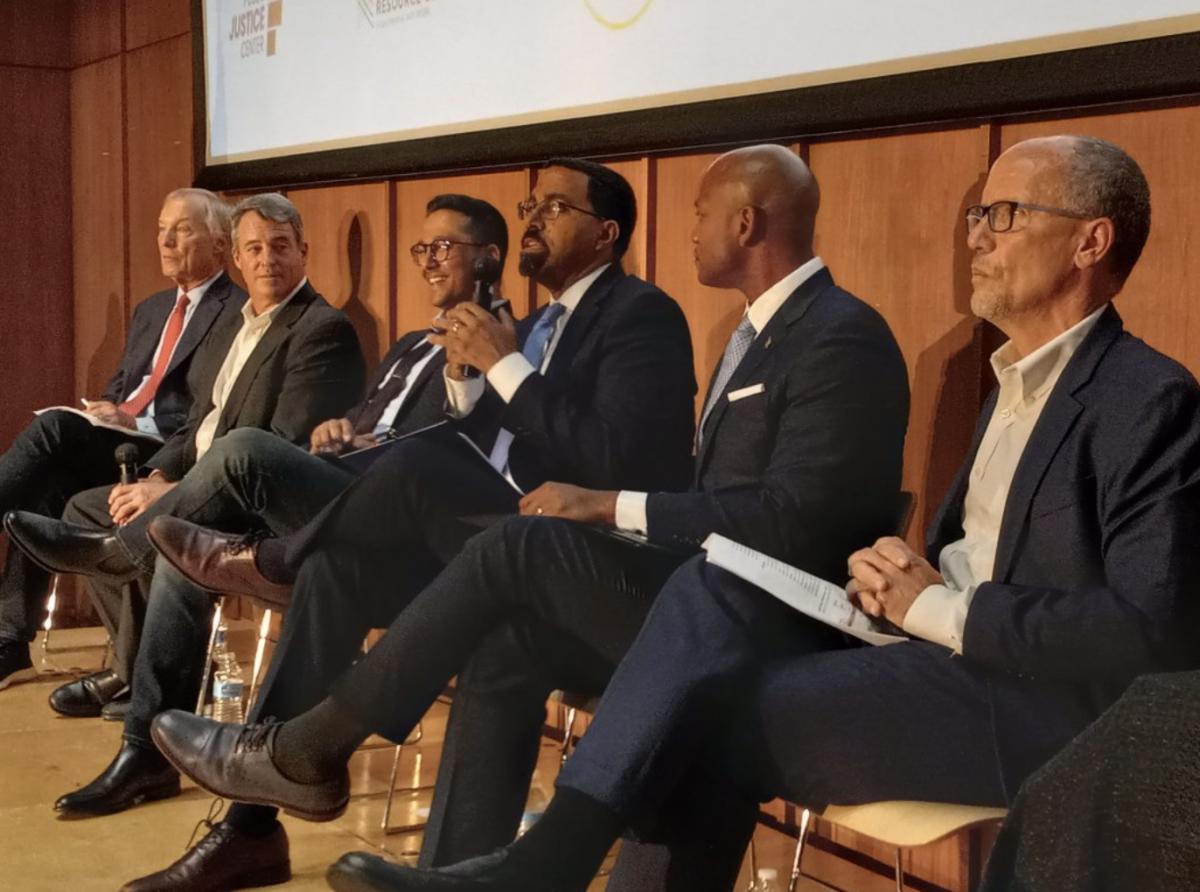
Democratic gubernatorial candidates Comptroller Peter V.R. Franchot, former Attorney General Douglas F. Gansler, former Obama administration official Ashwani Jain, former U.S. Secretary of Education John B. King Jr., former nonprofit CEO Wes Moore and former U.S. Secretary of Labor Tom Perez attended the Tuesday evening forum hosted by the Montgomery County Renters Alliance.

Maryland Matters Founding Editor Josh Kurtz, alongside Baltimore Sun reporter Pamela Wood and Washington Post reporter Kyle Swenson and attendees asked candidates about a wide range of proposed housing reforms.

Here’s what the candidates had to say about tenant protections, eviction prevention and affordable housing in Maryland:

Access to counsel in eviction cases

The Maryland General Assembly passed a bill from Del. Wanika T. Fisher (D-Prince George’s) during their 2021 legislative session to provide tenants access to counsel in eviction cases — but a separate bill that would’ve raised court filing fees and eviction surcharges to pay for that access to counsel didn’t pass before the session ended.

Candidates expressed their support for giving tenants the right to counsel in eviction cases at the forum.

King said his progressive advocacy organization Strong Future Maryland supported Democratic Attorney General Brian Frosh’s effort last year to raise court fees and summary ejectment surcharges to fund access to counsel.

“We have to have a right to counsel for tenants that is funded so that tenants are supported when they go to court,” King said in his opening remarks.

Perez said that Gov. Lawrence J. Hogan Jr. (R) should use some federal rent relief funding to pay for the expanded access to counsel until the General Assembly passes a more permanent funding solution. He also said the state should include diversion programs as part of the eviction process.

“This governor can solve this emergency with a stroke of a pen,” Perez said.

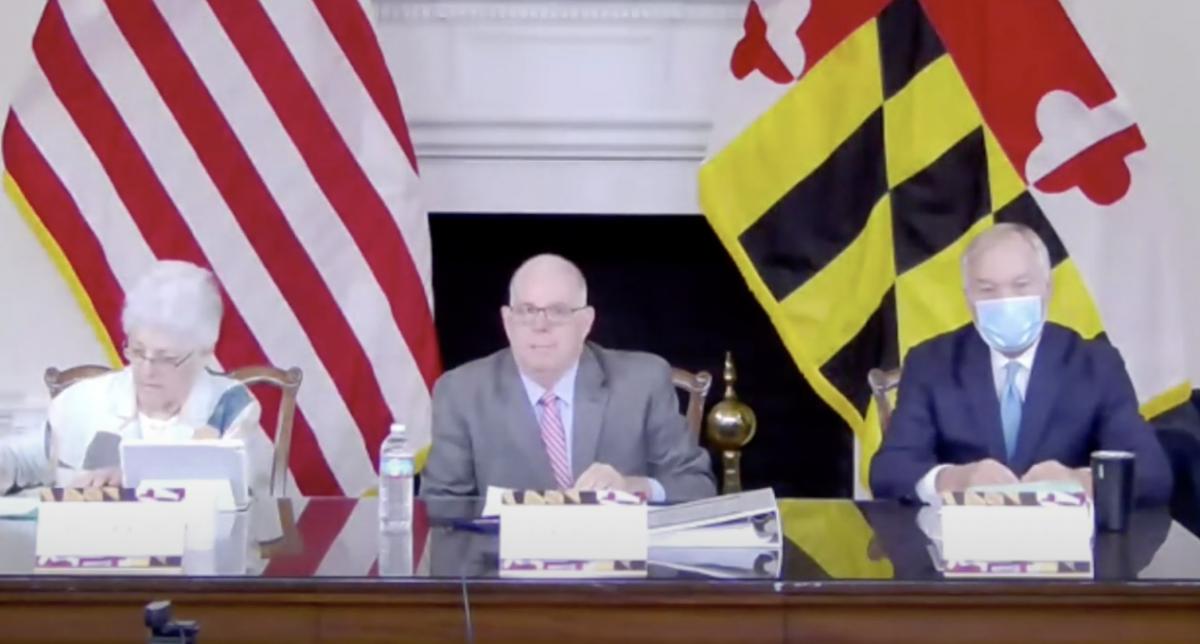
Franchot, who pushed for the fast disbursement of rent relief funding at a recent Board of Public Works hearing, said federal rent relief funding needs to be used to fund the initiative in the short term. He said Marylanders at risk of eviction can’t afford to wait until the General Assembly reconvenes for assistance.

“Hundreds of thousands of low-wage earners who are facing eviction couldn’t care less about what the legislature’s doing and what might be done down the road,” Franchot said.

Moore said that while the vast majority of landlords have counsel in eviction cases, only a small number of tenants do. He said providing tenants with access to counsel is “the just thing to do and it is the right thing to do.”

Gansler said he supports a full right to counsel in civil cases including evictions, and said the state should promote legal aid services until such a law is passed.

“When both sides have counsel, you’re more likely to come to a satisfactory resolution for both sides,” Gansler said.

Just cause eviction laws

HB 1312, introduced by Del. Jheanelle K. Wilkins (D-Montgomery) during the 2021 legislative session, required that landlords provide a “just cause” to evict a tenant. Just cause eviction laws are meant to shore up housing stability and protect tenants from unnecessary evictions, according to the housing policy organization Local Housing Solutions.

Just cause provisions were removed from Wilkins’ bill in committee, and the legislation failed to pass before the end of the 2021 legislative session, but candidates praised the proposed reform Monday night.

“We have to have just cause protections to make sure that the landlord is required to provide you with a notice, a reasoning, and at least some sort of effort to remedy the issue before going straight to evictions,” Jain said. “And again, not only is that going to help more people stay in homes and housing, but it’s going to be better for the economy and better for the community as a whole.”

King said candidates need to be clear about their policy stances on issues like access to counsel and just cause eviction reforms — which he supports — in their campaigns.

“One of my fears is, if this campaign is waged in generalities, not in specifics, we will not have a clear mandate to act,” King said. “Just Cause Eviction laws, yes or no? If yes, say it in a campaign and let’s campaign on that.”

Gansler likewise voiced his support for just cause legislation.

“We have to have a governor who stands for the principle that people should not be evicted from their home, unless there’s just cause to do so,” he said.

Perez said his “biggest disappointment” of the 2021 legislative session was that a package of housing reforms, including Wilkins’ bill, didn’t pass. He said he hopes the General Assembly will try again when they return to session.

“Success is about persistence and it’s not just just cause, but it’s other things,” Perez said. “I’d like to deal with appraisal issues in the home purchase context and some real barriers to entry for people who are trying to buy a home.”

Moore said conversations around eviction reforms like just cause legislation need to go beyond housing policy.

“We’re talking about things like how do we make rent more affordable and how do we think about preventing eviction and just cause, all really important things,” Moore said. “The other thing we must also couple that with is how are we making sure that people are getting paid a fair wage.”

Rent stabilization and affordable housing

Candidates also discussed rent stabilization, a reform highlighted by the COVID-19 pandemic when some local jurisdictions in Maryland, including Prince George’s County, placed temporary restrictions on rent increases and late fees. They also touched on how they would increase the state’s stock of affordable housing as governor.

Maryland has no statewide rent stabilization or rent control, although the city of Takoma Park has a longstanding stabilization law.

Jain said he supports rent control — but said such a program should only be undertaken if the state limits its property tax increases.

“Rent control is really important in terms of providing people a sustainable way of paying their bills, knowing what bills are going to come up,” Jain said. “The only exception is, we can only do that if we’re not raising property taxes.”

Franchot agreed with Jain, and said he was concerned about small landlords’ property taxes if rent stabilization rules are enacted.

“The devil’s in the details,” Franchot said.

King said Maryland needs a “statewide approach” to rent stabilization and other tenant issues. He advocated a holistic approach to housing policy by funding public transit and building up communities in addition to housing, and said he supports building the Red Line in Baltimore.

“By not building the Red Line project in Baltimore City, Gov. Hogan set Baltimore back 20, 30, maybe even 40 years,” King said, adding that he supports building light rail in southern Maryland. “We have to invest in transit as we invest in housing.”

He also argued for reforming zoning laws in order to make affordable housing easier to develop.

Moore said building affordable housing also needs to mean investing in education, transit and access to medical services within communities.

“This is not about how we move people to opportunity, this is about how we move opportunity to people,” Moore said.

Gansler advocated for renovating existing buildings into affordable housing rather than building entirely new units, citing concerns about urban sprawl.

“I don’t think the answer is to build more houses,” Gansler said. “There’s plenty of houses out there.”

Franchot echoed Gansler’s concerns about urban sprawl.

Speeding up rent relief funding

Maryland has received hundreds of millions in federal rent relief funding, but that money has been slow to get to tenants and landlords. While state and local governments’ disbursement of rent relief funding has increased in recent months, candidates said the state should be doing more to speed up the process.

Franchot reiterated his calls for streamlined rent relief throughout the forum.

“It is held up in a kind of pattern of incompetence that results in the very meager allocations that are made,” Franchot said.

Moore said the state government needs to work more closely with local jurisdictions to get out rent relief funding, and cautioned against putting all the blame on local governments for slow rent relief disbursement.

“The state can do a better job, and the state can actually take leadership and work in partnership with a local jurisdiction,” he said.

King said the state could be learning from local programs, like some jurisdictions’ partnership with United Way to bundle rent relief applications by working directly with landlords.

The current administration has a broader pattern of not coordinating with local governments, King said. “You talk to county executives and they’ll tell you they heard about some of the COVID policy changes at the governor’s press conference,” he said.

Perez said state officials should be working with the judiciary and sheriffs to find out which tenants are facing eviction in order to expedite rent relief funding to them.

“We should know, every person in this state, who is about to get evicted, so that we can provide that relief. We can move them to the front of the queue, so that doesn’t happen,” Perez said.

Baltimore tech entrepreneur and Democratic gubernatorial candidate Mike Rosenbaum, who along with former Clinton administration official Jon Baron was not invited to the forum, said in a statement that “despite millions of dollars being available to keep people in their homes, the vast majority of funds still haven’t made it into the pockets of struggling Marylanders. This is what frustrates people about government, and it spotlights why we need new leadership who understands how to make these systems work for regular people.”

Former Prince George’s County Executive and gubernatorial candidate Rushern L. Baker III (D) withdrew from the forum following the death of his wife, Christa Beverly Baker, on Sept. 18.

Watch the full forum here.

By Bennett Leckrone
The Spy Newspapers may periodically employ the assistance of artificial intelligence (AI) to enhance the clarity and accuracy of our content.

Filed Under: Maryland News Tagged With: candidates, democratic, forum, governor, gubernatorial, housing, Maryland

Commentary: Numbers That Tell Political Stories in the 1st District by Josh Kurtz

September 21, 2021 by Maryland Matters

Now that the General Assembly’s redistricting commission has begun meeting, even as Republican Gov. Lawrence J. Hogan Jr.’s redistricting commission continues to hold sessions, it feels a little like the varsity team has finally taken the field. With all due respect to the other redistricting commissioners.

Hogan will attempt to get as much political mileage as he can from the Maryland Citizens Redistricting Commission he assembled earlier this year, and whatever maps the commission proposes for Congress and the state legislature will undergird Hogan’s bully pulpit when he argues, yet again, that partisanship needs to be taken out of the redistricting process.

The Hogan commission itself has been a bit of a masquerade — both the notion that its work product would result in maps that actually get due consideration in the General Assembly, along with the fiction that this has really been a non-partisan effort, when one of the co-chairs, Walter Olson, a senior fellow with the right-wing Cato Institute, has been calling most of the shots. It’s the legislature’s commission that’s going to produce the congressional and legislative boundaries that get adopted — unless and until the maps get taken to court.

With the Democrats firmly in control of the process for now, the big question is whether they will attempt to draw an 8-0 Democratic congressional map, potentially sending Republican Rep. Andrew P. Harris into political oblivion, or whether they will keep it at 7-1 but generate a cleaner-looking product.

The draft map that the Hogan/Olson commission circulated earlier this month appeared to have five solid Democratic districts, two Republican districts, and one that theoretically could be up for grabs. That more or less accurately reflects the state’s political makeup.

But when has that ever been a consideration during redistricting — here or in the other states where one political party controls the process? And why should Maryland Democrats “disarm” when Republicans aren’t going to do so in Texas, Florida, North Carolina, Wisconsin, Michigan and Pennsylvania? It may be the right thing to do but it isn’t the smart thing to do in the current national political environment.

According to sources on Capitol Hill and here in the Free State, no less an eminence than U.S. House Speaker Nancy Pelosi (D-Calif.) has been brandishing a proposed Maryland map that shows Democrats with eight seats and Republicans with zero. She is touting it to her Maryland colleagues, urging them to embrace the idea, fully aware that are very few states where Democrats can take advantage of redistricting. In fact, national political analysts say that Republicans could take over control of the U.S. House in 2023 on redistricting gains alone — never mind whatever seats they’ll invariably pick up in the midterm elections.

Drawing an 8-0 Maryland map in favor of the Democrats, believe it or not, isn’t that difficult as a cartographic and statistical exercise. The resistance comes from the Democratic members of Congress themselves, who are often reluctant to give up safe territory even if doing so would help the partisan cause.

A quick look at the 2020 election results suggests that each of the seven Democratic House incumbents from Maryland have plenty of safe territory to sacrifice: Rep. Anthony G. Brown, whose 4th District includes Prince George’s and Anne Arundel counties, won by 59 points last November; Rep. Kweisi Mfume, whose 7th District is anchored in Baltimore City but also takes in territory in Howard and Baltimore counties, won by 43 points; Rep. John P. Sarbanes, whose hideous-looking 3rd District touches five jurisdictions, won by 39 points.

Those bulging margins were followed by Rep. Steny H. Hoyer’s 38-point victory in the 5th District, which covers the three Southern Maryland counties plus Prince George’s and a piece of Anne Arundel; Rep. Jamie B. Raskin’s 36-point win in the 8th District, which is based in Montgomery but also takes in Frederick and Carroll counties; and Rep. C.A. Dutch Ruppersberger’s 35-point victory in the 2nd District, which touches Baltimore City and Baltimore and Harford counties.

Even in what’s seen as the closest thing to a competitive district in the state, the 6th — the district Democrats specifically carved out in Montgomery County and Western Maryland after the 2010 Census to pick up an extra seat — Rep. David J. Trone won by 16 points last year.

Imagine if each of these guys, minus Trone, said, “I’d be willing to shave 20 points off my victory margin.” How much easier would it then be for Democrats to put Harris’ seat in danger? Harris won reelection, by the way, by 27 points last year.

Our appointed General Assembly

When Cheryl S. Landis is sworn in as the next delegate from District 23B in Prince George’s County sometime this fall, she’ll become the 33rd member of the House of Delegates who was originally appointed to their seat. This is about one-quarter of the 141-member chamber.

And the numbers are certain to grow, with Del. Michael E. Malone (R-Anne Arundel) set to resign soon to take a judgeship, and Del. Erek L. Barron (D-Prince George’s) awaiting U.S. Senate confirmation to become Maryland’s U.S. attorney. Their slots will have to be filled as well.

The numbers aren’t any better in the Senate: In all, 12 of the 47 senators were originally appointed to their seats — five since the 2018 election alone. Add to that two senators who first entered the legislature as appointees to the House.

For those who need reminding, legislative vacancies in Maryland are filled by the governor, usually after receiving a recommendation from the relevant Democratic or Republican central committees in a departed lawmaker’s county. For Landis, it was probably pretty easy to get the recommendation: She’s the chair of the Prince George’s Democratic Central Committee. Several other appointees got their starts in politics serving on a central committee, which greased the skids for their appointment to the legislature.

Some lawmakers have tried to change the system, introducing legislation to require special elections to fill House and Senate vacancies in the first two years of the legislative term. The bill has passed the Senate in the past two years, and unanimously last year, but has stalled in the House.

It’s time to pass that bill. Is this the people’s legislature, or is it the province of political bosses and insiders?

In the meantime, we’d probably all better pay closer attention to central committee elections.

Josh Kurtz, founding editor of Maryland Matters, has been writing about state and local politics since 1995.

The Spy Newspapers may periodically employ the assistance of artificial intelligence (AI) to enhance the clarity and accuracy of our content.

Filed Under: Op-Ed Tagged With: appointees, census, commentary, josh kurtz, Maryland, partisanship, politics, redistricting

Md. Citizens Redistricting Panel Starts Second Round Of Public Hearings, Draws Draft Map

September 13, 2021 by Maryland Matters

The Maryland Citizens Redistricting Commission kicked off its second round of public hearings Thursday night, and drew up their first complete draft congressional map.

Commission members reviewed several draft maps of individual congressional districts drawn up by their resident redistricting expert, Nathaniel Persily, for “illustrative, instructional and potential discussion” purposes at the meeting.

Those maps mostly deal with individual regions of the state and are available online, but aren’t meant to reflect the commission’s final plans. Commission members also drew up a draft congressional map and agreed on a few general principles such as not crossing the Chesapeake Bay and creating a western Maryland district that includes Carroll County.

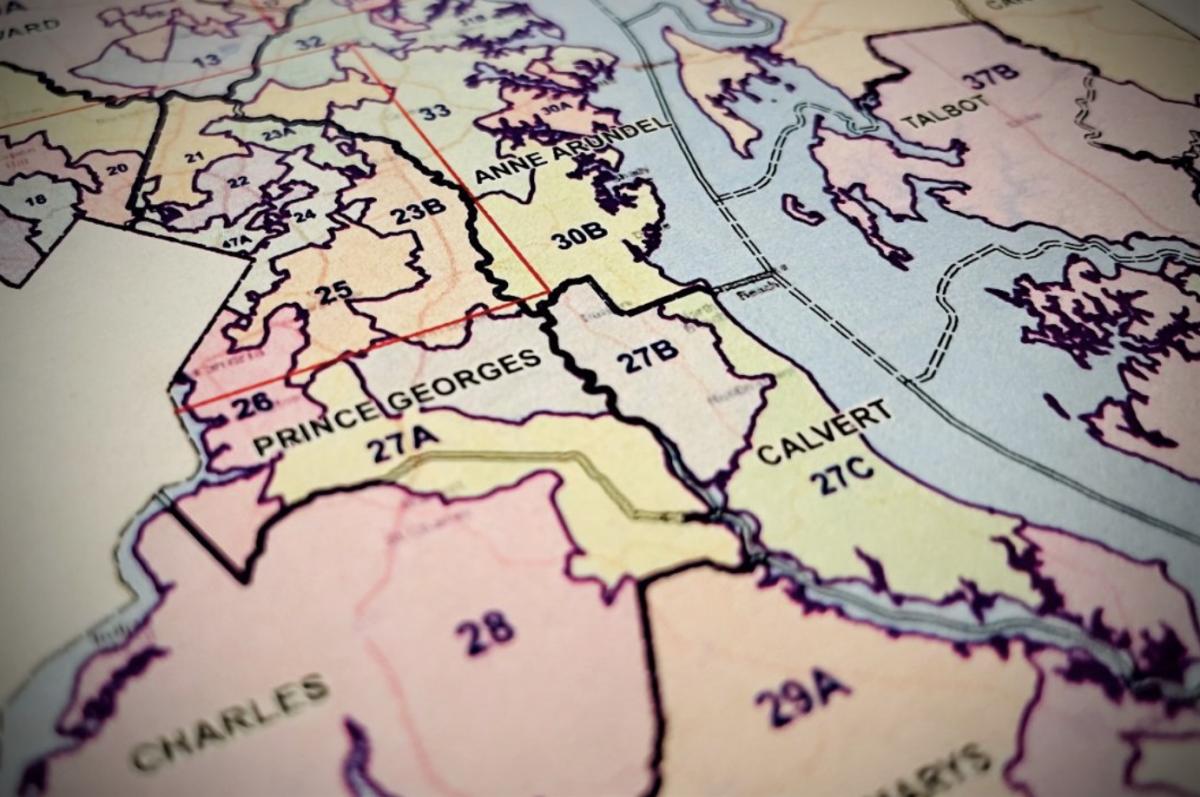
In addition to those principles, the draft map combines the three southern Maryland counties with southern Prince George’s County; combines most of Anne Arundel County with Howard County; keeps Baltimore City whole by combining it with portions of northern Anne Arundel County; and includes part of northern Montgomery County in the western Maryland district.

The draft map, which would add a second Republican-leaning district in western Maryland, generally features fewer county splits than the state’s current congressional maps. Baltimore is currently split between three congressional districts, and in the draft it is entirely contained within one. Anne Arundel County is currently split between four congressional districts, and is split between two in the draft map. Baltimore County also sees less splits in the draft.

The commission is still conducting public hearings and accepting map submissions for the public, so the draft map is likely to change.

The individual congressional districts included in the draft congressional map may be viewed in the pdf below.

2021-0909-individual-district-maps-for-draft-cong-plan


Just two speakers from the public testified at last week’s hearing: Zulieka Baysmore, a Baltimore resident who was a candidate in the 2020 Republican mayoral primary, and Reuben Collins, the Democratic president of the Charles County Board of Commissioners.

Collins noted that Charles County was one of the fastest-growing counties in Maryland, according to U.S. Census data, and said commission members should “look at amplifying opportunities for minority representation” in his county.

Baysmore urged commission members to keep districts competitive in their proposed maps rather than “fully red or fully blue.”

The commission has received 10 map submissions from the public to date, Maryland Department of Planning Director of Public Affairs Kristin Fleckenstein said at the meeting. The commission’s next virtual public hearings are set for 6 p.m. Monday, Sept. 13, and Tuesday, Sept. 14.

The Maryland Citizens Redistricting Commission was created via executive order by Gov. Lawrence J. Hogan Jr. (R) and includes three Republicans, three Democrats and three unaffiliated voters. The commission is tasked with drawing up congressional and legislative maps that Hogan plans to submit to the General Assembly.

The General Assembly, where Democrats hold a veto-proof majority in both the House of Delegates and the Senate, will have the final say over proposed maps. The Legislative Redistricting Advisory Commission announced Friday that it would hold its first public hearing at 6 p.m. Sept. 20 at Prince George’s Community College in Largo as part of its map-making process.

By Bennett Leckrone

The Spy Newspapers may periodically employ the assistance of artificial intelligence (AI) to enhance the clarity and accuracy of our content.

Filed Under: Maryland News Tagged With: citizens, commission, congressional, legislative, Maryland, redistricting

Hogan Makes Booster Shots Available to Nursing Home Residents, People With Health Issues

September 8, 2021 by Maryland Matters

Marylanders age 65 and over who live in nursing homes and other congregate care facilities became eligible for COVID-19 booster shots on Tuesday, under an order from Gov. Lawrence J. Hogan Jr. (R).

Seniors who live in assisted living facilities, residential drug treatment centers, and group homes for people with disabilities also became eligible for the shots, which health experts have said can bolster protection against the coronavirus.

Gov. Larry Hogan

Hogan issued the order after the state’s Antibody Testing Program determined that more than 60% of vaccinated residents had “some form of waning immunity over time, and showed that as many as one-in-three are now particularly vulnerable.”

He also cited an Israeli study which concluded that a booster — typically a third dose of the Pfizer/BioNTech or Moderna vaccines — led to an 11-fold reduction in infections and a ten-fold decrease in severe illness.

“All of the evidence makes it abundantly clear that we cannot afford to delay taking decisive action to protect our most vulnerable citizens,” Hogan said.

The state’s research tested more than 500 nursing home residents.

The state Health Department also issued guidance on Tuesday ordering all pharmacies and health providers to provide a booster shot “without any need for a prescription or a doctor’s order to anyone who considers themselves to be immunocompromised,” Hogan said.

“No one in this category should be turned away from receiving a booster,” he added.

The governor said Maryland has a strong supply of vaccine and does not anticipate reopening mass vaccination sites when the general public becomes eligible for booster shots.

A potential White House hopeful in 2024, Hogan continued his criticism of the federal government, saying that states “have had to operate without clear guidance” from the CDC or FDA as to when booster shots will be recommended for people under age 65 and those without health conditions.

“The limited guidance we have received has been confusing and contradictory,” Hogan said, echoing complaints he made on a Sunday talk show, “and it is still unclear when and how more people will become eligible.”

According to the state Department of Health, an average of 17 of every 100,000 Marylanders tested positive over the last week, a 15% decrease since the beginning of September.

Hogan said his administration is “proud” that Maryland is unlike the states that have “spiking numbers… with their case-rates surging out of control and their hospitals overflowing.”

According to the CDC, community transmission of COVID is “high” in 19 of Maryland’s 24 jurisdiction, and “substantial” in the remaining five. 

Hogan also announced a $3 million “Community COVID-19 Vaccination Project,” which he described as a “door-to-door canvassing effort to directly engage Marylanders living in areas with low vaccination rates and in effort to encourage more vaccinations.”

The project will also provide health education in “at-risk neighborhoods.”

“The vaccines are the single most effective way to protect people from severe illness, hospitalizations and deaths,” he said, adding that only 0.2% of fully-vaccinated Marylanders have been hospitalized.

At a time when right-wing media personalities and outlets are touting unproven treatments, Hogan encouraged people who test positive and begin to experience symptoms to consult with their health-care provider about monoclonal antibody therapy.

“These monoclonal antibodies are the only approved and effective treatment for COVID-positive individuals who are symptomatic but not yet severe enough to require hospitalization,” Hogan said.

Maryland has completed more than 10,000 infusions at 30 facilities, Hogan said, an effort that has cut hospitalizations and deaths significantly.

By Bruce DePuyt

The Spy Newspapers may periodically employ the assistance of artificial intelligence (AI) to enhance the clarity and accuracy of our content.

Filed Under: Maryland News Tagged With: booster, coronavirus, Covid-19, Gov. Larry Hogan, Maryland, shots, vaccine

Mid-Shore Saw Little Population Growth; QA’s County Added 2K Residents, Kent Lost 1K

September 8, 2021 by John Griep

Although Maryland’s population increased nearly 7% between 2010 and 2020, population growth on the Mid-Shore was virtually stagnant. Queen Anne’s County accounted for most of the growth in the last decade; Kent County’s population decline was the highest in the region.

Census population numbers are used to “determine the number of seats each state has in the U.S. House of Representatives and is also used to distribute hundreds of billions of dollars in federal funds to local communities,” according to the U.S. Census Bureau.

The numbers are also used to draw state legislative districts and county-level districts for county council or commission and board of education where those seats are elected by district.

While much of the focus is on the congressional and state legislative districts, the 2020 population figures may require some small adjustments for county-level seats that are elected from districts.

Queen Anne’s County, with 2,000 more residents, likely will require the most adjustments for its county commission and school board seats, depending on where the new residents are distributed. Kent County does not elect members from districts for county commission or school board and will not need to make any adjustments despite losing nearly 1,000 residents.

Mid-Shore public bodies with districts include:

Caroline County — board of education, three districts;

Dorchester County — county council, five districts; board of education, five districts;

Queen Anne’s County — county commissioners, four districts, one at-large; board of education, four districts, one at-large;

Talbot County — board of education, seven districts.

The biggest battles will occur with the congressional and state legislative district maps. Maryland’s current congressional map is considered one of the most gerrymandered in the nation. Gov. Martin O’Malley and Democratic lawmakers packed Democratic areas into a western Maryland district that had repeatedly elected a Republican to Congress. The mapping process following the 201o Census also put more Republicans into the First District, which encompasses the Eastern Shore.

As a result, Maryland’s congressional representation went from six Democrats and two Republicans to seven Democrats and one Republican (the First District’s Andy Harris).

Two redistricting commissions — one appointed by Gov. Larry Hogan and another by Maryland legislative leaders — are already at work on the maps for the congressional and legislative district maps.

The state planning department offers adjusted redistricting data on its website, which also includes a link to a mapping web portal through which anyone may submit proposed redistricting maps for review by the Maryland Citizens Redistricting Commission appointed by Hogan.

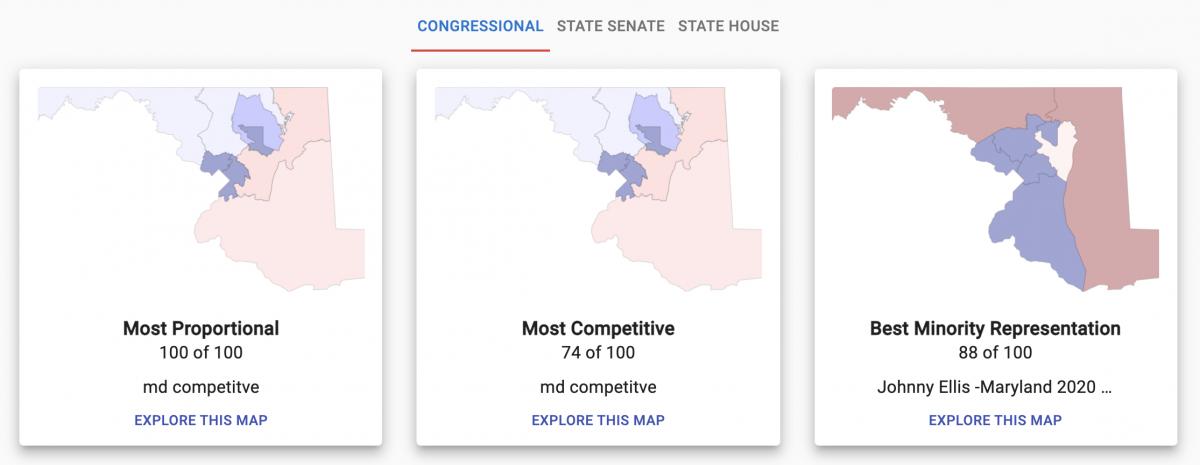
Outside groups also have offered maps, with several available to view at Dave’s Redistricting, “a free web app to create, view, analyze and share redistricting maps for all 50 states and the District of Columbia, according to the site.

The website offers five notable maps — most proportional, most competitive, best minority representation, most compact, and least splitting — for congressional, state senate, and state house redistricting plans.

At presstime, the notable congressional maps for proportionality, competitiveness, and compactness would split the Eastern Shore into two districts. The First Congressional District currently includes the entire Eastern Shore from Cecil to Worcester county and portions of Harford, Baltimore, and Carroll counties.

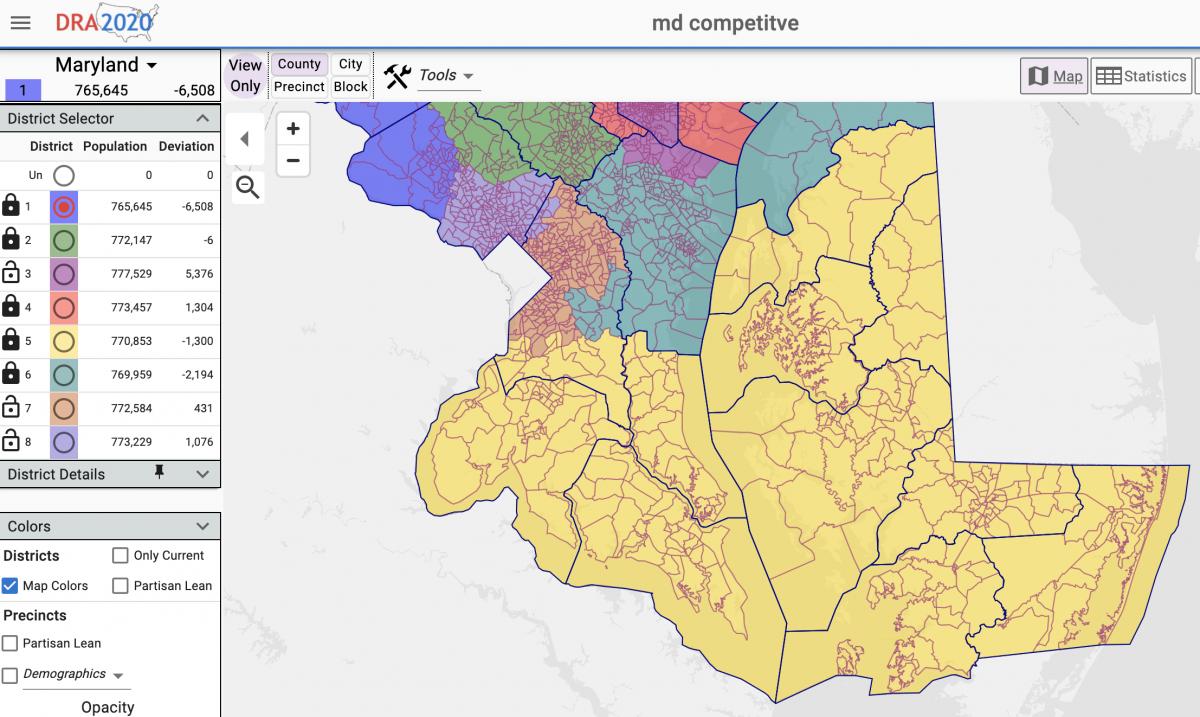
The current most proportional and most competitive congressional map would create a district that includes Queen Anne’s to Worcester county on the Eastern Shore, the southern Maryland counties of Calvert, Charles, and St. Mary’s, and a portion of Prince George’s County. That district is seen in yellow below.

The most proportional and most competitive Maryland congressional district maps published thus far would include seven Eastern Shore counties, three southern Maryland counties, and a portion of Prince George’s County. Screenshot from Dave’s Redistricting.

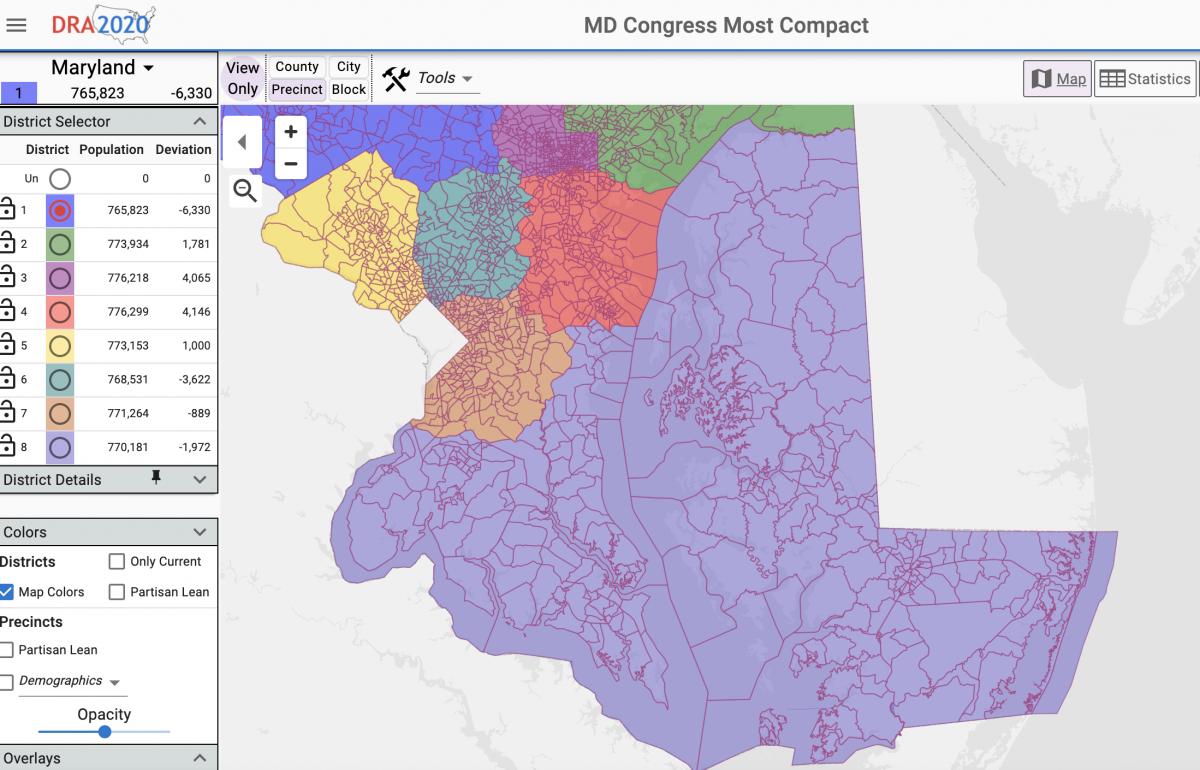
The most compact congressional map has a district that includes Kent to Worcester county, the three southern Maryland counties, and portions of Prince George’s and Anne Arundel counties. That district is seen in light purple below.

The most compact Maryland congressional district maps published thus far would include eight Eastern Shore counties, three southern Maryland counties, and portions of Prince George’s and Anne Arundel counties. Screenshot from Dave’s Redistricting.

The Spy Newspapers may periodically employ the assistance of artificial intelligence (AI) to enhance the clarity and accuracy of our content.

Filed Under: 2 News Homepage Tagged With: census, congressional, county, districts, legislative, maps, Maryland, mid-shore, population, redistricting, school board

It’s Map Drawing Time. Citizens Redistricting Commission Opens Public Submissions

September 3, 2021 by Maryland Matters

Marylanders can now submit their own proposals for redistricting to the Maryland Citizens Redistricting Commission, state officials announced Thursday.

The Maryland Department of Planning’s new submission portal allows users to map their proposals for congressional and state legislative districts, and includes instructions on how to draw districts.

Members of the Maryland Citizens Redistricting Commission will review maps that are received by noon on Sept. 24, according to the planning department. More submissions will be accepted when that panel begins its third round of hearings in October.

The map submission portal uses redistricting data which counts incarcerated Marylanders as residents of their last known address, as required by Maryland law, according to the release.

The nine-member commission — which includes three Democrats, three Republicans and three unaffiliated voters — is set to start a new round of public hearings on Sept. 9. That hearing will be virtual.

The commission worked with Stanford Law School professor Nathaniel Persily to hash out some rough criteria for maps on Wednesday. Although the commission won’t make its redistricting proposal for some time and will consider citizens’ proposals, members said they hope to have some early drafts ready for public comment by next week.

Commission members also mulled whether to keep the Eastern Shore whole or cross the Chesapeake Bay to create a district consisting of part of Southern Maryland and the Lower Shore. Commission Member Kimberly Rose Cummings (R), a Dorchester County resident, noted that some Lower Shore residents told panelists, during an initial round of public hearings, that they have more in common with Southern Maryland residents than with residents of north and central Maryland.

There is historical precedent for crossing the Chesapeake Bay in a congressional district, as the state’s 1st Congressional District once included portions of Southern Maryland as well as the entire Eastern Shore from the early 1970s to the early 1990s. The 1st District currently includes all of Maryland’s Eastern Shore and portions of Baltimore, Harford and Carroll countries.

Commission Co-chair Alexander Williams Jr. (D), a Prince George’s County resident and retired federal judge, said that rapidly developing Charles County has more in common with parts of Prince George’s County than with other parts of Southern Maryland. Commission members chose to leave both options on the table for public comment and map submissions.

As for drawing a district in Western Maryland, commission Co-chair Walter Olson (R) said the panel should look to include Carroll County with Frederick, Garrett and Allegany counties. Olson and Williams served on an emergency commission to redraw the state’s 6th Congressional District before the Supreme Court reversed a 2018 order to redraw the district. Olson said that, during the emergency commission’s run, Carroll County residents “overwhelmingly” asked to be included in a Western Maryland district.

Whether the Western Maryland district would draw from portions of northern Montgomery or Howard counties remains an open question for commission members.

None of the commission’s initial criteria are set in stone, rather they are meant to be a baseline for public comment during upcoming public hearings.

Gov. Lawrence J. Hogan Jr. (R) created the Maryland Citizens Redistricting Commission via executive order to draw congressional and legislative maps that he will propose to the General Assembly. Democrats hold a veto-proof majority in both the House of Delegates and the Senate, and lawmakers will have the final say over the state’s next set of maps.

Senate President Bill Ferguson (D-Baltimore City) and House Speaker Adrienne A. Jones (D-Baltimore County) created their own bipartisan redistricting commission, the Legislative Redistricting Advisory Commission, to draw congressional and legislative maps. The legislative commission held its first meeting this week and is set to kick off a statewide round of public hearings on Sept. 20 with a hearing focused on Prince George’s County.

By Bennett Leckrone

The Spy Newspapers may periodically employ the assistance of artificial intelligence (AI) to enhance the clarity and accuracy of our content.

Filed Under: Maryland News Tagged With: census, commission, congressional, districts, legislative, maps, Maryland, redistricting

Legislative Redistricting Commission Promises Transparent Process at First Meeting

September 3, 2021 by Maryland Matters

Maryland’s General Assembly will have the final say over the state’s next set of congressional and legislative maps, and legislative leaders’ bipartisan redistricting commission held its first meeting Tuesday evening.

The Legislative Redistricting Advisory Commission, convened by Senate President Bill Ferguson (D-Baltimore City) and House Speaker Adrienne A. Jones (D-Baltimore County), will conduct public hearings before proposing congressional and legislative maps. Karl Aro, former executive director of the non-partisan Department of Legislative Services, is the commission’s chair.

The Department of Legislative Services will be responsible for drawing maps based on the commission’s input, Aro said. He said the map drafts will be confidential until the commission is ready to release its proposal to the public.

Jodie Chilson of the Department of Legislative Services said that any member of the General Assembly will be able to request a map be drawn.

“Any request that comes to us for that would be confidential even with respect to the commission,” Chilson said. “Once the map is drawn and you get it, you can do with it what you want, but as we’re drawing it that would be confidential.”

The departments of Planning and Legislative Services finalized data to be used for redistricting on Tuesday, Legislative Services Senior Policy Analyst Michelle Davis told members of the panel. The U.S. Census data used for redistricting was released last month, but state officials needed to adjust that data to comply with Maryland law, which requires that incarcerated people are counted as residents of their known address. She said that data will be available to the public soon.

Senate Minority Leader Bryan W. Simonaire (R-Anne Arundel), a member of the panel, pressed for a bipartisan map-drawing process, and said he hopes commission members work together when it comes to creating a single, cohesive map.

“We’re not in the majority and don’t pretend to be there, but I would like to be included as opposed to Republicans going off and doing their maps, Democrats going off and doing their maps,” he said.

Simonaire noted that after the 2010 Census, Gov. Martin O’Malley (D) created a redistricting commission to conduct public hearings, but according to depositions from the Benisek v. Lamone case, most map-drawing during that process was done away from the public eye by political operatives and incumbents.

“We ended up with some of the worst maps in the nation … especially on the congressional side,” Simonaire said.

Aro said he hopes the legislative commission will produce a map that makes people feel that their communities are largely kept whole, but warned that some areas will likely have to be split due to how complex the process is. He likened redistricting to “doing brain surgery with a sledge hammer.”

“My hope too is that the geography will look, for lack of a better word, prettier,” Aro said. “It should. I imagine we’ll just have to work our way through it.”

Ferguson said public input will be “absolutely essential” to the commission’s work and pledged a transparent process.

“We will have a fair and transparent process, and in order for that to happen we need to hear from the public,” Ferguson said.

Jones likewise underscored the importance of public input.

“For those Marylanders watching this online, we are asking you to show up at our hearings, write us letters, and send us your ideas,” Jones said. “We are listening.”

Jones also acknowledged that the redistricting debate likely won’t end when the General Assembly adopts maps.

“There’s a good chance that these maps will end up in court,” she said. “That is the nature of redistricting. We will follow the advice of counsel at every step, making sure that the rights of all Marylanders are protected.”

The Legislative Redistricting Advisory Commission will conduct region-based and statewide public hearings in the coming months, and will kick off with a public hearing in Prince George’s County on Monday, Sept. 20. The location of that meeting wasn’t immediately available, but the meeting will be live streamed.

Other lawmakers on the commission are Senate President Pro Tempore Melony Griffith (D-Prince George’s), House Majority Leader Eric Luedtke (D-Montgomery) and House Minority Leader Jason Buckel (R-Allegany).

The Legislative Redistricting Advisory Commission is one of two panels tasked with conducting public hearings and drawing up a proposed set of congressional and legislative maps in the coming months: Gov. Lawrence J. Hogan Jr. (R) created the Maryland Citizens Redistricting Commission earlier this year to create maps that he will propose to the General Assembly.

That commission includes three Republicans, three Democrats and three unaffiliated voters, and completed one round of public hearings before the release of U.S. Census data in August.

Hogan plans to introduce both the congressional and legislative maps that are drawn by the Maryland Citizens Redistricting Commission. The governor is required to introduce legislative maps, but statutes are silent on who is responsible for introducing congressional maps. The General Assembly is allowed to make changes to those maps and draw their own.

While both commissions are tasked with drawing up maps, the ultimate authority for mapmaking in Maryland rests with the General Assembly, where Democrats hold a veto-proof majority in both the House of Delegates and the Senate.

Hogan can veto only congressional maps, although lawmakers easily overrode his vetoes on such measures as police and education reform during the 2021 legislative session. He can’t veto the General Assembly’s legislative maps, but his proposed maps would become law if the General Assembly doesn’t pass a redistricting plan within the first half of the 2022 legislative session.

At a media briefing ahead of the legislative panel’s first meeting Tuesday, Simonaire and Buckel reiterated their support for Hogan’s Maryland Citizens Redistricting Commission.

“The best way to do redistricting is in a bipartisan or nonpartisan fashion, letting the citizens drive the redistricting process rather than the politicians in the back room,” Buckel said.

Simonaire previously predicted that the legislative commission’s final vote would come down to a party-line split. He said Tuesday that he remains “skeptical” of the legislative redistricting commission.

Congressional maps could be adopted by the General Assembly later this year, with legislative leaders considering a special session in December to tackle congressional redistricting.

By Bennett Leckrone

The Spy Newspapers may periodically employ the assistance of artificial intelligence (AI) to enhance the clarity and accuracy of our content.

Filed Under: Maryland News Tagged With: census, Congress, general assembly, maps, Maryland, redistricting

Gov. Hogan Orders Assessment of Ventilation, Air Filtration in School Buildings

September 1, 2021 by Spy Desk

Governor Larry Hogan today announced that he is directing the State Superintendent of Schools and the Interagency Commission on School Construction to conduct an immediate statewide assessment of ventilation and air filtration in Maryland public school buildings.

The governor made the announcement at Wednesday’s meeting of the Board of Public Works:

“I know we are all pleased to see students returning to in-person instruction in every school system across the state. Unfortunately, this week, schools all over Baltimore City, including 31 just yesterday, had to dismiss students early due to the lack of proper air conditioning.

“It’s unbelievable to me that this is still happening after the Comptroller and I have worked together for the last six years to push to get every school air conditioned, and to provide record funding for every school to be air conditioned, and our nonstop efforts to hold schools accountable.

“We were successful in requiring Baltimore City to reluctantly create a plan to finally bring air conditioning to all their schools, even against fierce opposition from legislative leaders. But in spite of them putting plans together, the work was not actually completed.

“We established a Healthy Schools Facilities Fund to provide additional state-funded grants to public schools specifically to make urgently needed emergency air conditioning and heating upgrades. Baltimore City returned the money to the state after failing to spend it on the improvements.

“Our administration has provided seven years of record funding to our schools—all of our schools across the state and even more to Baltimore City schools. Among the 100 largest school systems in America, Baltimore is the third highest funded school system, which makes it even more inexcusable.

“Earlier this year, we enacted a historic school construction plan with record funding to make sure that all school buildings across the entire state were modern, safe, efficient, and air conditioned. Protecting students from the sweltering heat is critically important, and city leaders have continued to fail in this regard. But the problem goes far beyond that now because of COVID-19.

“Our public health experts have repeatedly stressed that proper ventilation is a critical tool to mitigate the impact of COVID-19. The CDC specifically recommended maximizing building ventilation and improving the level of air filtration as much as possible through the use of high-efficiency HEPA filtration units.

“And we have provided more than $3 billion in additional federal dollars in relief funding to the school systems in Maryland specifically for pandemic-related costs, including improvements to HVAC and ventilation, and filtration systems for safer school buildings for our kids. And yet, even with those billions of dollars to address these issues and with the school year already underway, city schools are still unairconditioned, and it’s unclear even which schools or school systems have properly utilized all these billions in funding.

“After months of requesting this information, we’re no longer asking. So today, I’m directing the State Superintendent of Schools and the Interagency Commission on School Construction to immediately provide us a report on ventilation and air filtration systems, district by district and school by school, and we will be holding school systems accountable for these financial resources and the way that they have been utilized to ensure that safe and healthy environments are in our school buildings for all of our kids.”

The Spy Newspapers may periodically employ the assistance of artificial intelligence (AI) to enhance the clarity and accuracy of our content.

Filed Under: Maryland News Tagged With: air conditioning, air filtration, assessment, Covid-19, Education, Gov. Larry Hogan, Maryland, schools, ventilation

Experts Support Mask Mandates for Students but Say Vaccine Mandates Will Be More Difficult

September 1, 2021 by Maryland Matters

As many students across Maryland return to school this week while the delta variant continues to drive the state’s COVID-19 case rates higher, requiring masks inside school buildings is the “lowest hanging fruit” schools could take to protect against the coronavirus, public health experts told lawmakers on Monday.

“Children with masks on play just as hard and learn just as well as children without masks, but they’re protected from acquiring COVID and spreading it to others,” Karen L. Kotloff, a professor of pediatrics in the University of Maryland Medical System, told the Senate Education, Health and Environmental Affairs Committee.

“I think that is the lowest hanging fruit and the easiest intervention that can be done,” she continued. “Masks are easy.”

Meanwhile, other measures such as requiring that students and teachers to get vaccinated or for students to maintain physical distance in classrooms are more difficult, she continued.

Mandating masks is a low-cost way to reduce COVID-19 transmission rates, said Tara Kirk Sell, a senior scholar at the Johns Hopkins Center for Health Security.

Monday’s legislative meeting came after the Maryland State Board of Education passed a universal mask mandate for public schools in a hastily-scheduled meeting last week. Previously, the decision to issue masking mandates for students, teachers and staff was left to local school boards in reopening decisions to be approved by Maryland State Superintendent Mohammed Choudhury.

By law, the General Assembly’s Joint Committee on Administrative, Executive and Legislative Review (AELR) has to approve the State Board of Education’s emergency regulation for it to go into effect. The committee is slated to vote on the matter at a public meeting on Sept. 14, allowing some school systems to start the school year without requiring masks.

Gov. Lawrence J. Hogan (R) has the ability to waive the 10-business-day waiting period required before the AELR committee can vote on the emergency regulation, but Hogan said Monday that he does not plan to do so.

“I’m not going to create a state of emergency to waive the ability for legislators to hear from the citizens, they just have to do the process that they normally do,” Hogan told WBFF-TV.

Republican lawmakers also implored the committee to not rush the 10-day review period to allow for a deliberative process.

“We have serious concerns regarding the State Board of Education’s unprecedented usurpation of local control in mandating masking for students across Maryland,” a statement from the House Minority Caucus said.

During the Monday briefing, Sen. Jason C. Gallion (R-Cecil and Harford) suggested that only children with underlying medical conditions should wear N95s — tight-fitting, high-filtration medical masks — “instead of making all children wear these cloth masks.”

But Kotloff highlighted that healthy children could also contract the coronavirus.

“You don’t have to have an underlying condition to have a fatal COVID infection, and so how do you know which child that’s going to be … to protect that child’s life?” she said. Furthermore, the more a virus passes back and forth among a population, the more a virus can mutate and become more virulent, she continued.

“Pretty much anything that can happen to an adult can happen to a child,” Kotloff said. Longer-term effects of contracting the coronavirus can also afflict children, such as cognitive impairments, fatigue and chronic respiratory issues.

Nationally, the number of children with COVID-19 grew from 26,000 to 200,000 in the last week, according to Kotloff.

Sen. Bryan Simonaire (R-Anne Arundel) questioned whether it was a good policy to have a “one size fits” approach if different areas in the state have different transmission rates.

But Sen. Paul G. Pinsky (D-Prince George’s) underscored that every county in the state currently has a high or substantial transmission rate of 50-100 or more cases per 100,000.

“When everything is substantial, then I think it makes sense that the policy is fairly uniform,” Sell said. “When things come down, people can make some more of those nuanced decisions at lower levels.”

Mandating Vaccinations?

Montgomery and Prince George’s counties public school systems are requiring teachers and staff to show proof of a COVID-19 vaccination or to undergo weekly tests.

But mandating vaccines for children will be harder than mandating masks, said Daniel Salmon, the director of the Institute for Vaccine Safety at John Hopkins Bloomberg School of Public Health. If a vaccine mandate is implemented before it has widespread public support, it risks backlash which can significantly undermine the immunization effort.

However, the bar is different for teachers and staff, he continued. “That’s a workplace mandate, which is different. And teachers get to choose whether or not they want to be teachers and where they work and it’s an occupational hazard, so I think it’s a lower bar,” he said.

When people feel forced to get inoculated, “that’s frightening for people,” Kotloff said. Allowing people to express their fears about the COVID-19 vaccine, as well as informing them of the science is the best way to move forward, she continued.

By Elizabeth Shwe

The Spy Newspapers may periodically employ the assistance of artificial intelligence (AI) to enhance the clarity and accuracy of our content.

Filed Under: Maryland News Tagged With: Education, Gov. Larry Hogan, mandate, Maryland, masks, school board, schools

Will Frosh Seek a Third Term as AG? What Happens if He Doesn’t?

August 30, 2021 by Maryland Matters

Political professionals in Maryland have focused intensely on the races for governor and — to a lesser extent — comptroller during the still-young 2022 campaign.

There has been almost no discussion about who will serve as the state’s attorney general for the next four years.

But that will change in a hurry if incumbent Brian E. Frosh (D) decides not to seek a third term as the state’s top lawyer.

Frosh will turn 75 in October, and he did not attend the Maryland Association of Counties summer conference in Ocean City earlier this month or a recent Democratic Attorneys General Association gathering that was held online.

The absences have fueled widespread speculation that the Montgomery County Democrat will not run for re-election. The $205,092 Frosh reported in his campaign account as of mid-January isn’t a lot for a veteran statewide officeholder, either.

“He ain’t running,” one insider predicted confidently.

But others who have spoken with Frosh recently came away with the distinct opposite impression.

Frosh himself would only say that he is planning to announce his decision soon.

Interviews with more than a dozen well-connected Democrats over the last 10 days offer some insight into how events might unfold. Many of the people Maryland Matters spoke with were granted anonymity to discuss the state of play candidly.

If Frosh runs again, he will be considered a prohibitive favorite to win another four years as attorney general, though a Democratic primary challenge — particularly from a younger person of color — cannot be ruled out.

James F. Shalleck, a former federal prosecutor and Republican activist who recently stepped down as head of the Montgomery County Board of Elections, filed papers with the state on Wednesday to run for attorney general. It’s possible that a Frosh retirement will prompt other Republicans to look at the race.

Whomever the Republican nominee ends up being, he or she will face long odds.

Frosh has prevailed in every election he has competed in since 1986, when he won his first of two terms representing the Bethesda area in the House of Delegates. He went on to serve for 20 years in the Senate, including a dozen years as chairman of the Judicial Proceedings Committee.

If Frosh opts not to seek a third term, the Democratic primary battle to replace him could get interesting very quickly — though many leading Democrats and party strategists predict that state Sen. William C. Smith Jr. (D-Montgomery) would be an early favorite.

Smith is relatively new to Annapolis, having been elected in 2014 to the House of Delegates and once to the Senate. (He was appointed to the Senate in 2016 following then-Sen. Jamie B. Raskin’s election to the U.S. House.)

Despite his relative youth and junior status, Smith, 39, was appointed chairman of the Judicial Proceedings Committee — Frosh’s former perch — in late 2019, and helped shepherd the police reform legislative package through the General Assembly earlier this year.

A lawyer by training, the Silver Spring native attended the National Intelligence University and has served as an intelligence officer in the U.S. Navy Reserve since 2009. He deployed to Afghanistan for six months in 2019, causing him to miss the end of that year’s General Assembly session.

Smith would be the first person of color to serve as attorney general in Maryland history. Although he lacks a statewide network, he is well-liked in Annapolis and he could attract significant support from a range of Democratic establishment figures.

At least one potential rival said they would not run for attorney general if Smith enters the race.

Smith, who has already begun canvassing his district in advance of his re-election bid, reported $122,083 in his campaign account in mid-January. He declined to discuss next year’s campaign.

Should Frosh choose to retire, Smith almost certainly won’t be the only Democrat who would seek to replace him in 2022 if he decides to run for the seat, though none would probably start with Smith’s level of institutional support. A survey of Democratic politicians, strategists and party stalwarts produces a list of several other possible candidates if Frosh retires — including two who have sought the office before:

Prince George’s County State’s Attorney Aisha N. Braveboy (D) — She ran for attorney general in 2014, coming in third in the Democratic primary, with 20% of the vote. An ambitious attorney and former state delegate in her first term as county prosecutor, she is considered more likely to want to run for Prince George’s County executive whenever there is a vacancy. But she might eye the AG slot again if she can see a path to victory. She had $74,945 in her campaign war chest in mid-January.

Rep. Anthony G. Brown (D) — An intriguing potential candidate whose name has surfaced repeatedly in recent days, the former lieutenant governor would enter the race a top-tier candidate. An aide declined to make Brown available for an interview, saying he was focused on Capitol Hill matters. But even with a very safe seat, Brown is thought to be restless in Congress, and may envision himself in an executive role again before long. Brown had less than $2,000 left in his state campaign account in mid-January and reported more than $1.4 million in his federal campaign account. But only $6,000 can be directly transferred from the federal war chest to the state fund.

Del. Jon Cardin (D-Baltimore County) — Cardin was the runner-up to Frosh in the 2014 primary and says that while the job of attorney general still interests him, he hasn’t given much thought to the idea that there will be a vacancy. If Frosh decides to retire, Cardin says he will give the race a look. Cardin reported $31,778 in the bank as of mid-January.

Del. Luke H. Clippinger (D-Baltimore City) — The chairman of the House Judiciary Committee, whose day job is working as a prosecutor in Anne Arundel County, says the job of attorney general interests him, but he fully expects Frosh to seek re-election. Clippinger was campaign manager to Tom Perez when Perez ran an aborted campaign for attorney general in 2006. Clippinger reported $105,893 in his campaign account in mid-January.

Montgomery County Councilmember William Jawando (D) — The former Barack Obama aide has already announced his intention to seek a second term on the council, but he’s also keeping his eyes open for other opportunities and has publicly expressed a general interest in the AG’s job in the past. He’s been the leading advocate of police reform on the county council and has also worked to protect struggling tenants during the pandemic. Jawando had $23,062 in his campaign war chest as of mid-January.

Former Congressman Frank M. Kratovil Jr. (D) — Now a Queen Anne’s County District Court judge, Kratovil, who served one term in Congress representing the Eastern Shore, is known to be eager to get back in the political game and would take a hard look at the AG race if there was a vacancy. Kratovil would likely be the most politically moderate candidate in a Democratic primary for AG — which could be beneficial or a hindrance depending on how the rest of the field shakes out. Kratovil has no active campaign finance account.

Montgomery County State’s Attorney John J. McCarthy (D) — McCarthy, the four-term prosecutor would start with one big advantage: Montgomery is home to one-in-six Maryland voters. But even though he’s facing aggressive Democratic primary opposition for the first time in his re-election contest, the 69-year-old attorney is still favored for another term — something he would have to take into consideration before deciding to roll the dice on a statewide bid. McCarthy had $146,297 in the bank in mid-January.

Baltimore State’s Attorney Marilyn J. Mosby (D) — Mosby in many ways has the most political talent and star power of any of the potential contenders — and also the most political baggage. She’s highly ambitious, and after more than 6 1/2 years in office, she’s no doubt thinking about her next political move. She’s got a loyal following in Baltimore. But she and her husband, Baltimore City Council President Nick J. Mosby (D) have faced plenty of unwanted scrutiny over the past several months for various financial dealings and they reportedly are the target of one or more federal investigations. A Mosby spokeswoman did not respond to a request for comment. Mosby, who is up for a third term in 2022, had $68,487 in her campaign account in mid-January.

Here are some other Democrats who are mentioned as possible candidates for attorney general but highly unlikely to run:

Prince George’s County Executive Angela D. Alsobrooks (D) — The popular first-term executive opted not to run for governor next year. Insiders believe she is more likely to run for the U.S. Senate in 2024 if incumbent Benjamin L. Cardin — who turns 78 in October — retires. The county’s former top prosecutor would have been a top-tier candidate for AG the last time the job was vacant, in 2014, and would be again. But she has said publicly she’s committed to remaining county executive.

Del. Vanessa E. Atterbeary (D-Howard) — Atterbeary took the reins on the House’s police reform effort in 2020 and 2021, demonstrating solid leadership skills. But as a favorite of House Speaker Adrienne A. Jones (D-Baltimore County) and with an ever-shifting legislature, she may have committee leadership opportunities coming her way in the next few years.

Sen. Jill P. Carter (D-Baltimore City) — She was a major mover in the police reform debate in the most recent legislative session — an issue she has worked on relentlessly for years. Carter seems most interested in running for Congress again someday, but some supporters will no doubt encourage her to take a look at AG if Frosh retires. On the other hand, she could be in line for the gavel at the Senate Judicial Proceedings Committee if Smith is running for another office.

Former Attorney General Douglas F. Gansler (D) — Elected attorney general in 2006 and 2010, the Montgomery County Democrat would be a viable candidate to get his old job back if his second run for governor falters, but those who’ve spoken with him in recent days came away convinced he intends to remain in the race for the top job and maintains he has a legitimate chance to win.

Del. Brooke E. Lierman (D-Baltimore City) — Lierman is a civil rights attorney, so a race for attorney general makes sense on paper. But she’s already immersed in and committed to her campaign for comptroller, which is well underway — and she is the early frontrunner.

Former U.S. Labor Secretary and Democratic National Committee Chair Tom Perez (D) — Perez ran for AG in 2006, after J. Joseph Curran Jr. (D) announced his retirement, but his candidacy was derailed after the state’s highest court ruled he hadn’t practiced law here for 10 years, as required. He would be Maryland’s first Latino AG if elected, but Perez has told associates he intends to remain in the race for governor.

Former state Sen. Robert L. Zirkin (D-Baltimore County) — Zirkin retired from the state Senate in late 2019, giving up his post as chair of the Judicial Proceedings Committee. But even though he seemed through with politics at the time, he’s only 50, and he may yet have a second political act.

By Bruce DePuyt, Hannah Gaskill, and Josh Kurtz

The Spy Newspapers may periodically employ the assistance of artificial intelligence (AI) to enhance the clarity and accuracy of our content.

Filed Under: Maryland News Tagged With: 2022, attorney general, brian e. frosh, campaign, election, Maryland, politics, re-election

« Previous Page
Next Page »

Copyright © 2026

Affiliated News

  • The Chestertown Spy
  • The Talbot Spy

Sections

  • Arts
  • Culture
  • Ecosystem
  • Education
  • Mid-Shore Health
  • Culture and Local Life
  • Shore Recovery
  • Spy Senior Nation

Spy Community Media

  • Subscribe
  • Contact Us
  • Advertising & Underwriting

Copyright © 2026 · Spy Community Media Child Theme on Genesis Framework · WordPress · Log in